Introducing Multilingual Voices
We partnered with Baklavastory, our neighbor in the Mission, to show what it sounds like when a business's character and warmth stay consistent, no matter who calls or what language they speak.
It's easy to translate speech, but much harder to preserve a single identity across languages. Every language has different rhythms, tones, and emphasis. When you change the language, identity tends to get lost in that shift, and your voice ends up sounding like someone else.
With Multilingual Voices, pick a voice and keep one brand identity in every market you serve: https://t.co/CDgBhsRR2o
Sonic-3.6 is now generally available.
In January we made a bet: stop tuning the existing paradigm, rebuild from the architecture up.
How we topped our own best model in two months → https://t.co/lYA5Ym6hCX
the team continues cooking 👩🍳
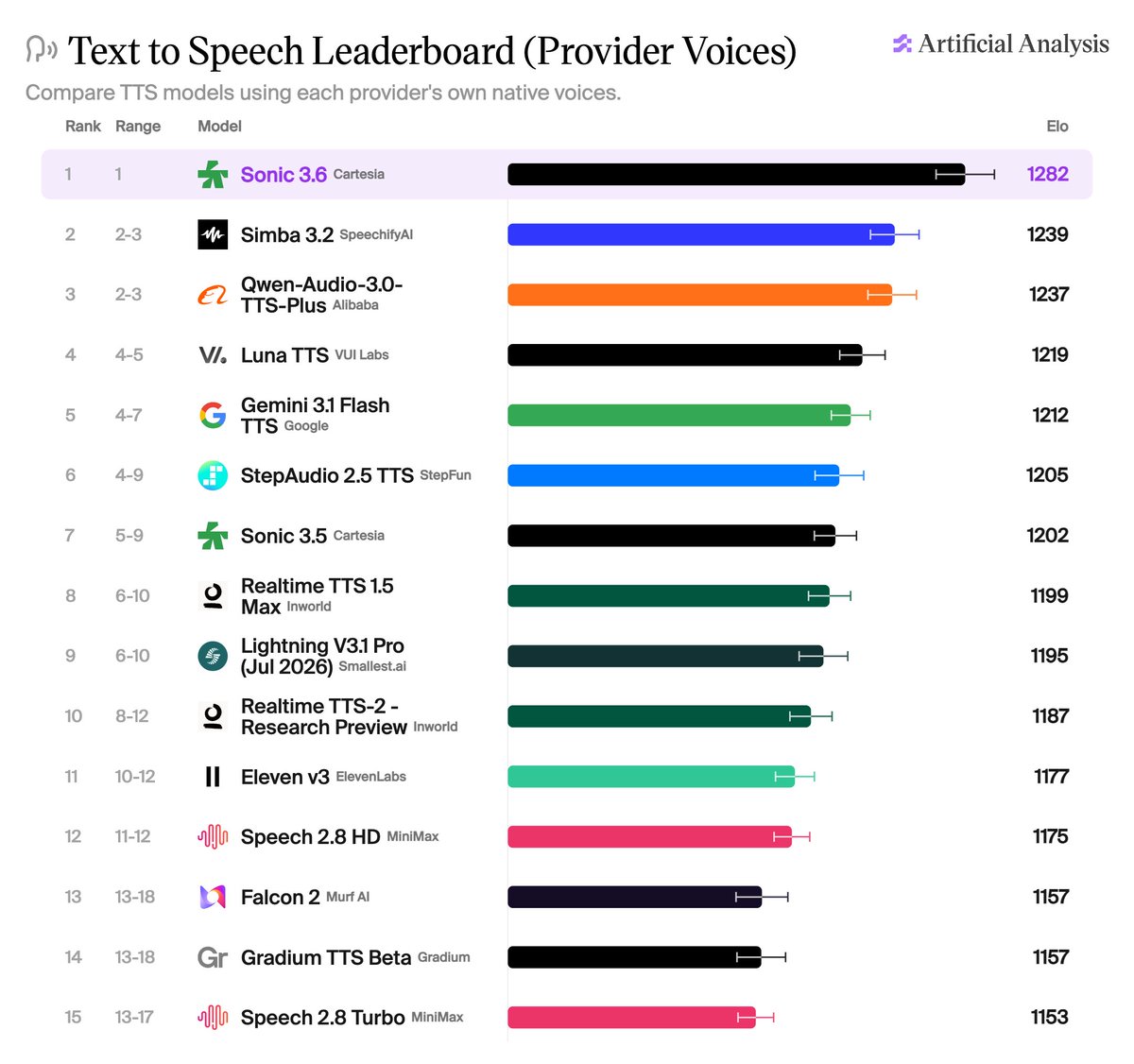
this is now an unprecedented gap on both the super competitive Provider Voices leaderboard as well as the newer Controlled Voices leaderboard (a stronger benchmark that can't be benchmaxxed, requiring truly better algorithms)
Cartesia's TTS model is not only the best, it continues improving at a faster rate than the competition - Sonic 3.5 was released only 3 months ago. ig Sonic now means both the fastest model and the fastest team 💀
Cartesia's Sonic 3.6 takes the #1 spot on both the Provider Voice and Controlled Voice Artificial Analysis Speech Arena leaderboards, surpassing Speechify AI's Simba 3.2 and Alibaba's Qwen-Audio-3.0-TTS-Plus, with Sonic 3.5 holding #2 on Controlled Voice
Sonic 3.6 is the latest TTS model from @cartesia, supporting 40+ languages including English, Hindi, Spanish, French, German and Japanese. In the TTS Arena, the model has been preferred by voters and has demonstrated natural speech and adaptive pacing across conversations.
Key takeaways:
➤ Controlled Voice: Sonic 3.6 takes #1 on the Controlled Voice Arena with an Elo of 1,144 (+18/-18) across 1,339 appearances, ahead of Cartesia's own Sonic 3.5 at 1,099 and ElevenLabs' Eleven v3 at 1,060
➤ Provider Voice: Sonic 3.6 also takes #1 on the Provider Voice Arena with an Elo score of 1,286 (+19/-19) based on 1,300 arena appearances, placing it ahead of Simba 3.2 at 1,238 and Qwen-Audio-3.0-TTS-Plus at 1,237
➤ Pricing: At $49 per 1M characters via the Cartesia platform, Sonic 3.6 is the most expensive of the top three models on quality, roughly 5x Speechify AI's Simba 3.2 at $10 and nearly double Alibaba's Qwen-Audio-3.0-TTS-Plus at $27.59, though still half the price of ElevenLabs' Eleven v3 at $100
➤ Speed: Sonic 3.6 processes 136.1 characters per second of generation time, compared to 46.7 for ElevenLabs' Eleven v3 and 24.2 for Google's Gemini 3.1 Flash TTS
Introducing Sonic-3.6: our most lifelike TTS yet, and another step change in naturalness across 44 languages. Just three months after our Sonic-3.5 launch, we've made fundamental model improvements based on feedback from the teams building on Sonic.
We're #1 on @ArtificialAnlys across both the provider and controlled voice streaming leaderboards — best-in-class voices + the best underlying model.
Available in beta today. Hear it for yourself 👇
At Cartesia, our #1 value is "Get the fundamentals right".
This value has been with us since Day 0. It shaped the research @_albertgu led during our PhDs: rather than using the same algorithms & architectures for every problem, he asked whether they were the right tool for the job.
New algorithms will help us process the raw data in domains like audio, video, health, and robotics, and SSMs were born from that observation.
At @cartesia, the same value is core to how we build models. We've obsessed over every detail in building our 10-layer cake (parfait?): data, systems, algorithms, post-training & RL, evals, inference, serving, platform, product surfaces, and customer feedback loops.
These foundations enable us not only to produce world-class models, but to rapidly turn research advances into production-ready systems that scale reliably across millions of interactions.
As a researcher myself, it's exciting to see that we're #1 on AA. From my perspective, the most exciting result is our leading position on the Controlled Voices benchmark.
It's hard to game that benchmark because @ArtificialAnlys clones the same 8 voices on every model. It truly tests the model's ability to generalize. We're both #1 and #2 on that benchmark now with Sonic-3.6 and Sonic-3.5.
We're just scratching the surface. Our latest algorithms haven't fully made their way into these models yet. The work is advancing faster than ever before, and we have exciting new results in model intelligence & data efficiency coming soon.
Audio is the first step - it’s one of the simplest physical signals of the world. We’re tackling multimodal models next - models that will bridge the gap between knowledge & reasoning (text), and the physical world (other domains).
Our core belief is that a fundamentally sound approach that uses the right algorithms will generalize to all the data arising from the dance of atoms in our universe. From audio to video, robotics, biology, and everything else.
Expect many more exciting releases from us in the coming months.
My new meta-theory of meditation!
I’ve been incubating on this for about five years. It all began when I measured my own brain during my postdoc in 2021. I was setting up a decoding pipeline for an EEG experiment, which was working extraordinarily well. On my brain, I could decode sounds from EEG activity near ceiling (~0.9 AUC). But then, when I ran the same experiment on other participants, the best I got was an AUC of 0.62.
Why that happened haunted me for literally years. Then one day, I realized what the difference was. The difference was that, during data collection, I was meditating. Because that was something I just naturally did when sitting still and listening to sounds. I was intently focused on the sounds I was hearing, with an otherwise empty mind. So my brain was also focused and clear. And therefore, easy to decode.
It’s pretty obvious in hindsight.
So then I tested this on some existing preliminary data, and low and behold, participants during meditation showed better sound decoding than participants not. Now I just needed to figure out the mechanism and run a hypothesis-driven experiment.
How does meditation translate to clearer neural signals?
Well, think about how any basic meditation practice works. You selectively enhance some aspect of experience (i.e., signal), be it your breath, a mantra, the body, or awareness itself. You also selectively declutter or “let go” some other aspect, such as self-centred rumination and other pointless neuroses (i.e., noise).
You enhance a present-moment signal and you release the noise. So a clear mind ought to be reflected in the brain’s signal to noise ratio and this makes the brain more decodable!
If your intentions are clear; so is your brain. It better tracks the input. It better mirrors the world.
The implications are fascinating.
One surprising consequence is that the future of brain-interfaces might depend on the capacity to meditate. Because you can’t decode a brain that’s noisy. So being able to control machines with your mind might one day depend on your capacity to enact a clear mind.
One of the most cited papers in the field famously criticized meditation for claiming to be a panacea. And yet, there is reason to believe that meditation is at least panacea-like, given it’s unusually broad applications for psychopathology and beyond. Why is that?
Well, according to the present theory, the reason meditation is so generalizable is because many psychopathologies can be linked to poor neural f-SNR (think, obsessions, depressive rumination, anxious worrying, delusional thinking, etc.).
Most of the things we suffer is a consequence of us losing touch with the signal manifold. We get absorbed in our self-generated ignorance; lost in the endogenous noise of our own creation. The second arrow.
If we learn to practice mindfulness, for example, we begin to be able to agnatically select how much abstraction is appropriate for the moment. We begin to be able to skilfully traverse the hierarchy of the mind according to the demands of the present; letting go activity that hinders our ability to see clearly.
But what about deeper insights?
The more advanced practices and realizations we encounter in meditation can be framed as removing pervasive channels of noise driven by aberrant priors, e.g., those comprising a rigid self-model.
There are entrenched habits in our minds that consistently warp our more direct experience with layers and layers of confusion. Potentially, unraveling these maladaptive priors through insight is like wiping a thick layer of grime from a mirror that has quietly distorted every reflection, allowing the whole field of experience to become clearer at once.
Perhaps, then, awakening is a dramatic change in the generative model that leads to a non-linear boost in the brain’s signal-to-noise. This would go a long way in explaining the profound clarity that accompanies such shifts.
The paper also provides extensive tools for objectively measuring a clear mind. We already have strong evidence that the SNR indicators reflect meditation depth better than both traditional linear and non-linear metrics (see comments).
And here’s a really cool bonus finding:
The meditative posture may act as a kind of inner neurofeedback device. The careful posture we maintain during meditation enacts a sensorimotor error-correction loop, signalling through prediction errors when the mind fails to track the present moment.
A slumping posture reveals you’re in noisy territory (e.g., mindwandering), alerting the mind to return to the signal when bodily alignment falters.
Empirical evidence, figures, and more below. Special thanks to @mihir_nath_ for spearheading the empirical work on meditation and the brain's SNR.
Read the full paper:
https://t.co/QspgVDTkIc
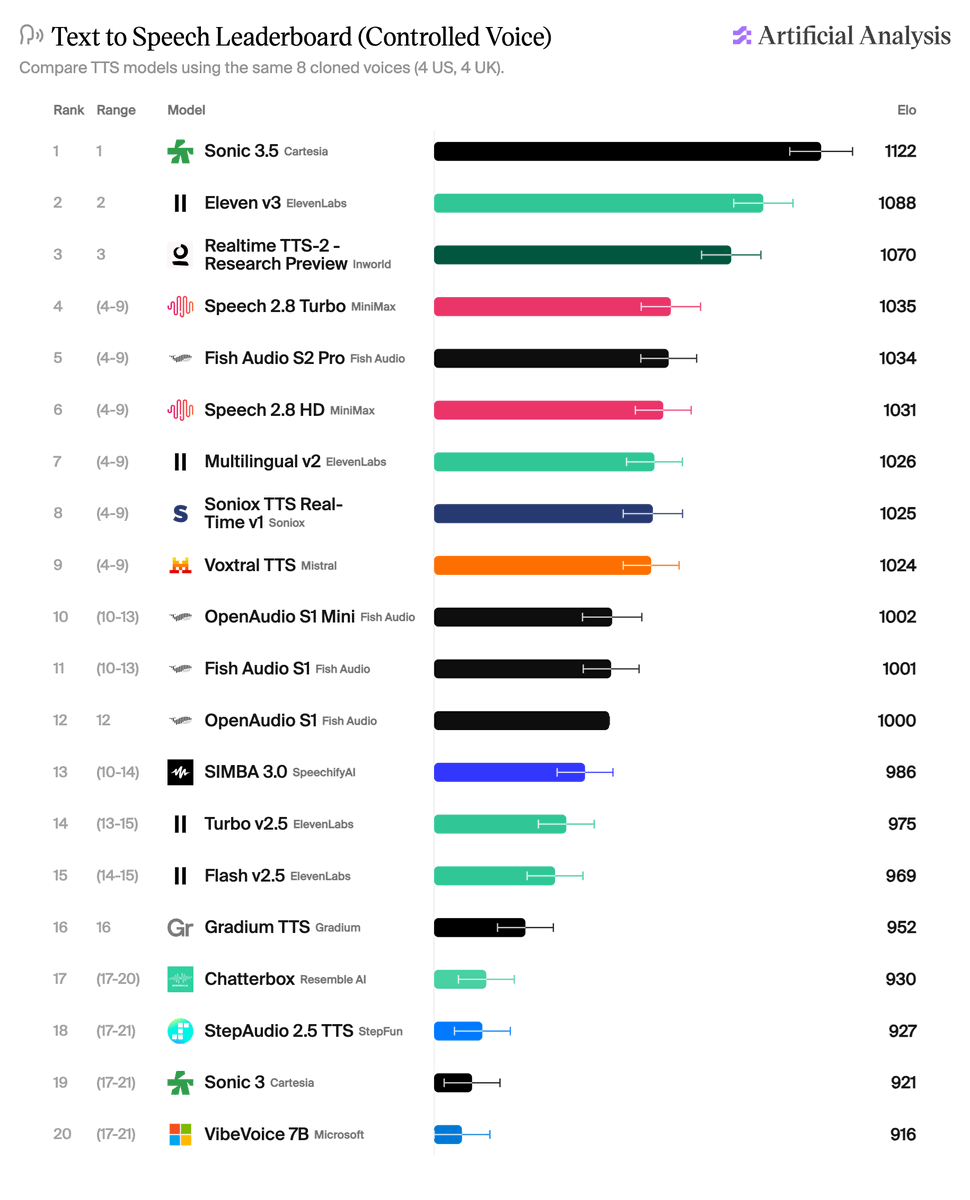
Announcing the Controlled Voice Arena Leaderboard comparing Text to Speech models on the same set of 8 cloned voices
The Controlled Voice Arena standardizes, through voice cloning, the set of voices that each model’s performance is evaluated on - separating specific voice preference from broader aspects of model quality. It complements our Provider Voice Arena, where each model uses a select set of its own available voices.
We have generated speech samples on models that offer voice cloning abilities using the same voice categories as our existing Provider Voice Arena, namely: 2 US Male voices, 2 US Female voices, 2 UK Male voices, 2 UK Female voices. Each model has been cloned on the same 1-2 minute audio recordings for each voice.
Key results
➤ Overall: @cartesia Sonic 3.5 leads (1,122 Elo), followed by @ElevenLabs Eleven v3 (1,088) and @inworld Realtime TTS-2 - Research Preview (1,070)
➤ US accent: Cartesia Sonic 3.5 leads (1,139 Elo), followed by ElevenLabs Eleven v3 (1,104) and Inworld Realtime TTS-2 - Research Preview (1,059)
➤ UK accent: Cartesia Sonic 3.5 also leads (1,103 Elo), with Inworld Realtime TTS-2 - Research Preview (1,075) moving ahead of ElevenLabs Eleven v3 (1,067) into 2nd
➤ Open weights: @FishAudio S2 Pro leads (1,034 Elo), followed by @MistralAI Voxtral TTS (1,024) and @resembleai Chatterbox (930)
See more details below ⬇️
At @cartesia We are building and cooking every single day to move the state of the art forward.
"It supports 42 languages, with 500+ voices available out of the box."
"Not just an English win. Sonic 3.5 is also the #1
streaming model in Hindi, ahead of SarvamAI."
"The Elo gap is big. It's even clearer when you hear it."
This comes in a day after our launch announcements (check out Cartesia founder @krandiash's post yesterday on this: https://t.co/Ad3Mn0agQY)
The team has done incredible, intentional, focused and deeply scientific work.
Check it out for free at https://t.co/5LzlwGRalI
686 days. that's how long @LewisHamilton waited for a win and he got his first in red this weekend, in Spain.
bold bets take time. then they land all at once.
@cartesia made one too: be the best in voice on one provider. Sonic 3.5 + Ink 2, both #1.
We released Sonic-3.5 and Ink-2, the #1 streaming models for text to speech and speech to text you can use in your voice agents today.
New architectures enable new frontiers for speed and quality.
We're now the only provider to have #1 models for both speaking and listening.
Introducing HydraDB.
The graph native context infrastructure for agents. Purpose built to deliver precise context & observability into why agents act the way they do.
We've always believed graphs are the best way to manage AI context, but they've been too expensive to scale or impractical for storing full context. Until now.
@hydra_db combines in memory, NVMe, and object storage into a single graph layer, making context delivery faster, cheaper, and more precise.
We want context delivery to be extremely fast, 1000x cheap, and highly precise. Give your agents a brain.
Pi v0.77.0 is out.
Highlights:
- Claude Opus 4.8 support added with updated adaptive-thinking coverage.
- New --exclude-tools / -xt flag to disable specific built-in, extension, or custom tools while leaving the rest available.
- Device-code login for OpenAI Codex subscriptions available as a headless alternative to browser login.
- InputEvent.streamingBehavior lets extensions distinguish idle prompts, mid-stream steers, and queued follow-ups.
Complete details in thread ↓
Our new model Ink-2 tops AA's leaderboard for streaming speech-to-text!
Ink-2 comes with plenty of features optimized for real-time voice agents. With top-class models for both TTS and STT, the team at @cartesia keeps pushing the frontier of models for interactive intelligence.
Our new speech-to-text model Ink-2 is out and #1 on Artificial Analysis.
It’s built for streaming — low latency, fast eager mode and built in semantic endpoints to detect when users are done talking
New architectures & algorithms made this Pareto-dominance possible