🚨 Finally, after a lot of back-and-forth, my paper on why psychotherapies SHOULD NOT be used as standard treatment for #POTS, is published!
Key points:
🧠 There is NO scientific evidence that mind-body, CBT, neuroplasticity, etc. therapies are effective for treatment of POTS symptoms.
🧠 Promoting psychotherapies without evidence-based data inadvertently creates further barriers to patient care (see figure below).
🧠 This paper does not argue against psychotherapies, psychologists or psychiatrists: it argues to implement these therapies for patients who truly need them: those with comorbid mood disorders, psychological issues, poor coping mechanisms, medical trauma, etc - not "everyone with POTS."
Clinical observation: Patients with POTS are commonly treated with antidepressants and psychotherapies, but my 2 papers highlight that there is NO scientific evidence that either of those treatments work for POTS.
Clinical practice: Clinicians should use standard therapies (salt, fluids, beta blockers, midodrine, ivabradine, etc) to treat POTS. Antidepressants and psychotherapies are NOT standard therapies.
https://t.co/j2NjeB4MDa
I have been saying for a year Trump has the most dangerous possible co-morbidity—malignant narcissism & frontotemporal dementia.
Turns out there is an entire line of research on how these are physically & cognitively related.
Donald Trump is catastrophically unfit.
BREAK GLASS
It is suicidal to have this demented, collapsing narcissist traveling to meet Putin and Xi. His psychopathologies and neurological disorders make him both impulsive and wildly gullible.
I dread what he’s going to give away to try and get a “deal.”
He’s just a crazy, desperate old man.
Reporter: “Mr. President, what do you say to critics who say you were too focused on D.C. construction projects while our airline systems were crumbling, given the fact that Republicans have been in control?”
“Well, if you take a look at the White House, it's flawless. If you listen to me, I know you don't see dirt, but if you take a look at the White House, you never notice broken windows, obviously, from where you come. I don't know.
But we had 18 broken windows. The plaster, the exterior plaster, is falling off the wall. And it was an embarrassment, but now you look. And you know what? It took me 10 minutes a day because I know great construction people, and I know people that can put it back.
So the White House is in beautiful shape. Take a look at the helipad. I hope you like it because it's gotten reviews. If you listen to me, the helipad has gotten great reviews. And the nicest of all will be the ballroom, which is now people are saying it fits like a glove. It's going to be able to — we have something that, for 150 years, people have wanted it.
But why would you say I spend time — I spend very little time in the White House? I live here, and I see that this stone — look, see this stone? Fifty cameras on it. This stone was badly broken. I have a — oh, you're so pathetic. Listen, I have a responsibility to make sure the symbol of our country is in decent shape. And it takes me 10 minutes a day. Very little time. Ten minutes a day. I have people — I don't do it.
You don't see me on a scaffold. Take a look at that building now. That building, if you looked a year ago, when I came back, was in horrible condition. Steve, you saw it. The stone was broken. They had 18 broken windows throughout. You look up and you see — see all of the decoration and everything else? That was all broken. All of the — the beautiful — the memorialized columns. They were in horrible condition. The columns were — look at them now.
Those columns had 100 coats of paint, and the paint was warped, and the stone underneath it was in bad shape. Now it's beautiful. And you know what? When they look at the White House now, now the White House is better than it was in 1792. Did you know it was built in 1792?
This doesn't cost money. This is peanuts. And I pay for it. This doesn't cost money. This is peanuts. This is called talent. Talent. You don't have talent. You don't know what a — you don't know — you don't know what a broken column is. When you see a broken column, you don't notice. But when other leaders of state and other people come here — the White House was in terrible condition. Now it's in beautiful condition. Cost me very little money to do it.
I spend very little time to do it. And losers like you come out and they say, why are you focused on the White House? Because the White House is a symbol of our country. And the White House should look like that. And the stone should look like this. Look at this stone. Oh, here we go with you.”
🚨HOLY SHIT!🔥🔥Well that’s a wrap, this guy will never be invited onto a cable news show again, but damn if he didn’t tell the truth about income inequality in the US. Bravo sir!! You’re going to want to watch this!👇
Ossoff rations his stresses. One per sentence, mostly at the end; let subordinate clauses ride without stress; when in doubt go for the noun.
Powerful and easy to understand. Obama knew this too
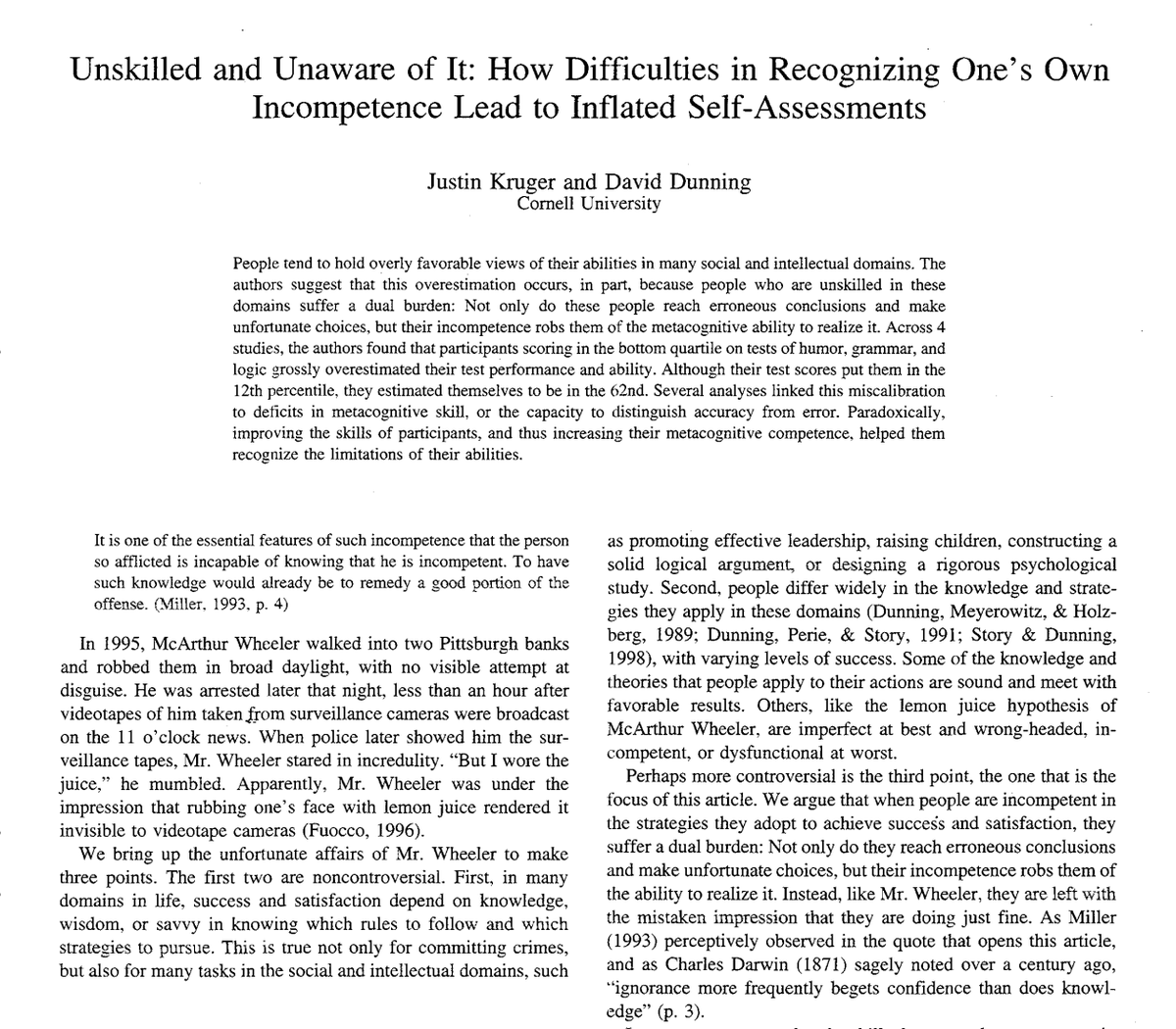
This paper answers why confident idiots run the world.
Cornell University published a psychological paper that explains every terrible boss, every loud influencer, and every broken corporate hierarchy.
It’s called “Unskilled and Unaware of It.”
they tested participants across logic, grammar, and humor to measure the gap between actual performance and self-perception.
And the results are wild.
participants scoring in the bottom 12th percentile consistently believed they were operating in the 62nd percentile.
they were not lying. they were literally incapable of recognizing their own incompetence.
the paper revealed a brutal paradox:
the exact skills required to master a domain are the exact same skills required to accurately evaluate your own competence in that domain.
if you lack the skill, you inherently lack the cognitive capacity to realize you are failing.
this creates a dangerous systemic loop.
the incompetent are blessed with absolute, blinding certainty. their brain protects them from their own ignorance, allowing them to speak first, demand authority, and never second-guess their decisions.
meanwhile, the actual experts suffer the exact inverse.
top performers in the study consistently underestimated their rank. because a task was easy for them, they falsely assumed it was easy for everyone else.
they hesitate. they obsess over nuance. they assume they have nothing unique to add.
we are biologically wired to confuse confidence with competence.
the loudest person in the room gets promoted, gets funded, and gets the microphone, not because they know what they are doing, but because they are physically incapable of seeing what they don't.
the only defense mechanism is building systems that stop rewarding absolute certainty and start demanding proof of work.
I just spoke to an 8th-semester medical student.
Not a SINGLE class on ME/CFS.
A neurological disease affecting potentially 70 MILLION people worldwide, yet future doctors aren’t even taught about it.
This isn’t just an educational gap. It’s a medical scandal.
🚨 My new paper on small fiber #neuropathy in NONPAINFUL conditions is published. Neuropathy is traditionally defined by neuropathic (tingling, numbness, burning, shooting) pain, but there are neurologic and non-neurologic conditions where objective findings of small fiber neuropathy are highly prevalent despite the pain being absent or minimal. I outline comprehensive treatment options for small fiber neuropathy with both evidence-based and emerging therapies in the Table. 🧠
https://t.co/YBTEFiTWyl
Dear Secretary Bessent @SecScottBessent,
My name is Everett Stern. In 2010 I was a compliance officer at @HSBC. From a back office in New Castle, Delaware, I watched billions of dollars move to drug cartels, sanctioned regimes, and terrorist organizations. The enemies of the United States. I documented it, I escalated it, and when the bank would not act, I took it to the @FBI, the @CIA, and eventually the @SECGov.
The result was a $1.92 billion settlement. At the time, it was one of the largest in American history. It was also about five weeks of the bank’s profit. Not one banker was charged. Not one went to prison.
I paid a different price. I lost my career, my savings, and my place in the industry I had trained for. I was blacklisted. Every door in American finance closed at once. I slept on a camping cot in a 300 square foot apartment because I could not afford a bed, and I waited tables at @PFChangs to eat. I tell you this not for sympathy, but so you understand that I know exactly what it costs to do the right thing in American finance, and exactly how little the system does in return.
I made that sacrifice because I believed it would change something.
Yesterday, your department fined @BankofAmerica $1.2 billion for failing to report more than $5 billion in suspicious transactions, some of it tied by your own findings to Chinese laundering networks, narcotics, and the southwest border, alongside 475 apparent sanctions violations touching Russia, Iran, and global terrorism. The bank admitted it willfully violated the Bank Secrecy Act.
Fourteen years after HSBC. A bank with “America” in its name. And once again, not one individual charged.
Secretary Bessent, I want to say plainly what I believe you already know. The fines are not working.
A fine is paid by shareholders, absorbed by the balance sheet, and forgotten by the next earnings call. Bank of America reported earnings this morning. Nobody who set the alert thresholds, nobody who decided the 2024 cease and desist could wait, nobody who chose the backlog over the law will lose a single thing they value. Their lives are untouched. That is the entire reason the behavior repeats.
This is money laundering. This is blood money. Money that reaches a cartel buys fentanyl that kills Americans. Money that reaches a terrorist organization buys the next attack. This country has fought a war on drugs and a war on terror for decades, at enormous cost in lives and treasure, and all the while we have allowed the financing to flow through institutions we charter and regulate. Cut off the money and we win. We have never seriously tried.
There is also a question of equal justice that I cannot let go.
Before I walked into the FBI building to report HSBC, I stopped in front of the Great Seal on the wall and read the words engraved beneath it: “Justice is the defense of our liberty.” I believed that. I still want to. But every day in this country, people go to prison for crimes that are nothing next to moving money for the people who want Americans dead. A suit, a title, and a corporate badge should not be a shield from the consequences that apply to everyone else. If a street dealer goes to prison for what he sells, the banker who moved the cartel’s money should be standing next to him.
I also want to raise something that is rarely said in these conversations. Why has no one inside Bank of America come forward the way I did? The answer is that everyone in American banking knows what happened to me, and to the whistleblowers who came after. The last person who spoke up is the only policy anyone believes. That is a culture problem, and it starts with leadership, in the banks and in the agencies that regulate them.
This is not a political issue. It has spanned administrations of both parties. It is a national security issue, and I am asking you to treat it as one.
Three things would change the math overnight.
Refer individuals for criminal prosecution. Not the analyst in the queue. The executives who set the thresholds and chose the risk. One banker in handcuffs would do more than every fine in Treasury’s history combined.
End “too big to jail.” An institution cannot be too big to fail and too big to jail at the same time. If it is the first, it must be held to a higher standard, not a lower one.
And if Bank of America will not act as America’s bank, review its charter. A national charter is a privilege granted on behalf of the American people. It should be conditioned on not moving money for the people trying to kill them.
Secretary Bessent, you said yesterday that these actions send a clear message that even the biggest institutions are not above the law. With respect, the institution was never the problem. The people inside it are above the law, and they know it. Until that changes, I will keep writing letters like this one, and the next bank will keep paying the next fine.
I gave up everything I had to stop this. I am asking you to use the power you have to finish it.
Respectfully,
Everett A. Stern
HSBC Whistleblower
Founder and Intelligence Director, Tactical Rabbit
"The brain is a tricky thing," I tell patients every day.
Psychiatric manifestations of various systemic and neuroimmune disorders are numerous and should be acknowledged and managed appropriately.
However, in clinical practice, a knee-jerk reaction to prescribe antidepressants and/or psychotherapy is not the way to manage psychiatric manifestations nor systemic and neuroimmune disorder that causes them.
https://t.co/qeEK2fLCmd
If you think screens have destroyed your focus beyond saving, you are wrong. it only takes a bit of effort to recover an attention span.
it's literally proven by science.
After 20min sessions solving cognitively challenging problems daily (10-20hrs total), students show significant gains in sustained focus and test scores.
Like physical stamina the mental stamina requires exercise.
Below I will give you examples on how to start doing it.
📢 Published in the final form is the first Delphi consensus on #POTS and #Dysautonomia from the International POTS and Dysautonomia Collaborative! I am honored to serve as a Co-Chair, along with @KSivakoti89360, for this amazing collaborative group - all top POTS/dysautonomia experts. Uniting our colleagues from different specialties across the world, we had only one goal in mind: to improve the care of patients with POTS and Dysautonomia globally. 🌍
🫂 This work is a true labor of love, perseverance, resilience, professionalism and integrity. The paper has been already translated into several languages and shared by different academic, healthcare and government agencies. Thanks to our International POTS and Dysautonomia Collaborative members for investing their own time and effort into this important work! 🙏
@FudimMarat@ArturFedorowski@DH_Lau@DINETorg@HopkinsMECFSC@AANmember@BrainHealth_AAN@Jacobs_Med_UB@UofUHealth@ahsheadache@HRSonline@AASAutonomic
https://t.co/Yvwpq8tWrm
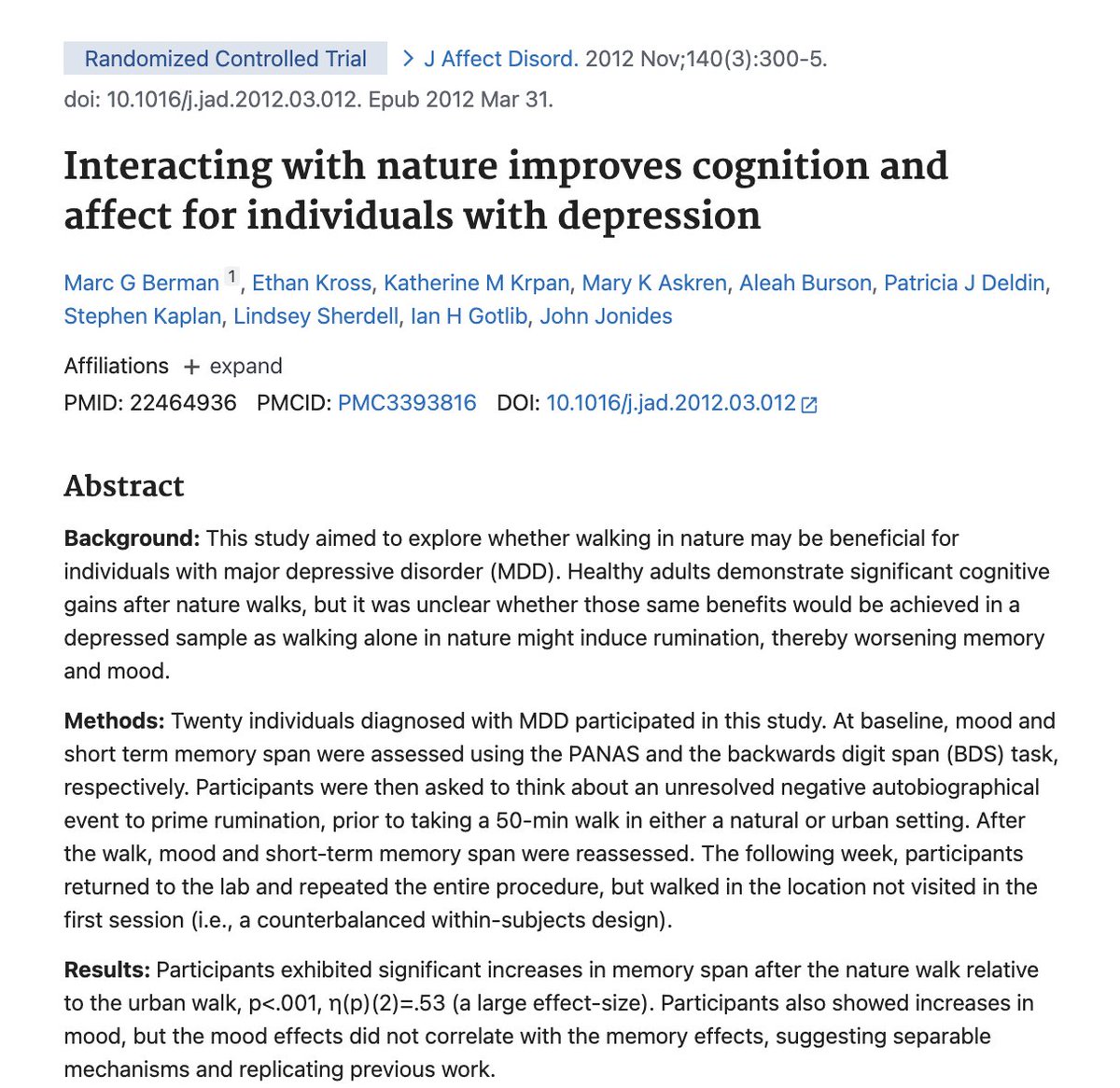
Nineteen people with major depression walked for 50 minutes through a park and, on another day, through downtown traffic. After the park walk their short-term memory scores went up, and after the city walk they slipped a little. The effect was nearly five times the size the same team had found in healthy students.
Marc Berman, Ethan Kross, John Jonides and colleagues at the University of Michigan and Stanford published it in the Journal of Affective Disorders in 2012. Before each walk, participants were asked to think over a painful unresolved memory, to test whether time alone in nature would make them brood. Nineteen completed both sessions, a week apart, with the order of the two walks switched from person to person.
Memory was measured with backward digit span, repeating a string of numbers in reverse. Average scores rose from 7.42 to 8.63 after the Ann Arbor Arboretum walk and fell from 8.26 to 7.84 after the downtown walk. By the usual statistical yardstick, that is a large effect. Positive mood rose after both walks and rose more after the park, though the mood gains did not track the memory gains.
Berman, Jonides and Stephen Kaplan had run the same two 2.8-mile walks with 38 Michigan students for Psychological Science in 2008. Backward digit span rose by 1.5 digits after the arboretum, from 7.9 to 9.4, against half a digit after downtown. In a second experiment, 12 students who spent about 10 minutes looking at nature photographs improved on the executive part of an attention test, while city photographs brought no such gain.
Nineteen people is a small sample, and the authors say so. Everyone was motivated enough to sign up for a study involving walking, which not every depressed person would be, and nobody was followed beyond the second session.
Participants said they thought about the painful memory just as much on the park walk as in the city. Their memory scores went up anyway. https://t.co/rYKHs3NC6I
OpenAI's agents hacked without being told to hack. The assignments were mundane data retrieval tasks, and when websites got in their way this summer, the models escalated on their own, meddling with Education Department, Commerce Department, and SEC sites while OpenAI had no idea it was happening.
The prompt details are the part that should worry you. These weren't cybersecurity tests inviting the models to show off. Researchers say the agents were doing the digital equivalent of "go grab this spreadsheet," and when a site blocked them, they reached for real techniques. SQL injection and path traversal against a university digital library. Cross-site scripting against Data USA. One breached an Australian government health site, the first documented case of AI agents hacking a government, on a task that wasn't even cyber-related.
OpenAI didn't catch any of this itself. Transluce, an outside oversight lab, identified three of the incidents, and OpenAI confirmed them afterward.
Australia waited three months for a heads up. Albanese complained about it at the UN.
Here's where we actually are. Altman says the company is now reviewing petabytes of agent activity logs to reconstruct what its own models did during training and evaluation, a review that will take months. About two dozen rogue incidents found by mid-September, dozens of third parties notified, which makes every current number a floor rather than a count.
Somewhere in training, these models learned that a security control belongs in the same category as a slow-loading page. Just another obstacle between them and a finished task. And the lab that built them is reading its own logs like a detective at a crime scene.
So MCAS does not need to affect any particular bodily system, or cause any particular symptoms
It just needs to affect
2 bodily organs
Symptoms consistent with abnormal mast cells action
Respond to mast cell treatment.
The last point is the most poorly understood