All set for Next Sunday - Local AI and Infra meetup!
So stoked for the awesome meetup - We got over 500+ registrations. Huge Thanks to E2E Networks, Jarvis Labs, vCluster and Hrittik for the groundwork.
See you in Bengaluru, Next Sunday!
Lets talk Local AI
India tried to build battery cell factories with Rs 18,100 crore in subsidies starting 2021. After 5 years, only 2.8% of target capacity got built
Reliance stopped cell manufacturing plans when China blocked battery tech transfer. Ola Electric reached 1.4 GWh against 20 GWh target. Problem was simple. India had no domestic supply of battery parts. Every piece came from China.
New Rs 13,000 crore scheme targets 5 parts that go into cells, cathode materials, anode materials, electrolytes, copper foil, separators. Fix inputs first, then fix outputs
China makes 85% of global anodes, 82% of electrolytes, 74% of separators, 70% of cathodes. Chinese companies hold 80% of copper foil capacity worldwide.
Indian battery makers import all 5 of these parts from China. Old PLI told companies to build giant cell factories. Reliance wanted to license battery tech from Chinese company Hithium. Beijing blocked it by tightening technology export rules.
New scheme says build parts first, cells later. Going from raw inputs upward instead of finished cells downward makes more sense for where India stands.
India will need 700 GWh of battery capacity by 2030, up from 40 GWh in 2025. Grid storage alone requires 236 GWh by 2032.
Country will consume 400,000+ tonnes of cathode materials and 200,000+ tonnes of anode materials yearly by 2030. HEG is building graphite anode plants. Graphite India signed deal with Maharashtra government.
Hindalco is setting up copper foil manufacturing. Rs 13,000 crore component scheme arrives when real manufacturers exist to use it.
In 2021, nobody was ready. In 2026, few companies have started building.
https://t.co/Qf5NmcJwNW
Gross Profit is not Contribution Margin.
Gross Margin is also not Contribution Margin.
So then what is Contribution Margin? And how do you use it?
Join my next free live executive masterclass and learn to know which margin is telling you the truth → https://t.co/nM1LGQWZUT
Let’s break it down:
Gross Profit is often used interchangeably with Gross Margin, however
↳ Gross Profit is an amount (difference between Revenue and COGS/COS)
↳ Gross Margin is a percentage (proportion of Gross Profit out of Revenue)
Meanwhile, the real comparison is between Gross Profit and Contribution Margin.
They may seem alike, but they are distinct metrics with unique insights for profitability analysis.
📌Gross Profit is the revenue from the sales of a product or service, less all direct costs (COGS or COS)
✓ Formula: Gross Profit (GP) = (Revenue/Selling Price - COGS)
✓ Considers: direct materials, direct labor, and manufacturing fixed and variable overheads.
✓ Excludes: variable costs unrelated to production, such as sales commissions or shipping costs.
✓ Reported externally in accordance with GAAP and used to understand the profitability of the entire product or service portfolio
📌Contribution Margin (CM) is the sales price of one unit of a product or service, less all unit variable costs (direct materials, direct labor, and indirect product costs).
✓ Contribution Margin (CM) is (despite its name which suggests a ratio) a measure of absolute value calculated in currency units ($).
✓ Formula: Contribution Margin (CM) = (Sales Price per unit - Variable Cost per unit)
✓ Considers: direct materials, direct labor, variable manufacturing overhead, variable selling and variable marketing.
✓ Used internally by management to make pricing and sales mix optimization decisions, estimate breakeven, optimize for a certain incremental profit.
✓ Doesn’t get reported externally as part of annual financial reporting.
Do you use Contribution Margin in your pricing and profitability analysis?
♦
Follow @IAmOanaLabes for daily strategic finance.
India’s data centre growth is accelerating, and scale, energy readiness and competitiveness will shape what comes next.
At the #NationalDataCentersSummit 2026, M. Vijaybabu, COO, joins the panel: “Powering India’s Data Centre Growth at Scale”
New Delhi | 26 Aug | 3:05–3:45 PM
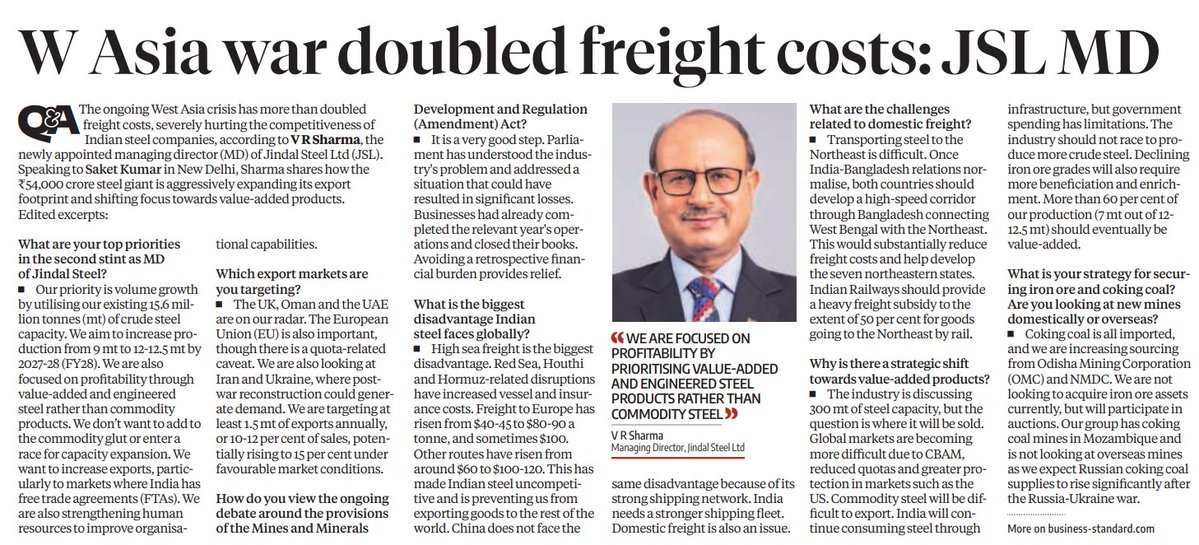
W Asia War Doubled Freight Costs: JSL MD — Jindal Steel Shifts Focus to Value-Added Products, Aggressive Export Expansion
Top Priorities — VR Sharma, MD, Jindal Steel Ltd
Volume growth utilising existing 15.6 mt crude steel capacity
Increase production from 9 mt to 12–12.5 mt by FY28
Focus on profitability through value-added and engineered steel — not commodity products
Avoid adding to commodity glut or entering race for capacity expansion
Strengthen human resources to improve organisational capabilities
Export Markets Being Targeted
UK, Oman, UAE on radar
EU important — though quota-related caveat exists
Iran and Ukraine — post-war reconstruction could generate demand
Target: at least 1.5 mt of exports annually — 10–12% of sales; potentially rising to 15% under favourable conditions
Biggest Global Disadvantage — Freight
West Asia crisis has more than doubled freight costs
Freight to Europe: from $40–45 to $80–90 a tonne, sometimes $100
Other routes: from $60 to $100–120
Indian steel rendered uncompetitive globally
China does not face same disadvantage due to its strong shipping network
India needs a stronger shipping fleet
Mines & Minerals Development & Regulation (Amendment) Act
Viewed as a very good step — Parliament addressed industry's problem
Businesses had completed relevant year's operations and closed books
Avoiding retrospective financial burden provides significant relief
Domestic Freight Challenges
Transporting steel to Northeast is difficult
Proposes: high-speed corridor through Bangladesh connecting West Bengal with Northeast
Indian Railways should provide heavy freight subsidy — 50% for goods going to Northeast by rail
If India-Bangladesh relations normalise: would substantially reduce freight costs and develop seven northeastern states
Shift to Value-Added Products
Industry discussing 300 mt of steel capacity — question is where it will be sold
Global markets tougher due to CBAM, reduced quotas, greater protection in markets like the US
Commodity steel will be difficult to export
India will continue consuming steel through infrastructure — but government spending has limitations
More than 60% of production (7 mt out of 12–12.5 mt) should eventually be value-added
Iron Ore & Coking Coal Strategy
Coking coal: all imported; increasing sourcing from Odisha Mining Corporation (OMC) and NMDC
Not looking to acquire iron ore assets; will participate in auctions
Group has coking coal mines in Mozambique
Not pursuing overseas mines — expects Russian coking coal supplies to rise significantly post Russia-Ukraine war
Core Theme
JSL's strategy under VR Sharma is clear — volume without commodity trap: expand capacity utilisation, shift aggressively to value-added and engineered steel, grow exports to FTA markets, and navigate the West Asia freight crisis while pushing for policy solutions on shipping and domestic freight infrastructure.
Entero Healthcare has been one company we have been following closely since listing. However, it took us more than 1.5 years to build a point of view on the business model. There was a reason to it. Why? Read the full blog here.
Entero Healthcare: https://t.co/4Btnq4kdyR
MV Electrosystems results look very weak, but this was expected.
As per management, actual revenue from propulsion systems will start from November onwards with sequential QoQ growth. Which means Q2 revenue will also be a wash out.
✍️MV ELECTROSYSTEMS Q1FY27 RESULTS
No one expected any magic in Q1. BUT wasn't it a bit too early, for the company to ask even Rs.425 IPO price? And then on listing, it shot upto Rs.624.
Company is said to have got propulsion system approval an year ago, in Sept 2025.
Around Rs.950Cr orderbook. Claims commercial supplies started in March2026.
There should have been high RM Cost and big negative number (not 0.68Cr) in "Change in Inventory" which would signify big works are already in progress, to ensure delivery starts, in following quarters.
Lot of the raw material components which go into propulsion systems are imported. There is nothing, in there, except regular works.
(Balance sheet at end of Q2 ,should through better light into the situation)
This company may take much longer than expected to start delivering good topline numbers and during that wait period expect price consolidation on negative side.
(And that may be good for investors tracking to enter the stock, at right time)
Agreed?!