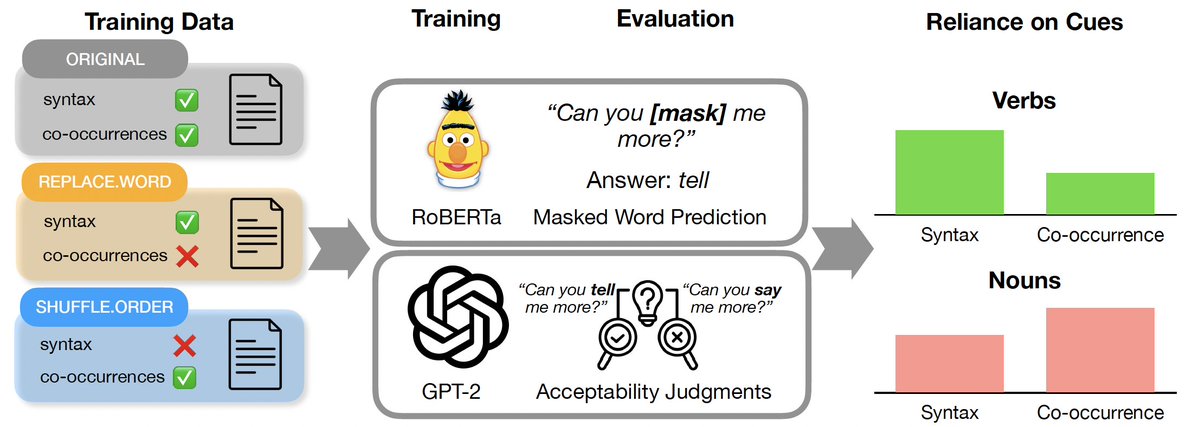
🤖🥾New paper: The Structural Sources of Verb Meanings Revisited: Large Language Models Display Syntactic Bootstrapping🥾🤖 now on Open Mind
We investigated the importance of syntactic vs. co-occurrence cues on verb learning with LLMs
w/ @RTomMcCoy@bob_frank 🧵
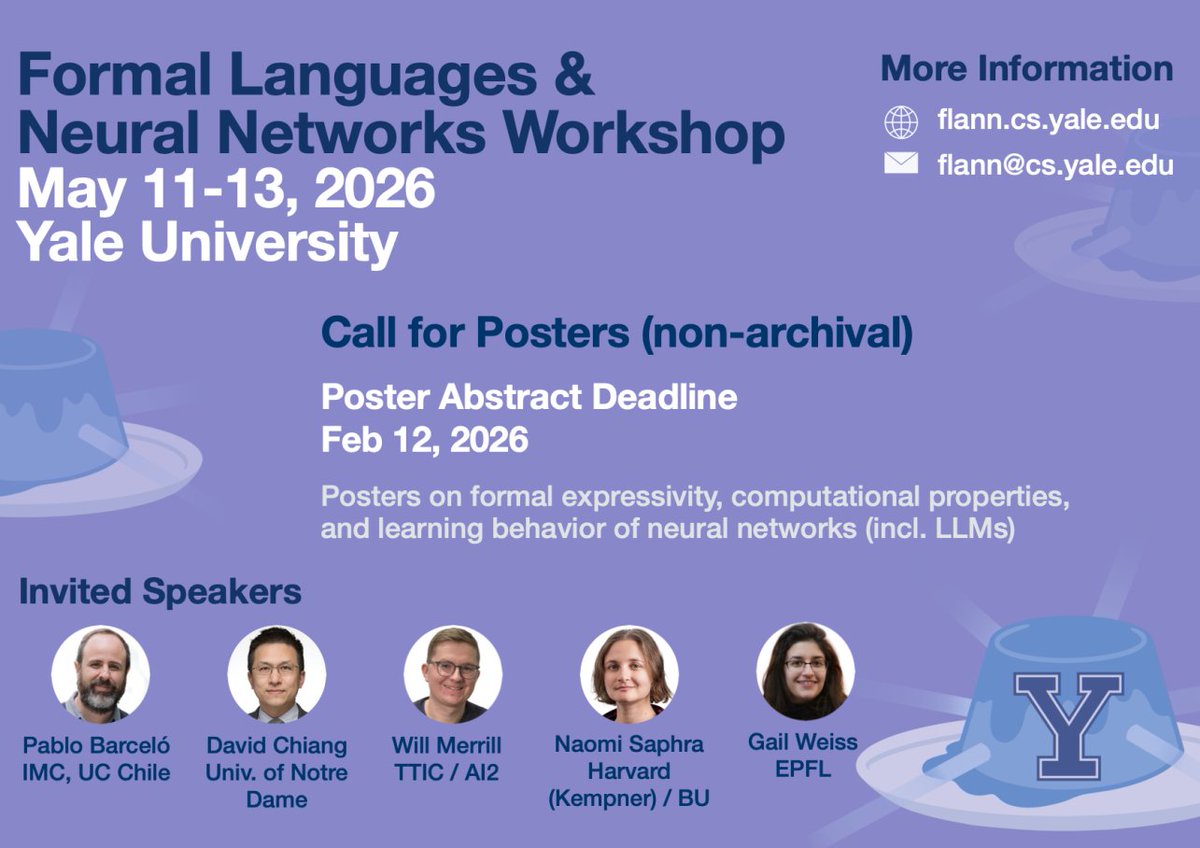
The FLaNN Workshop submission deadline has been extended to Feb 19!
Invited talks + posters (non-archival): expressivity, computation, and learning in neural nets/LLMs. Previous work welcome. Graduate students encouraged to submit!
📍 Yale University
🗓️ May 11-13, 2026
📣 FLaNN 2026 at Yale 🍮
Invited talks+posters (non-archival): expressivity, computation, and learning in neural nets/LLMs
Speakers: Pablo Barceló, David Chiang, Will Merrill, Naomi Saphra, Gail Weiss
Abstracts due Feb 12, 2026
Details: https://t.co/AzgF1TMyOS
My student, Xiomeng Miranda Zhu, is presenting her work on discourse entity recognition at the ACL meeting in Bangkok. This project shows how the tools of semantic theory can be used to assess LLM performance. Read the paper and (if you're there) go see the poster!
✈️to Bangkok🇹🇭 for @aclmeeting#ACL2024
Will present at 𝐈𝐧-𝐏𝐞𝐫𝐬𝐨𝐧 𝐏𝐨𝐬𝐭𝐞𝐫 𝐒𝐞𝐬𝐬𝐢𝐨𝐧 𝟔 (𝐀𝐮𝐠 𝟏𝟒, 𝟏𝟎:𝟑𝟎) for our paper https://t.co/fDjZJPFRds
If you are interested in the intersection of linguistics, cogsci, and LLM, let's find a time to chat😊
The Yale program in cognitive science is searching for a faculty colleague in the cognitive science of language. We're looking for someone who works across multiple disciplines (e.g., Ling, Psych, Phil, and/or CS). Come be my colleague! https://t.co/Jz0ynFzcO9
@complingy@yoavgo@tallinzen@pfau@FelixHill84 True. But given the enormous training sets that are used these days, it's far from clear that the fluency isn't the result of some sophisticated parroting of what it has seen, in appropriate contexts. That's no small feat, of course, but not the same as knowing syntax
@yoavgo@tallinzen@pfau@FelixHill84 If linguistic structure is going to offer something to LLM development, it's gotta be in facilitating generalization, reducing the data bottleneck. But syntactic structures of whatever sort weren't designed to encode facts about the world, and they're not going to help there. /4
@yoavgo@tallinzen@pfau@FelixHill84 To me the lesson of ngrams and LLMs is that they provide good proxies of world knowledge, which turns out to more important in doing well on NLP tasks (of the sort people are currently focused on) than having grammatical representations that allow systematic generalizations /3
An exciting opportunity here at Yale in the Wu Tsai Institute. Applications are welcome from scholars across the cognitive sciences at all ranks https://t.co/WdP3HpKNc0
@alexandersclark@lambdaviking Now if only we had a grammar formalism for exactly the recursive languages, then you could have it back. Now that would be something!
Yale Linguistics is looking to hire a computational linguist (open rank) with a secondary appointment in Statistics and Data Science or CS. The candidate's work should span and bridge linguistics and NLP. If this sounds like you, apply at https://t.co/K6oeWVQA4m