The founders worth betting on were often terrible employees. Many clashed with previous managers, ignored instructions and quickly realised they were smarter than their boss.
In the wrong environment these people are marginalised or ignored. It’s also why previous employer references for a founder don’t always show their true ability.
This kind of behaviour doesn’t tend to show up well on a CV. It looks like job-hopping or not being a team player. But in practice it signals someone who is perfectly suited to the unstructured, uncertain nature of running a startup.
Our data on 15,000 companies showed that founders who scored highly on emotional stability (not charisma or likability) were far more likely to build bigger companies.
An underrated trait we see in brilliant minds is the ability to delete months or years of work without hesitation.
Hemingway cut 90% of what he wrote before publishing it. His novels read effortlessly because of what was taken out. James Dyson built 5,127 prototypes of his bagless vacuum cleaner, each one an act of subtraction: fewer parts, fewer failure points, fewer steps for the user.
Michelangelo described sculpting as removing everything from the marble that wasn't the figure already inside it. The David sculpture emerged not by adding but by taking away.
It requires a rare talent to throw away months of work that isn't good enough or serving its true purpose.
Most people experience cutting as a loss, but exceptional minds feel it as relief. Everything must earn its place. Intelligence is common. Restraint is rare.
Across 5000+ founder meetings, the single rarest success trait we saw was pathological determination (<1% of founders). Having a good work ethic is not enough; these individuals possess a borderline-delusional ability to run through any wall they meet, and don’t have an off switch. It’s not easy to see and most investors don’t ask the right questions in founder meetings to uncover it.
We have 10-15 proxy signals that we use to turn determination into a data point. Across hundreds of founders, we looked for a desperate desire to prove someone/something wrong, multiple previous failed businesses, early-life adversity and irrational optimism when most others would quit.
Our early findings showed that founders with a high determination index were significantly more likely to build bigger companies, even if it took them longer on average. Determination wasn’t correlated with confidence or charisma. The most determined founders were more introverted and did not light up rooms.
Most investors overvalue raw talent and ignore the sheer power of persistence. Brilliance is fragile. Obsession is anti-fragile. When vetting a startup, back the team that refuses to stay dead.
@spamalotcamelot@karthiktadepall What you defines as basic is a luxury in many parts of the world, especially in places where there is socialism and not free market capitalism.
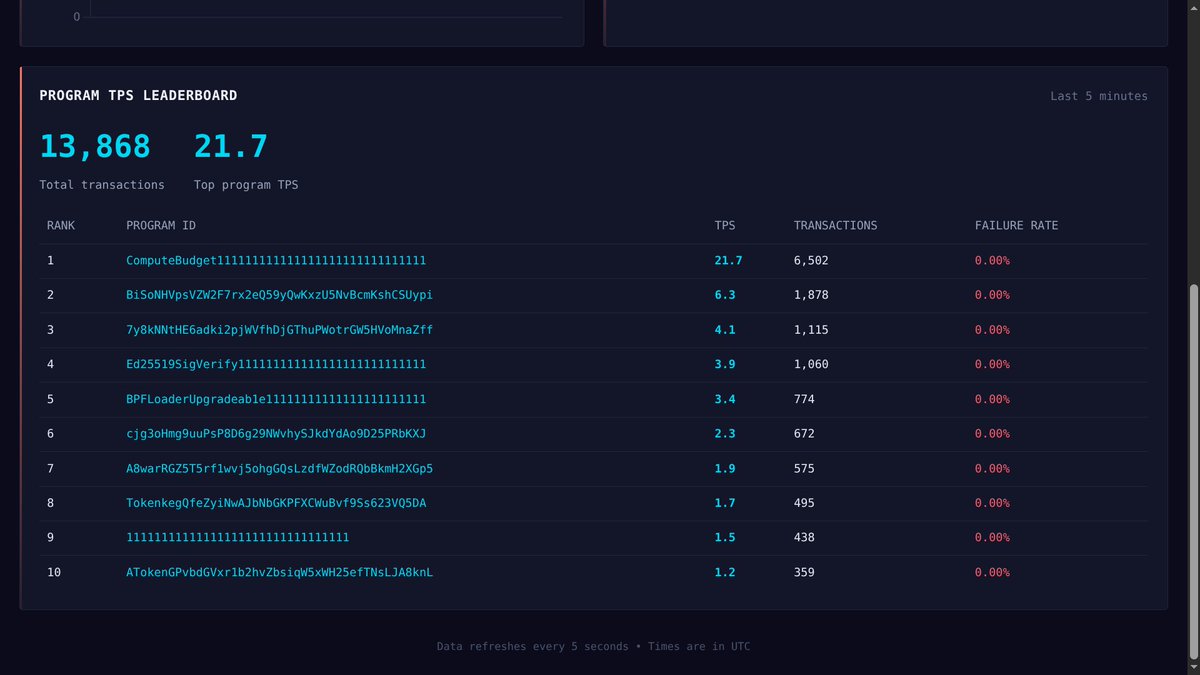
Built a real time Solana Indexer using @Helius LaserStream geyser, currently running live on:
https://t.co/fafY2rA7tB
CPI graph extraction and program TPS monitoring in Real time.
@maximschmidt94@mert
Pipeline internals (devnet numbers):
→ 40+ TPS sustained, zero event drops
→ 24ms processing lag validator → database
→ TimescaleDB continuous aggregates
serving API reads in <5ms
→ Geyser WAL queue with backpressure handling
Devnet is the stress test.
Mainnet is where the signals get economically meaningful.