worth reading in its entirety
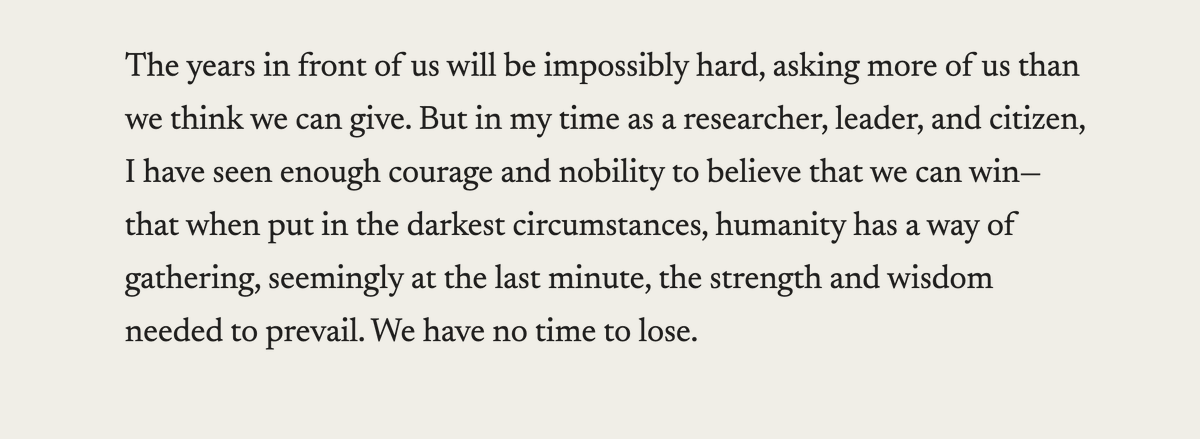
AI is incredibly powerful and not slowing down, there are many dangers ahead and it is natural to feel anxious, scared or angry
but we can win
The Adolescence of Technology: an essay on the risks posed by powerful AI to national security, economies and democracy—and how we can defend against them: https://t.co/0phIiJjrmz
I'm Boris and I created Claude Code. Lots of people have asked how I use Claude Code, so I wanted to show off my setup a bit.
My setup might be surprisingly vanilla! Claude Code works great out of the box, so I personally don't customize it much. There is no one correct way to use Claude Code: we intentionally build it in a way that you can use it, customize it, and hack it however you like. Each person on the Claude Code team uses it very differently.
So, here goes.
New Anthropic research: Tracing the thoughts of a large language model.
We built a "microscope" to inspect what happens inside AI models and use it to understand Claude’s (often complex and surprising) internal mechanisms.
Dylan Field on his biggest learnings from Figma’s 0 to 1 phase
Figma’s 0 to 1 phase was notoriously long. The company was founded in 2012, but it took four years before they publicly launched their product in 2016. Figma co-founder Dylan Field reflects on what he learned from this period:
“From August 2012 to June of 2013, that was a period where we were pivoting constantly trying lots of things. But then we had a thesis, felt like there was an opportunity, and started to build it out more. Then it was like, ‘Okay, this is going to take a while.’ In retrospect, we were lucky to have raised money and have resources, but I should have hired faster once we started to get signal from the market that we had product/market fit.”
Dylan recalls going to a user study with a friend who was a designer at Coursera. The following day, his friend sent over a 12-page document listing all of the stuff he wanted Dylan to build into Figma.
“I should’ve taken something like that and gone, ‘Okay, this is clear product/market pull.’ The market was pulling the product out of us. I should’ve then gone and hired faster. But instead I was still very cautious. And so that’s something where I wish — if I could go back in time — we would’ve gone a little faster there.”
Sam Altman gives similar advice:
“In the early days, when you’re experimenting and zig zagging, you’re like a fast little speed boat and want to be able to turn the whole company on a dime. You can’t do that if you’re a big company—cash burn aside, which is another problem. The flexibility of the company basically decreases with the square of the number of employees, so you want to stay really small until you’re sure things are working. Once things are working, then you can get really big.”
Video source: @ycombinator (2025)
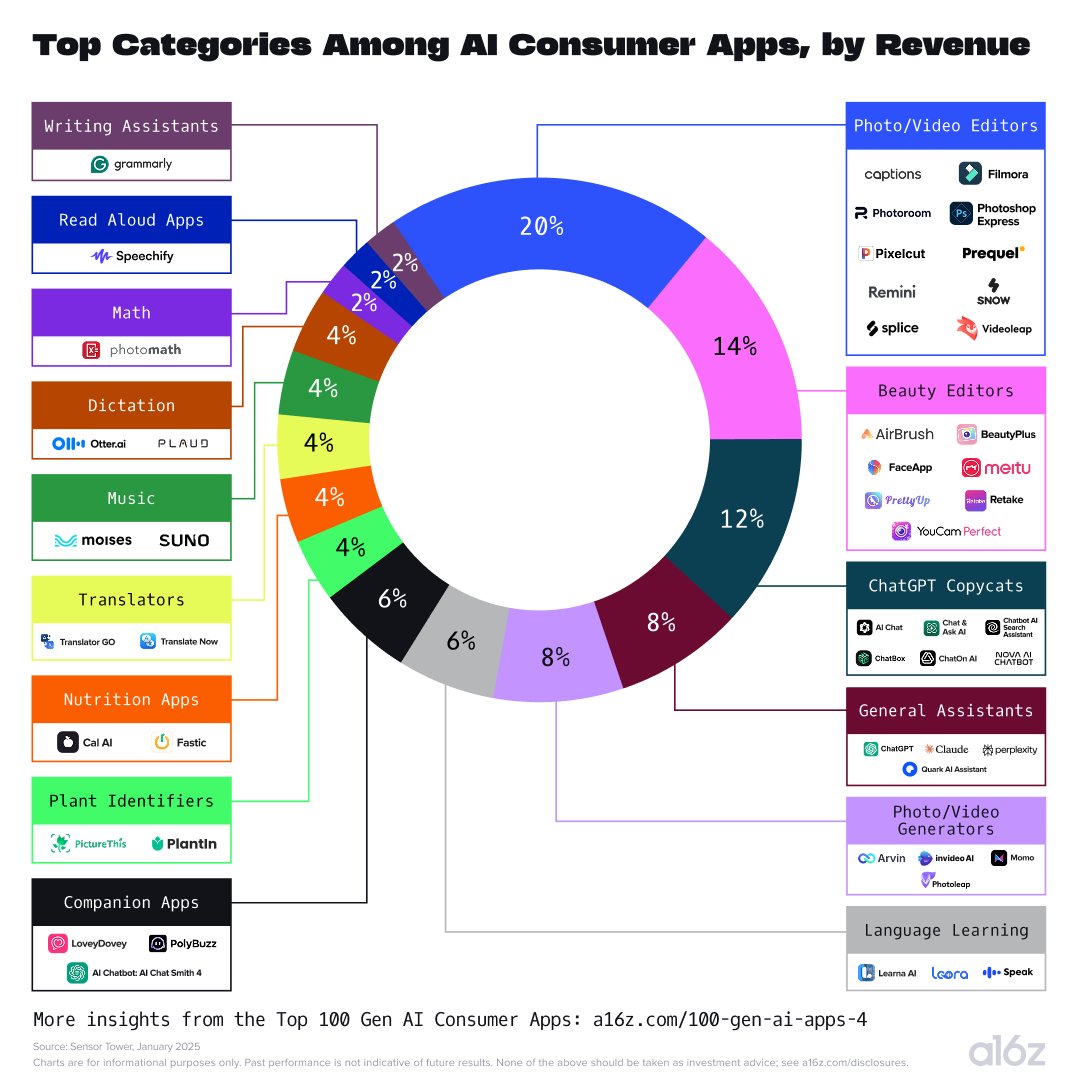
When it comes to apps, broad consumer appeal doesn’t always translate to revenue.
So what can turn engagement into earnings?
For our 4th installment of the Top 100 Gen AI Consumer Apps, we analyzed the top 50 AI mobile apps by usage and subscription revenue. Between them, there’s only 40% overlap.
Many apps with lower usage proved to be the most effective at monetization, achieving significantly higher conversion rates and revenue per user.
Those higher-earning apps are:
1. Niche apps catering to specific goals or skills, like plant identification, nutrition, or language learning. Though their audiences are less universal, these apps are more likely to attract users willing to pay for the product’s specialized value.
2. Apps with high-grade prosumer or enterprise-level features that more serious users will pay for.
A notable mention: ChatGPT “copycats” – these apps mimic ChatGPT’s name and logo to falsely suggest they offer the same premium model at a lower price. These make 12% of both the mobile usage and revenue lists.
"There are high-calorie ARRs and low-calorie ARRs" - @mignano
"There are lots of startups right now that are experiencing explosive revenue growth."
"However, many of the AI products are very churn-y. People want to experience the magic moment, but they never come back."
"We need to pay attention to metrics that have always mattered: consistent growth, retention etc."
-- honorable mention: @blakeandersonw@pattybuilds
I think entrepreneurs are the ones that have a chance to drastically change Europe's future, this decade.
It's an honor to try to help accelerate them by supporting young founders together with @joelhellermark@matiii@matthieurouif@HarryStebbings and other exceptional people. Project Europe is me of many initiatives to come with this ambition.
Startups are being built faster than ever.
Cursor: $4M to $150M ARR in 12mos
Midjourney: 0 to $200M ARR in 36mos
Glean: 0 to $100M ARR in 36mos
ElevenLabs: 0 to $100M ARR in 24mos
Lovable: 0 to $17M ARR in 3mos
Mercor: 0 to $70M ARR in 24mos
Bolt: 0 to $40M ARR in 4.5mos
"I really think Mars is going to be one of the biggest profit-generating endeavors in history." -- @shaunmmaguire
"(We need) nuclear power plants in a box, vertical farming, surgical robots, self-assembling fabs in space."
"I think all the second-order businesses that spin out from this are going to be outrageously valuable."
Honestly, @lovable just breaks all scaling rules.
The fastest-growing startup in Europe.
🤯 $17.5M ARR in 3 months
💰 $2.1M ARR added every week
👀 85% Day 30 retention- better than ChatGPT
🚀 30,000 new apps built every single day
Just the start and my 5 Key takeaways with @antonosika 👇