Every cycle gives you a window.
Right now, earnings are holding up and liquidity still exists — that window won’t stay open forever.
The biggest mistake investors make is waiting for clarity instead of using favorable conditions to compound.
Risk doesn’t disappear in good times. It just gets mispriced.
https://t.co/se67M1UdU7
$QQQ has touched or closed below the 50-day moving average in 17 of the last 38 trading days.
That kind of behavior points to growing indecision over the past two months.
Price typically doesn’t linger around the 50dma indefinitely.
The last three times we’ve seen a similar setup, price eventually moved lower—either revisiting the 200dma or coming close to it.
Fwiw.
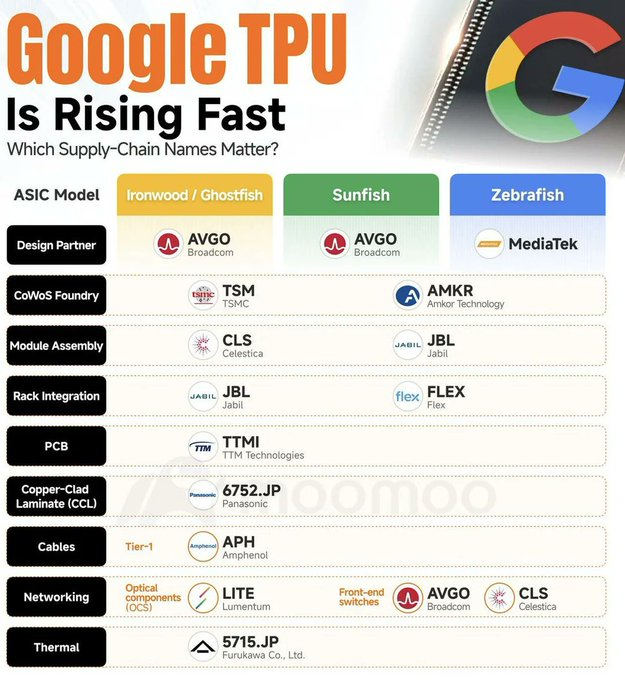
THE GOOGLE TPU ECOSYSTEM
• Custom Silicon — $AVGO designs and supplies the custom silicon that powers Google’s TPU chips
• Rack Integration — $JBL and $FLEX integrate TPUs into full rack-scale data center systems
• Module Assembly — $CLS and $JBL assemble modules, turning chips into deployable compute units
• Foundry & Advanced Packaging — $TSM and $AMKR manufacture and package TPUs at scale
• Interconnect & Power — $APH supplies high-speed cables and connectors that move power and data across TPU clusters
• Optical & Networking — $LITE, $AVGO, and $CLS provide optical and networking components that link TPU pods across data centers
Cap-weighted markets naturally reward scale, and tech sits at the center of earnings power, margins, and index influence. When profit share, innovation velocity, and capital intensity converge in one sector, sustained leadership isn’t rotation, it’s structural dominance. Until that architecture changes, tech remains the benchmark driver。
Germany’s message of confidence contrasts sharply with the data. Growth has lagged for decades, productivity is soft, and the economy still hasn’t regained pre-pandemic output. Political pressure is rising as voters respond to stagnation rather than ideology. 2026 is shaping up to be a stress test for both Germany’s economic model and its political
@ElephantCapita2 Your wave count is coherent. My read: gold’s structural bid is intact, but a major Wave 4 reset in the mid 3k zone would be healthy and create far better asymmetry for Wave 5. Momentum traders may chase, but true accumulation still sits ahead.
@SawyerMerritt@TroyTeslike expectations are tight, so any upside surprise on deliveries or storage could reset sentiment quickly. If Tesla hits above the low 420k range, the market may lean constructive; if not, investors will refocus on margin trajectory.
Those are sharp calls. My take: the US can still lead on growth even as capital rotation pressures the Dollar. Europe’s deflation drift remains unresolved. EM FX strength fits with cyclical catch-up and cleaner balance sheets. The debasement trade persists as liquidity stays abundant.
@CyclesFan The 2017–2018 analog fits the macro tape. Positioning, rate differentials and capital flows all support a continuation of the DXY downtrend into early 2026. Targets in the mid-90s aren’t unrealistic if the Fed eases while global growth stabilizes.
@HenrikZeberg Impressive framework. A late-cycle melt-up followed by a sharp defensive pivot is exactly how these macro setups usually play out. Liquidity, positioning and psychology can easily fuel an early-2026 surge, but the turn in the business cycle will matter more than any narrative.
A spike like this grabs headlines, but context matters.
Year-end collateral shuffling often forces banks into the repo window, and size alone doesn’t equal systemic stress. What does matter is how the Fed behaves afterward, and big injections usually signal they won’t risk overtightening.
@wallstengine BYD’s full-year execution remains solid, but the deceleration in domestic momentum is becoming more visible. The overseas surge is the real story here and is effectively masking softness at home.
@dannycheng2022 A calm monthly view cuts through a lot of emotional noise, and QQQ’s long-term structure still supports that. Pullbacks always feel like the “big one,” but the trend across cycles has rewarded staying aligned with US innovation rather than trading every scare.
@BullTheoryio Liquidity stress into year-end is classic playbook behavior, and this spike in SRF usage fits it perfectly. It’s not a policy pivot, but it is a signal that the Fed is sensitive to collateral tightness and won’t risk breaking funding markets in early 2026.
I think $UNH will be one of the easiest stocks to own over the next decade.
Not because it’s flashy—but because the business is built to last.
UnitedHealth operates in an essential industry, generates steady and predictable cash flow, and benefits from long-term healthcare demand that isn’t going away. These are structural tailwinds, not cyclical ones.
Layer in its scale, data advantages, and disciplined execution, and you have a company that doesn’t require perfect macro conditions to keep compounding over time.
It’s unlikely to dominate headlines. But historically, those are exactly the kinds of businesses that end up doing most of the heavy lifting in long-term portfolios.
@elerianm Strong year overall, but year-end liquidity makes metals prone to sharp swings. Rising margins amplify the moves, feeding volatility rather than fundamentals. Risk management matters more than direction here.
@JOBhakdi Fair take. Holding 450 keeps the trade intact and risk contained. After this drawdown, deliveries likely discounted. Near-term skew looks balanced to slightly positive, but conviction should stay measured.
@SethCL Worth noting, but I’d treat these as context, not signals. January seasonality is fragile, especially after strong prior-year gains. Flows and macro liquidity will outweigh pattern symmetry.
@SubuTrade@Mr_Derivatives Rare streaks like this often reflect peak uncertainty rather than destiny. History doesn’t repeat, but it does rhyme. What matters now is liquidity, positioning, and policy, not the calendar.