Pre-IPO trading is now on Jupiter.
Limit Orders are live on @PreStocks, giving you more control over how and when you enter and exit your trades.
https://t.co/N9SDL3i1ff
0/ The Ethereum Foundation continues to explore DeFi as part of its treasury strategy.
In Oct 2025, EF deployed 2,400 ETH + ~$6M in stablecoins into @Morpho Vaults V1.
https://t.co/YKbq4hKYaK
Today: another 3,400 ETH into Morpho, where 1,000 ETH in Morpho Vaults V2.
Why Morpho? 👇
an update on $SEA.
the team has been building at full speed, and the foundation had planned to kick off the first steps as part of our march 30th event. but @openseafdn is pushing back the timeline.
a delay is a delay. i’m not going to dress it up, and i know how it lands.
the reality is that market conditions are challenging across crypto right now, and $SEA only launches once. @openseafdn could force the original date, or we could ensure every piece is in place and make this moment what this community deserves.
we gave a tremendous amount of thought to how to do right here. I’m thankful to @HollanderAdam for bringing the community’s voice into every conversation. we’ll be doing the following:
no more waves: the current rewards wave will be our last.
optional fee refund: recognizing that we originally committed to a Q1 date, we’re offering refunds of the platform fees we retained while participating in the rewards waves (3 - 6) that followed our timing announcement. if you like, you can receive a refund of those fees, which when combined with treasure chest prizes, essentially means all of your trading during that period was on us. if you opt for a refund, the Treasures you were awarded during these waves will be removed from your account. details on this process will follow.
honoring existing Treasures: for Treasures you continue to hold, our prior commitment stands: they will be meaningfully considered by the Foundation at TGE. this is independent from allocations for historical activity.
0% fees for 60 days: starting on march 31st, opensea will reduce our own token trading fees to 0%. we want to make it a no-brainer for everyone to experience our new platform: cross-chain token trading, mobile app, perps and more. after this 60 day period, we will put a new system in place that makes fees significantly more competitive for anyone trading consistently on opensea.
product updates: while we’re postponing our march 30th event, we’ll host a separate one in the coming months focused on product updates. it’s been incredible to see the early responses to our mobile app, and we can’t wait to get it into more people’s hands.
so if not now, wen?
when we announced last year, it was too early. that created unnecessary uncertainty and reactivity. so when the Foundation sets a new timeline, it will be deliberate and specific.
here’s why i’m confident that’s the right move:
i’ve been building opensea for almost a decade. when this started, we were two people and the only thing you could trade on OS was cryptokitties. i’ve watched this space go from a niche curiosity to billions in volume to where we are today.
the thing that’s carried us through every cycle was a willingness to make hard calls when it mattered. when our market crashed, we rebuilt from zero: an entirely new stack, a new product, and a new team culture. that hurt in the short term. but today OS2 is undeniably the strongest marketplace offering, and it’s the foundation everything sits on.
we have huge ambitions as a company, and we’re here for the long game. making all of non-custodial crypto delightful on mobile is just the beginning. that means we have to set a very high bar for everything we do, and it’s why i’m so protective of delivering a launch that’s worthy of this community and everything we’re putting into this.
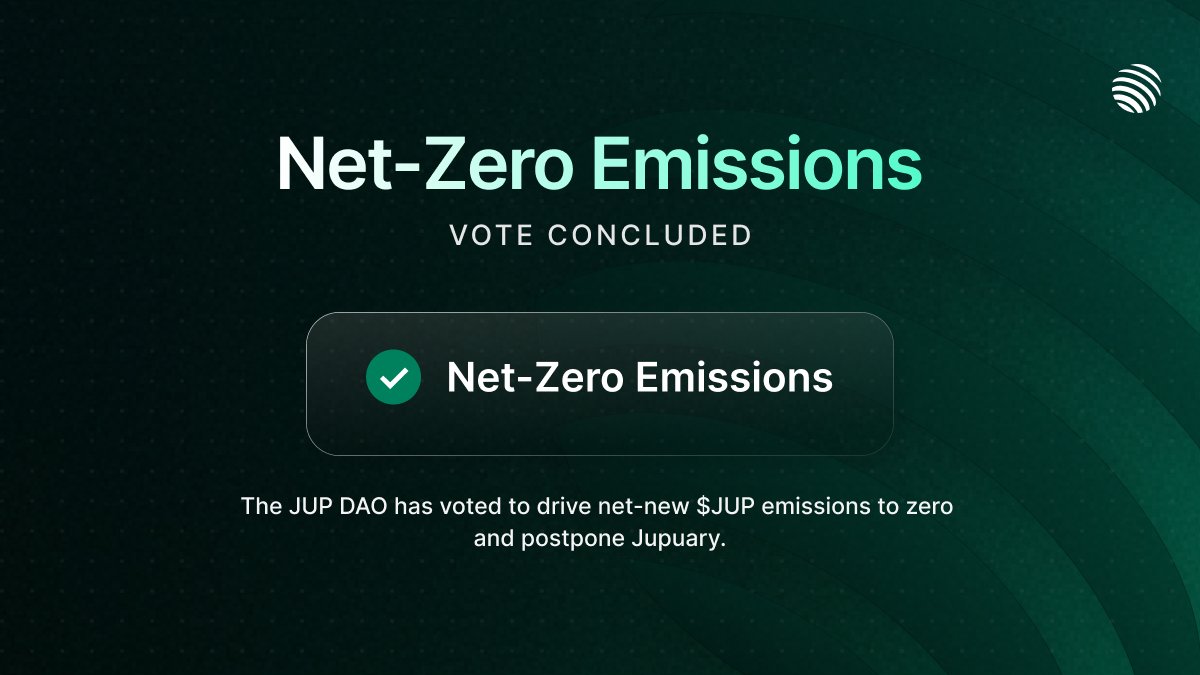
The Net-Zero Emissions Vote has ended with 75.3% in favor of Net Zero Emissions.
Net-new $JUP emissions are now effectively zero for the foreseeable future. Jupuary is postponed indefinitely, your snapshot is preserved and the 700M $JUP returns to the Community Cold Multisig. Team Reserve emissions are paused, and Mercurial vesting will be offset by Jupiter's balance sheet.
Thank you to every voter who took time to discuss the proposal and cast their vote. We move forward as one. There is still much to build, and we intend to build it.
More details on next steps will be shared soon.
Note: Active Staking Rewards for Q1 2026 will not be affected by this vote.
View the vote page here: https://t.co/8YloJlD0IE
"AI becomes the government" is dystopian: it leads to slop when AI is weak, and is doom-maximizing once AI becomes strong. But AI used well can be empowering, and push the frontier of democratic / decentralized modes of governance.
The core problem with democratic / decentralized modes of governance (including DAOs on ethereum) is limits to human attention: there are many thousands of decisions to make, involving many domains of expertise, and most people don't have the time or skill to be experts in even one, let alone all of them. The usual solution, delegation, is disempowering: it leads to a small group of delegates controlling decision-making while their supporters, after they hit the "delegate" button, have no influence at all. So what can we do? We use personal LLMs to solve the attention problem! Here are a few ideas:
## Personal governance agents
If a governance mechanism depends on you to make a large number of decisions, a personal agent can perform all the necessary votes for you, based on preferences that it infers from your personal writing, conversation history, direct statements, etc.
If the agent is (i) unsure how you would vote on an issue, and (ii) convinced the issue is important, then it should ask you directly, and give you all relevant context.
## Public conversation agents
Making good decisions often cannot come from a linear process of taking people's views that are based only on their own information, and averaging them (even quadratically). There is a need for processes that aggregate many people's information, and then give each person (or their LLM) a chance to respond *based on that*.
This includes:
* Inferring and summarizing your own views and converting them into a format that can be shared publicly (and does not expose your private info)
* Summarizing commonalities between people's inputs (expressed as words), similar to the various LLM+https://t.co/Nzord33s0z ideas
## Suggestion markets
If a governance mechanism values "high-quality inputs" of any type (this could be proposals, or it could even be arguments), then you can have a prediction market, where anyone can submit an input, AIs can bet on a token representing that input, and if the mechanism "accepts" the input (either accepting the proposal, or accepting it as a "unit" of conversation that it then passes along to its participant), it pays out $X to the holders of the token.
Note that this is basically the same as https://t.co/nUL0HyTyK2
## Decentralized governance with private information
One of the biggest weaknesses of highly decentralized / democratic governance is that it does not work well when important decisions need to be made with secret information.
Common situations:
(i) the org engaging in adversarial conflicts or negotiations
(ii) internal dispute resolution
(iii) compensation / funding decisions.
Typically, orgs solve this by appointing individuals who have great power to take on those tasks.
But with multi-party computation (currently I've seen this done with TEEs; I would love to see at least the two-party case solved with garbled circuits https://t.co/PIY2LZtbeK so we can get pure-cryptographic security guarantees for it), we could actually take many people's inputs into account to deal with these situations, without compromising privacy. Basically: you submit your personal LLM into a black box, the LLM sees private info, it makes a judgement based on that, and it outputs only that judgement. You don't see the private info, and no one else sees the contents of your personal LLM.
## The importance of privacy
All of these approaches involve each participant making use of much more information about themselves, and potentially submitting much larger-sized inputs. Hence, it becomes all the more important to protect privacy. There are two kinds of privacy that matter:
* Anonymity of the participant: this can be accomplished with ZK. In general, I think all governance tools should come with ZK built in
* Privacy of the contents: this has two parts. First, the personal LLM should do what it can to avoid divulging private info about you that it does not need to divulge. Second, when you have computation that combines multiple LLMs or multiple people's info, you need multi-party techniques to compute it privately. Both are important.
$JUP is the alignment engine between the team, the community, and token holders. When it wins, we all win.
Today we push one of our most important proposals yet, which can bring net-new emissions to effectively zero.
Vote runs through February 22nd.
Have been following reactions to what I said about L2s about 1.5 days ago.
One important thing that I believe is: "make yet another EVM chain and add an optimistic bridge to Ethereum with a 1 week delay" is to infra what forking Compound is to governance - something we've done far too much for far too long, because we got comfortable, and which has sapped our imagination and put us in a dead end.
If you make an EVM chain *without* an optimistic bridge to Ethereum (aka an alt L1), that's even worse. We don't friggin need more copypasta EVM chains, and we definitely don't need even more L1s. L1 is scaling and is going to bring lots of EVM blockspace - not infinite (AIs in particular will need both more blockspace and lower latency than even a greatly scaled L1 can offer), but lots.
Build something that brings something new to the table. I gave a few examples: privacy, app-specific efficiency, ultra-low latency, but my list is surely very incomplete.
A second important thing that I believe is: regarding "connection to Ethereum", vibes need to match substance.
I personally am a fan of many of the things that can be called "app chains". For example I think there's a large chance that the optimal architecture for prediction markets is something like: the market gets issued and resolved on L1, user accounts are on L1, but trading happens on some based rollup or other L2-like system, where the execution reads the L1 to verify signatures and markets. I like architectures where deep connection to L1 is first-class, and not an afterthought ("we're pretty much a separate chain, but oh yeah, we have a bridge, and ok fine let's put 1-2 devs to get it to stage 1 so the l2beat people will put a green checkmark on it so vitalik likes us").
The other extreme of "app chain", eg. the version where you convince some government registry, or social media platform, or gaming thing, to start putting merkle roots of its database, with STARKs that prove every update was authorized and signed and executed according to a pre-committed algorithm, onchain, is also reasonable - this is what makes the most sense to me in terms of "institutional L2s". It's obviously not Ethereum, not credibly neutral and not trustless - the operator can always just choose to say "we're switching to a different version with different rules now". But it would enable verifiable algorithmic transparency, a property that many of us would love to see in government, social media algorithms or wherever else, and it may enable economic activity that would otherwise not be possible.
I think if you're the first thing, it's valid and great to call yourself an Ethereum application - it can't survive without Ethereum even technologically, it maximizes interoperability and composability with other Ethereum applications.
If you're the second thing, then you're not Ethereum, but you are (i) bringing humanity more algorithmic transparency and trust minimization, so you're pursuing a similar vision, and (ii) depending on details probably synergistic with Ethereum. So you should just say those things directly!
Basically:
1. Do something that brings something actually new to the table.
2. Vibes should match substance - the degree of connection to Ethereum in your public image should reflect the degree of connection to Ethereum that your thing has in reality.
TheDAO is back. BULLISH
A decade later, we’re opening a new chapter.
TheDAO Security Fund: activating 75,000+ ETH to strengthen Ethereum security.
https://t.co/VV3cH313TE
Ink Chain, Kraken's blockchain, is now live on OpenSea.
To celebrate the launch, we collaborated with @inkonchain to drop a free commemorative NFT.
Mint link in the next Tweet! 👇
Joining OpenSea’s Flagship Collection…
@goodvibesclub, a community-first character IP that celebrates positivity, collectbility, and high-fidelity art as core cultural values for an onchain world.
Welcome home, 3681.
More below. 👇