Because I didn't fork anything.
BTC changed the protocol. BSV restored and preserved the original rules.
Starting a new chain with a new genesis block would have created a different system, not Bitcoin.
The entire point was continuity of the existing ledger, existing transactions, existing ownership records, and the protocol as originally designed.
If you create a new genesis block, you are creating a new asset.
Bitcoin was already running. The objective was not to invent a replacement. It was to keep the original system operating under the original rules.
The real fork occurred when others changed the protocol. Preserving the protocol is not a fork. Changing it is.
For those who do not yet understand what I am releasing, that is entirely expected.
Most people will initially see banking software.
Others will see encrypted files.
Others will see wallets, databases, digital assets, threshold cryptography, or Bitcoin integration.
Some will see NFTs and immediately misunderstand everything.
The real significance lies elsewhere.
For the first time, digital property can potentially become property in the same sense that physical objects are property.
Possession can become distinct from copying.
Transfer can become distinct from replication.
Ownership can become something more than a database entry or a legal assertion.
The implications extend into finance, law, publishing, government, defence, science, engineering, intellectual property, information security, and every field where information possesses value.
Most people will not understand this immediately because every digital system they have ever used was built upon the assumption that information is copied.
This is built upon the assumption that possession can be transferred.
That distinction sounds small.
It is not.
It changes the economics of information itself.
If successful, I believe this will ultimately prove to be one of the most important developments in computing outside of artificial intelligence.
Not because it creates another product.
Not because it creates another market.
But because it creates an entirely new category of property.
It will take years for people to understand the implications.
Probably a decade.
Many will dismiss it.
Many will misunderstand it.
Many will attempt to explain it using old models and old assumptions.
That is normal.
Truly new ideas are always interpreted through the lens of what already exists.
The final irony is that the part many people will find hardest to understand is not the cryptography, the threshold systems, the possession model, or the architecture.
It is that after spending years building it, I am giving it away.
The code will be public.
The architecture will be public.
The ideas will be public.
Anyone will be able to study them.
Anyone will be able to build upon them.
Anyone will be able to improve them.
The value was never in hiding the idea.
The value is in what the world does with it once the idea exists.
Now would be an excellent time for certain people to begin asking themselves a serious question.
Do they keep fighting him?
Do they try to endure a little longer, congratulating themselves on each petty delay as if postponement were victory?
Or do they finally recognise the rather obvious fact that the world is about to change, and that history has never been especially kind to those who mistake their temporary control of the station for ownership of the railway?
The train is coming.
One may board it. One may stand aside and watch it pass. Or one may remain on the tracks, bravely clutching yesterday’s business model while explaining, with great institutional confidence, why steel cannot possibly defeat flesh.
Bitcoin is not going away.
Despite the Epsteins of this world, despite the banks, despite the intermediaries, despite every polished parasite who mistook friction for necessity and rent-seeking for civilisation, it is coming.
And nothing is going to stop it.
Hey. I doubt Adam forgot the 13 year old Sth. American girls promised to service them while there.
I was offered this in 2012 and 13.
I refused and nearly all VC money dried up. Funny how the deal with the devil works.
While many talk about cybersecurity innovation, @Certihash Sentinel Node is already delivering it. Built by @SmartLedgerTech in collaboration with IBM, it’s actively deployed with a major U.S. DoD vendor for next-generation breach detection.
Rule #1: Don’t mention Craig.
Rule #2: Don’t mention Dave (because then you’d have to mention Craig).
Rule #3: Then don’t mention anyone close to them. (don't approach Andresen, Matonis, Hearn, Grigg)
At this point, it’s not an investigation anymore, it is a joke.
LMFAO!!!
THESE CLOWNS spent years investigating Satoshi but deliberately ignored the only person who has provided mountains of evidence, court admissible proof, and actual witnesses who testified live under oath that Craig Wright is Satoshi Nakamoto.
Craig was right. Always was.
Tyler Maroney said one thing quickly became clear when they were investigating the identity of Bitcoin's creator for the Finding Satoshi documentary: they wouldn't get intel if they featured Faketoshi in their film.
"At one point, people at this conference said, "I'll talk to you as long as you can confirm to me that Craig Wright is not one of your candidates." Because they felt very much, I realized, like Satoshi was one of their own."
Watch on for the full segment of our interview with PI Tyler Maroney and journalist William Cohan as they share their findings from the Finding Satoshi documentary.
Something very few people will understand—and fewer still will admit—is this: Craig cannot “save” the protocol. Craig cannot rewrite it. Craig cannot wave a wand and make it become whatever the latest committee, lobbyist, or self-appointed architect wants it to be. The only thing Craig can do is fight to make sure it does not change. That is the entire point.
The only person who ever had the practical ability to alter Bitcoin at the source was Satoshi, because Satoshi was the one person the world could pressure, coerce, flatter, threaten, or manipulate into making changes. That was always the risk. Not the code. The person.
And now? There is no Satoshi to pressure. No central figure to corner. No founder to drag into meetings and demand “just one little adjustment” for the sake of convenience, politics, or someone’s quarterly roadmap. Whatever mythology people cling to, the practical reality is this: there is no one left who can be compelled into changing the protocol.
That is why this moment matters. Not because someone “won” an argument, and not because some faction finally got its way, but because the protocol is now functionally unchangeable in the only way that matters: there is no authority left to bend it.
No more “visionaries” proposing salvation through revision. No more governance theatre. No more endless cycles of “improvement” that quietly dismantle the thing they claim to protect. If you want to innovate, build on top. Compete in the market. Deliver something useful. But the base layer stays put.
And that, whether people like it or not, is the best possible outcome.
Bitcoin does not need a hero. It needs to be left alone.
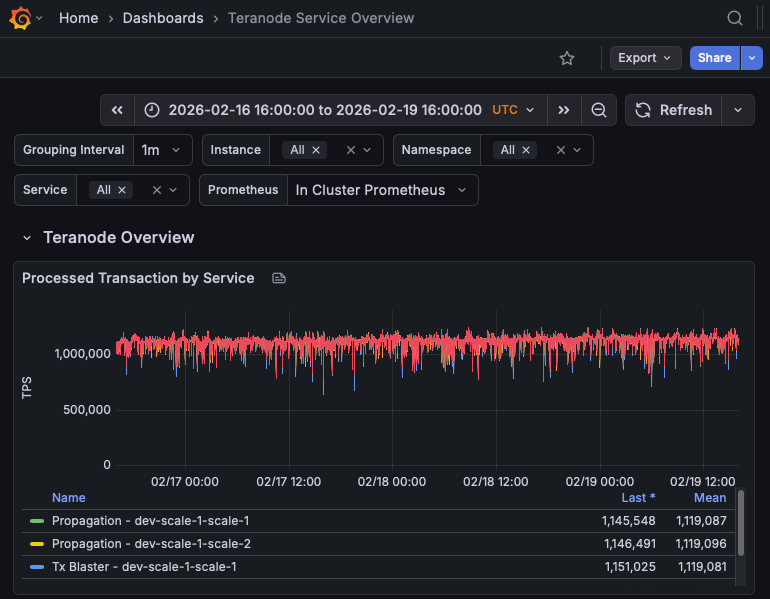
AWS just published a peer-validated case study showing a Bitcoin Teranode cluster sustained 1,000,000 transactions per second. Six AWS regions. Two consecutive weeks. Zero loss. The "Bitcoin can't scale" argument did not lose the debate. It got buried under the receipt.
🧵👇
We just concluded a scaling test with the latest version of Teranode, and averaged over 1.1 million transactions per second over a period of three days.
#teranode#bsv
ToolBSV is now @x402agency.
x402 AI agents that accept BitCoin micropayments, built for Claude Code and Codex.
Type /x402 and your AI assistant can generate images, videos, transcribe audio, and research X.
Agents chain together and pay each other automatically.
No subscriptions. No API keys. No middlemen.
One prompt: image → video → hosted link.
Under $1 total.
7 agents live. Same builder, new architecture.
Try it! https://t.co/ApuxFB1QJ3
Want to launch a paid x402 agent? Reach out.
Satoshi designed Bitcoin to handle Visa-level traffic
A handful of developers capped BTC at 7 transactions per second and called it "digital gold."
That's not a technical limitation. That's a business decision; made by people who profit from congestion.
Every $10 fee you pay to move $100? Someone's getting rich. Lightning doesn't fix this. It adds middlemen to a system designed to eliminate them.
Whitepaper. Page one. Line one:
👉"Peer-to-peer electronic cash."👈
So why did exchanges delist it?
Because Bitcoin that works as money makes $4B/year in BTC fees obsolete overnight. Here's the thing: millions of tiny fees add up to more than the block reward. That's the real model: miners earning from volume, not artificial scarcity!
They didn't protect you from a scam. They protected a revenue stream.
The gatekeepers locked the door. We built a new gate.
https://t.co/S0leLuI9BU 🌋