Assistant Professor @ut_mbs. Interested in disulfides, bacteria (especially Gram-negatives), protein structure-function, AMR, and urban art. All views my own.
What if we could turn off antibiotic resistance instead of constantly chasing new drugs? #WelchGrantee@bondSSbond Despoina AI Mavridou's research at @ut_mbs introduces this exact powerful strategy by targeting the protein-folding machinery bacteria rely on to build resistance in the first place.
The lab has demonstrated that disrupting oxidative protein folding disables key resistance proteins, making even multidrug-resistant bacteria vulnerable to existing antibiotics as well as eliminating entire bacterial communities in polymicrobial infections such as cystic fibrosis. Congratulations to co-1st-authors Nikol Kadeřábková and R Christopher D Furniss and the rest of the authors on this work! https://t.co/5F4Vm20SQM
This has been a long time coming. We targeted disulfides in antibiotic resistant CF pathogens and not only can we sensitize them, but we can also stop them from protecting each other in synthetic communities. Published @eLife#AMR. Read the paper here: https://t.co/QgOPYGlXc7
Our review on disulfide formation is out! Since the discovery the DSB system ~35 years ago, we have made great steps in understanding its role in processes like virulence and #AMR. In loving memory of my supervisor Stuart Ferguson. @nikikaderabkova
Link: https://t.co/evkLJM0EuN
We have some really exciting collections open @npjAMR - check out the link below. Includes, AMR in the food chain, Resistance genomics, AI/machine learning/data science approaches AMR, Pathogen Drug permeability and AMR in water!
A set of weapons bacteria use to fight each other, called microcins, are much more widespread and diverse than previously thought. They might inspire new ways to combat antibiotic resistant bacteria. Learn more in @NatureComms: https://t.co/hmYFVQlQEy
@ut_mbs@CIDatUT
Our overview of the challenging problem of antimicrobial resistance and how we can combat is finally out, after gestating for many years....
@IMBatUQ@COADD_news
https://t.co/oCti8weMca
It was such fun hanging out with Mark @markowenmartin during his visit with @UTAustinASM. Thank you for having me and for all the chats and laughs! We talked about #AMR and how we should work harder to combat it. @ut_mbs@TexasScience
https://t.co/McH7CinjYK
Thursday! So #MattersMicrobial Episode 93: Dr. Despoina Mavridou did a live podcast with me at UT-Austin. Hijinks and discussion of AMR and how protein folding can help against this growing threat. @profvrr@ASMicrobiology@univpugetsound
https://t.co/eSEIEtwW9O
In a newly transformed experiential-learning bio course, students take soil samples & isolate their own bacteria to search for new antibiotic candidates. Learn more & meet the team behind it: https://t.co/cBxb0rtxtc
#ExperientialLearning#STEMEducation#TexasScience#UTAustin
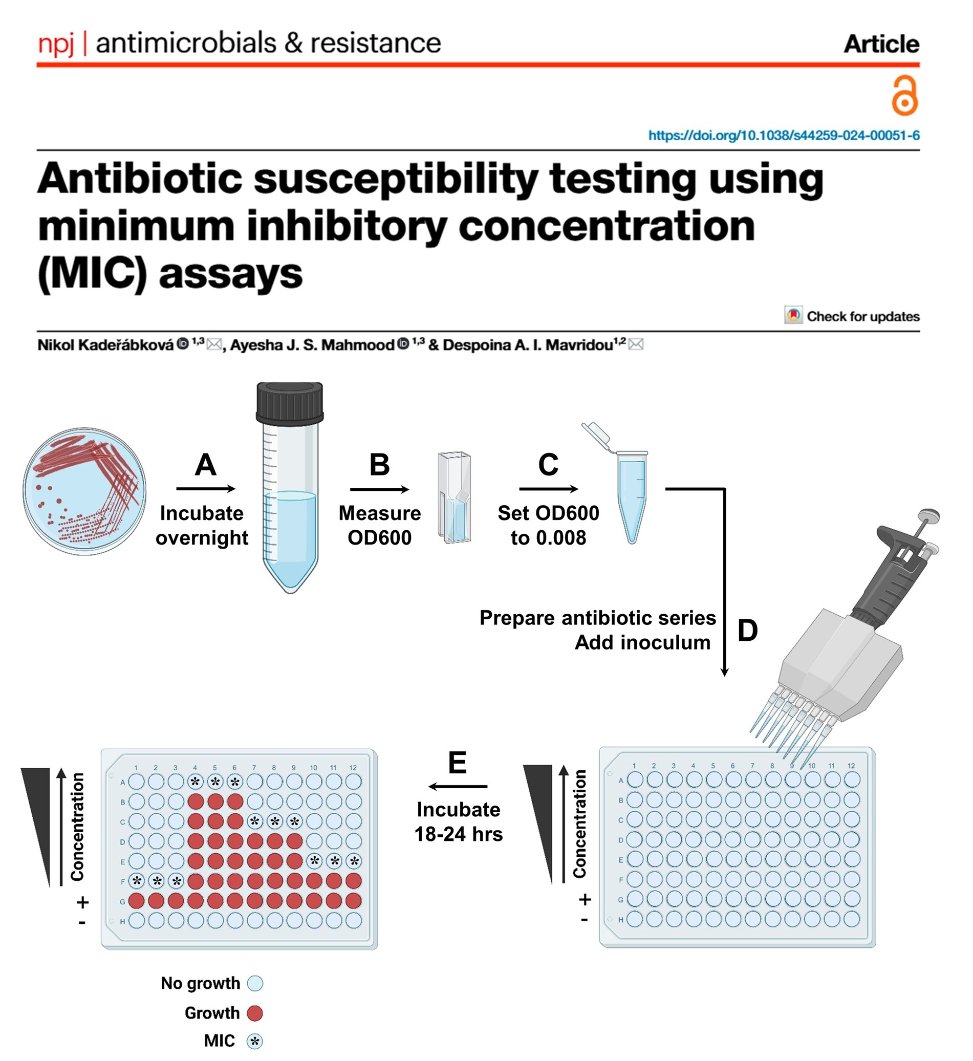
@Nana_Gaeta@nikikaderabkova@AyeshaMahmood2@npjAMR Thanks for the question. You can inoculate a single colony per well. However, that does not ensure reproducibility, which is the goal with MICs done in academic labs. I think that in the absence of a spectrophotometer, I would standardize the inoculum based on CFU determination.
You want to run antibiotic MICs according to best-practice clinical microbiology protocols, but you are not sure how? Our article will walk you through it all! Great to work with @nikikaderabkova@AyeshaMahmood2 and a pleasure to publish in @npjAMR. https://t.co/pvp6svqiRl #AMR