Professor, @WSUPullman | Ph.D. @uw_sjmc | Research Fellow, 2018-19 @univienna | Visiting Scholar, 2024 @uc_chile I EIC @IJPOR_Journal I
RT not endorsements.
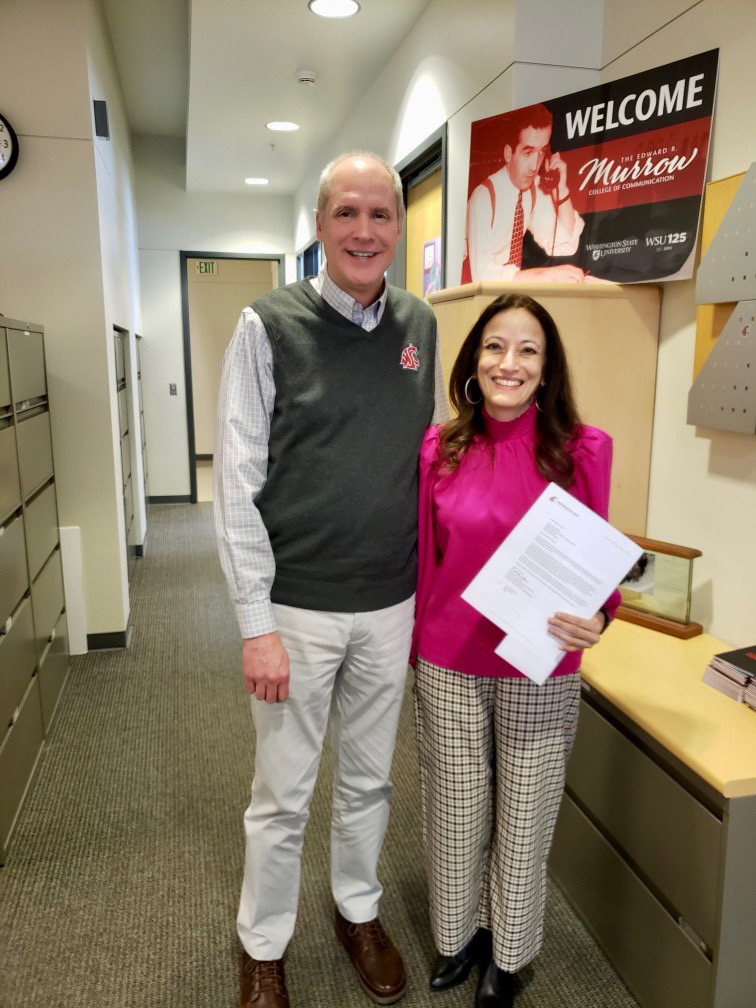
The official letter was delivered by our wonderful Dean @Bruce_Pinkleton! Happy to be promoted to Full Professor on my tenth year at @WSUPullman. I'm also incredibly grateful to be named the Les Smith Distinguished Professor. Thank you to all who have been part of this journey.
"News Surveillance and Democracy: The Effect of News Negativity and Political Trust on Intentional News Avoidance" by Manuel Goyanes and Márton Bene explores how negativity and political trust drive news avoidance. https://t.co/4WxUwR1nWW
🚨 New research alert! 🚨 Melike Saraç & Brady West explore how showcards in face-to-face surveys improve data quality by reducing item-missing responses and middle-point selection. Evidence from the European Social Survey 👉 https://t.co/97q58BTk0e
📢 New Article Alert! How does income inequality shape public demand for redistribution in Europe?@SchmidtCatran; @velev_valentin 🌍 Read more: https://t.co/OPIB5ACWDl
📱🗳️ New Study! "Political Meme Use Can Lead to Political Intolerance: Evidence from a Panel Study" @maxud_balti presents evidence from Hong Kong, showing how political memes drive intolerance, with political interest moderating this effect. https://t.co/oteXBXWugy
🌍⚔️ New Research! "Anxious But Hesitant to Act: The Impact of Concurrent Priming of the Climate Crisis and the War in Ukraine on Public Support"@JakobDreyer examines how priming the climate crisis and the war in Ukraine together affects public opinion. https://t.co/9yUnP4x92v
🧐 New Research! "Sense or Sensibility? Netizens’ Choice of Social Media Comments in an Authoritarian Regime" from Stan Hok-Wui Wong and Jiachen Liang shows that Chinese netizens favor emotional comments that challenge official narratives. Discover more: https://t.co/sXNyxqfh2X
🌎 New Study "The Roles of Media Platforms, Political Orientation, and Climate Change Belief in Pro-Environmental Behaviors" from Seo Yoon Lee and others compares how media exposure shapes climate change beliefs and actions in the U.S. and South Korea: https://t.co/YvRMiiZSiD
🚨"The Blame Game: The Role of Media Environments and Political Discussion in Americans’ Attribution of Blame for Interparty Hostility". Find out in this new paper from Brianna Zichettella, Brian E. Weeks and Ariel Hasell: https://t.co/MJNzHLMEkq.
🚨🚨 Exciting news! Research by @DrBoulianne on perceptions and concerns regarding misinformation on Facebook is now available. Check it out here: https://t.co/fkgU6rs1gN.
New study "Voters Share Polls That Say What They Want to Hear: Experimental Evidence From Spain and the USA" by @aleferna_ and @m_barnfield. Read it today https://t.co/LjmV6dVjhy.
New study "The Relationship Between Political Entertainment Media Use and Political Efficacy: A Comparative Study in 18 Countries" by Christian Schemer and others. Read it today https://t.co/35xQIsQ02G.
Curious about how mis/disinformation spread, the social impact, why people believe, and strategies to combat? Join us Sep26 when @borah shares "Misinformation and Disinformation: What do we know and what can we do?" https://t.co/eHynax97jq
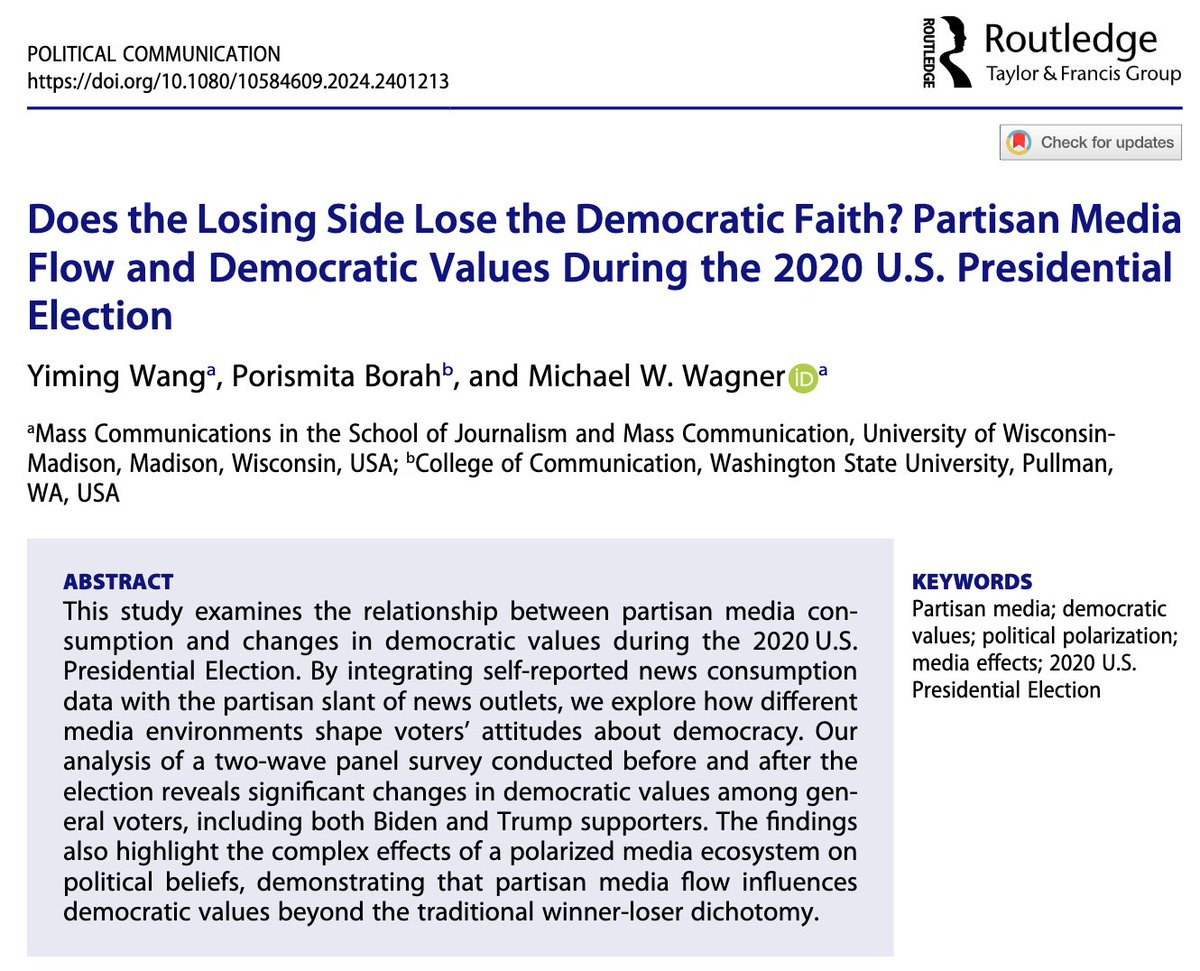
Fascinating study on the relationship between self-reported media exposure, democratic values, and electoral loss by @YimingWang_@borah@prowag in @polcommjournal https://t.co/X3Aaw5xWnh
New study "The Geopolitics of Disinformation: Worldviews, Media Consumption and the Adoption of Global Strategic Disinformation Narratives" by @DMadrid_M. Read it today https://t.co/FbSjLnapBA.
New article from Wei Ran and others on inter-society differences in public responses to their government’s anti-pandemic policies of zero-COVID strategy in Beijing, Taipei, and Singapore. Read it today. https://t.co/rkGAT6qwXA
New article from Jennifer Brundidge & Kelly Garrett on the influence of exposure to incivility on social media and online news use on a particularly emotional form of division, affective polarization. Read it today. https://t.co/pF7ADM428a
New article from @ElieMichel3 on panel data in 11 countries, we explore individual and contextual drivers of support for border closure in times of Covid-19. Read it today. https://t.co/dkaJAvWX2W
In our new book chapter with @bsirom and @_EylulYel, we explore news frames in Bangladesh, Malaysia, and Pakistan, highlighting how media representations shape public discourse and policy. Check it out! #Rohingya#RefugeeCrisis#MediaFrames https://t.co/8QZForLxP9