Welcome home Reid, Victor, Christina, and Jeremy! 🫶
The Artemis II astronauts have splashed down at 8:07pm ET (0007 UTC April 11), bringing their historic 10-day mission around the Moon to an end.
I mostly avoid commenting on what President Trump says from day to day, while pulling no punches in my assessments, whether positive or negative, of his policy. His Iran ultimatums feel different. Making such threats is a policy. If he were to follow through on them, the consequences would be immediate, irreversible, and catastrophic on a world-historical scale.
So while some will inevitably insist he should be “taken seriously rather than literally,” or that he is executing a sophisticated “madman” strategy in a complex game of 5-D chess, or that he needs everyone’s steadfast support to maximize his leverage, now rather than later seems the time to say that the actions that he is proposing would be a disaster for our country, both strategically and morally, which makes the remarks themselves a terrible mistake.
Simply put, what’s the point of all this? If these are empty threats that we all know he will not carry out, then they are ineffective threats (the Iranians are on X too!), merely making the president and our nation look foolish. If they are not empty threats, then the president is asserting the American position that such actions are acceptable in this situation and ones we are willing to take. We are not living in some quantum thought experiment where he simultaneously is and is not serious. We cannot expect the Iranians, but only the Iranians, will believe him.
Whether the threats are empty or not, we should be willing to say: This is wrong. We should not establish a pattern of threatening escalation from a blockaded strait to elimination of a civilization. We should not launch strikes intended to devastate the lives of millions of people and take our nation to total war without indisputable justification, or before the American people have deliberated upon and assented to the path with full understanding of what total war might mean for them. Those principles are vital to our Republic, independent of whether the strategy could “work.”
But it’s also worth emphasizing that the strategy is a dead end. This war is actively weakening American power, increasing the danger to American citizens, and frustrating the president’s important efforts at addressing our many domestic challenges. It has closed a strait that was previously open, strengthened the incentive for other nations to pursue nuclear weapons, and in this most recent rhetoric made more plausible their use. Our choices for continuing the war appear to be catastrophic escalation of the air war or extensive deployment of ground troops, neither of which were planned or had support at the outset.
Stepping back from these threats and admitting such actions do not offer a path to resolving the conflict may be unpalatable, but it is by far the least unpalatable option available. Let us all hope cooler heads prevail.
🚨 FLASHBACK
11 years ago, then Senator Marco Rubio stood on principle and voted AGAINST the disastrous Obama-Iran Nuclear Deal.
He warned it would fund terror, empower the mullahs, and put America at risk.
History proved him RIGHT.
Watch this.
America is blessed with leaders who have foresight like this 🇺🇸
Believe it.
For the Republic!
Thank you @marcorubio
I Love and Endorse the Bipartisan 3 % of GDP Budget Deficit Solution
In the House of Representatives there is now a bipartisan bill in the works to enact, and a growing agreement that we need, a 3% cap on the budget deficit. The bill was introduced by Representatives Bill Huizenga (R) and Scott Peters (D) to reduce and maintain the federal budget deficit at or below 3% of GDP. While most responsible members of both parties don't agree on much, they agree on this, which is also urged by the Committee for a Responsible Federal Budget and almost all knowledgeable investors, economists, and business leaders beyond them.
Treasury Secretary @SecScottBessent has long been a supporter of this path, publicly saying, “I would urge [President Trump] to make public his desire to get the deficit down to 3% by the end of his term.” In my book How Countries Go Broke: The Big Cycle, I described the mechanics of how the United States will go broke unless it gets the budget deficit down to 3% of GDP, which I describe as my "3% 3-Part Solution." All leaders from both parties I spoke with in private agree. The only impediment is their fear of the political consequences of being in favor of raising taxes and cutting benefits if that is required to reach the 3% GDP budget deficit. Passing this bill would be a step toward overcoming that objection as it would help legislators argue for fiscal responsibility. A stated 3% GDP ceiling goal would become a benchmark for accountability across administrations, providing both a rule and a report card. With it in mind, each year we would naturally ask, “Is the nation moving toward or away from sustainability?” That stated goal and progress toward fiscal responsibility would strengthens markets, bolster investor confidence, and reduce the risks of the U.S. experiencing a sovereign debt/currency crisis.
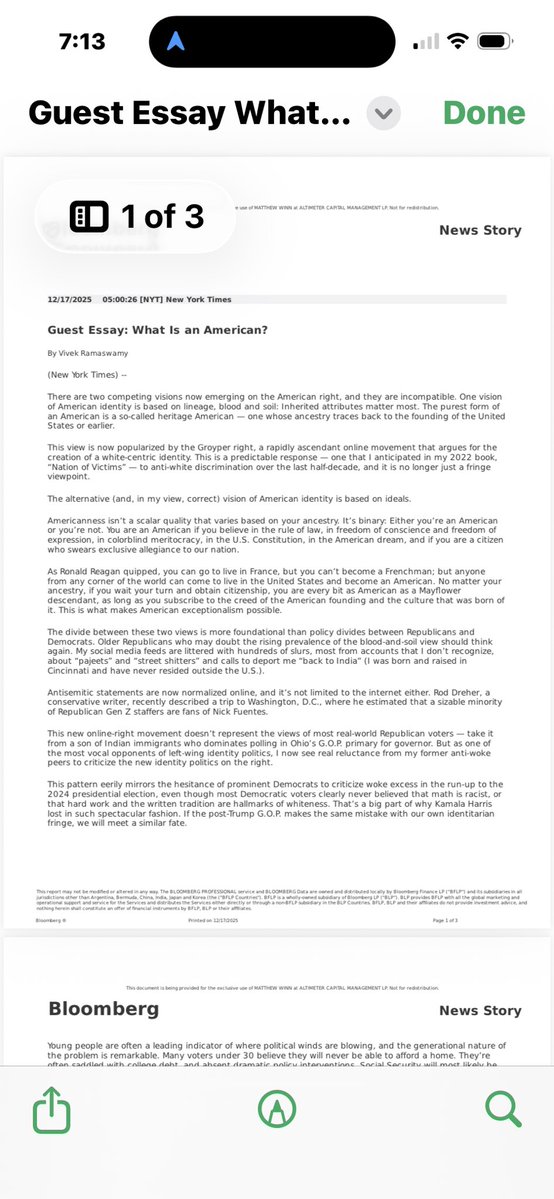
Important NYT op-ed by @VivekGRamaswamy who understands that a 401k from birth - where every citizen directly owns shares in our most valuable companies - reduces govt dependency, defends capitalism & unites those who feel left out around a more prosperous vision for America. 🇺🇸
Today’s historic announcement by @RayDalio to sponsor the children of Connecticut is a generational investment in opportunity.
The momentum for the fifty state challenge by @USTreasury is incredible and continues to build! 🚀🇺🇸