Who controls the media? Updated list.
Meta owns:
Facebook
Instagram
WhatsApp
Messenger
Threads
Oculus
Meta AI
Meta is controlled by Mark Zuckerberg who is jewish
Alphabet owns:
Google
YouTube
Android
Gmail
Chrome
Pixel phones
Nest smart home devices
Fitbit
DeepMind
Gemini AI
Waymo self-driving cars
Verily
Calico
Wing drone delivery
Alphabet is controlled by Larry Page and Sergey Brin who are both jewish
Tic Tok
U.S. algorithm and infrastructure is controlled by Oracle
Oracle is controlled by Larry Ellison who is jewish
-Hookup Apps
Match Group owns:
Tinder
Hinge
OkCupid
Match. com
Plenty of Fish
Meetic
The League
BLK
Archer
OurTime
Was founded by Barry Diller who is jewish
Grindr
Was founded by Joel Simkhai who is jewish
Bumble
Was founded by Whitney Wolfe Herd who is jewish
-Porn
Onlyfans
Owned by Leonid Radvinsky who is jewish
Vixen Media Group owns:
Blacked
Blacked Raw
Vixen
Tushy
Deeper
Founded by Greg Lansky who is jewish
Aylo/MindGeek Owns/owned:
Pornhub
YouPorn
RedTube
Brazzers
Reality Kings
Digital Playground
Men. com
Sean Cody
Tube8
Solomon Friedman is the owner of Aylo and he’s jewish
Gamma Entertainment owns/operates:
Adult Time
Pure Taboo
Wicked
many other affiliate studios/platforms
Founded by Karl Bernard who is jewish
-Movies/TV/News
Warner Brothers Discovery owns:
Warner Bros. Pictures
HBO
CNN
DC Studios
Cartoon Network
Discovery Channel
TNT
TBS
Max (formerly HBO Max)
Adult Swim
HGTV
Food Network
Animal Planet
Warner Brothers is run by David Zaslav who is jewish
Disney owns:
ESPN
ABC
Marvel Studios
Lucasfilm
Pixar
20th Century Studios
Disney+
Hulu (major controlling stake)
National Geographic
Disney is run by Bob Iger who is jewish
Paramount Global owns:
CBS
CBS News
CBS Sports
Local CBS stations
Film Studios
Paramount Pictures
Paramount Animation
Cable Networks
MTV
Nickelodeon
Comedy Central
BET
VH1
CMT
TV Land
Smithsonian Channel
Logo TV
Pop TV
Streaming/Premium:
Paramount+
Showtime
Pluto TV
Major franchises/IP:
Top Gun
Mission: Impossible
Star Trek
South Park (licensing/streaming)
SpongeBob SquarePants
Transformers
Teenage Mutant Ninja Turtles
Paramount Global is controlled by Sheri Redstone, who is jewish
Comcast owns:
NBCUniversal
NBC
Universal Pictures
Peacock
MSNBC
CNBC
Telemundo
Sky (Europe)
DreamWorks Animation
Xfinity
Comcast is controlled by Roberts family who is Jewish
Amazon owns:
Amazon Prime
MGM Studios
Twitch
Audible
IMDb
Amazon Music
Ring
Blink
Amazon Echo
Alexa
Kindle
Amazon is run by Andy Jassy who is jewish
-AI/Data Centers
OpenAI/ChatGPT
Run by Sam Altman who is jewish
Palentir provides advanced data integration, surveillance, AI, and analytics infrastructure used by military, intelligence, law enforcement, and major corporations. Its platforms help organizations combine massive amounts of fragmented data into real-time operational intelligence for warfare, policing, logistics, cybersecurity, manufacturing, and decision-making, making it one of the most strategically influential data and defense technology companies in the world.
Was founded by Alex Karp, Peter Thiel, Stephen Cohen and Joe Lonsdale, 3 of the 4 are jewish and the other gives speeches on the Antichrist. Operated by Alex Karp who is jewish.
Oracle owns:
Oracle Database
Java
MySQL
NetSuite
Cerner
Sun Microsystems technologies
It’s important because it owns core infrastructure software that powers governments, banks, hospitals, corporations, and large parts of the internet. Its control of technologies like Oracle Database, Java, MySQL, and Cerner gives it enormous influence over the backend systems modern society depends on.
Owned by Larry Ellison who is jewish
Only ~5% of SpaceX stock is floating right now
~95% $SPCX is still locked
Most don’t realize bearish pressure often comes later, when insiders finally get liquidity
Unlock schedule below ⬇️
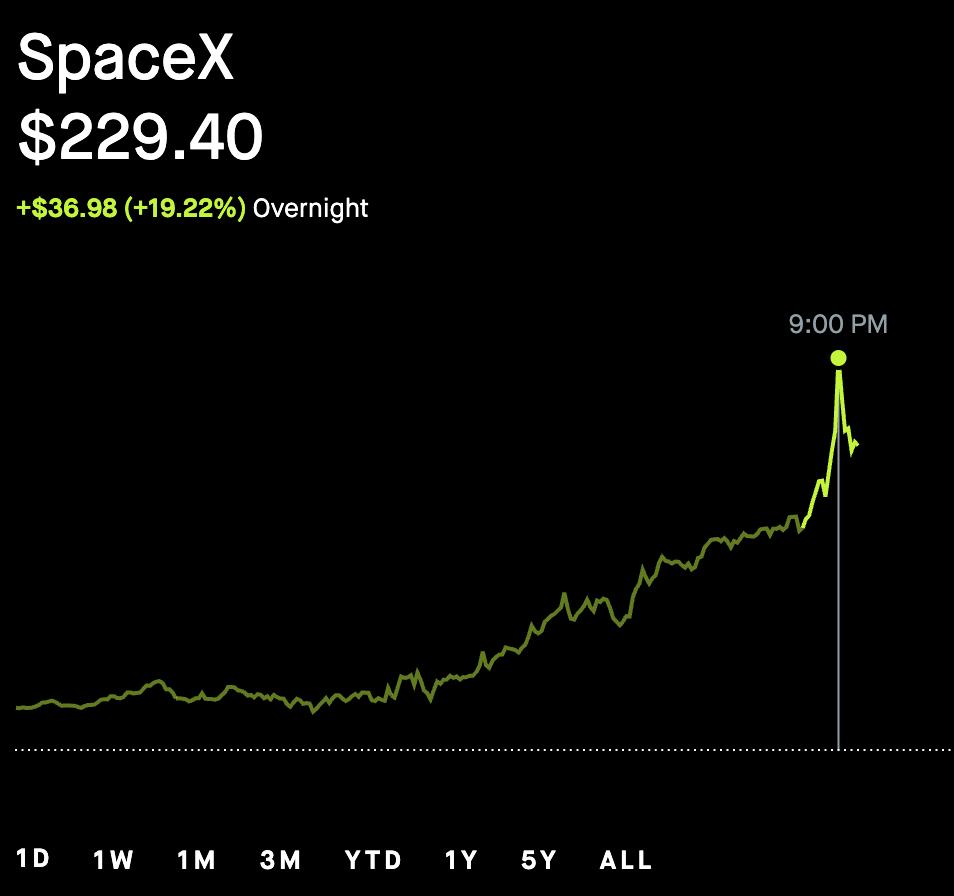
$SPCX surged to $229.40 on Robinhood, pushing its market cap to over $3 trillion during overnight trading, surpassing both Amazon and Microsoft.
SpaceX is currently trading at $213.59 after hours, up +11% from its closing price.
$SPCX is up +58.2% from its IPO price of $135.
The single biggest threat to Nvidia, Amazon and Azure right now is a rocket company: SPACEX
SpaceX generated $18.67 billion in revenue in 2025. At $184 per share today, it is valued at $2.41 Trillion, 129 times trailing revenue.
Nvidia trades at 22 times.
Amazon at 4 times. The valuation only makes sense when you understand what SpaceX is actually building.
SpaceX declared a total addressable market of $28.5 trillion in its IPO filing, equal to the entire annual GDP of the United States.
$26.5 trillion of that is AI alone. At just 1% capture of its own stated market, SpaceX generates $285 billion in annual revenue.
Starlink is the proven starting point.
The constellation has crossed 10,000 satellites, holds 60%+ of the LEO broadband market, and has 10 million monthly active users on Direct-to-Cell. Goldman Sachs projects Starlink reaches $144 billion in revenue by 2030.
At a standard 10x revenue multiple for subscription infrastructure, Starlink as a standalone business is worth $1.4 trillion, more than SpaceX's entire market cap today, before counting anything else.
The bigger bet is orbital AI infrastructure and this is where SpaceX directly threatens Nvidia, AWS, and Azure simultaneously.
AI data centers have a problem that is getting worse. A 1-gigawatt facility now draws more electricity than some mid sized nations. Local governments are rejecting new projects because of grid strain and water use.
AWS and Azure pay $0.05 or more per kilowatt-hour for electricity. That cost is rising as AI demand grows. SpaceX's answer is to move the compute off the grid entirely.
In orbit, solar panels generate more than 5 times the energy of an identical array on Earth because there is no atmosphere blocking sunlight. Capacity factor exceeds 95% versus 24% for terrestrial solar.
No cooling is required, the vacuum of space handles it passively. No land, No grid, No permits, No energy shortages.
An independently verified 10-year cost model for a 40-megawatt cluster: $8.2 million in orbit versus $167 million on the ground.
Effective energy cost in orbit: $0.001 to $0.005 per kilowatt hour, 10 to 50 times cheaper than what AWS and Azure pay today.
SpaceX unveiled the AI1 satellite a few days ago, its first orbital data center prototype with 150-kilowatt peak compute, a 70-meter wingspan, and Nvidia GPUs confirmed by the CFO.
The company has filed with the FCC to deploy up to 1 million AI satellites. Goldman Sachs projects this division alone generates $322 billion in revenue by 2030, a 100-fold increase from $3.2 billion today.
Nvidia generated $115 billion in data center revenue last year at 50 to 80% gross margins. AWS and Azure each generate approximately $120 billion in annualized cloud revenue.
All three are energy buyers locked into grid infrastructure. SpaceX's orbital compute becomes an energy generator with near-zero marginal operating cost. That is not a competitive advantage, it is a different physics regime.
SpaceX is also moving to eliminate Nvidia's chip pricing entirely.
Terafab is a joint semiconductor fabrication venture between SpaceX, Tesla, xAI, and Intel near Austin, Texas.
Total investment: $119 billion.
Target output: 1 terawatt per year of AI compute capacity.
Intel brings its 14A process node, one of only three sub-5nm processes in commercial production globally. The facility will produce D3 chips, radiation hardened and optimized for orbital data centers, alongside AI chips for terrestrial use.
Every dollar Terafab saves on chip costs is a dollar Nvidia loses.
The xAI merger on February 2, 2026 completed the vertical integration. At a combined valuation of $1.25 trillion, SpaceX now owns the AI models (Grok), the training infrastructure (Colossus 1 in Memphis), the orbital deployment system (Starship), the connectivity layer (Starlink), and the chip manufacturing (Terafab).
Anthropic is already paying SpaceX to rent unused Colossus 1 compute, a competitor writing checks to SpaceX for access to its own infrastructure. This is the exact model Amazon used when it built AWS from its own retail logistics and then sold access to the world.
The entire orbital data center thesis depends on Starship. At current launch prices of $900 per kilogram, a 1-gigawatt orbital data center costs $42 billion, three times the ground-based equivalent. At $200 per kilogram, the math inverts completely.
SpaceX has completed two consecutive Super Heavy booster catches. Full ship-side reusability has not yet been demonstrated. Goldman's $474 billion 2030 revenue projection requires growing from $18.7 billion at a rate faster than any company at this scale has ever managed.
SpaceX itself acknowledged in its IPO filing that orbital AI infrastructure "relies on unproven technologies and may not become commercially viable."
But if even half of this works, $2.35 trillion looks cheap before 2030.