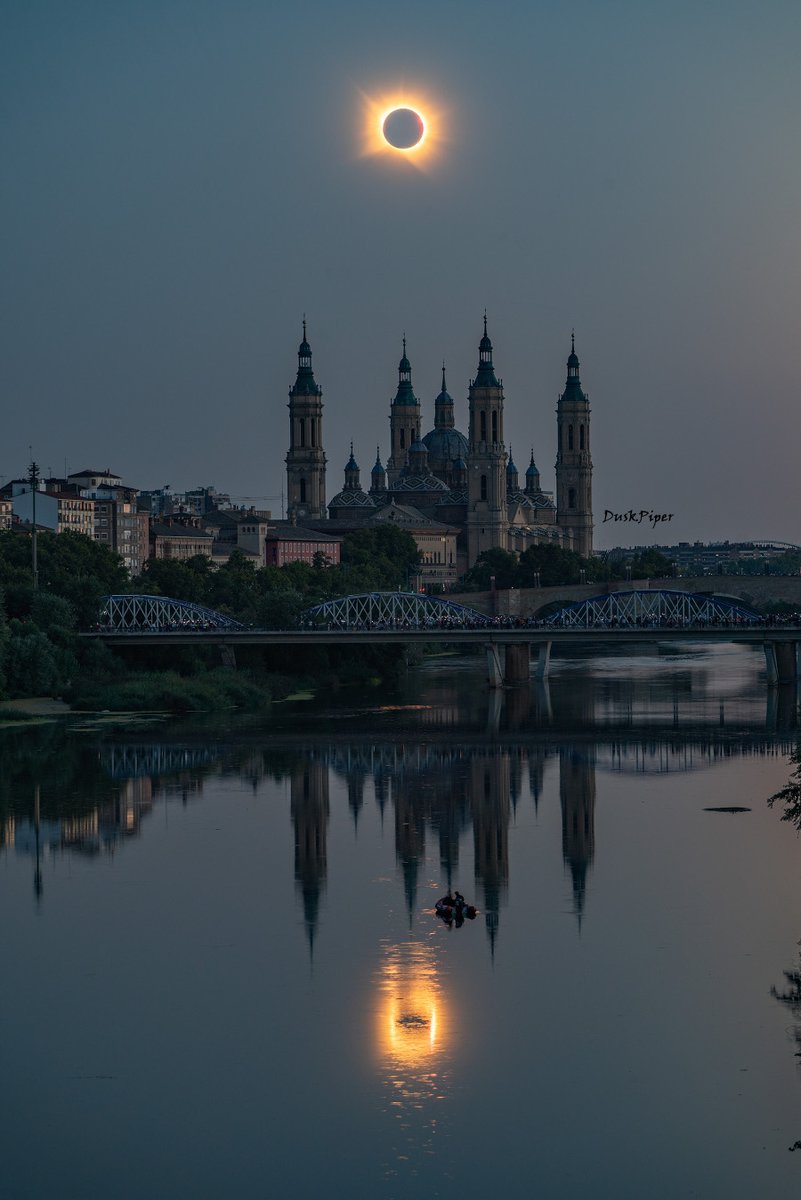
On August 12th, 2026, the Moon totally eclipsed the Sun and cast its shadow across Siberia, Greenland, Iceland, Spain, and Portugal. Today’s image features two total solar eclipses viewed from Zaragoza, Spain, one over the Cathedral-Basilica of Our Lady of the Pillar and the other reflecting in the Ebro River. For a few moments, Spain saw its first major total solar eclipse since 1905. Those witnessing totality may experience a chill in the air, the quieting of birds, the confused chirps of insects, and the shared awe of many. It’s the corona’s time to shine as the Sun’s bright disk is blocked by the Moon. Among other reasons to study eclipses, they help scientists understand why the corona is millions of degrees hotter than the Sun’s surface. Enthusiastic citizens can contribute to these studies by recording how wildlife responds, imaging the corona, and monitoring air temperature and clouds.
Image Credit & Copyright: Ruiyu Zhang Text: Keighley Rockcliffe (NASA GSFC, UMBC CSST, CRESST II)
BREAKING: The largest 3D map of the Universe is now complete 🌌
Last night @desisurvey, mounted on the Nicholas U/ Mayall 4 meter telescope at @KittPeakNatObs, finished its 5-year survey of the cosmos, mapping 47M+ galaxies and quasars.
🔗 https://t.co/sezuv9cnSL
New paper day! https://t.co/DVDRCYHIey In this work we ask: what mass dark matter structure (halos) can we confirm exist within CDM using strong gravitational lensing?
Answer: We get a strong constraint with the current sample: M_limit<10^8.3 M_sun.
The eclipse from Orion.
On April 6, external cameras attached to the Orion spacecraft's solar array wings captured the Moon backlit by the Sun during a solar eclipse.
Liftoff.
The Artemis II mission launched from @NASAKennedy at 6:35pm ET (2235 UTC), propelling four astronauts on a journey around the Moon.
Artemis II will pave the way for future Moon landings, as well as the next giant leap — astronauts on Mars.
Remember asteroid 2024 YR4? The one we thought might hit Earth in 2032, and later the Moon? New data from the JWST shows it will hit NEITHER!
The JWST's infrared eyes are really good for this kind of thing because the asteroid is small and far away, so it's really dim. So the JWST was able to take more precise measurements, and with that, any impact risk has been ruled out. Not just for Earth, but for the Moon as well.
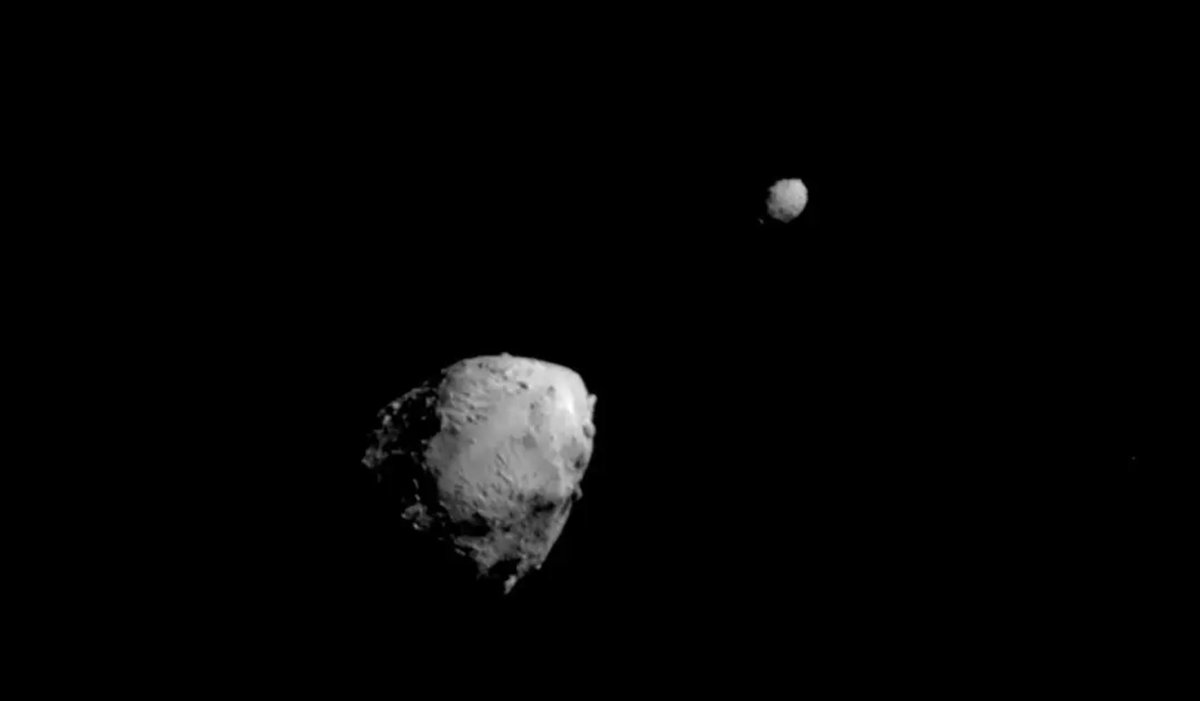
But here's the really interesting part to me: even if an asteroid were on a collision course with Earth, we already have tech that can change an asteroid's trajectory. In 2022, NASA's DART mission (or Double Asteroid Redirection Test) intentionally slammed a spacecraft into the asteroid moonlet Dimorphos, which orbits the larger asteroid Didymos. And yes, we know the impact shifted Dimorphos orbit around Didymos. But new data shows that it actually shifted the entire binary asteroid system's orbit around the Sun!
The change was tiny, but that's really all you need: given enough time and distance, even a small shift can change an asteroid's trajectory. We've proven we can MOVE CELESTIAL OBJECTS. This is WILD for planetary defense!!
Paper Day! https://t.co/v0VMSLkRef; “How invisible stellar halos bias our understanding of ultra-faint galaxies”
In Wheeler+2019, we speculated that observed UFDs might be the bright central cores of more extended objects, and may have invisible stellar halos. (1/5)
This is horrifying and will shorten trans lives.
At the same time, we know that trans people have survived attack and erasure many times over, providing each other with love, care, and basic needs. We won't stop or be stopped.
https://t.co/z3pmEs8kVT
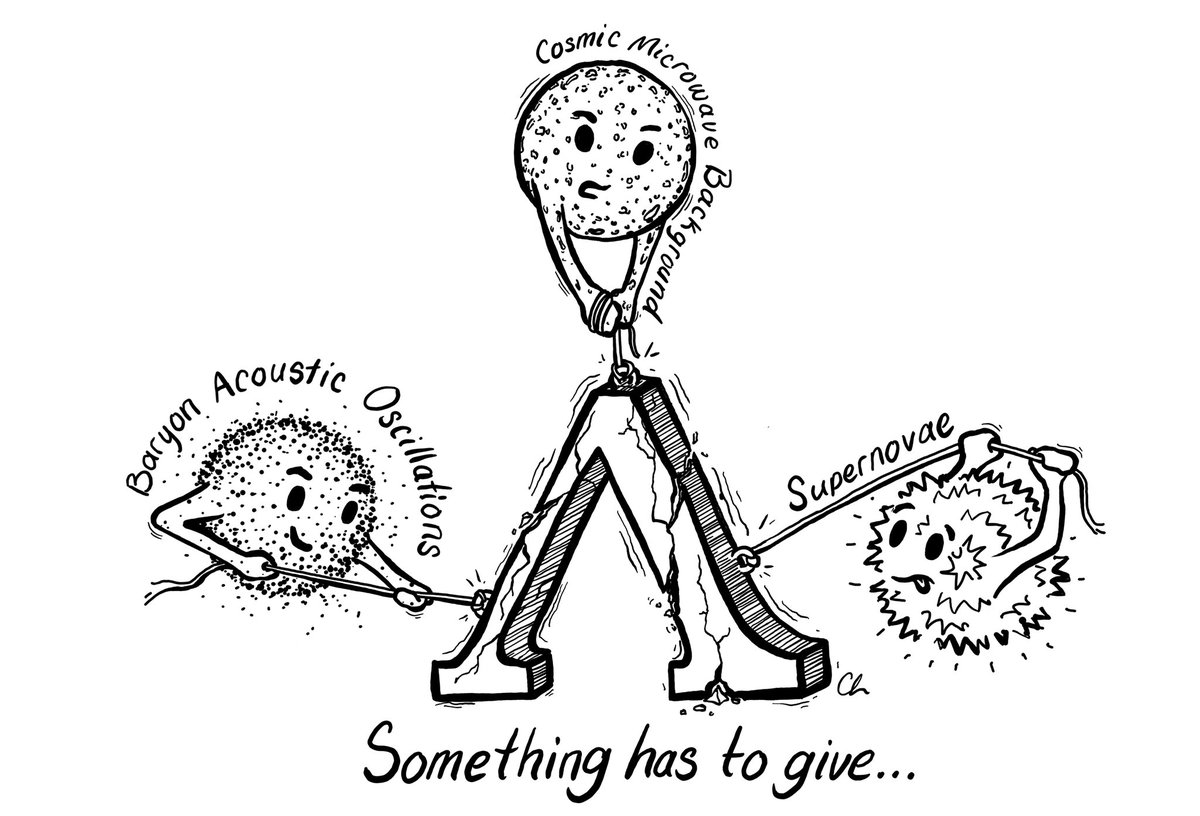
Science means changing your mind. Last week, I wrote that the "S8 tension" (the apparent difference in the amount of clustering seen at early times vs. late times as predicted by the fiducial model) was exciting. Today this from the KiloDegreeSurvey (KiDS)
Papers about DESI DR2 and BAO constraints: https://t.co/mXwnOhkBdk
A guide to all March 19 DESI papers: https://t.co/293QwQO7Ji
A stunning updated flight through DESI galaxies: https://t.co/HmxGB9IAZE
Nice blurbs from @UCIrvine's own Kev Abazajian on “chaos cosmology” in the context of latest big results from DESI.
Context: hints for fluctuating dark energy w Keeley & Kaplinghat: https://t.co/1kfx1blKw5
https://t.co/06CQp5AKHp
🌊 Today in @Nature: Is the AMOC on the brink of collapse?
Unlikely before 2100—but the risks are real 🚨
We find Southern Ocean winds keep this vital ocean “heat engine” running, even under extreme #climatechange. But the Pacific holds a surprise…
Let’s explore 🧵👇
The chance of asteroid 2024 YR4 hitting out planet in 2032 is now 1.5%, or 1 in 67.
The OVERWHELMING likelihood is that the asteroid will miss Earth.
But for the first time ever, we might have to seriously consider a deflection mission soon.
Let me explain. 🧵 (1/x)
For 14 billion years, our Universe has been expanding.
For 5 billion years, its expansion has been accelerating.
But now... is our Universe slowing down again?
Make your own mind up on Episode 12 of The Open Universe Podcast!
https://t.co/8Omfgb0XxY