The article Brexit and the Iraq War on BBC Question Time: Demographic and Political Issue Representation in UK Public Participation Broadcasting (The International Journal of Press/Politics, November 2024) revealed a new original dataset on the background of #bbcqt panellists.
'The true class divide in British politics is not which party people choose, but whether they vote at all'
A recent article by @olhe and me on the problem of growing working class abstention.
Read here: https://t.co/j9sjgr7Lle
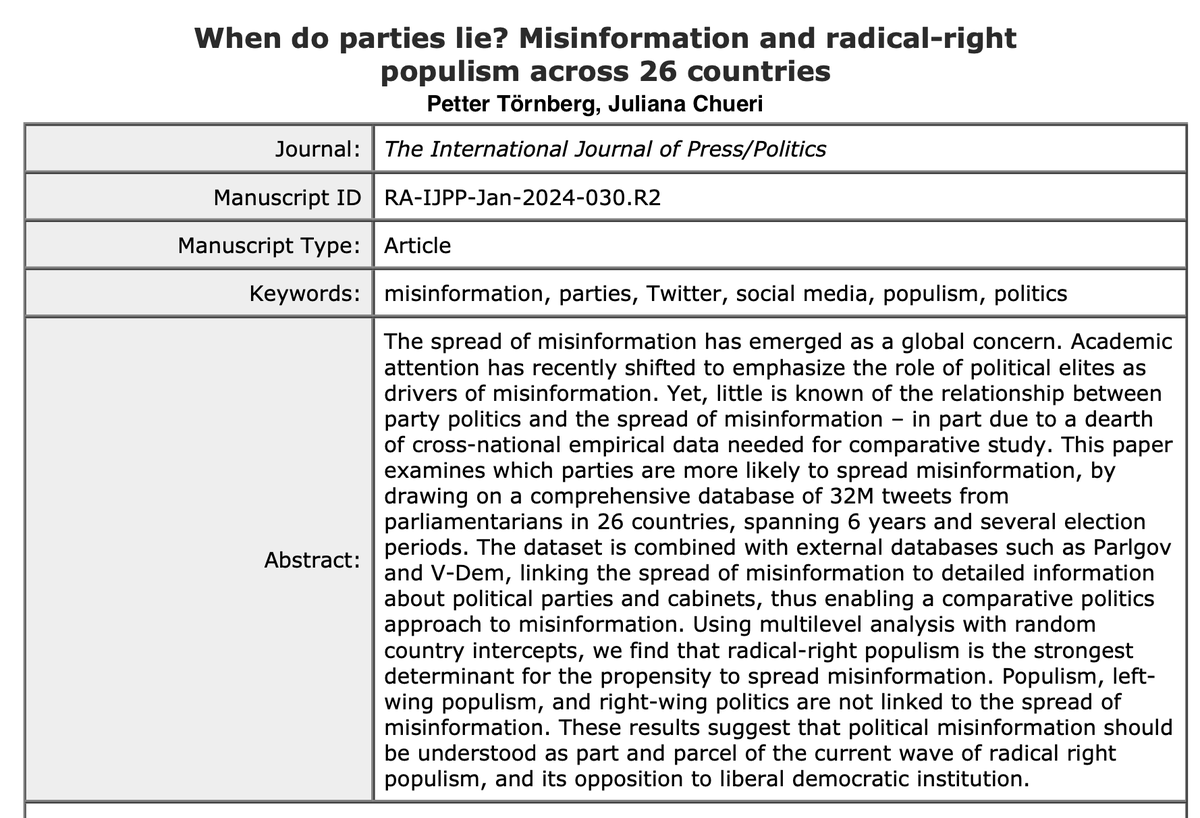
Misinformation isn't random - it's strategic.
We carry out the first cross-national comparative study, examining 32M tweets from politicians.
We find that misinformation is not so much a general condition: it is driven by populist radical right parties.
with @julianachueri
New publication w/ Giuliano Bobba, @morenomancosu, @alessandro_nai e Antonella Seddone.
We introduce and validate the M-POP survey, a tool to study populism in media outlets in 38 national and subnational contexts worldwide. (1/2)
https://t.co/jxqc7G6aU5
Join us for the third session of the @CCC_Research@UKandEU talk series on the UK General Election, 10 October. 4:10-6pm. We'll discuss public opinion in the run-up to the election with @p_surridge@frasmcm@SophieStowers & @jim_blagden
Registration: https://t.co/7mvvyyBEK3
@ProfLizJEvans and I have written a short (open access) piece on disability, political representation, and barriers in politics in Britain, with a focus on the July 24 election: https://t.co/RGIvCkpZc1
#disability#access#cripthevote
This was a lot of fun to make! Please watch/read our new post-election analysis of the UK GE.
In short, the Liberal Democrats benefited from tactical voting when they were the main anti-Tory option!
https://t.co/OS0MBrUEuF
My article "Policy Discounting Across and Beyond the Lifespan" was published open access over the weekend @EJPRjournal. It shows that people prefer policies with short-term payoffs, but not because they will personally live to see those future benefits.
https://t.co/W3RO3oA9N4
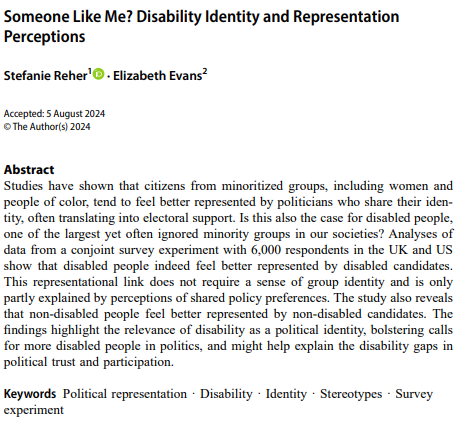
@ProfLizJEvans and I have a new article out: "Someone Like Me? Disability Identity and Representation Perceptions". https://t.co/qT0KlvIrhT
Through survey experiments in UK+US we found:
🦾Disabled citizens feel better represented by disabled than non-disabled candidates. (1/3)
It took me SEVEN years to figure out that you can save a ggplot as a vectorized .svg file ggsave("file.svg"). The svg file can be opened on powerpoint and it will be completely vectorized, even text are still recognized as text boxes! No more recreating plots on illustrator!!!!!
📰 Another day, another resource (though this one is more a draft): a list of #polcomm and computational social science conferences (e.g., comm, journal, po, polisci, css, hci). Feel free to share with colleagues/students/classes.
https://t.co/rgxEm2KPP6
#ERSTrending#TrendingArticle
@nspmartin, @ProfSobolewska, @neemabegum's 2024 article exploring how #EthnicMinorityVoters were divided along ethnocentric and generational lines, similar to majority voters, is one of our current trending articles!
You can read this trending article here: https://t.co/895qOPR5Sd
If you’re a @psa_ecn member attending EPOP, we are pleased to be able to offer accessibility grants. Just fill out the form by the 30th August and we will be in touch.
☕️ The only thing you need to read over breakfast 🥐
🗣️ NEW BLOG: Why are graduates more socially liberal?
👉 @ralphascott summarises his recent research in our latest blog.
https://t.co/dk6hjxFT2j
How did parties campaign for the #EU2024 Parliament elections? Together with @wiebkedrews, @andreas_neumeie and @RiedlJasmin from @projekt_sparta, we published the EUDigiParty data set today including social media handles, website links etc. of 401 European parties. Link follows!