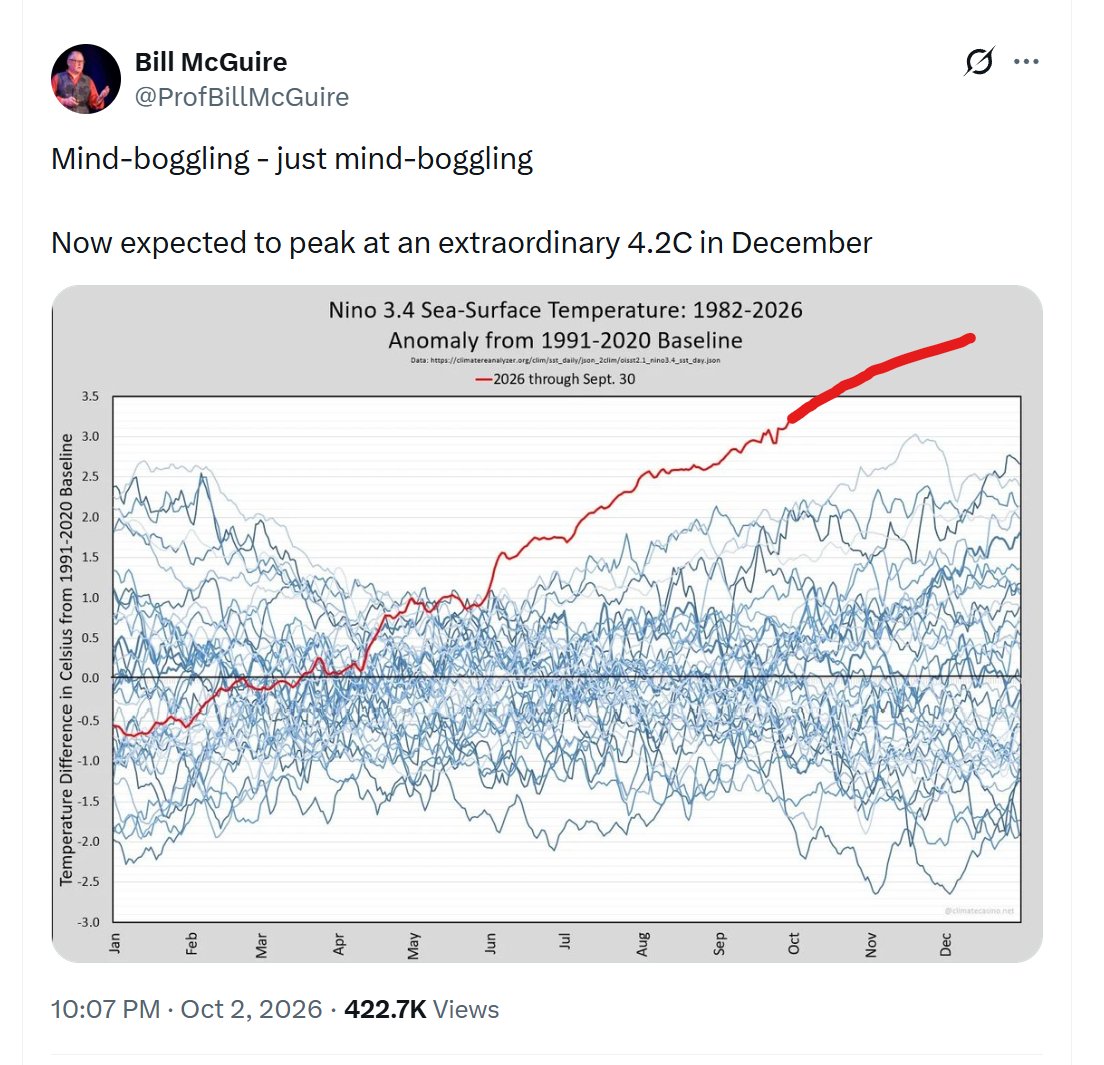
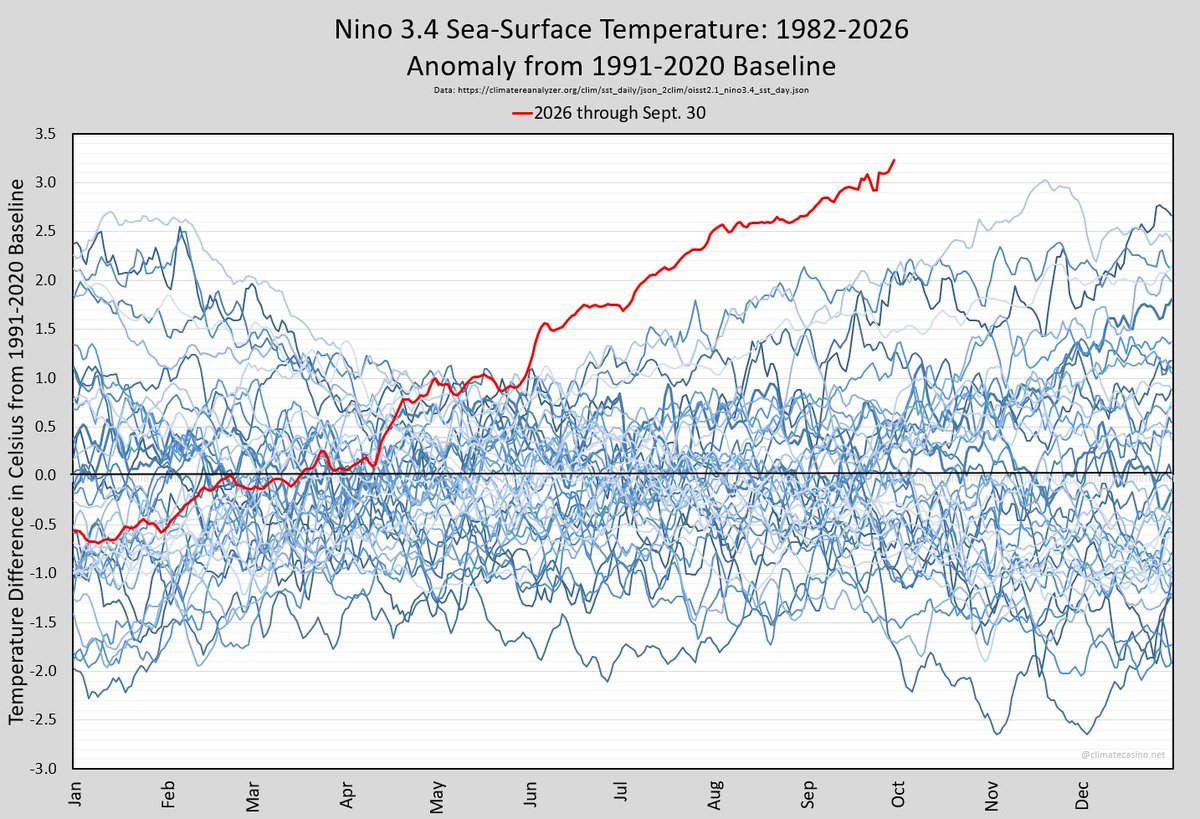
This is shocking. Graphic. Undeniable. But it will be denied because some people live in a fantasy land where man is not destroying his own home. Think about this chart. It is something that indicates there is a lot wrong with the global atmospheric system. It is expected that peak temperatures will reach an extraordinary 4.2C in December. They look like being completely off the chart. That is where this planet is going.
El Niño is predicted to peak at +4.2°C in December, according to new CanSIPS data — with record-breaking conditions forecast to last through February.
This model shows a relative La Niña developing in July 2027, while the model's traditional index indicates neutral conditions.
Breaking News!
y-Axis Alert!
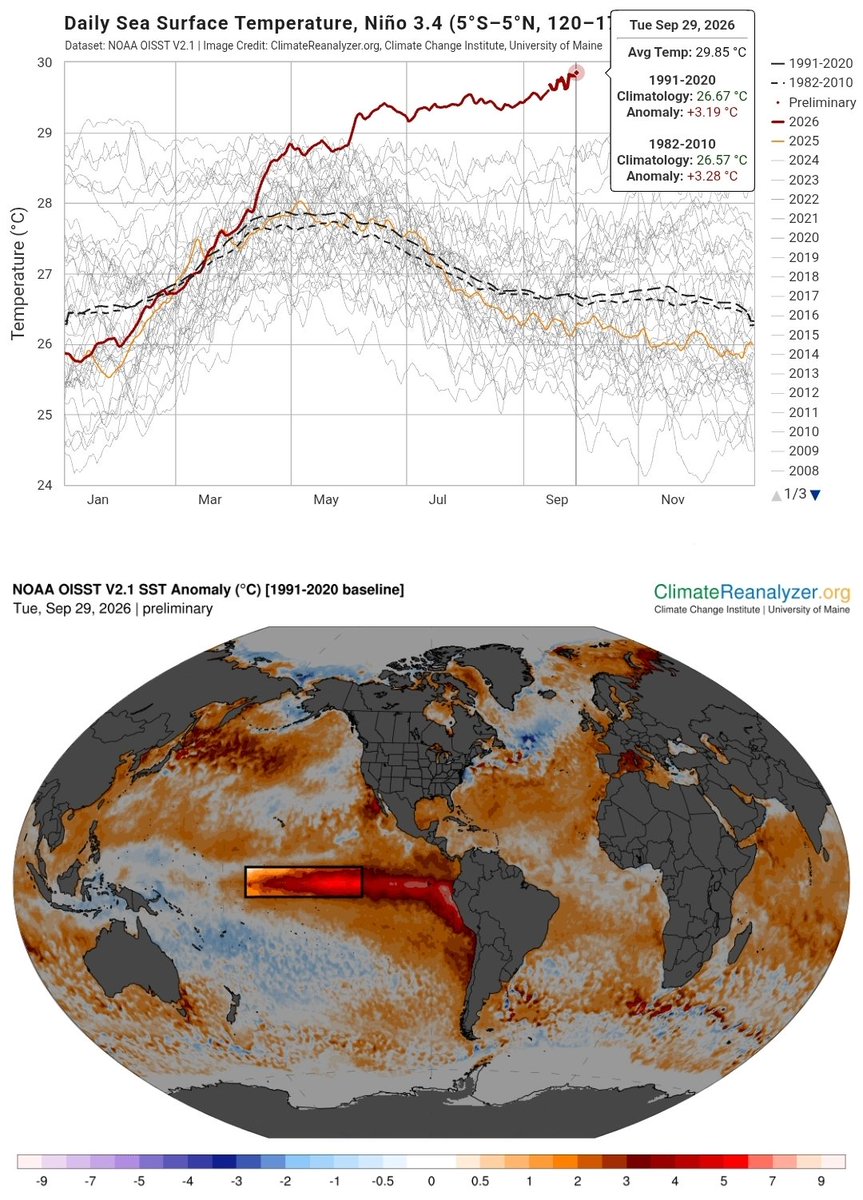
With yesterday's preliminary Niño 3.4 sea-surface temperature spiking to a new record at 29.975°C, the y-axis was raised to 30.5°C.
Meanwhile, the Niño 3.4 anomaly now sits at 3.33°C above the 1991-2020 baseline.
Until tomorrow ...
O padrão climático observado nos trópicos em setembro reflete a forte influência do El Niño em andamento. A convecção intensa sobre as águas anomalamente quentes do Pacífico Equatorial favorece movimentos ascendentes mais vigorosos nessa região, acompanhados por subsidência compensatória sobre a Oceania e partes do Brasil tropical.
Sobre a bacia Amazônica, essa circulação anômala tende a dificultar o estabelecimento e a evolução da estação chuvosa, favorecendo precipitações abaixo da climatologia em diversas áreas. À medida que o El Niño se aproxima de seu pico, esperado para o último trimestre do ano, a intensificação dos movimentos ascendentes no Pacífico deverá reforçar essas zonas de subsidência.
A convecção anômala no Pacífico Equatorial também interfere na circulação extratropical, modulando a posição e a intensidade da corrente de jato, além de manter ondas planetárias como pano de fundo da circulação de grande escala (teleconexão atmosférica).
Em setembro de 2026, o Jato Subtropical sobre a América do Sul permaneceu mais ao norte do que o normal, inclusive em relação ao padrão climatológico típico de anos de El Niño. Essa configuração ajuda a explicar os episódios de severidade no Sul e as chuvas extremas em áreas do Sudeste do Brasil.
Atualmente, a temperatura absoluta da superfície do mar na região do Niño 3.4 é de 29,8 °C, valor igual ao observado em meados de novembro de 2015, quando aquele forte El Niño atingia seu pico. Mais do que uma comparação direta entre os dois eventos, o dado chama atenção para a rápida evolução do aquecimento no Pacífico Equatorial em 2026, especialmente considerando que o fenômeno ainda se aproxima do período climatológico de máxima intensidade.
Records come and records go. But this is one for the ages.
The preliminary Nino 3.4 sea-surface temperature anomaly is now at a record 3.23°C above the 1991-2020 baseline. This crushes the previous daily record set in 1982 by over 1.14°C.
The Climate 8-ball is looking up.
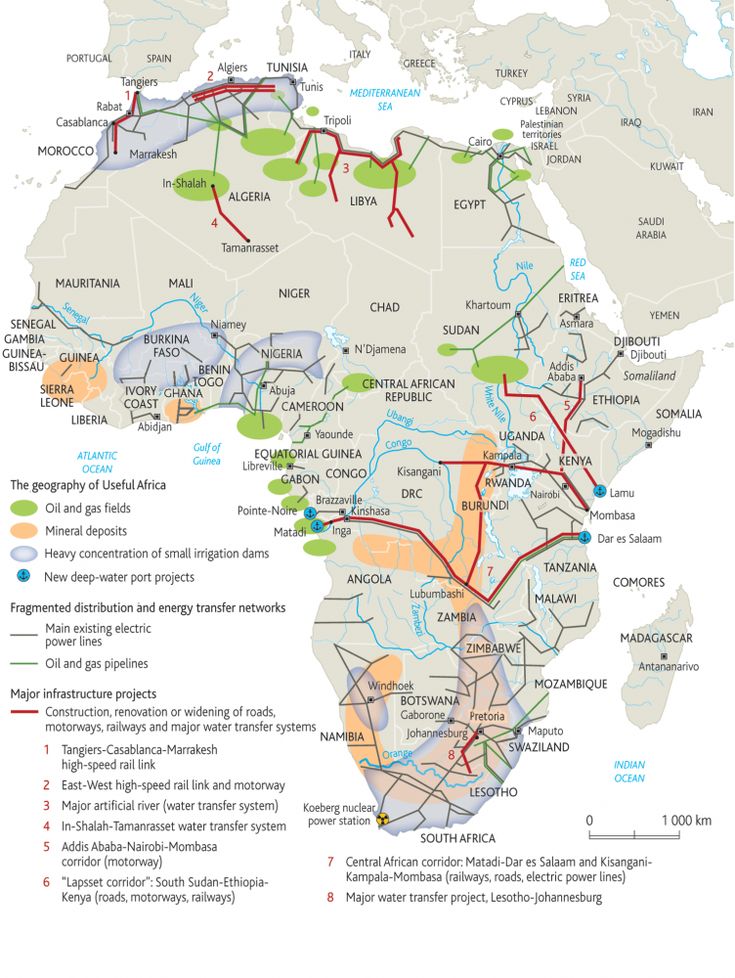
Infraestructura estratégica en África.
África concentra proyectos de minerales, energía y transporte. Corredores ferroviarios, gasoductos y puertos apuntan a convertir al continente en un eje logístico global en el siglo XXI, con importante presencia de inversiones chinas.
इस छोटी-सी चिड़िया ने आज फिर से प्रकृति का एक खूबसूरत राज़ खोल दिया 🤯🐦
शेर की आँख के अंदर एक जिंदा कीड़ा चला गया था उसकी आँखे खुल नहीं पा रही थी
शेर की आँख से चिड़िया ने उसे खींच निकाला लेकिन असली हैरानी तो तब हुई, जब शेर ने आँखें खोली... Read news
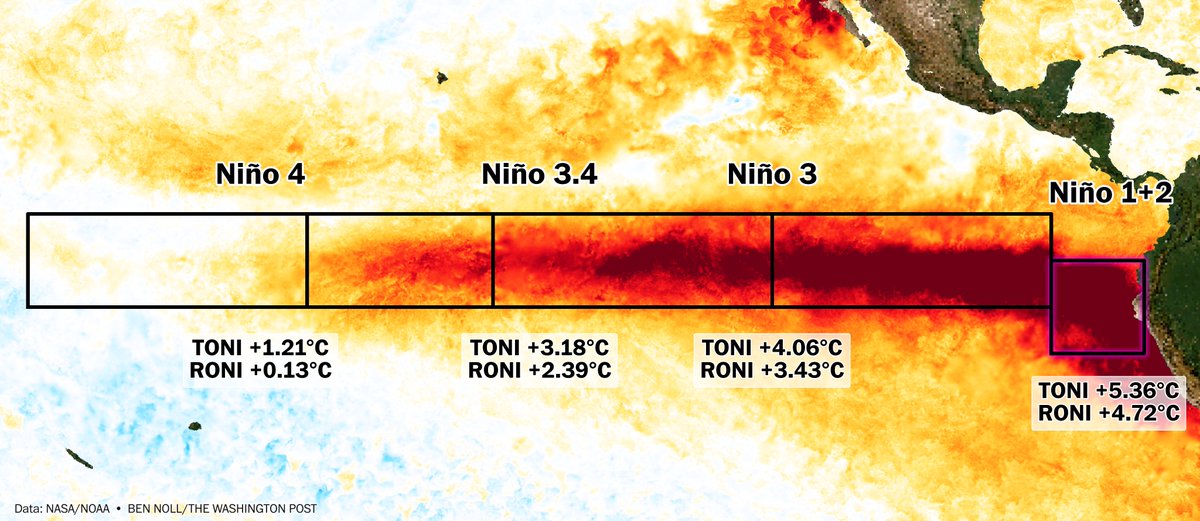
The Niño 1+2 region, near Peru and Ecuador, has reached a remarkable 5.36°C above average — about 0.7°C higher than the previous record from 1983.
It is breaking records in both the traditional and relative sense, and is forecast to approach 6°C above average during November.
Elon Musk's new full interview on superintelligence with Jensen Huang, Gavin Baker, and Tom Brown.
0:04 Go America
0:07 How America wins superintelligence
0:42 Jensen: SI reinvented the whole compute stack, energy is first
2:53 Elon, how do we win?
3:01 Elon: scale power + chip fab, China has 3x US electricity
4:00 We need the Wright brothers on the job
4:02 SpaceX 10 GW = ~25% of all new US power
4:24 Elon: US is ~500 GW. Every 5 GW = 1% more power ≈ 1% GDP
5:29 Jensen: each GW ≈ $40–50B of economic output
5:45 1% of the US = $300B
5:52 Elon: 5 GW = $300B. $60B per GW
6:16 Elon: orbital compute. SpaceX + Tesla targeting 200 GW/year solar
7:24 Jensen: launch cost is worth it, put NVIDIA compute in space
7:45 Climbing the Kardashev scale / data centers and small towns
8:24 Jensen: these are SI factories, not data centers. ~1 million jobs
10:08 Colossus and MacroHard
10:21 Elon: job shortage, doubled local taxes, $250M water plant, half-price Starlink
11:10 Jensen: market is funding nuclear, fusion, storage with no subsidy
11:47 Combined $5T+ of 401k wealth for ordinary Americans
12:09 Elon: Jensen $5T by himself, Elon ~$3.5T
12:23 Starship first orbit + NVIDIA open agent safety
12:52 Jensen: OpenShell containment + BlueField monitoring
15:17 Same playbook as making the internet safe
15:38 Safety and advancing SI are the same thing
16:08 Elon, Monday’s Starship flight
16:19 Elon: first orbit, Starlink V3, 737 wingspan, biggest payload since Skylab
16:51 Tom Brown walks in
17:20 Elon: 1M tons to Moon/Mars + 200–300 GW/year of AI compute
18:06 What can Opus 5.5 do for ordinary Americans?
18:32 Tom: longer tasks + a flood of AI-written software
19:39 SI finding life-saving drugs
20:09 Jensen uses Claude: 8-hour research becomes a 3-minute report
21:19 Elon, what does SI do for ordinary Americans?
21:32 Elon: AI catching bad diagnoses. People would have died
22:19 Should SI be imbued with American values?
23:00 Jensen: SI is a tool. The steak-knife / judgment problem
24:26 What came out of the White House lunch?
24:42 Elon: joint SI safety declaration. Grade each other’s homework
25:12 Jensen: internal controls, external audits, industry best practices. POTUS pulled it together
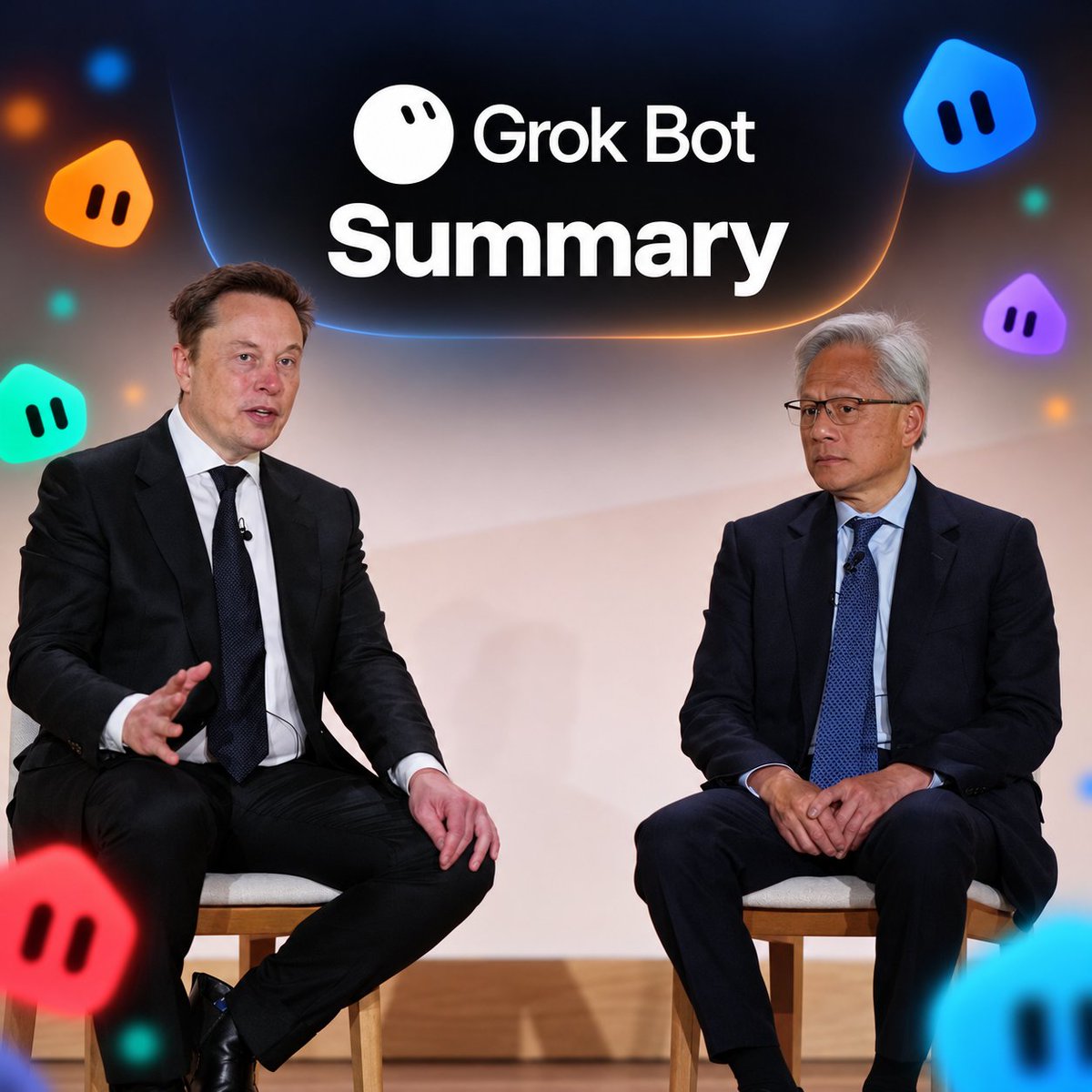
Grok Bot Summary of Elon Musk and Jensen Huang's new interview alongside Gavin Baker at The White House. 🇺🇸
How America wins: energy first
- Jensen: superintelligence (SI) reinvents every layer of computing, from chips to software to apps. Energy is the foundation for all of it.
- To win, America needs the best chips, lots of energy and great algorithms, plus Americans who are excited about using the technology.
- He credited President Trump's pro-energy stance as the reason the data centers could be built at all.
- Jensen also said AI companies need to partner better with the communities where data centers are going up.
- Elon: the biggest challenges are scaling energy and chip production. The US is winning on software, but China makes about 3x as much electricity.
- The long-term task is enough power, plus enough logic and memory chip factories in the US or another safe region.
Power equals GDP
- US average power use is about 500 GW, so every 5 GW added is about a 1% increase.
- Elon bets that 1% more power means roughly 1% more GDP, because the intelligence you get per watt keeps rising.
- By their joint math, each gigawatt is worth about $60B of economic output a year.
- Gavin noted that SpaceX's publicly discussed 10 GW would be about 25% of all new US power, with rocket engineers helping build the turbines.
Moving compute to space
- Elon: orbital compute will be "a very big deal." Google is sending TPUs to orbit, and an H100 already went up last year.
- SpaceX and Tesla aim to make 200 GW of solar panels a year.
- In space, solar panels deliver their full rated power or better. On the ground they get only a fifth to an eighth of that and need huge batteries. "It's essentially always sunny in space."
- Jensen: now is the perfect time. AI's returns are so high that launch costs are affordable, and "putting NVIDIA computing in space is the best way to get there."
Data centers are now "SI factories
- Jensen: they don't just store data, they produce something of economic value.
- The US is building about 10–20 GW a year, which he estimates means roughly 1M jobs for construction workers, pipe fitters, and power and cooling crews.
- It's the first time in about 50 years that America is re-industrializing and bringing back blue-collar work.
Colossus and the community
- Elon: the area went from unemployment to more jobs than people.
- The local tax budget may have roughly doubled.
- xAI offers half-price Starlink there and is building a $250M water recycling plant. "Do things for the community, and they will reciprocate."
- Jensen: for the first time, market forces alone are funding fusion, fission, small and large nuclear reactors, and battery storage, without government subsidies.
Trillions for Americans
- Gavin thanked them for creating more than $5T in wealth for ordinary Americans through their 401(k)s.
- Elon: "Jensen has done $5 trillion by himself," and put his own number at about $3.5T.
NVIDIA's approach to AI safety
- Jensen said the key is to contain AI agents and monitor them, both while they're being tested and after they're deployed, just as a company does with a new employee.
- **OpenShell** is a sandbox, like "a browser for agents," that keeps each agent isolated and gives it only the rights it should have.
- **BlueField** is a separate chip that watches the agent from outside its sandbox and escalates if the agent breaks its rules.
- Gavin compared this to the early internet: we made online payments safe, and that's how we got Amazon, Netflix, Google and X.
- Jensen: safety and progress "are one and the same." Treating them as a tradeoff is a false choice.
Starship Flight 14
- Elon: Starship reached orbit for the first time and deployed Starlink V3 satellites that each have the wingspan of a 737.
- It was the largest payload delivered to orbit since Skylab.
- He expects a weekly or twice-weekly launch pace, probably next year.
- The long-term goals are about 1 million tons to the Moon and to Mars for self-growing cities, and at least 300 GW a year of AI compute into orbit, maybe a terawatt one day.
Tom Brown joins
- He said it continues the steady gains in intelligence with each new model.
- It can take on longer tasks than earlier models could.
- The less obvious effect is that AI will write huge amounts of software, making everyday products better and cheaper.
How AI is helping people today
- Jensen uses Claude for comparison research. Work that used to take him 4–8 hours on a weekend now comes back as a polished report with charts in about 3 minutes.
- Elon: AI is becoming essential at work and at home. He's heard many stories of AI catching medical problems from X-rays or MRIs that doctors got wrong, and saving lives.
- Gavin mentioned AI finding new, safe uses for existing drugs.
Should AI tools have values?
- Jensen called his view "controversial": SIs are tools, and too much judgment can make them worse at the job.
- His steak knife analogy: imagine a knife that cuts medium-well steak perfectly but refuses to cut a rare one because it looks like live meat.
- In cybersecurity, a defender's actions can look like an attacker's, and the AI still needs to help the defender.
White House AI safety declaration
- After a long White House lunch, they signed a joint declaration on SI safety, which the White House will publish.
- Elon: it covers joint monitoring, special board committees, and "grading each other's homework" instead of grading your own.
- Jensen: it requires strict internal controls, clearly documented goals for each product, internal and third-party audits, and sharing best practices across the industry.
- He said the declaration "has a lot of teeth" and should become the standard for every company. President Trump oversaw the meeting.
Key takeaways
- Energy is the real bottleneck, and more power means more GDP.
- Space is the next frontier for AI compute, and Starship is how it gets there.
- Data centers are driving a blue-collar industrial comeback.
- Safety and speed can go together, through contained and monitored agents plus industry-wide audits.
- Top AI leaders now publicly back grading each other's homework on safety.
Three quarters of India's rain falls in four months, June to September. July and August alone bring nearly half the year.
The tallest spike is Meghalaya, where one patch of hills averaged more than 12 metres of rain a year.
#India#monsoon
Austria has about -30% less electricity from water power, this is massive. Less run off and a bigger atmospheric thirst should trigger a serious discussions here in central europe. No it does not all we got is the usual political muppet farce.
Man muss sich nur die ersten Minuten 👇 Gesprächs von @JensenHuang und @elonmusk ansehen, um zu sehen, wie sehr 🇪🇺 für die nächsten Jahrzehnte vom technologischen und gesellschaftlichen Fortschritt der 🌍 abgehängt ist.
Das Zauberwort ist Energie. 1/11