I've got an agent in a loop optimizing a renderer with the goal to minimize frame times (and tests to measure). It got times down from 88ms to 2ms and allocations down from ~150K to 500. Sounds good, right? Wrong. This is exactly why agent psychosis is a big fucking problem.
As an experiment, I rewrote the Ghostty core render state in Go, with access to identically laid out data structures as Ghostty and the exact same validation tests. I made a purposely naive renderer (simple, correct, but slow). 88ms per frame with 150,000 allocations (horrendous, lol)!
I then kickstarted a Ralph loop to bring the frame times down. I told it it can't modify input data structures or the public API or tests (they're correct), but it can do anything else it wants. It got to work.
It has worked for about 4 hours. I've spent around $350 on this experiment so far. The results?
88ms => 1.5ms
150K allocs => ~500 allocs
Incredible right? Nope.
My hand-written renderer I ported has frame times (same benchmark) of ~20us (0.020ms) and 0 allocations in the update path.
This is the problem with psychosis and lacking systems understanding. If you don't understand the system, you're going to accept that this is an incredible result. If you understand the system, you'll see better solutions immediately and can do roughly 75x better on throughput.
The people who blindly trust agent output are in the former camp. They're sheeple, overdrinking from a fountain of mediocrity.
Standard disclaimer: I use AI all the time. I like AI. The point I'm making is to not blindly accept results. Think. Analyze. Learn.
It’s almost cute that Larry Ellison might bankrupt Oracle — a feat equivalent to bankrupting a casino — in his attempt to make his failson a media and movie mogul.
When I was in middle school I took the public bus home from another city. It dropped me off about 3/4 of a mile from home and I walked the rest of the way. I genuinely cannot fathom how fast a bunch of people decided that middle schoolers should be treated like kindergarteners.
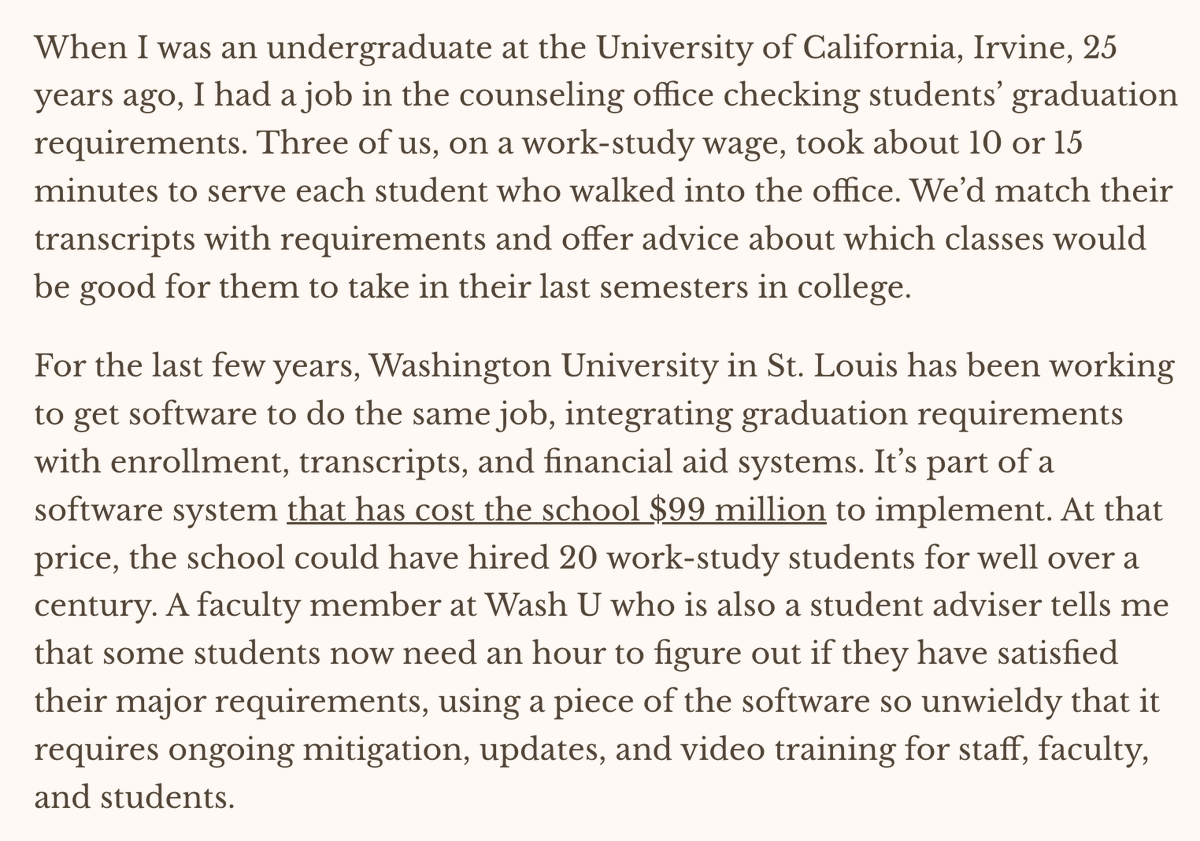
@ProfBarryLam As anyone who has spent time at a college in the 21st century can tell you, the problem with academic software isn't merely that it's the digital arm of an inhumane, Kafka-esque bureaucracy; it's also inefficient and makes everything worse. But hey, at least it's crazy expensive!
Declined to file criminal charges against a woman who swatted a former federal official and who also “was involved in at least three separate police encounters, including an arrest for domestic battery, during which her blood alcohol level was reportedly 0.32, four times the legal driving limit in most states.”
I wish everyone understood that 90% of the time a university kills an academic initiative to "save money" or "increase efficiency" they are really killing off something they just don't value because, believe me, they are happy to throw money into the wind.
@DrClaireEdu@docwilsonsci and interest doesn't come from introspection, it comes from contact. a kid who has only ever met school subjects can only pick from school subjects. asking at seventeen what they love is asking them to order off a menu nobody let them read.
"There's a satisfaction [to onboarding a junior eng] that you can't get from talking to Claude."
When will more of the industry re-discover a big reason we hired interns and new grads? It wasn't because they were productive on day one. And yet they help teams from day one...
It's amazing to me that GitHub has rewritten itself as a React app, but now the only way to get the number of open issues and PRs to update is to hard-reload the page.
The decline of beauty in everyday life shows up in even the smallest things, like tickets, where we’ve let our obsession with efficiency win out over personality and artistic expression.
Like the ticket from the Guggenheim Museum in New York, which I've shared in the first photo. It's an iconic building that could have so easily inspired a beautiful ticket design, but they opted for the most economical option instead.
Each example of this decline isn't a big deal, but the world becomes less charming and enchanted when people stop caring about craftsmanship.
For some alternatives, scroll through the photos. The second one shows old Japanese train tickets, the third one shows an old circus ticket, and the fourth one is a World Series ticket from 2002, which felt magical when I got to hold one as an eight-year-old.
So yes, there’s definitely been a decline. And maybe we’re okay with it! But it’s worth remembering that this decline isn’t inevitable. There is another way.
I think this perfectly illustrates why the community concerns about mass-surveillance are justified.
As soon as he gets any pushback the police chief threatens to investigate concerned citizens in attempt to dig up any and all dirt on them. Imagine what he would do with Flock.
I’m a physics teacher, and quite a few stories have stayed with me throughout my career.
In my class, there’s an unwritten rule: For every final research project, students must submit a lab notebook recording all raw measurement data. Missing data or fabricated results mean an automatic F, in science there’s simply no room for dishonesty.
At the end of the term that year, a girl came to turn in her reversible pendulum project which was meant to measure the acceleration due to gravity. The data in her notebook was all over the place, and her graph was wildly off from the theoretical value of 9.8 m/s².
"My results are... completely ruined," she said. "Everyone else got nice numbers close to 9.8. I guess I'm getting an F".
I looked at her densely packed notebook, filled with meticulous notes: measurements taken at 2:00 AM, the humidity in her bedroom, even the exact times the string snapped and had to be retied. Having taught for over a decade, I can easily tell who fakes their numbers to match the textbook and who stays up all night putting in the real work.
"Why didn't you just tweak the numbers a bit to get closer to 9.8, like the others?" I asked.
She looked up, her eyes rimmed with red, but her voice was steady: "Because the data is what it is. You taught us that a scientist never lies about their data."
I silently flipped to the next page and marked a big red A.
She was stunned. "Wait... but my experiment completely failed?"
"Your experiment didn't fail. It just proved that your pendulum had air drag and a wobbly pivot" I said. "Science isn't about manufactured perfection, it's about the pursuit of truth. You stood up for the truth, and that's the true mark of a researcher."
Starting that semester, I created a small award in the corner of the lab: "The Best Failed Lab Report", given to the experiment with the most skewed results, but the most honest logs and thorough error analysis.
I want these kids to understand that having the courage to acknowledge mistakes and confront reality matters far more than faking a perfect score just to please someone else.
Why the fuck do the 8 Data Centers in Gary, Indiana have power, and have remained fully powered, when the residents have gone without power and water for the past 12 days???
✋️I know! I know.
BECAUSE DATA CENTERS ACROSS AMERICA ARE OWNED AND OPERATED BY PRIVATE CORPORATIONS.
@htmx_org Reminds me of a note from a recent re-reading of Papert's Mindstorms: "You can't think about thinking without thinking about thinking about something" - too much abstraction creates results that are equally disconnected from reality