Hydration water directly interacts with the protein interior or exterior and adopts different structures. The question we ask is whether the light-activated unfolding of AsLOV2 is driven by a thermodynamic action of water!
@songihanlab@SpinLovett@braddprice#GlobalnmrOC2024
Triggered functional dynamics of AsLOV2 by time-resolved electron paramagnetic resonance at high magnetic fields https://t.co/7zSFFQsHcx #biorxiv_biophys
Please RT. We are delighted to announce the prize winners of the @global_nmr Twitter Conference 2022 #GlobalnmrTC2022!
We thank ISMAR for funding these awards and we look forward to bringing this special event back to the #NMR community in 2023.
See🧵👇🏽
#NMRchat#chemtwitter
@moxie9028 @shiny_maity@songihanlab@arnab_mukh3rjee@SpinLovett field-swept scan as a function of time for proper distance extraction.
My guess is that the simplest step to SNR improvement would be reducing protein tumbling through some sort of immobilization, maybe by attaching part of the protein to something more rigid. (2.5/2.5)
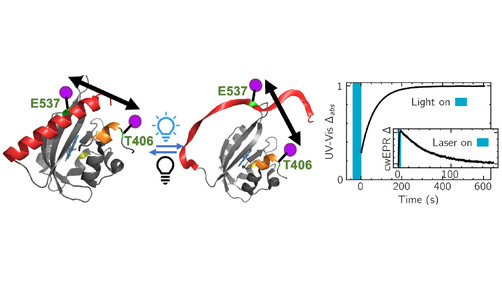
My EPR poster submission for #GlobalnmrTC2022. We (@shiny_maity, @songihanlab, @arnab_mukh3rjee, @SpinLovett, and others) are working on filming protein motion in real time using EPR. Initial results on AsLOV2 -- a photoactive protein found in plants -- are quite promising!
@moxie9028 @shiny_maity@songihanlab@arnab_mukh3rjee@SpinLovett though I think our main sensitivity concerns now come down to three things: (1) ensemble measurements and measuring dead or improperly labeled proteins (2) dipolar averaging due to fast tumbling in solution (3) only have a transient scan instead of a full (2/2.5)
@adriandraney@shiny_maity@songihanlab@arnab_mukh3rjee@SpinLovett Sorry for the slow response! There is a pretty well understood mechanism of undocking (here, for example: https://t.co/Fal2HZodxS). Doubly-labeled protein wasn't trivial to produce, but the enrichment process certainly helped. It is still relatively labor-intensive (1/2)