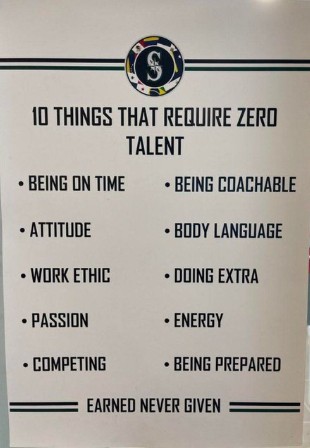
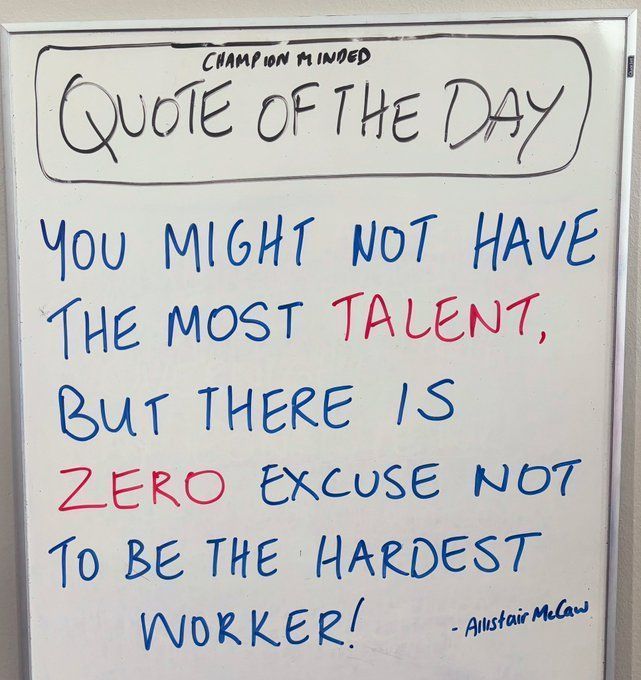
Tom Brady: To be successful at anything, the truth is, you do not have to be special.
You just have to be what most people aren not: consistent, determined and willing to work for it. No shortcuts.
Marcus Freeman shares why "leading by example" isn't enough.
"We don't love leaders by example. Because leaders by example are guys that do what they're told to do, they do everything they're asked, right?"
"But they don't say things when their teammates aren't reaching the standard. We can't have that."
Real leadership isn't just performing at the standard. It's protecting the standard.
"We need more leaders. Guys that are willing to hold their teammates accountable because it's gonna make your teammate better."
Accountability isn't about being hard on people. It's about caring enough to not let them settle.
"I wanna make everybody in our organization the best they possibly can be. So if I let you cut corners or I don't say something to you when you're falling under the standard, then I'm not helping push you to the best you can be."
Leading by example is the baseline. Leading with accountability is the standard.
(🎥notredamebusiness)
Thought of the morning… Running and listening to a podcast with Mike Smith formerly of NAU and hearing him talk about the beauty of the sport and the power of the team.
Mike touches on how he gave Nico Young a race plan for the NCAA championships that might sacrifice Nico’s chances for an individual win and Nico understood the assignment because that would be what was best for his team. Nico didn’t flinch.
Cross country is a team sport. The most raw team sport there is in my opinion.
For a coach, private or otherwise to vocalize that individuality is all that matters while tearing down the importance of team is ruining the beauty of what cross country is and robbing their athletes of what it means to be part of a team. To be part of something bigger than just yourself.
I love this sport because it’s a team game.
Tom Izzo shares why the best thing a leader can do is hold people accountable to their own dreams and how he does this with his teams.
"I always ask them: What do you think my job is for you?"
Most players don't know how to answer. So Izzo tells them:
"The best thing I could do for you is to hold you accountable to your dreams and goals - not mine."
"Sometimes as leaders, we look at what we want instead of what they want."
Izzo has each player write down their goals on a card. Then he uses that card when they push back.
"When he's mad at me because I'm on his butt about academics, I say: You told me you wanted to be an academic All-American. That's not my goal. That was your goal. My job - if I do my job right - is to hold you accountable to your goals."
Leadership isn't about pushing your agenda. It's about helping people become who they said they wanted to be.
Hold them to their dreams - not yours.
(🎥 Michigan Association of Counties 2020)
Kara Lawson shares why great teams embrace conflict.
Most people think chemistry means the absence of conflict. Everybody agreeing all the time.
But Lawson says that's not just wrong - it's backwards.
"Conflict is a pivotal part of a successful team. There's no absence of conflict in successful teams."
Read that again. Not despite conflict - because of it.
"You know what there's an absence of? There's an absence of the conflict lingering. That's the difference."
"There's gonna be conflict. You're gonna be mad at me sometimes. I'm gonna be mad at you sometimes. You're gonna be mad at each other."
She's not describing a worst-case scenario. She's describing Tuesday.
"But the teams that have success - they don't allow the pettiness to linger. They don't allow it to fester."
Fester is the operative word. Conflict itself isn't the infection. Letting it sit untreated is.
"Squash that thing, man, when it's over."
Then she says the part that explains everything else:
"We disagree about something on Wednesday - but on Friday, we don't have it still be there."
1-2 days later...that's the standard. Not never disagreeing. Not holding a grudge for a season.
"You commit to one another so that when there is conflict, you're able to move past it. That's why you commit to someone else - 'cause you're gonna have conflict. It's inevitable."
That reframes commitment entirely.
You don't commit to a team because conflict won't happen. You commit because it will - and you need people who'll work through it with you instead of walking away from it.
The strongest teams aren't the ones with the least friction. They're the ones with the shortest memory for it.
(🎥@DukeWBB)
“To be successful at anything, you don’t have to be special. You just have to be what most people aren’t: consistent, determined and willing to work for it. No shortcuts.”
— Tom Brady
The Captain himself, Derek Jeter (@derekjeter) on why his leadership style worked and how important it is to know the difference between leadership and leadership 🎭 theater:
Ironically the @Yankees legend earned his nickname specifically because:
He never declared himself a leader. He never waited for the cameras to correct a teammate. He never treated every person the same.
His approach was almost too simple:
🤔 Get To Know The People
🔑 Communication Is Key
1️⃣ Lead By Example
Real leadership doesn’t have to be loud or performative.
It often times happens in private conversations within honest relationships, and when nobody is watching.
You do not become a leader by announcing that people should follow you. 🙅♂️
You become one by living in a way that makes them want to!
Sean McVay nailed the job description.
Be an elevator.
Lift people to their highest potential.
That's it.
That's leadership.
Not a critic. Not a ceiling. An elevator. 🔥
Worth 40 seconds:
Kobe's epic explanation of the three costs every great leader must be willing to pay. ⬇️🔥
🌲 Leadership is often lonely. The higher you climb, the fewer people can make the decisions for you. Solitude isn't a sign you're on the wrong path, it is often the cost of carrying responsibility. If you need constant approval, you'll eventually trade conviction for comfort.
⚔️ Avoiding confrontation doesn't preserve culture, it erodes it. Every difficult conversation you postpone quietly becomes permission for the behavior to continue... Leaders don't confront because they enjoy conflict. They confront because clarity is kinder than confusion, and short-term DISCOMFORT prevents long-term DYSFUNCTION.
📏 Accountability is an act of belief. Holding someone to a high standard is one of the clearest ways to communicate that you think they're capable of reaching it. The easiest leader to follow is the one who expects little. The most transformational leader is the one willing to endure uncomfortable moments so people can become who they're capable of being.
The moments that make leadership feel the loneliest are often the same moments that make your leadership matter the most. 💯
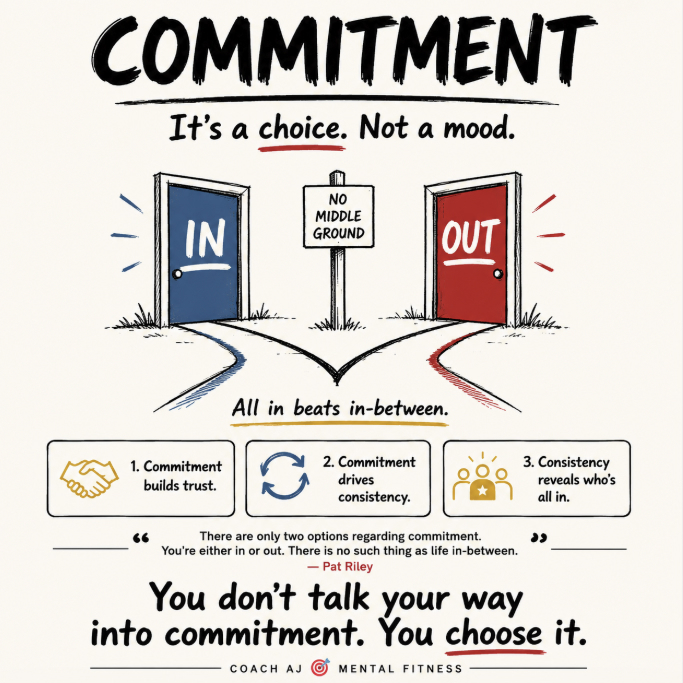
Pat Riley said, “There are only two options regarding commitment. You're either in or out. There is no such thing as life in-between.”
Commitment is a choice. Not a feeling or a mood.
Everyone talks about it, but most people have no idea what it really means to go all in.
Listen to World champion Josh Kerr:
“I don’t do crazy workouts or crazy mileage. I just don’t miss days.
Consistency is my biggest weapon.
I’ll break any athlete down with how consistent I’m going to be training wise and just getting the work done.”
FOCUS ON WHAT YOU CAN CONTROL!
“The more concerned we become over the things we can't control, the less we will do with the things we can control.” – John Wooden
~ via @DrewMaddux
COACHES: Our team's true culture is like an iceberg with most of it unseen. The unseen part makes or breaks our team. The things that go on in a cafeteria, dorm room, back of the bus, or locker room is our culture. How are we equipping our players for when we're not around?