Aave is still DeFi’s biggest lending protocol, but its numbers have fallen considerably from their peak, despite generating millions in fees, AAVE holders aren’t directly earning protocol revenue.
Here’s where things stand.
➥ What is Aave?
@aave is a decentralised lending protocol where users deposit assets to earn interest and borrow against collateral.
V3 holds most of the liquidity, while V4 introduces a new architecture. Aave is also expanding into stablecoin vaults for yield-seeking investors.
➥ The numbers
According to DefiLlama’s November 18 data:
- TVL: $14.7B–$15.1B, depending on the metric.
- 30-day TVL change: -18.3%.
- Active loans: $10.98B.
Aave’s own figures differ because it includes assets actively borrowed. On November 5, it reported $33B in net deposits and $12B in active loans.
Datawallet puts Aave’s TVL 64% below its October 2025 peak of $45.81B.
➥ Revenue Vs Token holders
For November so far, DefiLlama reports:
- $26.67M in fees.
- $3.68M in protocol revenue.
- $0 in direct holder revenue.
More than 205,000 AAVE were bought back between April 2025 and April 2026, but buybacks stopped in April.
A new buyback framework is reportedly being considered, though a restart isn’t confirmed.
➥ V4 is growing
Aave V4 had around $786M in TVL on November 4, up 16% over 30 days. However, its November fees were still relatively modest at $188K.
I really do think that Aave still remains a major pillar of DeFi, and its borrow base shows real usage.
But TVL is declining, revenue has cooled, and token holders still lack a direct link to protocol revenue.
I’d be watching active loans and whether the DAO actually restarts buybacks.
Not financial advice.
Do you track Aave by TVL or active loans?
Lighter is gaining serious traction in the onchain derivatives market. However, a security incident this week raises questions worth paying attention to.
Let’s look at both sides.
➥ WHAT IS LIGHTER?
@Lighter_xyz is a decentralised perpetual futures exchange built around verifiable trading.
Its core idea is to use zero-knowledge proofs to make matching-engine activity verifiable rather than asking users to trust the platform blindly.
Other key features:
- Standard accounts pay zero taker fees.
- Its native LIT token launched in December 2025.
- Trading fees help fund token buybacks.
➥ THE NUMBERS ARE IMPRESSIVE
According to DefiLlama, on November 17:
- 24-hour perp volume: approximately $3.15B.
- Hyperliquid: $10.75B.
- Variational: $1.99B.
- 30-day perp volume: approximately $79.5B.
- Cumulative perp volume: nearly $1.95T.
That puts Lighter firmly among the biggest players in the market.
➥ BUT THERE’S ANOTHER SIDE TO THE DATA
Lighter’s TVL stood at approximately $690.76M on November 16, down from around $828M on October 27.
Castle Labs also estimated its open interest at approximately $646M on November 14, representing roughly 5.8% of onchain perp OI.
Another interesting comparison:
CoinPaprika’s November 16 data put Lighter’s daily volume at 5.82 times its open interest, compared with 0.65 for Hyperliquid.
That’s a significant difference.
It suggests considerably more trading activity relative to outstanding positions. Zero fees can encourage frequent trading, but high volume alone doesn’t prove deep or sustainable liquidity.
➥ THE SECURITY INCIDENT: WHAT WE KNOW NOW
On November 16, an attacker exploited a leaked API key belonging to a trader on Lighter, resulting in approximately $10.39M USDC being withdrawn.
However, there has since been an update.
Lighter reopened withdrawals and reportedly recovered approximately $5M USDC for the affected trader. The team also introduced additional security measures, including requiring wallet signatures for transfers into public pools.
Importantly, Lighter said its protocol and smart contracts were not compromised.
While this is a positive development, the full extent of the losses and recovery remains unclear.
➥ DON’T IGNORE LIT TOKEN SUPPLY
According to Tokenomist data from November 5, approximately 73.9% of LIT’s maximum supply remained locked.
That means future token unlocks are another factor worth monitoring.
MY TAKE
Lighter clearly has real scale, impressive trading activity and an interesting approach to trust minimisation.
But there are questions beyond the headline volume:
- TVL has been declining.
- Trading volume is unusually high relative to open interest.
- The security incident could test user confidence.
- A substantial portion of token supply remains locked.
I’m not dismissing Lighter. I’m saying its growth deserves a closer look beyond the volume rankings.
For now, I’d be watching TVL, open interest, token unlocks and, most importantly, how the team handles the aftermath of the security incident.
One question: When evaluating a perp DEX, which metric matters more to you: trading volume or open interest?
Not financial advice.
Ondo is expanding rapidly in the tokenised real-world asset (RWA) market, but its dominance is declining as competitors enter.
Both things can be true. Here’s why it matters for $ONDO.👇
1. WHAT IS ONDO?
Ondo brings traditional financial assets onto blockchain infrastructure, including:
➥ Short-term US Treasury products.
➥ Tokenised stocks and ETFs.
➥ On-chain trading and financial products.
Its Global Markets platform launched in September 2025, targeting users outside the US. By October 2026, it supported more than 450 tokenised assets.
2. THE GROWTH IS REAL
According to Ondo’s October 14 announcement:
➥ Over $4B in assets managed across its products.
➥ Approximately $1.3B in tokenised stocks and ETFs.
Fundstrat reported that Ondo Stocks’ supply reached $1.34B by October 25, up from roughly $300M a month after launch.
Ondo Perps has also recorded approximately $20.9B in cumulative trading volume.
That’s meaningful growth.
3. BUT MARKET SHARE IS DECLINING
Here’s the interesting part.
A DWF Labs report from October 16 estimated Ondo’s share of tokenised stocks at approximately 26%, down from around 56% in early January.
Why?
The overall market is growing faster than Ondo itself, as new competitors attract capital and users.
BNB Chain has also overtaken Ethereum as the leading blockchain for tokenised stocks.
Ondo executives have discussed a $5B tokenised stock TVL target by year-end. From the reported $1.34B in October, that’s almost a fourfold increase.
An ambitious target, to say the least.
4. TWO THINGS INVESTORS SHOULD UNDERSTAND
➥ Tokenised stocks aren’t direct share ownership. Holders own secured notes linked to underlying securities, not the actual shares.
➥ TVL isn’t token value. Ondo’s business can grow without automatically increasing the economic value of $ONDO.
Ondo Perps’ open interest and liquidity are also worth monitoring as the derivatives business expands.
5. COMPETITION IS GETTING SERIOUS
Traditional financial institutions are entering the RWA space.
Two developments worth watching:
➥ NYSE’s reported selection of Avalanche for tokenised securities infrastructure.
➥ DTCC’s plans for a Solana integration.
These developments validate the broader tokenisation opportunity, but they also mean Ondo will face increasingly capable competitors.
6. WHAT ABOUT $ONDO?
$ONDO has a fixed maximum supply of 10 billion tokens.
Approximately 48.7% was circulating as of August 21, 2026.
Its all-time high was $2.14 in December 2024, while it traded around $0.44 in mid-October 2026.
But remember:
Growing TVL doesn’t automatically translate into token price appreciation.
MY FINAL TAKE
Ondo has genuine traction and remains an important player in the RWA sector.
However, declining market share is something investors shouldn’t overlook.
The competition is getting stronger, and early leadership doesn’t guarantee long-term dominance.
Personally, I’d watch market share, product adoption and token value capture more closely than headline TVL.
Not financial advice. 🫡
What’s more important when evaluating a RWA project: TVL growth or market share?
Bitcoin closed at $65,351, marking its sixth consecutive weekly decline and falling below its 200-week moving average for the first time since August.
It also touched approximately $62,000 over the weekend and is down roughly 17% in November.
Here’s what the data tells us.
➥ WHAT THE REPORTS CONFIRM
- US spot Bitcoin ETFs recorded approximately $1.91B in outflows over seven consecutive sessions through November 13.
- Weekend liquidations were largely concentrated in long positions, with estimates ranging from $1.3B to $2B.
- Market sentiment has fallen into extreme fear, with readings between 10 and 13.
- Bitcoin is trading roughly 14.5% below Strategy’s average purchase price of $75,456.
Upbit operator Dunamu reportedly recorded a 61% quarterly revenue decline as trading activity slowed.
➥ WHAT THIS COULD MEAN
My interpretation is that we’re seeing a leverage flush happening alongside weakening demand.
ETF outflows suggest institutional exposure is being reduced, while Dunamu’s revenue decline points to weaker trading activity.
When both sides of the market become less active, liquidity can thin out. That makes it easier for forced selling to trigger larger price movements.
➥ ONE POSITIVE DEVELOPMENT
A new Bank of Russia rule taking effect Tuesday allows ordinary investors to access Bitcoin, Ether and USDT within annual limits.
It’s a small step toward wider access, but I wouldn’t treat it as an immediate price catalyst.
➥ WHAT MATTERS THIS WEEK
Markets will be watching Fed speeches, October retail sales, Nvidia earnings and consumer sentiment data.
Macro conditions remain a major driver, so these releases could influence the next move.
WHAT I’M WATCHING:
- Whether Bitcoin ETF outflows begin to slow.
- Whether the $62K area holds on a weekly close.
- Whether stablecoin supply starts stabilising.
For now, the key question isn’t simply whether Bitcoin can bounce. It’s whether demand is strong enough to support that recovery.
Not financial advice. If you’re using leverage, know your liquidation price before the next move, not after.
Everyone keeps asking when Polymarket will launch its token and announce an airdrop.
I think there’s a more interesting question:
Is Polymarket actually winning the prediction market it just re-entered?
Let’s look at the project, the numbers, the competition and what could come next. 👇
1. WHAT EXACTLY IS POLYMARKET?
Polymarket is a prediction market where users trade contracts based on the outcomes of real-world events.
You can find markets covering:
➥ Politics and elections
➥ Sports
➥ Economics
➥ Cryptocurrency
➥ Geopolitics and global events
The original platform was built on Polygon, using USDC as its primary trading collateral.
However, its US expansion is a different story.
In July 2025, Polymarket acquired QCEX, a CFTC-licensed exchange and clearinghouse, for $112 million.
The acquisition provided the foundation for its return to the US market through a regulated exchange structure.
In November 2025, the CFTC amended QCX’s designation to allow customer accounts through registered intermediaries.
Polymarket US subsequently relaunched, allowing eligible American users to participate through regulated brokerages and USD deposits.
2. THE NUMBERS: KALSHI VS POLYMARKET
Here’s where things get interesting.
According to the latest comparable 30-day volume data, covering October 17 to November 15, 2026:
➥ Kalshi: $115.71B
➥ Polymarket US: $16.63B
➥ Polymarket International: $5.74B
That’s approximately $138.07B in combined notional trading volume.
Kalshi accounts for approximately 83.8% of the tracked volume.
Polymarket US contributes 12%, while its international platform accounts for 4.2%.
Put simply:
Kalshi is still processing almost seven times the volume of Polymarket US.
There’s another interesting development.
Polymarket US is now generating substantially more volume than its original international platform.
That’s an important milestone for its US expansion.
But there’s something worth understanding before comparing these numbers.
Notional volume is not the same as actual dollars deposited or paid.
A prediction contract can trade repeatedly at different prices, generating substantial cumulative trading volume without an equivalent amount of new capital entering the platform.
Always compare the same measurement when evaluating competing exchanges.
3. ATTENTION IS A DIFFERENT STORY
Trading volume isn’t the only way to measure market dominance.
Blask tracks branded search demand, offering another perspective on which platforms are attracting public attention.
Its numbers tell an interesting story.
For the first time since April 2024, Kalshi overtook Polymarket in US search demand in October.
The October breakdown:
➥ Kalshi: 51.8%
➥ Polymarket: 37.5%
However, November’s figures show the competition tightening:
➥ Kalshi: Approximately 51.9%
➥ Polymarket: Approximately 45.2%
Polymarket is recovering some ground.
But remember, search demand measures attention, not trading activity, liquidity or actual users.
A platform can dominate conversations without dominating trading volume.
That’s why I wouldn’t use search rankings alone to determine which platform is winning.
4. THE $POLY TOKEN: WHAT IS ACTUALLY CONFIRMED?
Now, let’s address what most people are waiting for.
In October 2025, Polymarket’s Chief Marketing Officer, Matthew Modabber, publicly confirmed plans for a native token and an accompanying airdrop.
His statement was clear:
“There will be a token, there will be an airdrop.”
CEO Shayne Coplan also teased a possible announcement around TOKEN2049 Singapore in October 2026.
However, there’s an important distinction between expressing token intentions and announcing an actual launch.
As of November 17:
➥ No confirmed token launch date.
➥ No published airdrop snapshot.
➥ No official eligibility criteria.
➥ No confirmed token supply or allocation.
➥ No confirmed airdrop distribution schedule.
Polymarket’s own Help Center, updated June 24, 2026, still states that it has not announced plans for a token generation event or an airdrop.
The frequently circulated estimate of 5–10% of total supply for an airdrop is community speculation, not an official allocation.
So, if you’re participating in Polymarket activities in anticipation of an airdrop, understand that the reward is not guaranteed.
Also, be careful with fake token contracts and unofficial claim websites.
5. THE REGULATORY RISKS ARE GETTING BIGGER
Polymarket’s US expansion is promising, but the regulatory environment remains complicated.
Here are three developments worth watching.
A. The Maryland and Michigan Disputes
Polymarket has faced legal challenges over its sports-event contracts.
In Maryland, the City of Baltimore filed a lawsuit challenging the legality of the platform’s sports offerings.
However, this should not be described as a statewide ban. The Baltimore proceedings were stayed, and the lawsuit itself does not establish that Polymarket has been prohibited throughout Maryland.
Michigan presents a separate development.
In October, Polymarket US agreed to stop offering new sports-related event contracts to Michigan customers and close remaining positions by November 25.
These disputes matter because sports are an important category for prediction market activity.
B. Congressional Scrutiny
On November 13, the US House Oversight Committee released a staff memorandum examining insider-trading risks on prediction markets.
The memo recommends that Congress consider additional restrictions on federal officials, lawmakers and government employees participating in these markets.
An outright ban on certain government personnel was also raised as a possibility.
This is a recommendation, not an enacted nationwide trading ban.
Nevertheless, it shows how seriously Washington is beginning to examine the industry.
C. The Supreme Court Cases
Several prediction-market-related legal disputes are also moving through the US judicial system.
December 7 is an important upcoming deadline for responses in Supreme Court cases involving Kalshi, Robinhood and https://t.co/QkTiIs0Py2.
These cases concern the relationship between federally regulated event contracts and state gambling laws.
They are not direct Supreme Court proceedings against Polymarket, but their outcomes could influence the regulatory environment in which Polymarket US operates.
6. WHAT I’M WATCHING NEXT
There are four things I’d pay attention to:
➥ US trading volume: Can Polymarket increase its share and close the gap with Kalshi?
➥ User demand: Can it maintain its search momentum and convert attention into actual trading activity?
➥ Token announcement: Will the team finally publish concrete details about the token, airdrop and eligibility?
➥ Regulation: How will the sports-market disputes and broader regulatory developments affect its US expansion?
MY FINAL TAKE
Polymarket has genuine momentum.
Its return to the US market is a significant achievement, its international platform remains relevant, and its attention metrics show that it still has considerable brand strength.
But there’s a distinction I don’t think we should ignore:
Polymarket is attracting attention, but Kalshi is currently winning the battle for trading volume.
The token speculation is interesting, but a future airdrop won’t automatically solve the competitive, liquidity or regulatory challenges facing the platform.
Personally, I’d rather see Polymarket consistently increase its US trading share before declaring it the winner.
The next few weeks should be interesting.
Not financial advice.
One question: When evaluating a prediction market, which metric do you trust more: actual trading volume or user demand and attention?
🚨 BITCOIN JUST TOUCHED $62k, WHAT’S REALLY HAPPENING IN THE CRYPTO MARKET?
Bitcoin dropped to approximately $62,000 over the weekend, its lowest level since mid-July.
Ethereum wasn’t spared either, falling to around $1,711.
Both have recovered some ground, but the bigger picture remains concerning.
Here’s what’s confirmed, what’s still interpretation, and what I’m watching next.
⇨ WHAT ACTUALLY HAPPENED?
The weekend sell-off was significant.
Here’s what the numbers show:
➥ Bitcoin: Touched approximately $62,000 on November 14–15, its lowest level since July 14.
➥ Ethereum: Fell to approximately $1,711, its weakest level since early July.
➥ Liquidations: Around $2 billion in crypto positions were liquidated over a 24-hour period, with leveraged long positions accounting for most of the damage.
This is important because when leveraged traders get liquidated, exchanges automatically close their positions, adding further selling pressure.
In other words, the decline can accelerate very quickly.
⇨ INSTITUTIONAL MONEY IS ALSO MOVING OUT
This is another part of the story worth paying attention to.
US spot Bitcoin ETFs recorded seven consecutive trading sessions of net outflows between November 5 and November 13.
The numbers:
➥ Approximately $1.91 billion in cumulative outflows across those seven sessions.
➥ Around $1.07 billion left during the latest trading week.
➥ The previous week recorded approximately $1.28 billion in outflows, its largest weekly withdrawal since June.
That’s two consecutive weeks of substantial institutional withdrawals.
ETF flows aren’t a perfect measure of institutional sentiment, but sustained outflows suggest that demand through these investment products has weakened.
⇨ WHAT’S DRIVING THE SELL-OFF?
This is where we need to separate confirmed events from market interpretation.
Several factors are contributing to the pressure:
—> Higher Interest Rate Expectations
Hotter-than-expected US inflation data has strengthened expectations of further Federal Reserve tightening.
Markets are increasingly pricing in a December rate hike.
Higher interest rates can make riskier assets less attractive.
—> Stronger Dollar and Rising Bond Yields
A stronger US dollar and rising Treasury yields have added pressure to speculative assets, including cryptocurrencies.
—> Weakening Risk Appetite
Technology and AI-related market concerns have contributed to broader uncertainty.
When investors become more cautious, highly volatile assets are often among the first to experience selling pressure.
—> Leverage Unwinding
As prices fell below important technical levels, leveraged positions faced liquidation.
This accelerated the decline, creating additional selling pressure.
Importantly, we cannot confidently attribute the entire move to one factor. These pressures appear to have compounded one another.
⇨ WHY STRONG PROJECT FUNDAMENTALS AREN’T ENOUGH
This is something I’ve been observing through my project research.
Hyperliquid and Midnight have both reported meaningful ecosystem activity, yet their tokens haven’t been immune to the wider market decline.
And that’s an important distinction.
A project can continue building, attract users and record genuine ecosystem growth while its token price falls.
During risk-off conditions, liquidity, positioning and investor sentiment can outweigh positive project developments.
Strong fundamentals don’t automatically protect token prices from a market-wide sell-off.
⇨ WHAT I’M WATCHING NEXT
There are four things I’d pay attention to:
➥ ETF flows: Do institutional withdrawals slow down, or do we see another week of significant outflows?
➥ Liquidations: Has the market cleared enough leveraged positions to reduce immediate forced-selling pressure?
➥ Macro conditions: Do inflation data, Treasury yields and Federal Reserve expectations become more supportive of risk assets?
➥ Bitcoin’s recovery: Can BTC reclaim important technical levels, particularly its 200-day moving average around $73,000?
The $62K area is worth monitoring as the recent weekend low, but holding above it alone wouldn’t confirm a recovery.
MY FINAL TAKE
I don’t think this decline should be dismissed as just another liquidation event.
Leverage accelerated the sell-off, but the broader picture includes weakening ETF demand, tighter monetary-policy expectations and deteriorating risk appetite.
The weekend bounce is encouraging, but it isn’t enough to establish that the market has found a bottom.
For now, I’d rather watch capital flows and market positioning than rush to call a reversal.
And one more thing:
If you can’t comfortably withstand a 10% market swing, taking excessive leverage is probably not worth the risk.
Protect your capital
Stay patient
Let the market show its hand
NFA.🫡
Solana Breakpoint is taking place in London, and one thing stands out from this year's agenda.
The conversation is moving beyond crypto trading.
Look at some of the organisations represented:
MoneyGram.
Zelle.
Western Union.
Mastercard.
Paystack.
DTCC.
Barclays.
BNY.
Their scheduled discussions cover stablecoin payments, digital assets, tokenized equities, fund distribution and financial infrastructure.
I find this interesting because it points to a bigger opportunity for blockchain networks.
The next phase of adoption may not come only from more people buying and trading tokens.
It could also come from businesses using blockchain infrastructure to move money, issue assets and settle transactions.
But there's an important distinction:
A company attending a conference or discussing an integration doesn't mean it has deployed a production product on the network.
The real test is what gets built, who uses it and whether it generates sustainable economic activity.
That's what I'll be watching from Breakpoint20261
Wall Street is taking another step towards public blockchain infrastructure.
On November 12, DTCC announced plans to connect its tokenization service to Solana.
The target is to make eligible securities held at its depository available on Solana in the second half of 2027.
But there's something more important about this development.
DTCC isn't simply creating tokens that follow stock prices.
Its service is designed to create tokenized representations of eligible securities already held within its existing custody infrastructure.
The idea is to preserve the ownership rights, investor protections and regulatory safeguards attached to those securities.
The initial eligible assets include selected Russell 1000 stocks, major index ETFs and US Treasuries.
This is part of a wider multi-chain strategy that already includes Canton and DTCC's private Besu network.
The bigger picture?
Traditional financial infrastructure is beginning to connect with public blockchains.
And the interesting question is no longer just whether securities can be tokenized.
It's how they can move onchain while retaining the protections of traditional markets.
Midnight is one of the most interesting projects in crypto right now, and also one of the easiest to misunderstand, I went through it properly.
What it is?
@MidnightNtwrk is a zero-knowledge privacy blockchain built by Input Output, the company behind @Cardano
It runs as a partner chain alongside Cardano, with its own ledger and smart contracts, it is not a Cardano layer 2.
Mainnet launched in late March 2026.
The idea is "rational privacy", meaning selective disclosure.
An app can prove something is true (say, that a user meets an eligibility rule) without exposing the data behind it.
The network keeps public and private state separately, so regulated users can still show things to auditors.
That's the opposite of the privacy-by-default approach of Monero.
The token design is unusual, $NIGHT is public and fixed at 24B supply, holding it generates $DUST, a private, non-transferable resource that pays for transactions.
So fees don't swing with NIGHT's price. One analysis does note that NIGHT doesn't capture fees directly.
What's confirmed; transactions passed 1 million by October, with daily volume reportedly rising from 128 to 47,714.
Monument Bank announced a deal to tokenize £250M of retail assets.
The Q4 roadmap lists audited shielded-token contracts and tokenized-deposit templates.
The risks are real too:
Circulating supply is about 69%, and Glacier Drop thaw releases run until Dec 4, 2026, which can add sell pressure (a 90-day grace period follows)
A certain July Wanchain bridge exploit reportedly took about 515M NIGHT (roughly $10M), causing a 43% intraday drop.
Whether NIGHT counts as a privacy coin under MiCA is unresolved
My take;
The technology is credible and the regulated-privacy angle is a smart niche, but usage is still early.
Hoskinson calls it Cardano's largest project, yet it's roughly a ninth of Cardano's valuation. I'm watching real apps, not announcements.
Not financial advice.
I'll update this when the Dec 4 thaw ends.
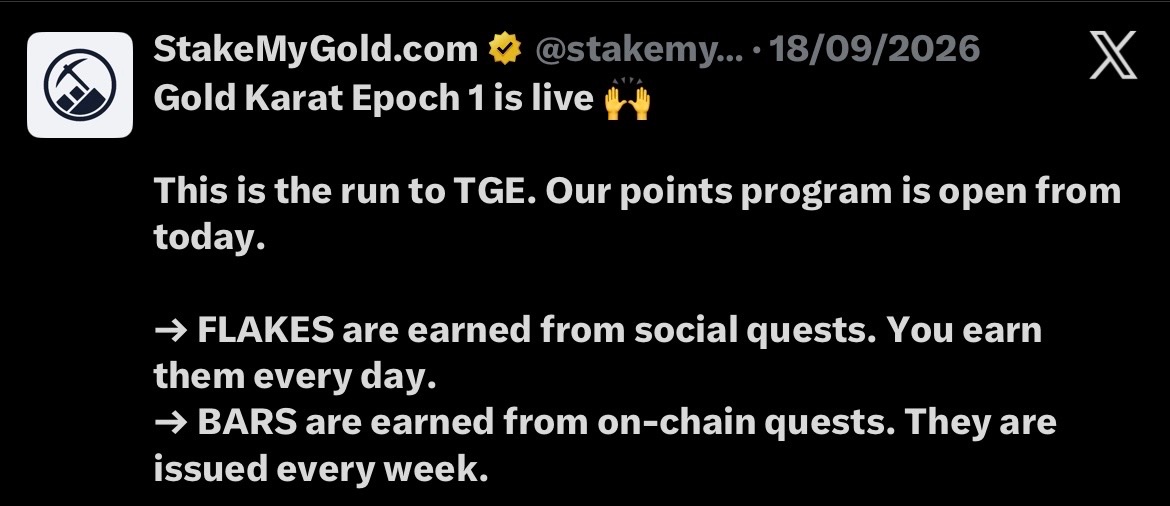
Gold Karat Epoch 1 is LIVE.
I came across @stakemygold and went through the setup.
It takes about 10 minutes to get started, and there’s a free path if you don’t want to spend anything.
Here’s how it works:
StakeMyGold is building a staking protocol around gold-pegged tokens.
Epoch 1 is their current points campaign, and the goal is simple:
Get on the board early, complete quests consistently, and build up your points before TGE.
Start here: https://t.co/c2z04s0mMK
There are two types of points to pay attention to:
➤ FLAKES
➤ BARS
FLAKES come from social quests.
You can earn them by:
→ Posting on X
→ Replying to posts
→ Following accounts
→ Joining Telegram
→ Completing other social tasks
These are the easiest ones to start with.
BARS are different.
They come from weekly on-chain quests.
Some quests can involve holding or staking gold-backed tokens like $GGBR.
This is where I wouldn’t rush.
If a quest requires you to buy or stake an asset, understand what you’re getting into first.
My approach would be:
➥ Start with the free quests.
➥ Connect your EVM wallet.
➥ Complete the available social tasks.
➥ Collect your FLAKES.
➥ Then come back when new quests drop.
The leaderboard is another thing to watch.
Your activity contributes to your position on the board, and the leaderboard updates weekly.
There are also badges tied to higher tiers.
So this isn’t really a “connect once and forget about it” campaign.
If you’re farming it, consistency makes more sense.
I’d personally separate the campaign into two buckets:
FREE:
→ Social quests
→ FLAKES
→ Daily activity
→ Leaderboard
ON-CHAIN:
→ BARS
→ Weekly quests
→ Holding/staking requirements
→ Possible capital exposure
The second bucket deserves much more caution.
And one important distinction:
Future incentives are possible, but there is no confirmed allocation or conversion rate to rely on yet, the most important thing is to accumulate points and climb the leaderboard, if they eventually become valuable, great.
If they don’t, you haven’t overexposed yourself chasing them.
For me, the simplest strategy is:
- Farm the free FLAKES consistently.
- Check the BARS quests every week.
Only touch an on-chain quest when I already understand the asset, the cost and the risk.
See you on the side that prints!🫵
🪂 NOISE: CLAIM YOUR $20 USDC REWARD!
Noise (@noisedotxyz ) is rewarding 3,000 early users who previously purchased credits during its beta phase.
If you were one of the early buyers, you could have $20 waiting for you!
Here’s how to check and claim your reward.
HOW TO CLAIM:
⇨ Visit the official website: https://t.co/tkx721A9BJ
⇨ Download the official Noise iOS beta through the TestFlight link provided on the website.
⇨ Open the Noise app and look for the “Claim Rewards” option.
⇨ Enter the email address you used when purchasing Noise credits during the previous beta.
⇨ Check your inbox for the verification code and enter it in the app.
⇨ Follow the instructions to check your eligibility and claim your $20 reward if selected.
ABOUT NOISE
Noise is building an attention-economy platform where users discover, curate and invest in emerging trends, brands and ideas.
The project has raised approximately $7.1M in seed funding, with Paradigm leading the round.
Its ecosystem is being built around Base, making it an interesting project to keep on your radar.
IMPORTANT NOTES:
↱ This particular reward is intended for previous Noise credit purchasers.
↱ Use the email associated with your original purchase.
↱ The campaign is limited to 3,000 eligible users.
↱ The current reward campaign is separate from any potential future token distribution.
↱ Use only official Noise links only, Never share your wallet seed phrase or private keys.
If you purchased Noise credits during the beta, don’t miss the opportunity to check your eligibility.
OG Noise users, did you successfully claim your $20? 👀
There's a difference between an AI assistant and an AI agent.
An AI assistant helps you respond to instructions.
An AI agent can be given a goal and work through multiple steps to achieve it.
For example:
An assistant can help you write a business plan.
An agent could research a market, identify potential customers, test interest in an idea and organise the results.
The important parts are its ability to use tools, make decisions within defined limits and carry out multi-step tasks.
But there's something worth remembering:
Completing a task doesn't automatically mean producing a useful outcome.
An agent can execute perfectly and still solve the wrong problem.
That's why human oversight, clear objectives and measurable results still matter.
Ever thought about using your crypto to book your next vacation?
That’s exactly what @travalacom makes possible.
You can book hotels, flights and more, pay with crypto, and even earn AVA rewards along the way.
Here’s a closer look at how it works.
⇨ What is Travala?
Founded in 2017, Travala is a travel booking platform that allows users to book hotels, flights, car rentals and activities around the world.
Think of the traditional travel booking platforms people already know, but with cryptocurrency integrated into the payment experience.
Instead of limiting users to conventional payment methods, Travala supports over 100 cryptocurrencies alongside credit cards and other traditional payment options.
Its current inventory includes:
↱ 2.2M+ accommodation properties across 230 countries.
↱ 600+ airlines.
↱ 50,000+ car rental locations.
↱ 400,000+ activities and experiences.
The important part here is that Travala isn’t asking people to change their lifestyle to use crypto.
It is bringing crypto into something people already do.
⇨ How does Travala actually work?
The platform is designed to make booking travel relatively straightforward.
Users can visit the website or mobile app, search for their preferred destination, compare available options and book their travel.
The available services cover:
↱ Hotels and accommodation.
↱ International and domestic flights.
↱ Car rentals.
↱ Tours, activities and experiences.
At checkout, users can choose from supported cryptocurrencies or traditional payment options.
This means someone holding BTC, ETH, USDT, BNB or other supported assets can use them to pay for travel instead of necessarily converting everything into fiat first.
It also means you don’t need to be a crypto enthusiast to use the platform.
Traditional payment methods remain available.
⇨ The AVA Smart Program: Where things get interesting.
One feature that makes Travala stand out is its AVA Smart Program.
This is essentially a blockchain-powered travel loyalty and rewards system.
Rather than simply paying for a service and walking away, users can earn additional benefits through their bookings.
Here’s how it works:
Travala has different membership tiers, starting with a free Basic membership and progressing through Steel, Bronze, Silver, Gold, Platinum and Diamond.
Higher membership levels require users to lock specified amounts of AVA tokens.
Depending on the membership tier and booking category, users can enjoy:
↱ Up to 10% back in rewards on eligible completed bookings.
↱ Up to 5% discounts on listed travel prices.
↱ An additional 3% discount when paying fully with AVA.
↱ Quarterly AVA bonuses for eligible members.
↱ Access to exclusive benefits and experiences.
What’s particularly interesting is that the rewards aren’t exclusively reserved for people paying with crypto.
Eligible members can earn rewards even when paying through traditional payment methods.
This makes the loyalty program accessible to a broader audience.
And unlike ordinary loyalty points that are restricted to one company, AVA is a token that can be used for eligible Travala bookings, membership upgrades and other platforms that accept it.
⇨ What benefits can users actually get?
Beyond the crypto narrative, there are some practical advantages worth looking at.
↱ More ways to spend your crypto
For people who already hold digital assets, Travala provides another way to put those assets to use.
Rather than having crypto sitting in a wallet exclusively for trading or investment purposes, users can spend supported assets on something tangible.
↱ Additional savings on travel
Travel can be expensive, especially when booking accommodation and flights.
The AVA Smart Program introduces another layer of potential savings through discounts and post-trip rewards.
For frequent travellers, these benefits can become meaningful over time.
↱ Rewards for ordinary spending
One thing I particularly like about the model is that users don’t necessarily need to be actively trading AVA to benefit from the ecosystem.
They can participate through travel bookings and receive eligible rewards.
This connects token utility to an actual service.
↱ Flexible payment options
Not everyone wants to pay with crypto, and Travala doesn’t force that choice.
Supporting traditional payments alongside digital assets makes the platform more accessible to people who are unfamiliar with Web3.
↱ Travel opportunities in one place
Having accommodation, flights, car rentals and activities available through one platform can simplify travel planning.
Instead of jumping between several services, users have the opportunity to organise multiple parts of a trip in one place.
⇨ The business side: Is there actual activity behind the project?
This is an important part of my analysis.
A project can talk about utility all day, but actual commercial activity makes the conversation more meaningful.
Travala has been operating since 2017, giving it years of experience in the travel industry.
Its May 2026 monthly report recorded approximately $7.6 million in gross booking revenue.
The platform also reports more than 180,000 AVA Smart members and over $15 million saved by members.
These figures suggest that Travala has built more than just a crypto payment narrative.
There is an operating business, an existing customer base and a loyalty system connecting users to its token ecosystem.
Of course, gross booking revenue isn’t the same as profit, and platform-reported figures should always be considered in that context.
⇨ AVA 3.0: What’s next for the ecosystem?
On November 12, 2026, the AVA Foundation and Travala announced the AVA 3.0 roadmap.
The central idea is simple:
Make AVA more useful by connecting its token utility directly to Travala’s travel business.
Some of the key developments include:
↱ Monthly AVA buybacks to replenish member rewards.
↱ Travala matching the Foundation’s buybacks and locking its share in the AVA Strategic Reserve.
↱ Increased AVA utility through payments and loyalty benefits.
↱ AVA+ Partners, a planned initiative that will allow partner projects to lock AVA for their tokens to be accepted as payment on Travala.
↱ Further exploration of AI-powered travel booking experiences.
One particularly interesting part is the buyback mechanism.
The Foundation purchases AVA to replenish rewards, while Travala matches its contribution and locks its share in the strategic reserve.
The intention is to connect actual platform activity with token demand and the ecosystem’s long-term reserves.
However, some AVA 3.0 initiatives are still planned, so their eventual impact will depend on execution.
⇨ What should users consider before using Travala?
No platform is without considerations.
First, the value of AVA rewards can fluctuate with the token’s market price.
Second, higher membership benefits require locking AVA, which means users should understand the token exposure and applicable unlocking conditions before committing.
Third, rewards are subject to eligibility rules. They are not all credited immediately; booking givebacks generally become available after the trip has been completed.
And finally, users should compare prices, check cancellation policies and review the terms of individual travel providers before confirming bookings.
The fact that a platform accepts cryptocurrency doesn’t automatically make every booking cheaper or every transaction risk-free.
⇨ My overall take
What makes Travala interesting to me isn’t simply that it accepts cryptocurrency.
It’s the business model behind it.
Travel is an industry with an existing global demand. People will continue booking hotels, purchasing flight tickets, renting cars and exploring new destinations regardless of what happens in the crypto market.
Travala is positioning itself at the intersection of that existing demand and the growing digital asset economy.
It gives crypto holders another way to spend their assets, gives travellers access to additional loyalty benefits and gives AVA a practical utility within an operating business.
And with AVA 3.0 placing even greater emphasis on the relationship between platform activity and token utility, there’s an interesting direction to watch.
Of course, execution, competitive pricing, customer experience and sustainable token economics will ultimately determine how successful the ecosystem becomes.
But the bigger idea is worth paying attention to.
Crypto adoption doesn’t have to start with convincing everyone to trade tokens. Sometimes, it starts by making those tokens useful in everyday life.
If you’re planning your next trip, take a look at @travalacom and see what it offers.
𝙊𝙉𝘾𝙃𝘼𝙄𝙉 𝙍𝙊𝘽𝙊𝙏𝙄𝘾𝙎 — 𝙀𝙋. 5
We’ve explored the narrative, the infrastructure, and some of the projects building in this space.
But where could the actual opportunities be?
Let’s look at a few things worth paying attention to.
⇒ 1. The Infrastructure Layer
Before robots can operate at scale, they need reliable infrastructure.
Positioning, mapping, connectivity, compute and real-world data are all important pieces of the puzzle.
This makes infrastructure providers particularly interesting.
The companies and networks solving these problems could become important to the wider robotics ecosystem.
⇒ 2. AI & Robotics Software
Hardware alone won’t make robots intelligent.
They need software that allows them to perceive their surroundings, learn, make decisions and interact with the physical world.
As Physical AI develops, the software powering these machines could become an important area of growth.
⇒ 3. Machine Identity & Coordination
Imagine a future where thousands of robots operate across different locations.
How do they identify themselves, communicate, coordinate tasks and exchange payments?
This is where blockchain infrastructure could become useful.
Machine identity, verifiable activity and automated payments are areas worth watching.
⇒ 4. Real-World Adoption
This is probably the most important one.
A project can have an impressive website, a strong community and an attractive token.
But is anyone actually using what it builds?
One should look for:
→ Active network participants
→ Paying customers
→ Real partnerships and integrations
→ Growing demand for its services
→ Revenue generated from actual usage
Narratives can attract attention, but adoption is what makes infrastructure valuable.
⇒ 5. Token Value Accrual
Building something useful doesn’t automatically make its token valuable.
You also need to understand how the token captures value.
Does network usage create demand for the token?
Are there meaningful utility mechanisms?
Is the token essential to the ecosystem, or could the product operate without it?
These are questions worth asking before getting involved.
But there are risks too.
Robotics still faces challenges around production costs, reliability, safety, power consumption and mass adoption.
Decentralized networks also have to compete with established centralized infrastructure.
And not every project positioned under Onchain Robotics will necessarily survive.
My biggest takeaway:
I believe the interesting part of Onchain Robotics isn’t simply the idea of putting robots onchain.
It’s the possibility of building an entirely new infrastructure and economic layer around intelligent machines.
The opportunity may not always be in the robots themselves, but in the networks, software and services that make them useful.
This is still an emerging space, so research matters more than hype.
Don’t just follow the narrative.
Understand what is being built, who needs it and how it creates value.
Thank you for following this series.❤️🫂
The next interesting opportunity in DeFi might be hiding in a RWA project most people haven’t paid attention to yet.
Have you started exploring @metricxyz yet?
Metric is building a decentralized exchange designed to bring real-world assets (RWAs) into DeFi.
Think tokenized stocks, commodities and other assets that already have prices in traditional markets.
What makes Metric interesting is its Active Pools technology.
Unlike traditional AMMs that rely on internal pricing formulas, Metric uses external reference prices and dynamically adjusts liquidity around them.
The goal is to make onchain trading more efficient, with better pricing and capital utilization.
The platform is already live on Ethereum, BNB Chain and Robinhood Chain.
Now, here’s how to get started with its Points Program
— Visit https://t.co/MLPfnERPhb
— Connect your EVM wallet.
— Explore the available token swaps
— Provide liquidity to supported pools if you’re comfortable with the risks.
— Explore the ecosystem and keep track of your activity.
A few things to note:
→ Metric distributes 1,000,000 points weekly.
→ Points have been accruing retroactively since October 15.
→ Trading, providing liquidity and building on the platform are recognised activities.
→ You can also explore its referral feature.
→ Check your points through the official application.
MetricScan is another useful tool for tracking the protocol’s activity:
https://t.co/MI0K7MSQl5
The interesting part? The points program is live, but a token launch or airdrop hasn’t been confirmed.
So, don’t approach this with unrealistic expectations. Explore the product, participate responsibly and keep an eye on official announcements.
Could Metric become one of the interesting RWA plays in this cycle?
It’s worth keeping on your radar for sure. 🫂