A Lens That Takes Derivatives
US Patent Basis: US8610839B2 - Optical Processing System for Computing Derivatives.
In a 4f Optical Processor, the first lens takes the incoming field and forms its Fourier spectrum. At that middle plane, a tiny optical mask multiplies the spectrum by iξ. This is the derivative operator written in Fourier language
u(x) -> U(ξ) -> iξU(ξ) -> ∂u/∂x
Then the second lens brings the field back to the real space. What comes out is no longer just a focused beam. It is the spatial derivative of the input field, computed by light as it propagates.
So, this is the serious promise of optical computing. A physical optical train can perform operations that usually live inside numerical code: differentiation, filtering, convolution, edge detection, correlation, and many other linear transforms.
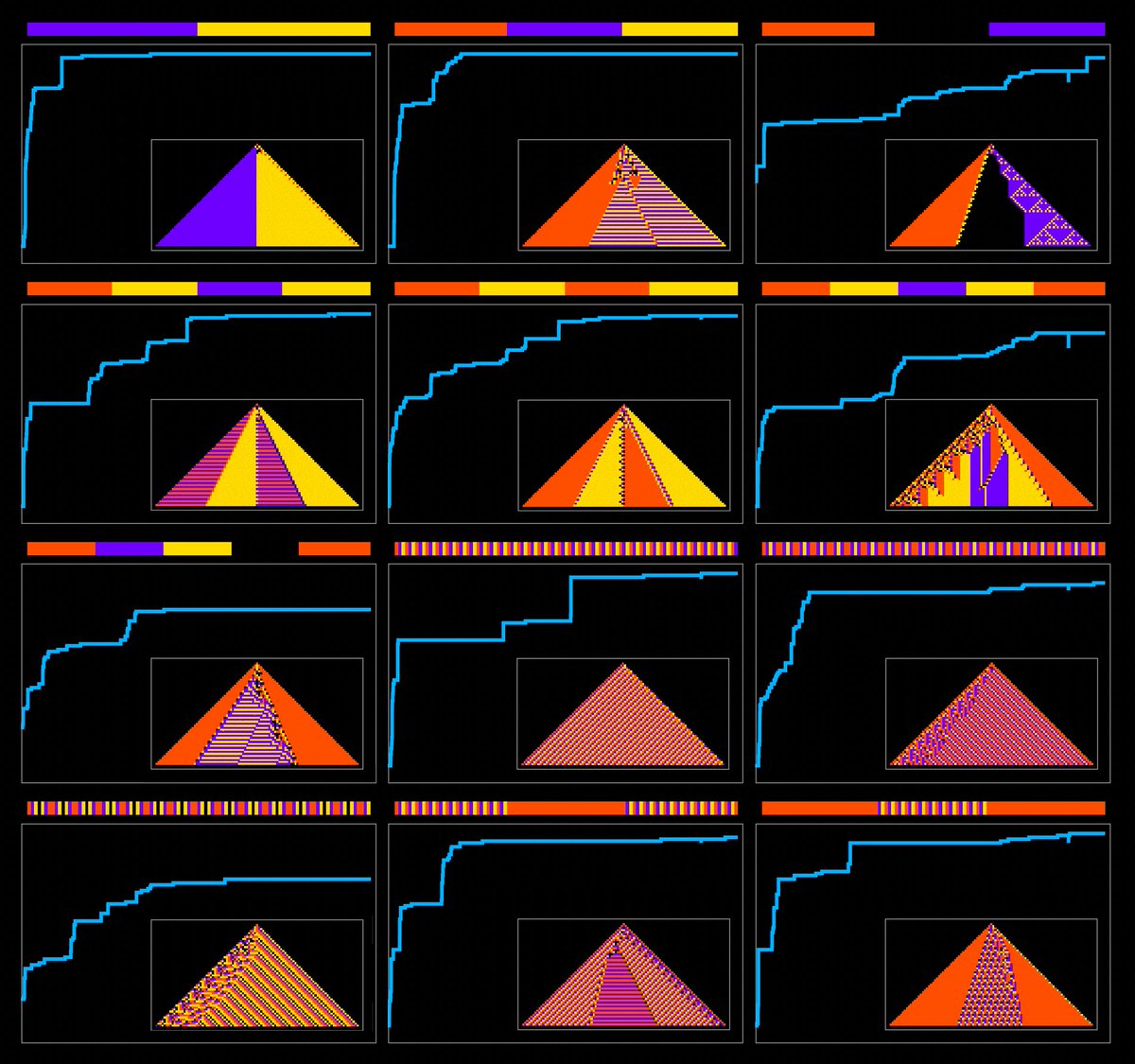
Victorians called it "protoplasm". But what really is "living matter"? And can we make a foundational theory of such a microscopically "bulk orchestrated" form of matter? Seems like maybe we can ... and it's based on the idea of a rulial ensemble ... and predicts things like mechanoidal behavior. It's another surprising step towards general theory in biology...
https://t.co/l9RuhLfkSe
Through the development of metal–organic frameworks, 2025 chemistry laureates Susumu Kitagawa, Richard Robson and Omar Yaghi have provided chemists with new opportunities for solving some of the challenges we face.
Following the laureates’ groundbreaking discoveries, researchers have created numerous different and functional metal–organic frameworks (MOF). So far, in most cases, the materials have only been used on a small scale. To harness the benefits of MOF materials for humanity, many companies are now investing in their mass production and commercialisation. Some have succeeded. For example, the electronics industry can now use MOF materials to contain some of the toxic gases required to produce semiconductors. Another MOF can instead break down harmful gases, including some that can be used as chemical weapons. Numerous companies are also testing materials that can capture carbon dioxide from factories and power stations, to reduce greenhouse gas emissions.
Some researchers believe that metal–organic frameworks have such huge potential that they will be the material of the twenty-first century.
#NobelPrize
What if a spacecraft could cycle between Earth and Moon orbits, performing multiple circuits of each, naturally and indefinitely, with zero propulsion?
We’ve discovered a new class of stable, prograde, low-energy cycler orbits that do just that.
Why these orbits matter:
Ballistic → fuel-free
Stable → long-term ready
Near-chaotic → agile with low ΔV
Low-energy → access to Earth/Moon, Lagrange points, Sun–Earth L1/L2, even heliocentric space
At the AAS/AIAA Astrodynamics Specialist Conference in Boston next week, I’ll present on a new family of ballistic Earth-Moon cycler orbits that are stable, prograde, and mission agile—unlike any cyclers in the current literature.
The example below is shown in both the Earth-Moon rotating frame and inertial frame.
Conference Paper: https://t.co/v3VDPIT0X4
*Quantum Computational Sensing* -- a perspective/mini-review. A new kind of quantum advantage has recently been discovered, arising from a merger of quantum sensing with quantum computing: _quantum computational-sensing advantage_. 1/
Theory predicts that phonons—quanta of lattice vibrations—can carry finite angular momentum and thus influence physical properties of materials. Now phonons with angular momentum have been seen in tellurium with a chiral crystal structure.
https://t.co/ipQsjSfnWJ
If you want to study magnetic fields in biological organisms, you can feed your critters diamonds with nitrogen vacancy centers, then optically probe the microwave spin transitions, which are sensitive to magnetic fields! Totally wacky.
#A quantum material has been found to naturally form one of the world’s thinnest semiconductor junctions—just 3.3 nanometers thick—opening new possibilities for ultra-miniaturized electronics. @nanoscale_rsc https://t.co/qMz2BUZkWC https://t.co/fwRKFRLktR
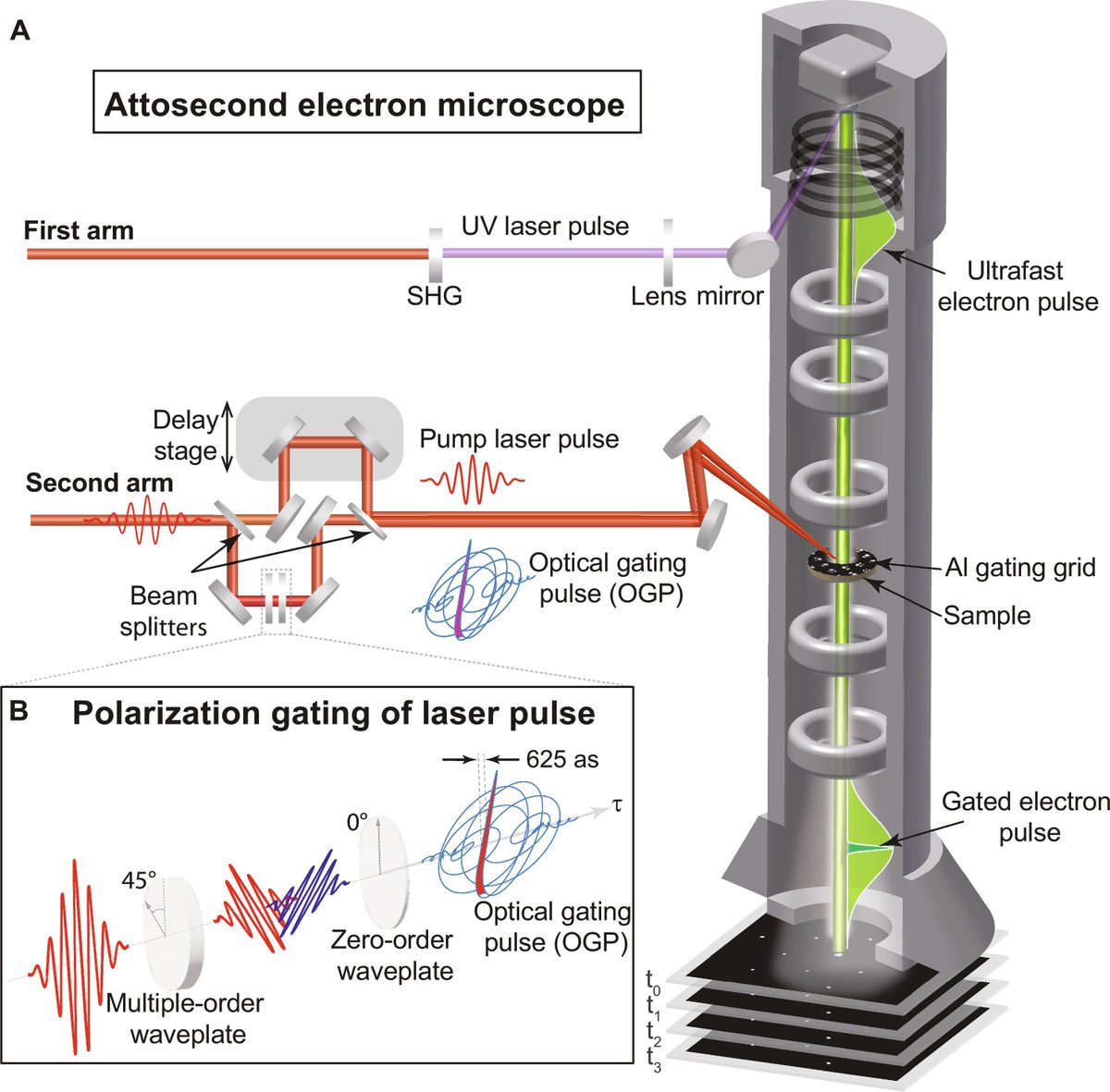
from a bunch of fundamental constants you could find electrons in materials are vibing at 10s to 100s of attoseconds, how would one image their motion?
We can use the fastest thing we have control over (femtosecond laser, gives you 5 fs laser pulses) to generate an electron pulse (100s of fs) to probe the sample, as well as use the same thing to gate that pulse right before it reaches the sample, down to ~600 as or 6e-16 s.
The gating is done with an optical pulse that is mostly circularly polarized except for half a cycle of linear polarization, and this part couples with the electrons and filters/scatters them in time domain.