Today we're excited to launch Fern by @ishikilabs, backed by @ycombinator: high-fidelity simulation platform for robotics!
Robotics teams are bottlenecked by hardware evals. Running evals in the real world is slow and expensive, and building a simulation that's a) high fidelity, b) fast, and c) scales to millions of rollouts is difficult.
Using only 3 teleop episodes, Fern creates a high fidelity simulation that's grounded in both physics and visual fidelity. Then the platform allows you to run thousands of rollouts in parallel through our API, with no infrastructure, sims, or solvers to manage.
One customer has run 900k+ sims on Fern. Hear how their experience has been 👇
If running high fidelity, scalable evals is a need, schedule a meeting with us at https://t.co/Eq15bHHgCw !
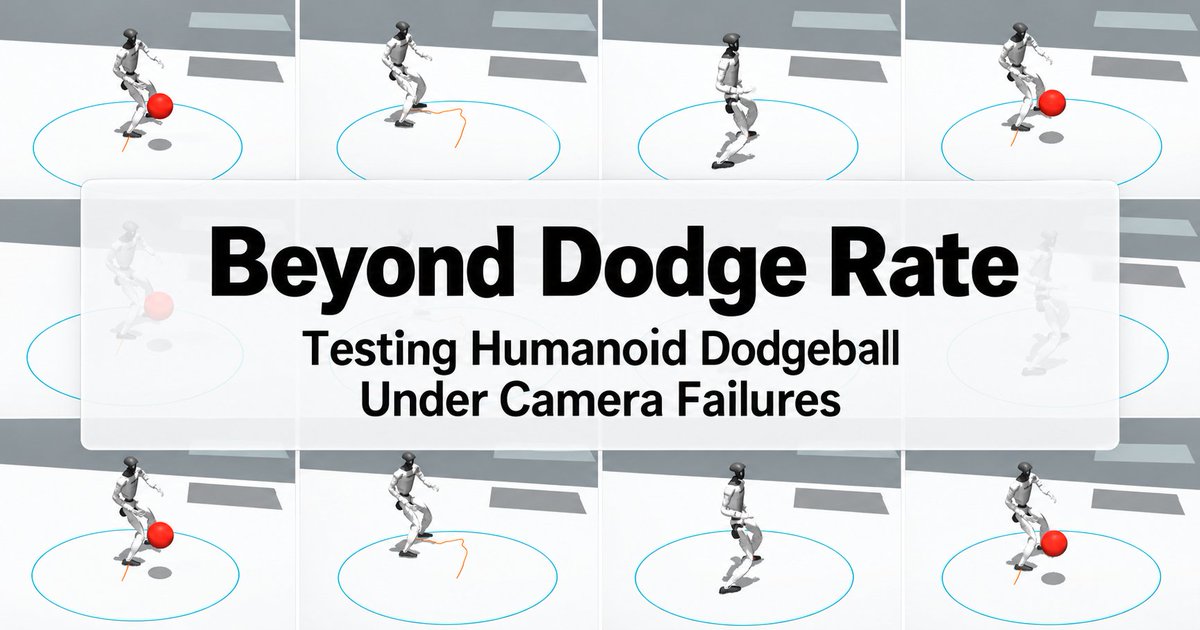
Our recent work with CMU and Stanford, "Beyond Dodge Rate: Testing Humanoid Dodgeball Under Camera Failures," was accepted to the CoRL 2026 Workshop on RoboLetics.
Athletic sports are to robotics what video games are to LLMs: a safe, challenging arena for measuring how close machines actually are to human performance.
In sports, robots have to constantly adapt to the dynamics of the world while keeping up with the cognitive demands of the game.
We tested a Unitree G1 humanoid playing dodgeball in simulation and discuss how overlooking seemingly minute details in the design of evaluation settings can have an outsized impact on downstream success rates.
We hope this work brings us a step closer to safe, capable humanoid loco-manipulation. We're excited to share more soon about what we've been working on.
AI agents are now starting to train robotics models autonomously.
Conventional autoresearch optimizes a single value, but robotics is fundamentally visual.
We need a new kind of interface to track what agents are actually doing.
Gemini 4 Argon with MotionBricks
NVIDIA’s MotionBricks just got open sourced and you can now easily prompt a character to quickly move around in 3D space.
Gemini sees a rendered view of the gym, the scene geometry, and the character’s current state. It generates a plan: where to walk, which way to face, and numerical targets for the hands, feet, pelvis, and lean.
MotionBricks is the motion-generation system. Our system validates Gemini’s spatial goals and uses MotionBricks’ IK tools to construct body target poses. Its learned model generates movement toward those poses, while its Smart Primitives and authored assets support locomotion and interactions like jumping, vaulting, and sitting.
Games are the obvious use, but there's potential in creating varied, labeled synthetic data for robotics model training, or video demonstrations for prompting physical agents.
For controlled tasks, could an LLM driving an explicit 3D scene be a practical alternative to generating the entire scene with a world model? You get access to the geometry and skeletal state, which could make control and annotation easier.
DeepMind’s Genie 4 announcement describes Gemini 4 Argon planning steps for Genie to render.
Could Google’s work across Gemini, Genie and robotics could become an advantage as those systems come together?
I’ve been building with LLMs since my first startup in 2022, and for years I waited on the sidelines for someone to solve memory.
Nobody did, so I spent the last 4 months building it: a shared learning layer that gives every agent on your team the context your best engineer carries around. Today we’re opening it to everyone: Glen
• 21% faster to a merged change while using 1/3 fewer tokens.
• One agent learns something, every agent on your team knows it (harness agnostic, cross teammate)
First 15,000 memories are free, we are building the shortest path to a truly compounding org.