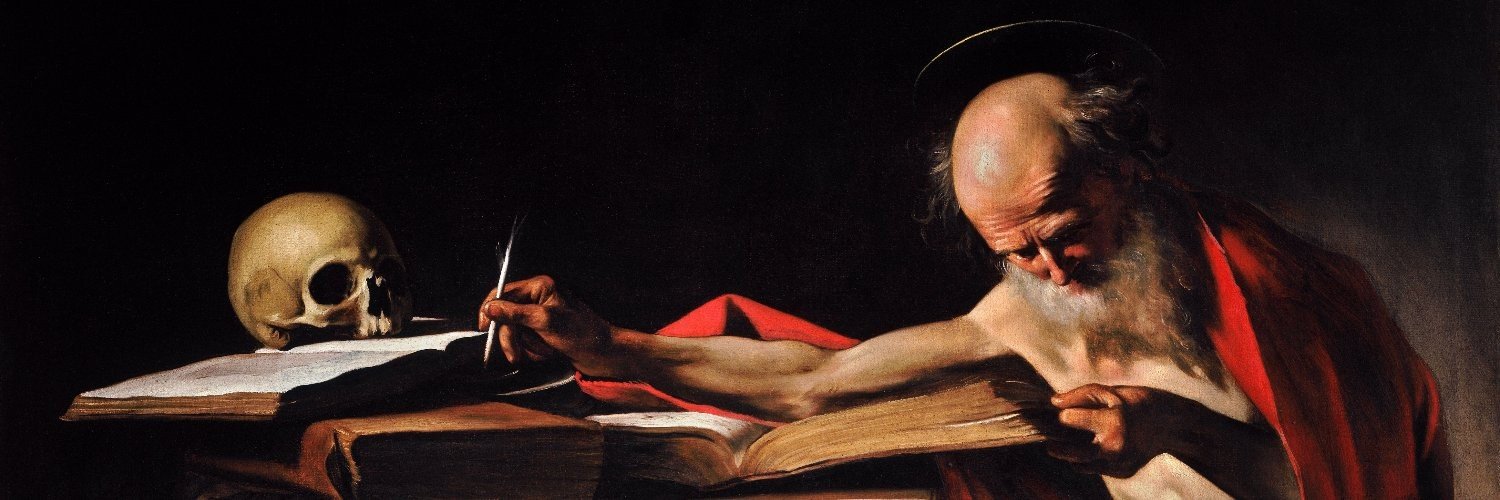
Gospel of the Day (Mark 6,17-29)
Herod was the one who had John arrested and bound in prison on account of Herodias, the wife of his brother Philip, whom he had married. John had said to Herod, "It is not lawful for you to have your brother's wife." Herodias harbored a grudge against him and wanted to kill him but was unable to do so.
https://t.co/9HTG9tUR8k
This is the priest who died on the Titanic to hear confessions and administer last rites.
Given the opportunity to board a lifeboat on two separate occasions, Father Thomas Byles firmly declined. He chose instead to stay behind, absolving sins and consoling the doomed passengers.
Following the vessel's collision with the iceberg, he assembled the remaining crowds on the aft deck.
Those who lived through the disaster recalled him standing bravely amid the panic, listening to confessions, granting collective absolution, and reciting the Rosary right up until the ocean claimed the stern.
This is the type of story we should elevate, heroic virtue. May the Lord bless us with more holy men possessing the courage of Father Thomas Byles.
St. Augustine of Hippo's importance to Catholicism is difficult to overstate. He wrote extensively about grace, original sin, the Trinity, the Church, the sacraments, Scripture, Christian morality, and the nature of human happiness. His theological influence reached across the Middle Ages and continues into Catholic theology today.
But Augustine is particularly valuable for apologetics because his life demonstrates something fundamental: conversion to Catholicism need not mean abandoning the pursuit of truth or reason. Augustine was converted because his intellectual search eventually led him to a fuller understanding of the truth.
Today the Church celebrates the Memorial of St. Augustine (354-430), bishop and Doctor of the Church.
Augustine Aurelius was born on November 13, 354, in Tagaste, North Africa. His father was a pagan, his mother, St. Monica. Still unbaptized and burning for knowledge, he came under the influence of the Manicheans, which caused his mother intense sorrow. He left Africa for Rome, deceiving his mother, who was ever anxious to be near him. She prayed and wept. A bishop consoled her by observing that a son of so many tears would never be lost. Yet the evil spirit drove him constantly deeper into moral degeneracy, capitalizing on his leaning toward pride and stubbornness. Grace was playing a waiting game; there still was time, and the greater the depths into which the evil spirit plunged its fledgling, the stronger would be the reaction.
Augustine recognized this vacuum; he saw how the human heart is created with a great abyss; the earthly satisfactions that can be thrown into it are no more than a handful of stones that hardly cover the bottom. And in that moment grace was able to break through: Restless is the heart until it rests in God. The tears of his mother, the sanctity of Milan's Bishop Ambrose, the book of St. Anthony the hermit, and the sacred Scriptures wrought his conversion, which was sealed by baptism on Easter night 387. Augustine's mother went to Milan with joy and witnessed her son's baptism. It was what it should have been, the greatest event of his life, his conversion — metanoia. Grace had conquered. Augustine accompanied his mother to Ostia, where she died. She was eager to die, for now she had given birth to her son for the second time.
In 388 he returned to Tagaste, where he lived a common life with his friends. In 391 he was ordained priest at Hippo, in 394 made coadjutor to bishop Valerius, and then from 396 to 430 bishop of Hippo.
Augustine, numbered among the four great Doctors of the Western Church, possessed one of the most penetrating minds of ancient Christendom. He was the most important Platonist of patristic times, the Church's most influential theologian, especially with regard to clarifying the dogmas of the Trinity, grace, and the Church. He was a great speaker, a prolific writer, a saint with an inexhaustible spirituality. His Confessions, a book appreciated in every age, describes a notable portion of his life (until 400), his errors, his battles, his profound religious observations. Famous too is his work The City of God, a worthy memorial to his genius, a philosophy of history. Most edifying are his homilies, especially those on the psalms and on the Gospel of St. John.
Augustine's episcopal life was filled with mighty battles against heretics, over all of whom he triumphed. His most illustrious victory was that over Pelagius, who denied the necessity of grace; from this encounter he earned the surname "Doctor of grace." As an emblem Christian art accords him a burning heart to symbolize the ardent love of God which permeates all his writings. He is the founder of canonical life in common; therefore Augustinian monks and the Hermits of St. Augustine honor him as their spiritual father. (Excerpted from The Church's Year of Grace by Pius Parsch)
I hinted to you yesterday that today is the feast of St. Augustine, one of the towering intellects of western civilization. Augustine recognized that there’s a hole in the human heart that only God can fill! We come from God and our hearts are restless until they return to Him for all eternity. @thegnewsroom
“You have made us for Yourself, O Lord, and our heart is restless until it rests in You.”
— St. Augustine of Hippo
Happy Feast Day of St. Augustine of Hippo!! 🎊 🎉 🎊
St. Augustine, pray for us.