The Jensen Huang story keeps getting crazier.
US intelligence reportedly discovered that Nvidia’s CEO was romantically involved with a suspected Chinese spy.
Here's where things get insane:
1.) The woman, Alice Huang, was an executive at Megaspeed, a company under investigation for allegedly helping Chinese firms circumvent US chip export restrictions.
2.) US intelligence believes she was recruited by China's Ministry of State Security, its primary intelligence agency.
3.) Intelligence officials reportedly suspected her objective included gathering information about Huang and potentially influencing Nvidia to push for looser US chip export controls.
4.) Huang has spent the past year repeatedly lobbying Washington to loosen those exact restrictions.
5.) US officials reportedly prepared an intelligence memo detailing the relationship and circulated it among senior government officials shortly before Trump's summit with Xi Jinping.
6.) Trump had reportedly already been briefed on the suspected espionage operation and chose not to act on the information.
7.) Huang has met with Trump repeatedly, reportedly even accompanying him aboard the presidential aircraft on a trip to China.
8.) Megaspeed's Malaysian affiliate reportedly purchased at least $4.8 BILLION in equipment containing Nvidia chips between June 2024 and February 2026.
9.) Federal authorities have been investigating Megaspeed since 2024, with the Justice Department reportedly taking over the Commerce Department's investigation this year.
10.) Investigators reportedly found Nvidia equipment in boxes that appeared ready for shipment rather than installed in operational data centers.
11.) Alice Huang's name was reportedly removed from Megaspeed's corporate documents as scrutiny intensified. Her continuing involvement with the company remains unclear.
12.) Nvidia maintains that it investigated Megaspeed's chip deployments and found no evidence of illegal diversion.
13.) Three congressional committee chairmen are now demanding that Huang appear for a closed-door briefing on November 18.
We're talking about the CEO of the world's most valuable company, a suspected Chinese intelligence operation, billions of dollars in advanced AI chips, and the US government's efforts to control China's access to the technology.
There is still no public evidence that Huang knowingly cooperated with Chinese intelligence or that the alleged operation successfully influenced US policy.
But the questions surrounding this are extraordinary.
How is the internet less private than in 2006, when the whole family shared one computer?
Back then, the internet was weird, personal, and all of ours.
So, we got your favorite meme legends back together to say it louder: What happened to the internet? 1/3
Language is by far the most important tool we’ve ever created and it’s always worth the time to study and improve on it through writing. Nothing else can convey the complexity and intent of your thoughts as efficiently or effectively.
everyone spent ten years learning to code and it turns out the terminal skill was english composition. the machine will do anything you tell it. the only thing left between you and what you want is whether you can form a clear thought and put it into words
@whop's cofounder once offered an Uber driver $100 to knock on a prospect's door and woke him up from a nap in the process.
That's how far they went to acquire customers on the road to a $1.6B valuation.
Here's the rest of his playbook for reaching customers who don't answer:
1. edible arrangements
find the address, send food. it's hard to ignore a fruit bouquet at your door
2. iMessage their email
most people's main email is tied to their iCloud. paste it into iMessage and it often goes through as a text. "we've gotten in touch with a lot of people doing that", Cameron says
3. buy their product
early on he rented a seller's ~$60 bot just to open a convo. "I don't actually want it, but can we call for 10 min?" → "sure"
4. pose as a buyer
DM'd sellers in Discord: "do you still have this for sale?" → "yes" → "I've got someone who'll buy it, list it on our marketplace"
5. camp in a competitor's feature request channel
he sat in a competitor's Discord #suggestions all day. every new request got a DM: "we'll build this for you right now." then DM'd everyone who upvoted it too
6. selfie videos >>> cold emails
"hitting you up from Whop HQ… the engineers are not leaving the office tonight until you respond." some of their best responses came from these
7. voice memo the pitch before you write it
pretend you met them at a bar and you have 20 sec. if it sounds weird read out loud, don't send it
8. pay for intros
early on they paid $500-$1,000 per intro to get to the big names
his rule: people remember what surprises them. "hey can I get on a call?" takes zero effort to send, so it rarely gets a reply
takeaway: most outbound fails because it obviously took 3 seconds to send. giving the most effort always wins
h/t @czoob3
https://t.co/rZXIY63JEl Cameron Zoub from Whop gave some really practical (and unconventional) examples of how they go above and beyond to acquire customers in their ICP that are hard to reach like sending edible arrangements, hiring an uber driver to go knock on their house (lol), and even purchasing their product to start a convo
Wispr Flow ships 500–700 UGC ads a month.
They only pay for the ones that perform.
Their 22-year-old head of content @hectorserrranoo broke down the whole program:
1/ Pay creators 7% of ad spend (SaaS) or a % of sales (e-com)
2/ Guarantee a minimum: $1k for 25 videos, topped up only if commissions fall short
3/ Start with 4–5 creators picked to fill gaps, not hundreds
4/ Recruit on Instagram first: 100–200 DMs in a week
5/ Run creators like a sales team: coaches, weekly calls, gear, a retreat
6/ Grow 5 → 10 → 20 → 40. They hit 50 in 6 months
7/ Pay $100 per referral. They accept 5–7 of ~7,000 applicants
8/ Ban copycats. Meta suppresses videos that are ~60% similar
9/ Small groups of great creators beat big groups of average ones.
Ran an AI workshop for our https://t.co/4yf1cflCa0 operators yesterday.
Everyone uses the same Claude model. But they get wildly different results.
One built a bus GPS for his dad. Another said his AI use looked like "a 70-year-old man running his business because someone told him to."
The gap wasn't intelligence. It's primitives:
1/ One folder per project
2/ Show 5 examples, don't just say make it "good"
3/ Turn SOPs into skills
4/ Connect all your tools
5/ Have it read your sessions and schedule what repeats
6/ One shared brain for the whole team
Lmk if I'm missing anything!
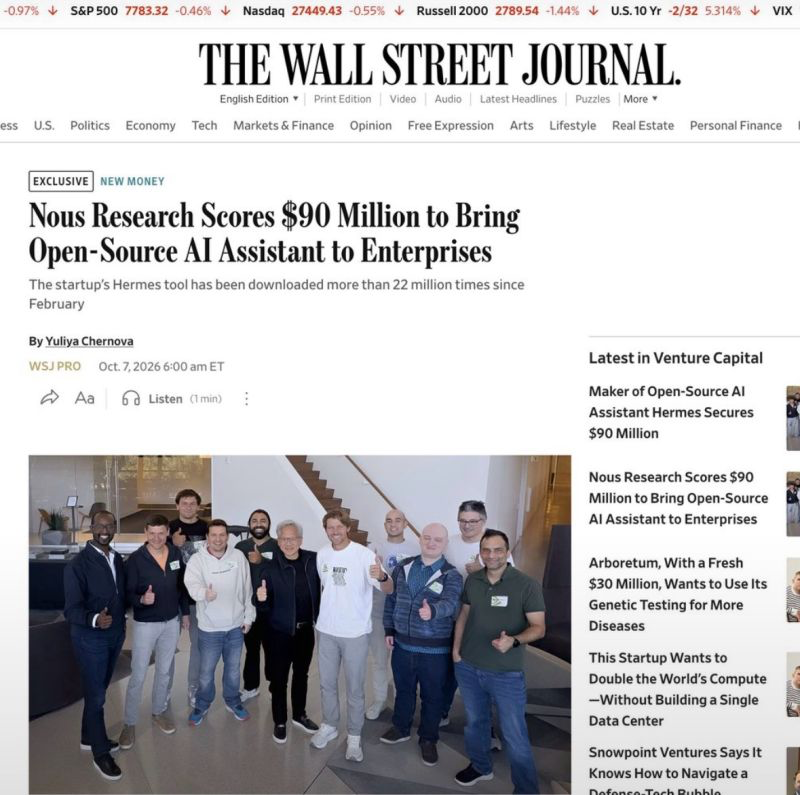
Congrats to the @NousResearch team on the $90M raise.
IMO it’s hands down the best agent harness for businesses and I love it.
We’ve been using Hermes agents as coworkers in Slack for months now.
Here are the 3 biggest things it’s unlocked for us:
1. Removed information bottlenecks
What did we promise this client? Why did we make that decision? Have we done something like this before?
Those questions used to suck hours of the day from multiple team members trying to triage the request.
But after we connected our Chief of Staff agent to our CRM and all our systems, now the team can ask in Slack and get the right answer in seconds.
2. We spend less time on the operational side of the work, and can just do the work....
For our content team that handles hundreds of articles a month, a single assignment can mean pulling together interview transcripts, past content, client feedback, and publication and brand requirements before even writing a single word.
Our agent can now assemble that context into briefs and drafts for the team instantly.
We still make the judgement calls. We just get to spend more time understanding the client and on the actual content. With far less mistakes along the way in terms of factual errors or missed client feedback.
3. We can upskill the agent on how our company works.
Everytime the agent makes a mistake or gets stuck, we turn the correction into a reusable skill.
How we structure a brief, what to research before recommending options in a proposal, when to ask for approvals.
As a byproduct, it's also forced us to get much clearer about our own processes.
And it means the time spent "teaching" an agent compounds. The lesson carries over to the next time the task is requested, upgrading the entire team's capabilities.
Putting our agents in Slack, where the team already works, is what unlocked agents for them.
It's no longer a siloed chat bot on your desktop or browser.
It's more like teammates that become the foundation of how the company works.
Thanks Hermes.
@EXM7777 It opens up large scale classification opportunities that weren’t economically feasible previously. For example I wouldn’t even have attempted scoring 30,000 company sales emails before (which then I use to feed the best performing copy to use in each and every situation).