I built this company. I've watched its value fall 62% in four years. Today its minority shareholders vote to hold the board to account, a vote we cannot win but will not stay silent on. Here's why. #WPPScangroup, @WPP
Find audacity. There is nothing that will help you more in this life than audacity, find it, let it push you to do things , to silence the noise , to go back to school, to leave the country, to start a business, to do things . To fight for your life.
Major cheat code for life: Stop dragging yesterday into today. The argument. The mistake. The missed chance. It’s already gone. Stop reliving it. Learn fast. Forgive yourself faster. Move forward. Life happens in the direction you face.
Warren Buffett: "When you've got a problem, once you find out about it, you've got to get it right, get it fast, get it out, and get it over."
"Getting it right is hard. [When] you turn over rocks, sometimes you find some things."
Why old farts like me are so serious about integrity:
We know the people who cheat on little things are likely to bend the rules on big things.
And that always ends poorly.
Nobody tells you this: Ignore your mood. It doesn't matter whether you want to do the thing. It matters that you said you'd do it. The world belongs to the people who show up and do what they said they'd do. Reliability is the key to life. Just keep showing up.
Milton Friedman: “Everywhere in the world, all of the emphasis was on central planning, on collectivism.”
“Those few of us who believed in freedom and free markets, in minimum government, were regarded as nuts over on an extreme fringe of the intellectual scene.”
Competition is largely an illusion. 95% of people don't even try to do great things. 0.1% of the people are loud, so you overestimate how many people there are. The rest get stuck worrying about competition and quitting after 2 weeks.
I often wonder how many extraordinary people wasted their entire lives waiting for permission that never came. Nobody tells you this: Permission isn't granted. It's taken. You get to tap yourself in whenever you want. You can just do things.
🚨 Do you understand what happened in the last 12 hours?
> A CEO of a $200 billion company said on camera that 35% of new grads won't find jobs. He didn't even flinch saying it.
> Meta made $165 billion last year and is still firing 15,000 people because apparently record profit isn't profitable enough.
> Some random guy in Florida sold his entire house in 5 days using ChatGPT. No real estate agent, no commission, no experience. Just vibes and a $20 subscription.
> A man in Australia cured his dying dog's cancer with AI after every single vet told him there was nothing left to do. Built a custom vaccine from his couch.
> The guy who created Uber and left 300,000 taxi drivers broke is back. Building robots now because apparently ruining one industry wasn't enough.
> Tinder wants access to your camera roll. Your drunk photos, your 3am notes app meltdowns, your deleted selfies. They're calling it a "vibe check."
> Naval, the man who made hundreds of millions investing in software, just said software is dead. Four words and the entire industry felt it.
> And Anthropic removed the limit on how long their AI can think and then doubled everyone's usage for free. Because when the product is addictive enough you give the first taste away.
All of that happened today. Not this week, not this quarter. Today. A random Saturday in March.
This is worse than you being on meth.
Nobody tells you this: Dopamine from information gathering is a dangerous drug. It’s the dopamine from reading, planning, or learning, but never doing. Stop looking for more information and start acting on the information you already have. Get your dopamine from action.
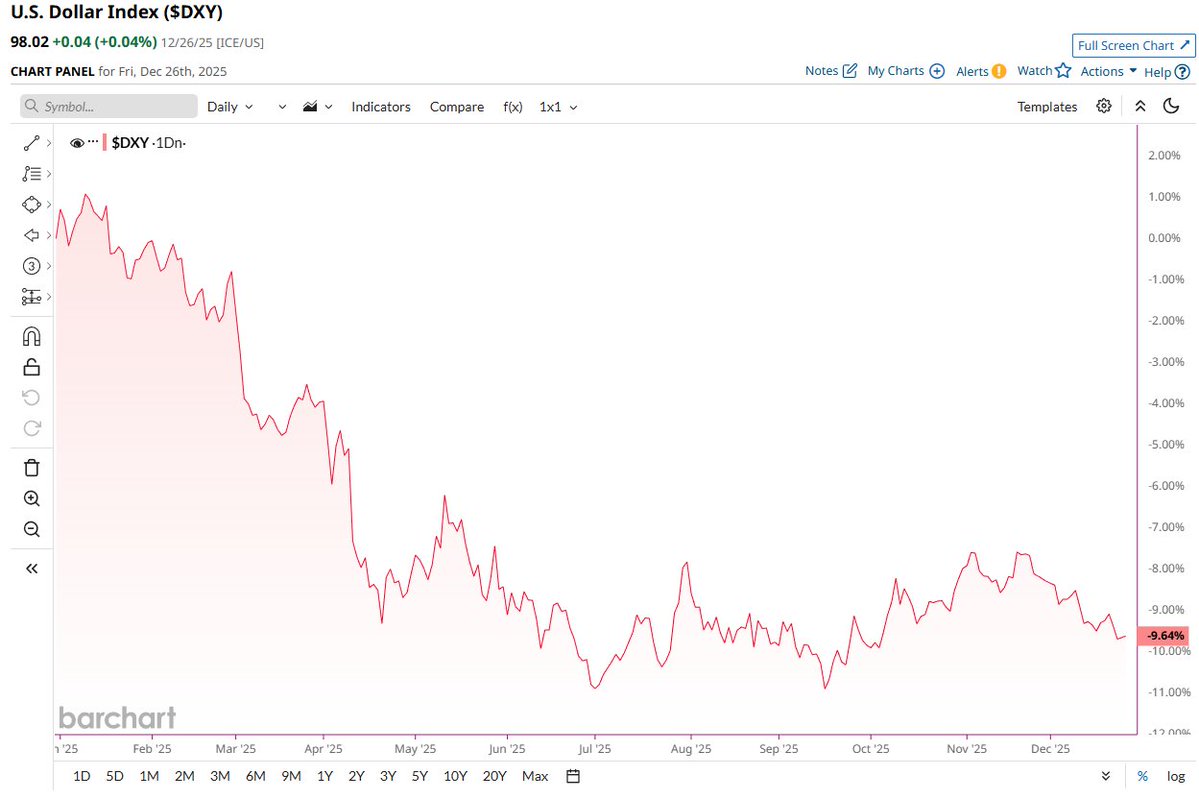
Nobody wants to admit to this or be honest about it but the actual price everyone paid for the utter stupidity in the covid era was that the monetary supply doubled, which means everything inflated by 100% and that is actually why you feel like you can’t afford life anymore.
Stay home stay safe had a price. Now you’re paying it and you will continue to pay it for as long as you live. Food for thought next time someone tells you it’s a good idea to press pause on the economy.
Incoming Fed Chair Kevin Warsh:
1. Youngest Fed Governor in history during 2008 Financial Crisis
2. Said the Fed waited too long to raise interest rates in 2022
3. Said the Fed lost credibility by overstimulating post-COVID
4. Said QE inflates asset bubbles and worsened inequality
5. Claims to support a rules-based Fed, not discretionary policymaking
6. Wants a smaller Fed balance sheet and more focus on price stability
A new era of monetary policy is ahead of us.
This is the biggest irony in tech history.
Microsoft beat revenue estimates. Stock plunged 11%, wiped out $400 BILLION in market cap.
Salesforce reported growth. Stock fell 5.6%.
ServiceNow beat earnings. Stock crashed 11%.
SAP beat projections. Stock dropped 16%.
Entire software sector entered bear market territory. Down 22% from peak.
These are the companies everyone said would WIN from AI.
They spent billions BUYING AI companies.
ServiceNow: $7.75 billion for Armis.
Salesforce: $8 billion for Informatica.
They launched AI products. Built AI workflows. Hired AI teams.
And the market said: You're all dead.
Because investors just realized something nobody wanted to admit:
AI doesn't make software companies stronger.
AI makes software companies OBSOLETE.
Morgan Stanley:
"In an environment of heightened investor skepticism, stable growth falls short of shifting the narrative."
Good earnings aren't enough anymore.
The market is pricing in a world where AI replaces the software these companies sell.
ServiceNow CEO tried defending on the earnings call: "AI needs workflow orchestration. ServiceNow is the gateway to this shift."
Market response: 11% crash.
Because here's what he didn't say:
If AI can write code, automate workflows, and generate apps at a fraction of the cost, why would anyone pay $50,000 per year for enterprise software licenses?
The per-seat pricing model that made SaaS companies rich is getting murdered by AI efficiency.
One AI agent replaces 10 seats.
One prompt replaces months of custom development.
One LLM call replaces entire software categories.
Klarna already proved it. CEO said they pulled Salesforce out of their stack.
Built everything themselves using AI.
And that's just the beginning.
The software apocalypse hit hardest on companies that INVESTED IN AI:
Atlassian: down 12.6%
Intuit: down 7.8%
HubSpot: down 11.5%
Zscaler: down 6.3%
Meanwhile, the companies ENABLING AI made money:
Nvidia: up
Semiconductor stocks: surging
Memory firms: rallying
The divide is brutal.
Hardware companies print cash.
Software companies get destroyed.
Because in an AI-first world, you need GPUs to build the models.
But you don't need software subscriptions when the AI builds the software for you.
Jim Cramer called it the "P/E multiple compression crisis."
Translation: Investors don't care about earnings anymore.
They care about whether your business model survives the next 5 years.
And right now software business models look doomed.
They're literally stuck:
If they DON'T invest in AI, they fall behind.
If they DO invest in AI, they cannibalize their own products.
It's a death spiral with no exit.
ServiceNow spent $12 BILLION on acquisitions in 2025 alone.
Trying to buy their way into relevance.
And yesterday the market cooked them.
The craziest thing to me tho...
Most software companies beat earnings.
Revenue was solid. Growth was fine.
But it didn't matter.
Because the market stopped pricing software on what it earns TODAY.
It's pricing software on what it's worth in a world where AI does the job for free.
And in that world these companies are worth nothing.
This is the biggest sector repricing since 2008.
$500 billion in market value gone in ONE DAY.
And it's not stopping.
Because every company watching this is thinking the same thing:
"If I can replace ServiceNow with 3 AI agents and save $10 million per year, why wouldn't I?"
The answer used to be: "Because you need enterprise-grade reliability."
But now? AI agents are getting reliable. Fast.
Software companies just realized they're competing with open-source models that cost $0.02 per 1,000 tokens.
You can't win a pricing war against free.
The companies that spent BILLIONS preparing for AI are getting killed BY AI.
What an irony.
Everyone assumes the hardest CFO jobs are at the biggest companies. Revenue, headcount, market cap - the classic measuring sticks.
Bullshit.
The biggest (but not only) determinant of CFO difficulty level is what your business actually sells.
Tier 1: Access & Expertise - SaaS, software, professional services. The product is infinitely reproducible, with no inventory. Sure there is some revenue recognition complexity, but ... so what? That’s just reporting. Your finance challenge is unit economics: CAC, LTV, payback periods. Important, yes. But the data broadly behaves itself.
Tier 2: Moving Other People's Stuff - Retail, distribution, e-commerce. Now your balance sheet wakes up. Inventory. Working capital. Obsolescence. You're betting cash on demand with someone else's product sitting in your warehouse. SKU complexity is a force multiplier (making mix management, and cashflow, exponentially more complex.)
Tier 3: Making Things - Manufacturing, hardware, CPG. Everything from Tier 2, plus transformation complexity. BOMs. Yield variance. Labor absorption. Costing methodologies that swing margin by points depending on how you breathe on overhead allocation. Each product has its own individual cash conversion cycle. You are working with deeply imperfect information even at a transaction level.
Then add the force multiplier: SKU count / component count. This introduces complex mix equations which makes getting a ‘clean’ story so much harder.
Messy stories are harder to tell, harder to solve, and harder to fund. The finance team skill level has to go up significantly to combat this.
A CFO role at a $50M manufacturer with 50 SKUs and 500 components is infinitely more complex than a $500M single-product SaaS business.
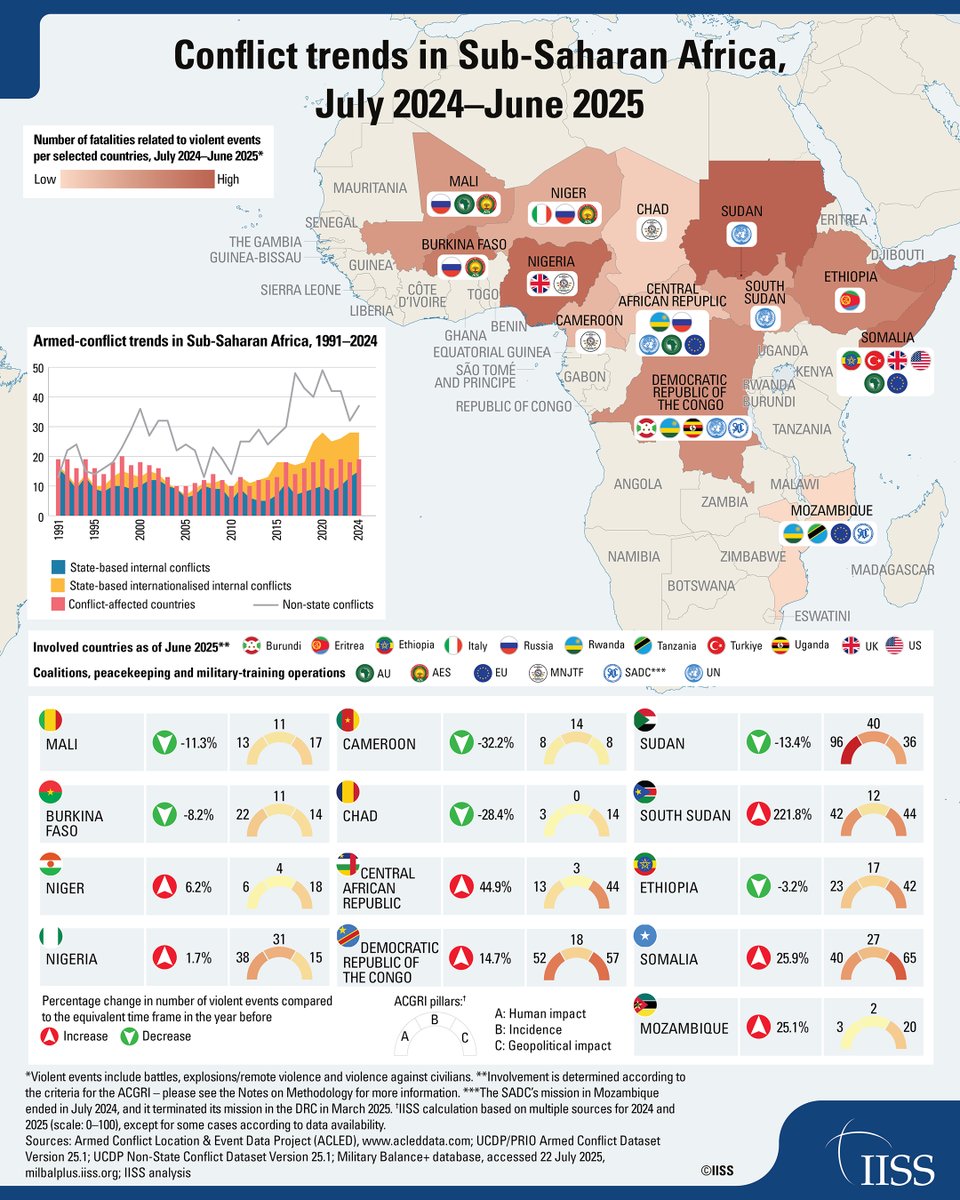
The assessment of conflict trends in Sub-Saharan Africa (July 2024 - June 2025) reveals a worrying reality: while no new conflicts emerged, nearly all existing conflicts intensified or persisted, deepening humanitarian crises across the region. With 28 internal conflicts registered in 2024, rising clashes among non-state armed groups, and declining humanitarian aid, crises in Sudan, the DRC and the Sahel continue to worsen.
Armed Conflict Survey 2025 | 🔍 Find out more: https://t.co/Ng5n8E3NM2