Rose Kimanzi was gang raped inside of a police station on 22nd Oct 2025. We've taken this matter as far as we are able to. Please help us amplify @ODPP_KE@DCI_Kenya@IPOA_KE this couple needs justice.
Thank you.
Amkeni... This govt wants to limit information you get as a Kenyan.
BILL ALERT 🚨
The Access to Information (Ammendment) Bill, 2025.
Drafted as The Official Secrets (Ammendment) Bill, 2025. NA/DLS/BILLS/2/43/2025
Thread 🧵
I don't think many Kenyans have understood the weight of the figures David Maraga released yesterday.
According to the former Chief Justice @dkmaraga, 3,958 Kenyans have been killed by police since President William Ruto came to power, an average of roughly 990 deaths every year.
Now put that number next to the country's terrorism figures.
Available Kenyan terrorism data records roughly 343 terror-related deaths between 2022 and 2025.
That means the number of Kenyans Maraga says have been killed by police is more than 11 times the number of people killed in terror-related violence over the same four-year period. Think about that.
We have spent years being told to fear Al-Shabaab terrorism, and violent extremism as some of the greatest threats to our national security.
And rightly so.
But what does it say about the state of our country when the number of people reportedly killed by the police is an order of magnitude greater than those killed in terror-related attacks?
The police are supposed to protect citizens from violence.
They are supposed to be the institution standing between citizens and those who want to harm them.
The State gives them uniforms, guns, training, and extraordinary powers because we are supposed to trust them with our lives.
So when thousands of citizens are reportedly dying at the hands of the very institution tasked with protecting them, this is no longer simply a conversation about police brutality. It is a national security question.
Who is protecting Kenyans from those who are supposed to protect Kenyans?
And perhaps that is the figure we should all be struggling to comprehend: 3,958.
Not a statistic.
Not a political talking point.
3,958 human beings.
3,958 families.
3,958 stories.
3,958 people who did not go home.
And if a terrorist organization killed anything close to that number of Kenyans, we would quite rightly call it a national catastrophe.
So why should the identity of the person holding the gun change the seriousness with which we treat the death?
A terrorist killing a Kenyan is a threat to the State.
A police officer unlawfully killing a Kenyan is also a threat to the State.
The difference is that one is supposed to be our enemy. The other is supposed to be our protector.
🚨 WAKE UP, KENYA.
We reveal that there this bill is coming for the dead… and maybe more.
The Kenya Blood, Cells, Tissue and Organs Bill is quietly advancing, and the clauses are chilling.
Clause 74 says that after just 6 months, cells, tissues and organs can be taken from an unclaimed body in a mortuary. Newspaper notices are supposed to warn families, but how many poor or rural families even see those papers?
Your relative dies, no one claims the body fast enough, and suddenly their organs are fair game. Could this also encourage abductions? And won't organs be already bad in 6months ??
Clause 35(2) appears to require blood donation to be free and voluntary… then adds “unless under innovative approaches.”
That vague line could create a loophole for paid blood and quiet commercial deals.
Clauses 70 and 106 go further: living, non-related people can donate organs, and donors can be paid for “loss of earnings,” “justifiable expenses” and “technical fees.”
Broad language like that raises serious questions about whether financial incentives could create opportunities for organ trading or pressure on desperate people.
Then add Clauses 90 and 92, officers can search premises without a warrant and seize medical records without consent, and the whole thing starts feeling less like healthcare and more like a system built for extraction.
When a law makes it easier to take organs from the dead and creates payment pathways for the living, a hard question has to be asked:
In a country where people can disappear or die unclaimed, how far could the risk go that some Kenyans end up becoming sources of organs?
This is not conspiracy talk. These are the actual clauses. I have attached them in this tweet replies
This might make you angry.
A Kenyan mother got the call every parent fears: “Your only son is dead.”
George Odhiambo had just three months left on a three-year sentence in Huelva, Spain, after falling into bad company and getting caught in petty theft - stealing alcohol and shisha with friends. He was so close to coming home.
She travelled for hours, begging to see her boy. They refused.
Then they shoved papers in her face and told her to sign so a funeral home could bury him without her even looking at his face. As we speak she is devastated.
How do you bury your only child without seeing him? How do you sleep when no one will tell you how he died?
This is not just a prison death. This is a mother’s nightmare that Spanish authorities and Kenyan diplomats are letting turn into silence.
George made a young man’s mistake. But he was still someone’s entire world.
Justice for Brian Odhiambo.
Nairobi Water has warned that the shutdown of Tata Chemicals Magadi could disrupt water treatment in Nairobi.
The utility relies on more than 360 tonnes of soda ash from Magadi every month to treat and stabilise water.
Didn't expect Sony to out themselves to this degree, but there it is.
THIS is the real issue of the "no disc, no buy" conversation. Stop fighting only for the plastic collecting dust on your shelves and start thinking about long-term digital ownership rights and protections.
This shit needs to change IMMEDIATELY.
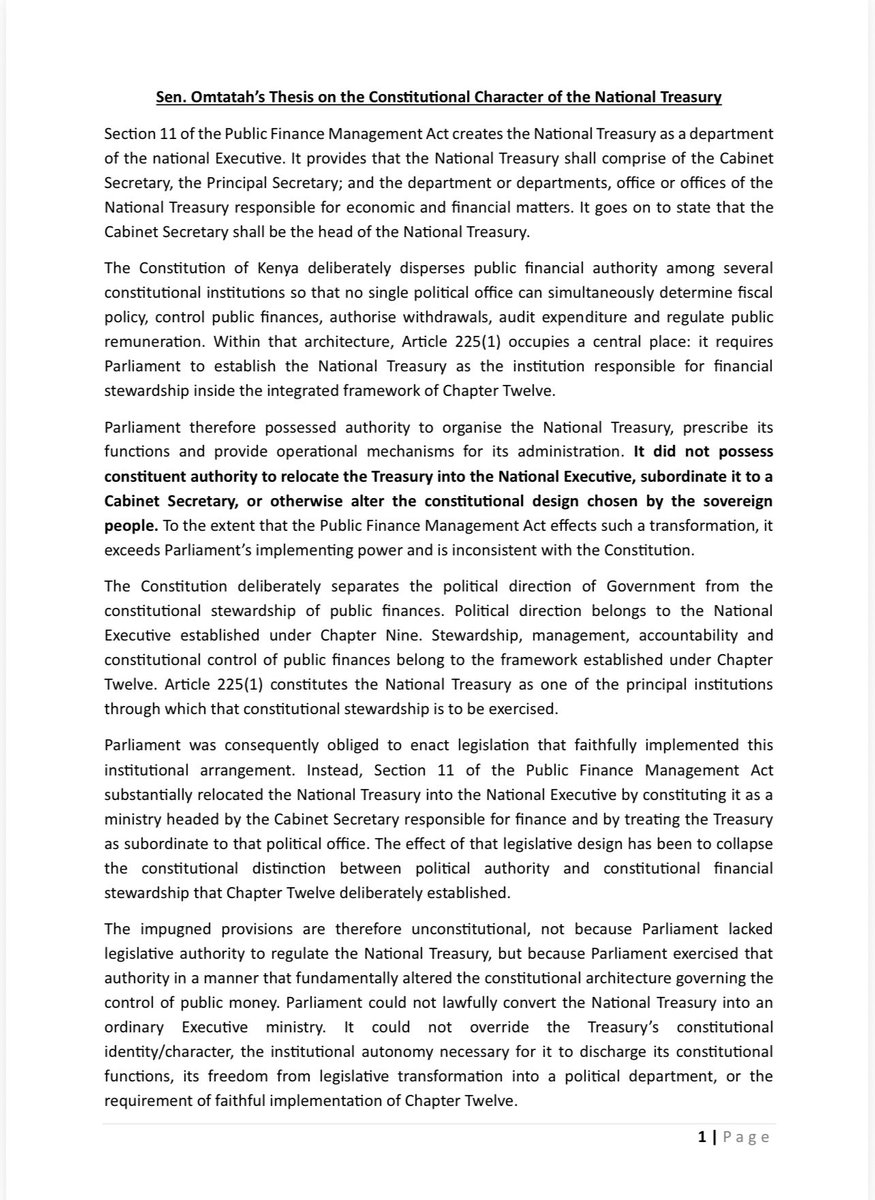
FELLOW KENYANS, THE CONSTITUTION IS UNDER SIEGE! 🇰🇪
Our Constitution was designed with one clear principle. No single political office should have unchecked control over public money. That is why it separates political leadership from the management of the country’s finances.
Article 225(1) establishes the National Treasury as the constitutional custodian of public finances. Its role is too important to be left to politics alone.
Yet Section 11 of the Public Finance Management Act places the National Treasury under the National Executive and under the authority of a political Cabinet Secretary.
This is not a small legal issue. It goes to the heart of constitutional governance.
Parliament has the power to make laws that implement the Constitution. It does not have the power to change the Constitution through an ordinary Act of Parliament.
When the independence of public financial management is weakened, the checks that protect taxpayers’ money are weakened too.
The Constitution must remain above politics. Every law passed by Parliament must respect it.
If we fail to defend Chapter Twelve today, we risk eroding one of the most important safeguards for accountability and responsible use of public resources.
The Constitution belongs to all of us. Defending it is a duty we all share.
Kuna dem Amesema alikua amekaa kando ya chali flani kwa matt aka offer kumlipia fare ,Msupa aka smile akifikiria ni pretty privilege kumbe ni chali alikua amemuibia simu so hakutaka aangalie bag yake apate Hana simu😂😂😂😂😂😂Nimeisha..