New article is now LIVE!
I break down exactly how to tell when you should be buying $CVX over $CRV and vice versa based on both their prices at any given time.
After reading the article below you'll be able to determine this yourself, at any given time, without my (or anyone else's) assistance.
Likes/shares/comments appreciated as always, enjoy! 👇
vlCVX delegation on Stake DAO just hit 8M vlCVX, a new all-time record.
Delegate your @ConvexFinance vlCVX, let Stake DAO optimize your votes.
Rewards distributed every Tuesday in scrvUSD, one single yield-bearing stablecoin for simplicity. No fee.
Delegate now.
They built a whole metric called the “Kingmaker Ratio” just to prove what we've been saying all along… vlCVX is the move. Welcome to the 4% club @Raacfi, the flywheel is intact.
🌌 Imagine a world where **all your money is digital and controlled by the State**.
The USA is in the hands of **Tornald Drump**, who seized power by force.
Insane taxes, automatic withdrawals, funds frozen if you protest online.
Bitcoin? Hoarded for decades by governments and private funds.
Freedom = dead.
#Crypto #Privacy #DeFi #Blockchain
No complexity. No accident.
10/10 was caused by irresponsible marketing campaigns by certain companies.
On October 10, tens of billions of dollars were liquidated. As CEO of OKX, we observed clearly that the crypto market’s microstructure fundamentally changed after that day.
Many industry participants believe the damage was more severe than the FTX collapse. Since then, there has been extensive discussion about why it happened and how to prevent a recurrence. The root causes are not difficult to identify.
⸻
What actually happened
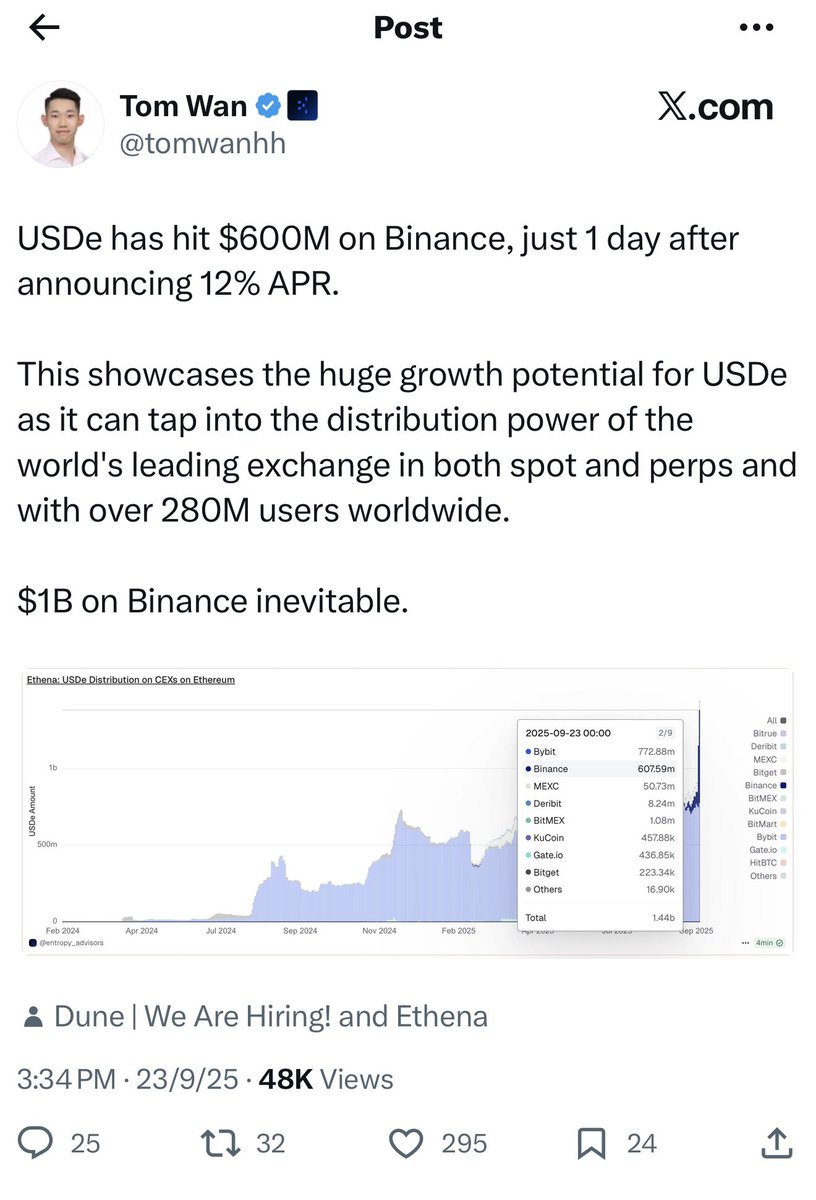
1.Binance launched a temporary user-acquisition campaign offering 12% APY on USDe, while allowing USDe to be used as collateral with the same treatment as USDT and USDC, and without effective limits.
2.USDe is a tokenized hedge fund product.
Ethena raises capital via a so-called “stablecoin,” deploys it into index arbitrage and algorithmic trading strategies, and tokenizes the resulting fund. The token can then be deposited on exchanges to earn yield.
3.USDe is fundamentally different from products such as
BlackRock BUIDL and Franklin Templeton BENJI, which are tokenized money market funds with low-risk profiles.
USDe, by contrast, embeds hedge-fund-level risk. This difference is structural, not cosmetic.
4.Binance users were encouraged to convert USDT and USDC into USDe to earn attractive yields, without sufficient emphasis on the underlying risks. From a user’s perspective, trading with USDe appeared no different from trading with traditional stablecoins—while the actual risk profile was materially higher.
5.Risk escalated further as users:
•converted USDT/USDC into USDe,
•used USDe as collateral to borrow USDT,
•converted the borrowed USDT back into USDe,
•and repeated the cycle.
This leverage loop produced artificial APYs of 24%, 36%, and even 70%+, widely perceived as “low risk” simply because they were offered by a major platform. Systemic risk accumulated rapidly across the global crypto market.
https://t.co/IK2gW4xUOP that point, even a small market shock was sufficient to trigger a collapse.
When volatility hit, USDe depegged quickly. Cascading liquidations followed, and weaknesses in risk management around assets such as WETH and BNSOL further amplified the crash. Some tokens briefly traded near zero.
The damage to global users and companies—including OKX customers—was severe, and recovery will take time.
⸻
Why this matters
I am discussing the root cause, not assigning blame or launching an attack on Binance. Speaking openly about systemic risks is sometimes uncomfortable, but it is necessary if the industry is to mature responsibly.
I expect there may be significant misinformation and coordinated FUD directed at OKX in the near future. Even so, speaking honestly about systemic risk is the right thing to do—and we will continue to do so.
As the largest global platform, Binance has outsized influence—and corresponding responsibility—as an industry leader. Long-term trust in crypto cannot be built on short-term yield games, excessive leverage, or marketing practices that obscure risk.
The industry needs leaders who prioritize market stability, transparency, and responsible innovation—not a winner-take-all mentality where criticism is treated as hostility.
Crypto is still early.
What we choose to normalize today will determine whether this industry earns lasting trust—or repeats the same mistakes again.
Spectre is moving forward, making new progress while private Beta is running. Runs much more smoothly than the first demo video.
Liquidity will be relocked soon, Public beta is coming, and the Arcane wallet extension is coming aswell.
Lean back and relax. #0x0#WAGME@0x0exchange
Privacy on Ethereum is massively undervalued.
- Institutions need it
- Whales need it
- Everyone will need it
Early positioning = generational wealth opportunity.
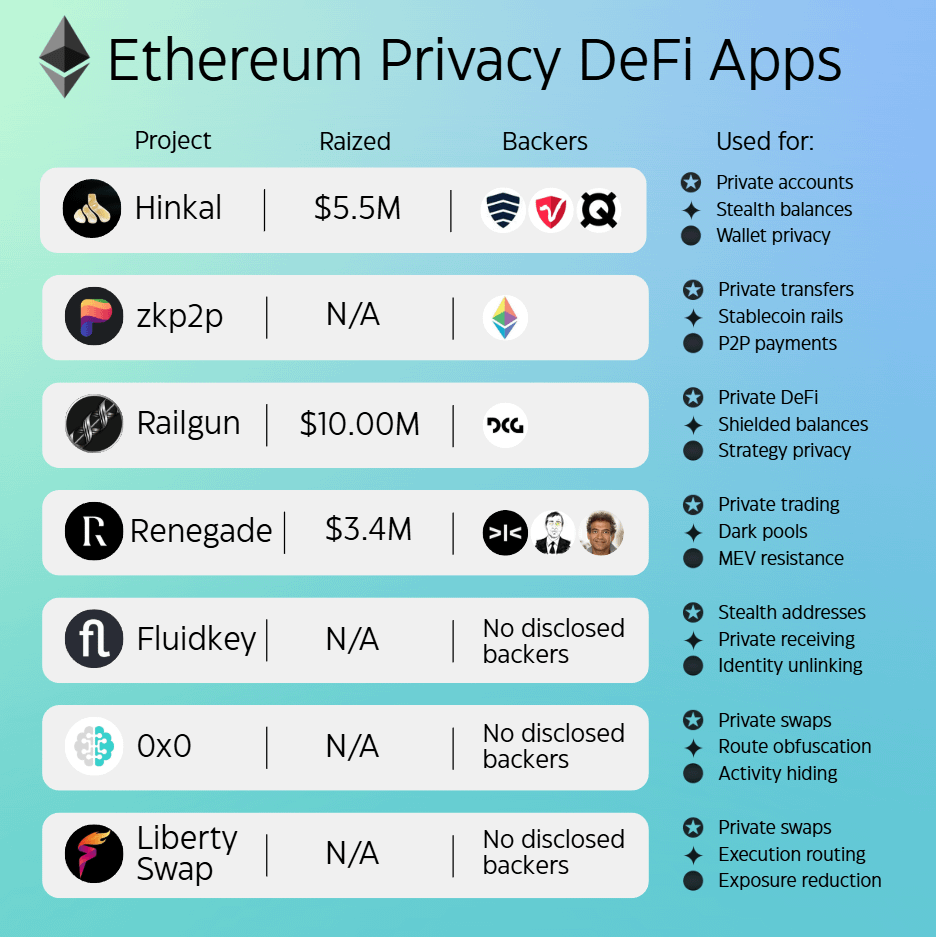
7 Ethereum privacy DeFi apps before the crowd arrives:
1. @hinkal_protocol
Private accounts on Ethereum. Stealth balances, shielded interactions, and account abstraction combined. Protects users at wallet and execution level, not just swaps.
2. @zkp2p
ZK-powered P2P rails for stablecoins. Private transfers and onramps without leaking balances or counterparties. Simple, aligned with real usage.
3. @RAILGUN_Project
Private interaction layer for existing DeFi. Trade, lend, or rebalance on Uniswap, Aave, and others without exposing balances or strategy. Privacy without leaving Ethereum.
4. @renegade_fi
Dark-pool style onchain trading using MPC. Orders, balances, and execution hidden while settling on Ethereum. Built for serious size, not retail.
5. @fluidkey
Privacy-focused payment tooling for Ethereum. Stealth addresses by default, clean UX, minimal abstraction. Solves a basic but real privacy problem.
6. @0x0Exchange
Privacy-oriented DEX and routing layer. Obfuscates swap paths and user activity. Practical execution privacy over ideology.
7. @LibertySwapFi
Privacy-preserving swaps with routing designed to reduce traceability. Early stage, but built around the idea that DeFi users don't want history indexed forever.
That’s why #0x0 hits different.
Not a “privacy tool” — a full modular, chain-agnostic privacy layer: stealth addresses, encrypted txs, relayers, private DeFi… the whole stack.
If you’re looking for where the exponential actually lives, it’s here.
@0x0exchange is the final PvE.