🍿BREAKING NEWS🍿
HUGE THANK YOU to @DORKpodcast & @RVonD!
From now on the Annual Dorky Award for the “Movie That Needs To Be Seen in the Best Cinema Possible” will be called
“The Bright Side Home Theater Award”
What an honor!
Click here to hear what movie takes the award home for 2024!
https://t.co/OTLpvumLqw
And while you’re there don’t forget to RATE, REVIEW AND SUBSCRIBE!!
**** MONDAY SHOW ALERT ****
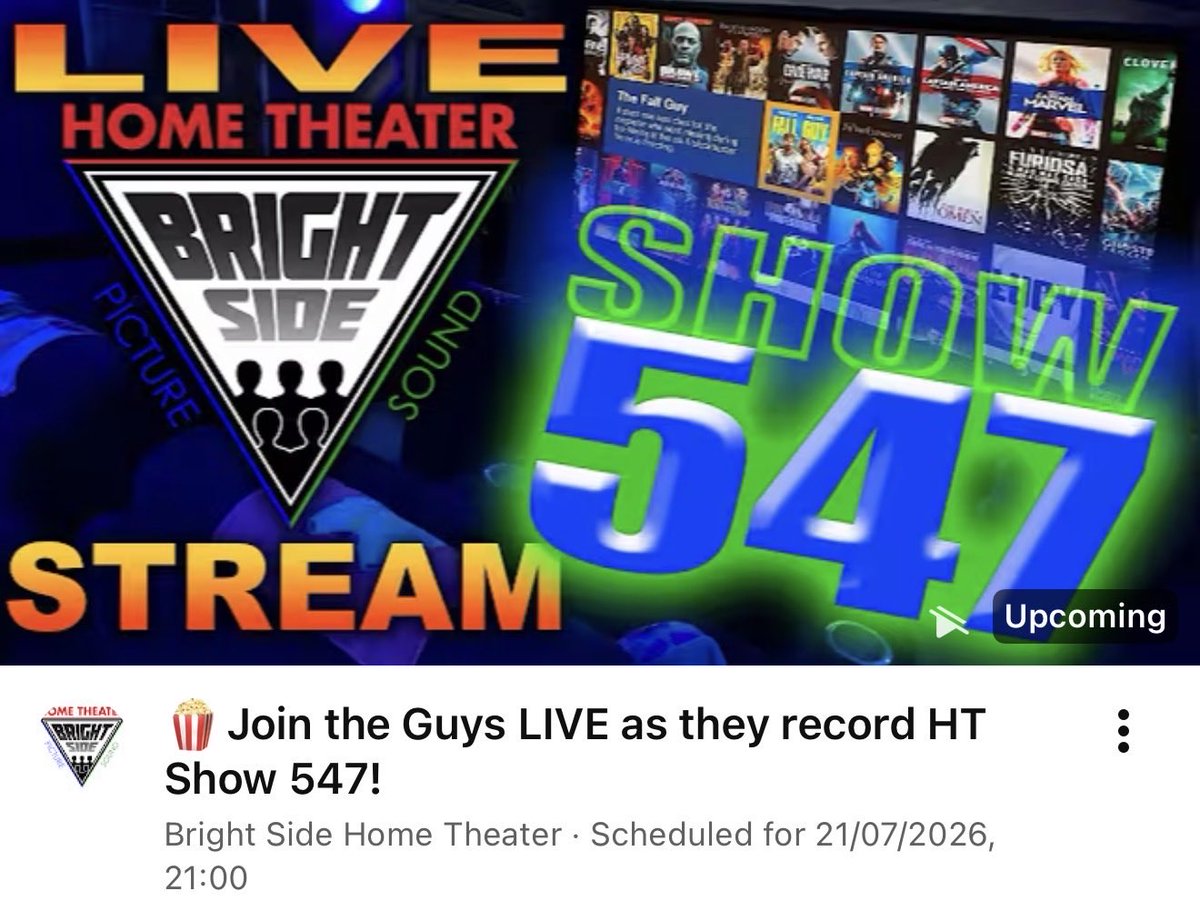
Hey HT guys n gals! Because of ‘life’, this week’s @BrightSideHT LIVE show will be tonight…
This week: AWESOMENESS!! 😀😀
🍿🍿 Join us LIVE on YouTube at 1pm (PST)/ 3pm (CST)/ 4pm (EDT) & 9pm (GMT) 🍿🍿
https://t.co/78AyxlZXwZ
Matt Damon jokes he only landed Christopher Nolan’s movie because every other A-list star passed. 😂
Matt Damon: “Chris usually works with actors he already knows.”
“My competition was Christian Bale, Tom Hardy, Leonardo DiCaprio, Matthew McConaughey, John David Washington, Robert Pattinson, Hugh Jackman, and Cillian Murphy.”
“They all would’ve been fantastic.”
Christopher Nolan: “And they all passed!”
Matt Damon: “I thought, ‘He’s finally looking outside his usual group I better take this before he calls Josh Brolin, Benicio del Toro, or Sean Penn.’” 😂
Just 41 IMAX 70mm theaters generated $6.3M for The Odyssey, averaging an incredible $153K per screen.
Despite representing only 0.3% of all IMAX screens worldwide, they accounted for 12.2% of the global IMAX box office.
(via @Luiz_Fernando_J)
I think we are witnessing the test program of whether this is a viable business model or not…. Oppenheimer had 30 70mm IMAX Theaters that were sold out. They expanded their theaters by 30% and it paid off with The Odyssey having them all sold out. I wouldn’t be surprised if we had 60 70mm IMAX theaters, ready for the next Nolan film. Movie fans are voting with their wallets. Look online and try to find ticket, never mind and good ticket, to The Odyssey in 70mm IMAX. It’s viable for sure. It’s not meant for the masses but we definitely need more than 41 in the world.
The entire movie is shot on film and everything scanned digitally. They edit the movie digitally first. Then based off the digital edit of the film they know EXACTLY, to the frame, where to cut and paste the actual FILM. Once the actual film was edited it is then reproduced for each of the 41 theaters. The 70mm film version was NEVER in digital form. It was filmed, edited and shown on 70mm film.
Hey there HT nerds! Tonight, we return to our regular Tuesday show…
We have some AWESOME HT experiences to share with you!!
🍿🍿 Join us LIVE on YouTube at 1pm (PST)/ 3pm (CST)/ 4pm (EDT) & 9pm (GMT) 🍿🍿
https://t.co/iaPsidWyy0
🍿TODAY @ 4PM ET🍿
Join @LegalBeagleOK and me for this Special Edition HT Show featuring The Odyssey!
-How does the IMAX 70mm presentation compare to a Barco Laser Projected Presentation?
-How does the IMAX 6 Track Audio Compare to the "Atmos" Track?
-What do you think of the movie?
-Does the Presentation Matter?
-Constant Height vs Constant Width Screens
https://t.co/dZphwxAjZW… via @YouTube@imax @imax70mmfilm @theodysseymovie #ShotWithIMAXFilmCameras @AppleCinemas #TheOdysseyMovie #ChristopherNolan #TheOdyssey
@JohnnyFocal
Exactly. The mistake is treating aspect ratio as nothing more than the shape of a rectangle.
The essential composition is protected across the different ratios, while the expanded 1.43:1 image extends the environment into the viewer’s peripheral vision. That is where the additional image belongs: around the central action, creating immersion rather than supplying missing narrative information.
The complete IMAX experience depends on screen scale, curvature, seating distance and viewing angle-not aspect ratio alone. Put the same 1.43:1 image onto a smaller conventional screen and you have preserved the image area, but not the experience. Scope presents a window; full IMAX is designed to make the edges of that window disappear
I think people should try and think of it this way, the term “FRAMING” is referring to how you frame a picture. Movies are typically framed so you feel like you’re looking through a window into another world. The composition of the subject in the scene is placed within the frame to set the mood or direction the Director is looking for the viewer to see.
Seeing The Odyssey in a typical scope aspect ratio is like watching the movie through the window of a boat. Seeing The Odyssey in 70mm IMAX is like stepping out onto the deck of the boat and seeing the same thing. The subject matter and framing of every shot is exactly the same but in 70mm IMAX there’s really NO FRAME. It’s meant to be more like a cinema version of an infinity pool where you don’t see the edges.
This is why you can’t just take that same IMAX aspect ratio and put it on a scope screen and get the same experience. You would see the edges and the framing would look like you’re actually looking through a smaller window which is the exact opposite of the intent of the taller aspect ratio.