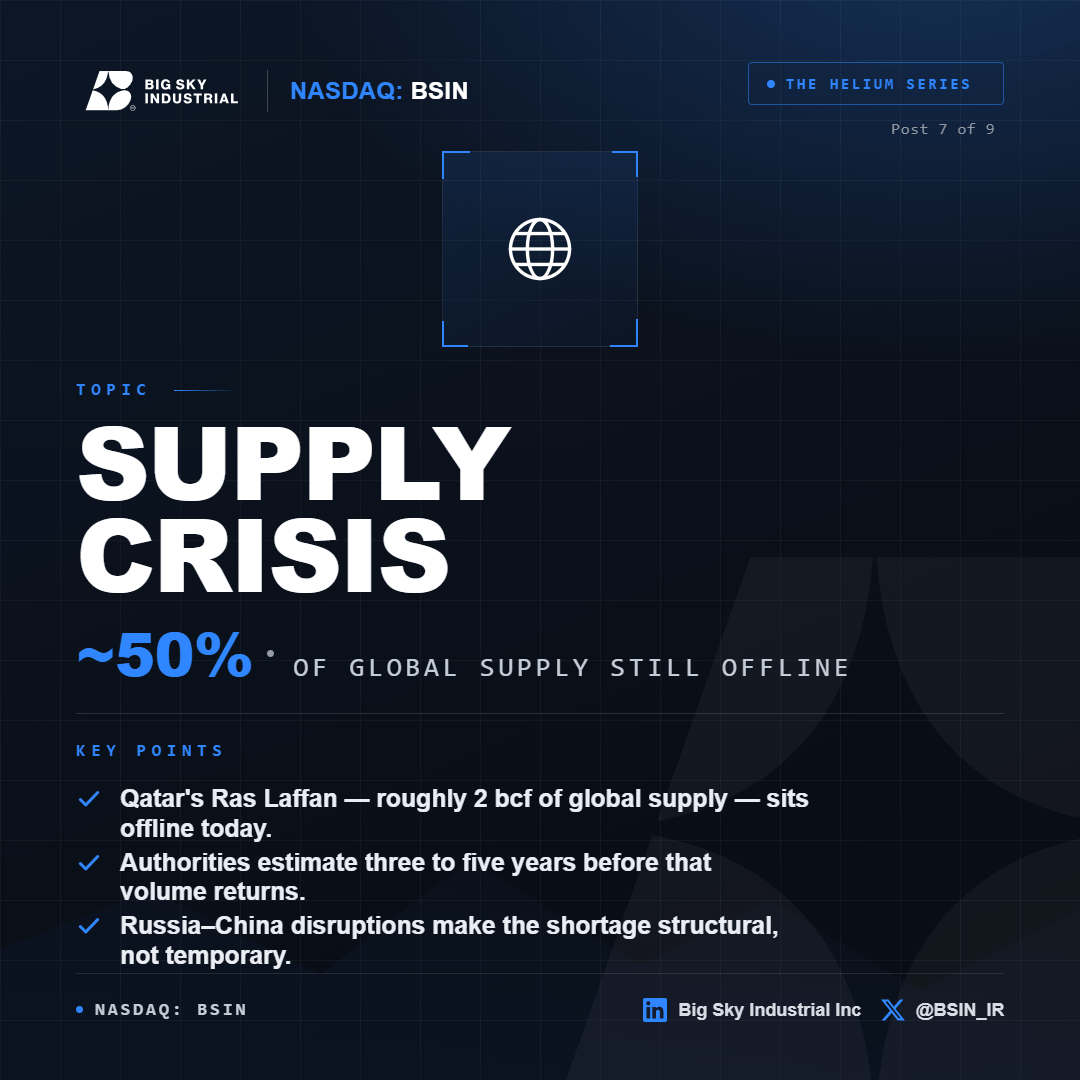
The helium supply crisis isn't resolved when the Strait of Hormuz reopens. That's the part most people are missing.
Qatar's Ras Laffan — roughly 2 bcf of global supply — is offline. Industry experts estimate half of global helium supply remains unavailable today. Qatari authorities say three to five years before it returns. Then add Russia-China supply disruptions on top.
The Strait reopening is a separate, complex problem. The helium shortage is structural and long.
Domestic contracted product. That's the only answer.
$BSIN #Helium #SupplyChain #CriticalMinerals #DomesticEnergy
Most don’t yet appreciate the strategic importance of the Titan Project and the valuable Xenotime mineral to U.S. supply chain security — or how Tennessee’s Big Sandy Critical Minerals Province could become the rare earth and critical-minerals equivalent of America’s Permian Basin.
The true rare earth supply shortage is heavy rare earths — especially dysprosium, terbium and yttrium. These are the vital elements required for high-temperature permanent magnets, radar, semiconductors, advanced ceramics, hypersonics, aerospace and advanced defense platforms.
This is why xenotime matters. Xenotime is the most strategically valuable rare earth minerals because it is highly enriched in yttrium and key heavy rare earths.
Light rare earth-dominant mines and projects can produce large volumes of total rare earths, but they do little to solve the real U.S. supply-chain vulnerability: secure supply of the heavy rare earth elements Dy, Tb and Y.
That is also China’s hidden strategic weakness.
China may dominate rare earth separation, processing and magnet manufacturing, but its domestic heavy rare earth resource base is nearly depleted. China is now reliant on imported heavy rare earth feedstocks from Myanmar and Southeast Asia.
The U.S. response should not be limited to building downstream processing and permanent magnet capacity. Downstream manufacturing is only as secure as the upstream feedstock that supplies it.
America urgently needs secure, long-term domestic heavy rare earth mineral feedstocks.
That is where Titan and the large-scale Big Sandy Critical Minerals Province become strategically important.
Titan’s xenotime-based heavy rare earth concentrate is enriched in dysprosium, terbium and yttrium — the exact elements that light-dominant rare earth mines and projects cannot supply.
Titan is just the first high-grade rare earth and critical mineral project in Tennessee, and the bigger story is ‘Big Sandy’.
The Permian Basin helped underpin American energy dominance because it was not simply one well — it was a vast, repeatable, infrastructure-rich resource system. The pre-eminent Big Sandy Critical Minerals Province has the potential to underpin the next era of American industrial power.
IperionX, Titan and Big Sandy are the cornerstones for long-term American supply security across heavy rare earths, titanium and zircon minerals. These are the critical feedstocks that can underpin the most important U.S. defense, aerospace, semiconductors, nuclear, robotics and advanced manufacturing technologies.
Temporary “unnatural “ selling makes zero difference in the long run. I am completely familiar with SPAC mechanics…the truth is the selling - if in fact it happens-will only improve the liquidity of the stock, allowing for broader ownership. The selling for reasons of profit in this case have nothing to do with fundamentals, on which the company should be evaluated
Transocean $RIG update.
The Transocean Equinox will remain employed in Australia after its current program.
This confirms that the market for high quality semisub rigs remains tight. Santos had been looking for a suitable rig since early 2025, which means operators have to plan early if they want access to good equipment.
The region is also interesting because it is close to the Dorado oilfield development. If the Bedout prospects work, this could open the door for more work later.
This is not a massive contract, but it means the rig likely stays busy instead of returning idle to the market.
$LUMN
الكل مركز على شركات الذكاء الاصطناعي اللي تصنع الشيبات.
لكن من ينقل كل هالبيانات بين مراكز البيانات؟
هنا تدخل LUMN.
إذا كانت NVIDIA تبيع المحركات ف LUMN تحاول تكون من الشركات اللي تبني الطرق السريعة لبيانات الذكاء الاصطناعي.
وهنا سبب اهتمام السوق بالسهم.
$SES has a lot more room to move. It’s a future $AMPX level stock with three distinct business components (drones, ESS, SaaS). Add some positive news from partnerships and/or their Molecular Universe SaaS and it will move past its previous issues. Investors concerned about the class action potential should look at how $AMPX has the same version of class action brewing.
IperionX scaling next-generation titanium manufacturing in Virginia, USA
New high-productivity uniaxial press and the cold isostatic press marks key milestones in advanced titanium powder metallurgy and manufacturing
Lower waste, lower cost high-performance titanium via HAMR and HSPT - built with American technology and innovation
Building the defence-grade titanium supply chain America urgently needs. $IPX
We're pleased to announce assay results from the 6 previously reported Vault Zone drill holes at the Tamarack Project.
These assays confirm high-grade nickel-copper mineralization across multiple areas of the Vault Zone as our team continues to evaluate the mineralized system.
Read the full press release: https://t.co/3tKbjhw5UO
#Nickel #CriticalMinerals $TLO $TLOFF
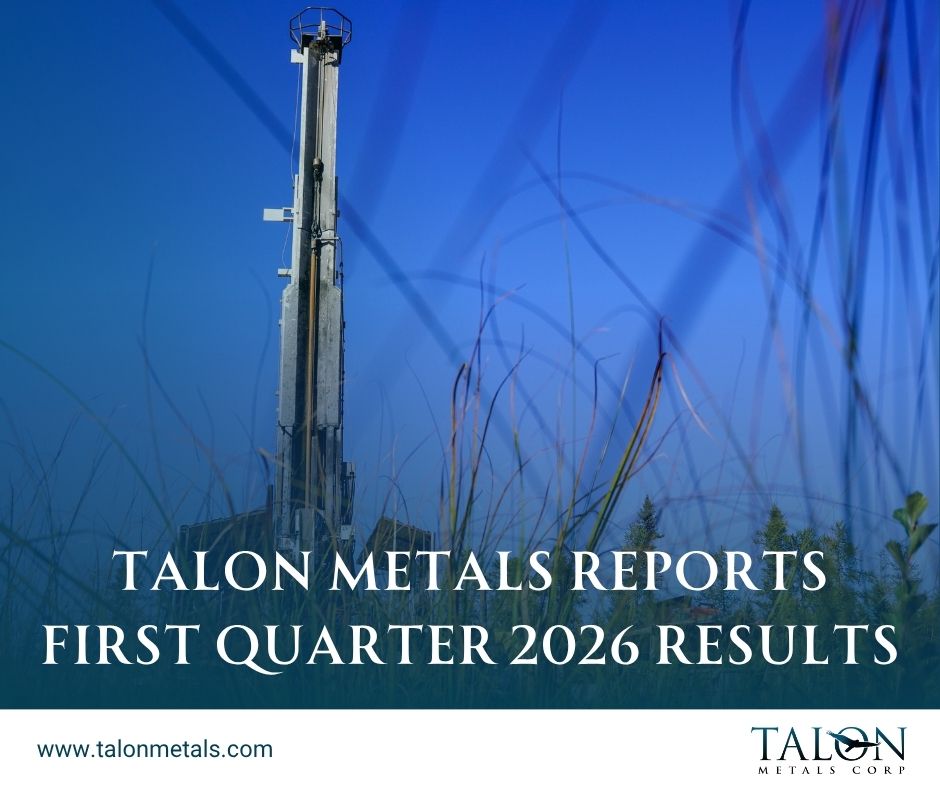
Talon has released its first quarter 2026 financial results.
The quarter included the company’s first results following the acquisition of Eagle Mine and the Humboldt Mill, with continued focus on safe operations, integration, and advancing Talon’s broader critical minerals strategy.
Read the full release: https://t.co/CdQDHDjnKh
#TalonMetals $TLO @EagleMine_MI
The two different fleets of Transocean and Valaris underscore the complementary nature of their *proposed* merger. The key differences are RIG's seven Norway-eligible semisubs — an asset class absent from Valaris' fleet — and VAL’s ~35-unit jackup fleet, which RIG lacks entirely.
(1) Comparatively, a hypothetical Valaris-Noble combination would combine two more similar, 7G drillship-heavy fleets. While the fleet chart depicts six of the larger drillers, other drillers exist including Saipem, Stena, Foresea, Ventura, Eldorado, Vantage, Northern Ocean and others. Also, NOC’s such as TPAO (Turkey) and Sonangol (Angola) own their own fleets.
(2) If the $RIG $VAL merger is approved, a common question is what Transocean should do with the jackup fleet? Contract drillers are similar to equipment rental businesses, and like financial entities, their equity value creation comes down to their ability to earn returns on their assets that exceed their cost of capital. Transocean retaining VAL’s jackups post-merger could be a meaningful lever in lowering its cost of capital: the geographic diversification into shallow water markets provides more stable through-the-cycle cash flows, which rating agencies and credit investors reward with lower financing costs, ultimately compressing the cost of capital and improving returns to equity.
(3) After navigating soft demand conditions from 2025-1H26, the market recovery is materializing broadly as anticipated. The drillship market has several multiyear tenders representing incremental demand — notably Indonesia, as well as Mozambique and Namibia where formal FIDs have yet to be taken but are likely. While awaiting regulatory approval on the Transocean merger, Valaris is likely marketing one or two of its cold, “stranded newbuild” 7G drillships, DS-13 and DS-14, acquired in Dec ‘23 for $337 million via purchase options negotiated with the shipyard during VAL’s bankruptcy.
(4) A key question on TotalEnergies’ two-rig Namibia (Venus) tender will be if they choose to use a harsh environment semisub (NOL’s Mira) or two drillships? Namibia can have seasonally harsh environment conditions but drillships are capable of operating in the environment. NOL’s Mira is a candidate for Total’s upcoming Mopane 2-3 well appraisal campaign in Namibia likely commencing in 4-5 months.
$SLNH Q1 confirms the transformation is happening.
Soluna is rapidly shifting from a Bitcoin mining story into a power-backed data center infrastructure play.
Revenue grew from $5.9M to $9.4M YoY, but the real signal is the mix shift:
Data hosting revenue jumped from $2.4M to $6.7M and now represents 70%+ of total revenue.
That is a major inflection point.
This is exactly what investors should want to see: Soluna converting its energy-first model into scalable hosting revenue while positioning itself for the AI/HPC boom.
Dorothy 2 and Kati are now contributing revenue, the balance sheet is much stronger, and the company is advancing massive 300+ MW AI/HPC opportunities at Kati 2 and Dorothy 3.
The market still seems to price $SLNH like a small miner.
But the business is evolving into something much more valuable: a power-constrained AI infrastructure platform.
Next major validation: AI/HPC customer, hyperscaler/neocloud deal, JV, or project financing.
https://t.co/FdmEeNvUnK
$LUMN initiating coverage at BUY fair value 10x EBITDA or $17. you can't have AI without transport and connectivity. Comp $CCOI multiple supports even higher targets.
At $100/bbl Brent, energy offers some of the most differentiated stories in high yield credit and not all are positive.
Thoughts on Odfjell, Transocean, Comstock, Azule, TGS and Petrobras: the other Central Bank of Brazil 🇧🇷
Odfjell Drilling (B1/B+): On April 18th, the Deepsea Atlantic dropped its blowout preventer (BOP) to the seabed in 1,100m water depth at the UK's Rosebank field, forcing a suspension of operations. No updates have been provided since. Odfjell reports earnings on May 12th, which should provide some clarity on the duration and financial impact of the downtime. The rig had been earning ~$460k/day, and a prolonged suspension could reduce 2026 EBITDA by 5–10%. Despite ODL's strong track record and top-tier fleet in a healthy NCS market, Tuesday's update will be closely watched.
Transocean (B3/B-) is successfully executing on its stated deleveraging strategy, reducing net leverage to approximately 3x. A near-term focus is receiving regulatory approvals on the proposed Valaris merger and closing by year-end. I do not believe a Transocean-Valaris merger is anticompetitive, as the global market has an adequate amount of competitors.
Comstock’s (B3/B) Western Haynesville spending program should make credit investors nervous. The nat gas E&P is burning cash and yielding weak drilling results in the controversial Western Haynesville. In March 2026, Comstock announced Western Haynesville gas would feed a natural gas-fired power generation hub built by NextEra to power data centers as a part of a $550B US-Japan trade deal. With commercial terms still unresolved, Comstock appears content to continue delineating the play and refining drilling techniques ahead of what it expects to be peak data center demand, but the weak well results and elevated water volumes are difficult for less patient investors to look beyond.
Azule Energy (B2/B) is an E&P alternative with credit spreads of ~260 on its 2030s. Azule is the 50/50 JV of BP and Eni and is a deepwater E&P in Angola. Azule’s recent Algaita-1 was a 500mm bbl oil in-place discovery in Block 15/06 near an existing FPSO for capital-efficient investment. Azule is also currently appraising its Capricornus discovery in PEL 85 Namibia, arguably the country’s best discovery to date although may eventually be followed by a large capex program considering it would be a greenfield project.
TGS (Ba3/BB-) has good spread for its rating, partly due to investor distaste for marine seismic industry. Regardless of your view on volatile offshore exploration demand, this industry has consolidated significantly and TGS has ~40% market share. TGS produces free cash flow, has net leverage below 1.0x and I believe advances in data processing via artificial intelligence makes their seismic data library more valuable, although is still in early stages.
Petrobras (Ba1/BB) is the Central Bank of Brazil under a theoretical Bretton Woods 3 framework and will be ramping up its world-class Búzios field in the next 12-24 months. PBR’s Santos Basin E&P also includes the Tupi and Mero fields.