@daverichard Currently 0-3. I have Hampton and Swift as my RBs and Amon, Parker, Tee Higgins, Nabers, Burden, and Boston as WR depth. I need help upgrading my RBs. Thoughts on what I can get for Hampton + Higgins or Hampton + Burden? Or do I just go straight swap Hampton for Tuten or Bucky?
I was sad about losing a
friendship.. then i learned about the campfire theory
Imagine you're sitting around a campfire.
Throughout the night, people come and go.
Some pull up a chair for five minutes before heading home.
Some stay for hours, laughing and telling stories.
Some leave early because they have somewhere else to be.
And a few remain until the very last ember burns out.
The dishes are in the sink because people ate.
The shoes are by the door because people came home.
The toys are scattered everywhere because people were happy.
Some of the mess is proof of a good life.
Stay grateful.
Thirty-six years ago, two men dressed as police officers cut Jesus out of His frame with a blade.
March 18, 1990. Boston. 1:24 in the morning.
They walked into the Isabella Stewart Gardner Museum, tied up the guards, and spent 81 minutes taking whatever they wanted. Thirteen works of art. Half a billion dollars.
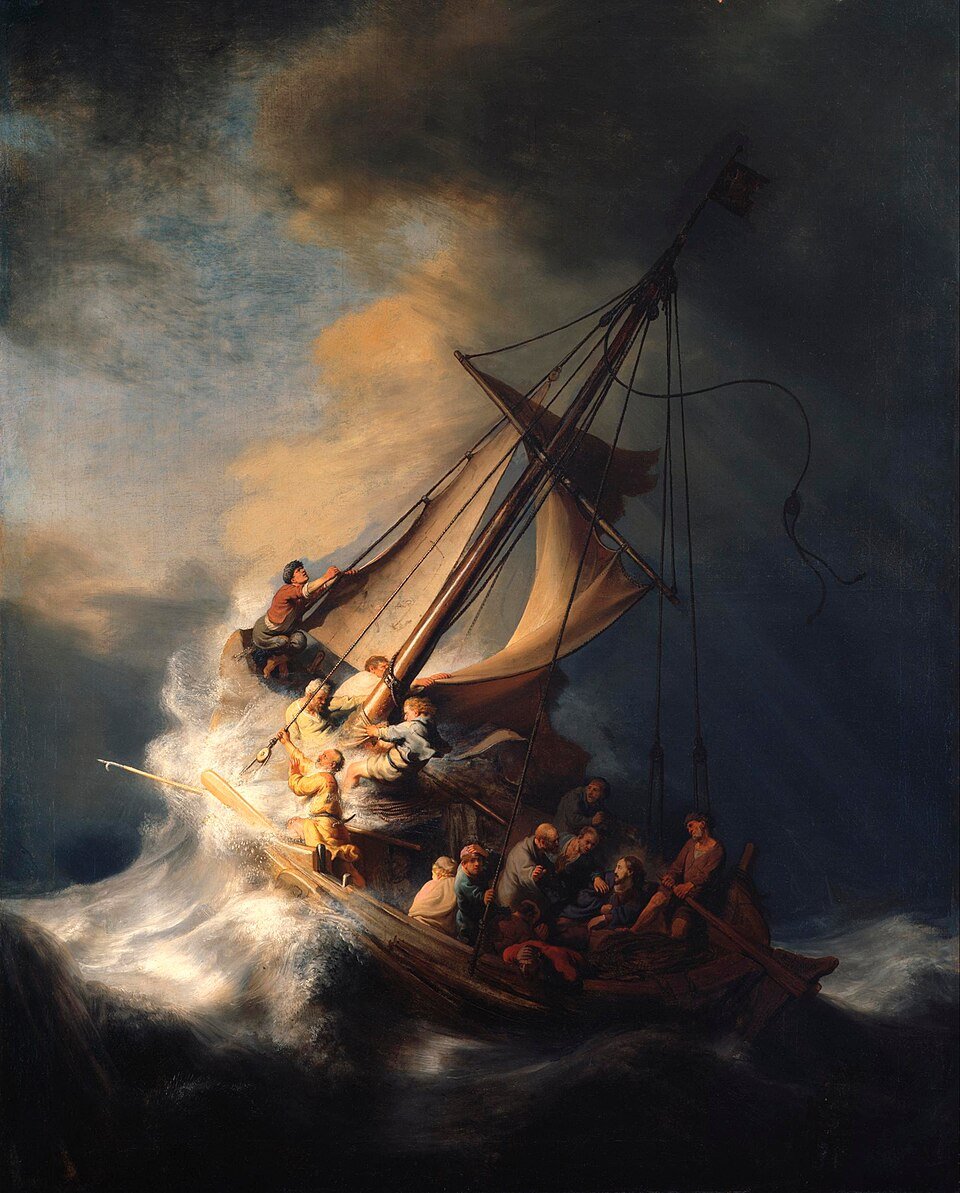
One of them was Rembrandt's The Storm on the Sea of Galilee.
Painted in 1633. The only seascape Rembrandt ever made. And he spent it on Mark chapter 4.
Look at what he painted.
A fishing boat tipped almost sideways. A wave breaking over the bow like a fist. The sail tearing loose. Men hauling on ropes that are winning against them. One disciple leaning over the rail, sick into the sea. Grown men. Fishermen. Men who had worked that water their whole lives, and their faces say they know this is the night it kills them.
And in the stern, in the one patch of calm light in the whole canvas, Jesus.
Asleep.
Mark 4:38. And he was in the hinder part of the ship, asleep on a pillow: and they awake him, and say unto him, Master, carest thou not that we perish?
Carest thou not?
That's not a question. That's an accusation. Screamed over wind by men who watched Him heal lepers a week earlier.
Now count the men in the boat.
Twelve disciples. Plus Jesus. That's thirteen.
Rembrandt painted fourteen.
Look at the middle of the boat. One man is holding the rigging with one hand and his cap with the other. He isn't fighting the sail. He isn't bailing water. He isn't looking at the wave, and he isn't looking at Christ.
He's looking straight out of the canvas. At you.
It's Rembrandt. He painted his own face into the storm.
A 27-year-old Dutchman put himself in a boat on the Sea of Galilee sixteen centuries after the fact, because he understood something most people miss when they read Mark 4.
This story doesn't have thirteen men in it.
It has every man in it.
You're in the boat. You've been in the boat. The night the phone rang. The diagnosis. The marriage taking on water faster than you can bail. Wind you didn't ask for and can't argue with. And the same accusation rising in your throat that rose in theirs:
Carest thou not that I perish?
And He stood up in the boat, and rebuked the wind, and said unto the sea, Peace, be still. And the wind ceased, and there was a great calm.
Then He turned to them and asked the question that should still sting:
Why are ye so fearful? How is it that ye have no faith?
Not: Why did you wake me? Not: Why are you in a storm?
Why are you afraid with Me in your boat?
The painting has never been found.
The FBI searched for decades. Ten-million-dollar reward. Nothing. Somewhere in the dark: a warehouse, an attic, a wall it was never meant to hang on, that storm is still frozen mid-wave. And the museum never replaced it.
The empty frame still hangs in the same spot on the same wall in Boston. It has hung there empty for thirty-six years. Waiting for what belongs in it to come home.
Sit with that.
Because that's God.
He doesn't take the frame down. He doesn't hang something else in your place. However long you've been missing, however dark the room they're keeping you in, the space you were made for is still on the wall.
Thieves can steal the painting.
Nobody has ever stolen the Man in it.
He's still in the stern of every boat that carries His people. And the storm still needs His permission.
Peace. Be still.
Jesus performed roughly three dozen recorded miracles. Only one of them appears in all four Gospels. Not the raising of Lazarus. Not walking on water. Not even the healing of the blind. The one miracle that Matthew, Mark, Luke, and John all insisted on telling is the feeding of the five thousand. When four independent accounts of Jesus' life, written for different audiences with different emphases, all refuse to leave out the same event, it is worth asking why.
Start with the setting. Jesus has just received devastating news: John the Baptist, His cousin and forerunner, has been beheaded by Herod. He withdraws by boat to a remote place, seeking solitude to grieve. But the crowds see where He is going and run ahead on foot around the shore of the Sea of Galilee. When Jesus lands, expecting emptiness, He finds thousands waiting. And the Gospel says He looked at them and was moved with compassion, for they were like sheep without a shepherd. He does not send them away. He heals their sick and teaches them until the day is nearly gone.
Then the practical crisis arrives. The disciples come to Him with the obvious solution: send the people away to buy food in the villages. It is late, the place is remote, and the crowd is enormous. Matthew records five thousand men, besides women and children, meaning the real number may have been ten to fifteen thousand people. Jesus' answer is one of the most quietly staggering sentences in the Gospels: "They do not need to go away. You give them something to eat."
John's account adds a detail the others leave out. Jesus turns to Philip and asks where bread could be bought for so many, and John notes that He said this to test him, for He Himself knew what He would do. Philip does the math and despairs: two hundred denarii, roughly eight months of a laborer's wages, would not buy even a mouthful for each person. The need is beyond any reasonable resource. That is precisely the point of the test, and Philip, like most of us, sees only the arithmetic.
Then Andrew brings forward the most unimpressive offering in Scripture: a boy with five barley loaves and two small fish. Barley was the grain of the poor, the cheap bread, and the fish were likely small dried or pickled fish, a peasant's lunch. Andrew himself seems embarrassed by it: "but what are they for so many?" Everything about the offering is insufficient. A child. Poor man's bread. A portion for one. Set against fifteen thousand hungry people, it is almost a joke.
And this is what Jesus takes. He does not conjure food from nothing, though He could have. He takes what is offered, blesses it, breaks it, and begins to give. The verbs matter: He took, He blessed, He broke, He gave. These are the exact four verbs the Gospels will use again at the Last Supper, when He takes bread, blesses it, breaks it, and gives it, saying, "This is my body." The feeding on the hillside is a deliberate foreshadowing of the cross, written in the grammar of the text itself.
The people eat. All of them. The Gospels say they were satisfied, the Greek word implying they were filled completely, not given a polite taste. And then comes the detail all four writers preserve: twelve baskets of broken pieces left over. Twelve, one for each tribe of Israel, one for each disciple who had doubted. The God who fed Israel with manna in the wilderness is feeding a new multitude in a desolate place, and the abundance is so great that the leftovers exceed the original supply many times over. With Jesus, the surplus after the miracle is greater than the total before it.
The crowd understands exactly what they have witnessed. John records that the people begin saying, "This is indeed the Prophet who is to come into the world," a reference to Moses' promise in Deuteronomy that God would raise up a prophet like him. Moses gave manna in the wilderness; here is One doing the same. They are so certain that they move to take Him by force and make Him king. And Jesus, refusing the crown offered on their terms, withdraws alone to the mountain. He will be made King, but by way of a cross, not a coronation.
The story has a sobering final act that most retellings skip. The next day, in the synagogue at Capernaum, Jesus confronts the same crowd that chased Him around the lake: "You are seeking me, not because you saw signs, but because you ate your fill of the loaves." Then He preaches the sermon the miracle was pointing to all along: "I am the bread of life; whoever comes to me shall not hunger." The teaching is so hard, so demanding, that John records the outcome bluntly: from that time many of his disciples turned back and no longer walked with him. The crowd that wanted a bread king by the thousands dwindled to twelve men, and Jesus asks even them, "Do you want to go away as well?" Peter's answer still stands as the confession of every believer since: "Lord, to whom shall we go? You have the words of eternal life."
To the world, this is a charming story about sharing, and some modern skeptics have even tried to reduce it to exactly that, a crowd inspired to open their picnic baskets. But that is not what any of the four accounts describe, and it is not why thousands tried to seize Him and crown Him by force. Something happened on that hillside that fifteen thousand eyewitnesses could not explain away. Bread multiplied in His hands.
Here is what it means for you. The need in front of you may be beyond any reasonable resource. The math may be hopeless, as it was for Philip. And what you have to offer may look like five barley loaves, small, poor, laughably insufficient. Bring it anyway. The miracle never depended on the size of the offering, only on the hands it was placed into. He took the lunch of a child and fed a city with it, and there were twelve baskets left over.
He is not a Savior of scarcity. He fills until they are satisfied, and then keeps going.
Jesus is the Bread of Life, broken so that you would never go hungry. Thank You, Jesus.
Imprisoned fathers at Angola Prison spend Father's Day outside of prison with their sons, thanks to Christian organization 'God Behind Bars.'
For some fathers, it was the first time they had ever spent a whole day with their sons.
62 boys got to fish, play sports, and BBQ with their dads, many for the first time.
"Each dad wrote his son a personal letter and handed him a Bible to take home. Words of love, apology, hope, faith, and legacy were shared face to face..." the organization said.
Awesome.
Mauricio Ruffy after winning has a message for everyone!
"John 3 :16 says For God so loved the world that he gave his one and only Son, that whoever believes in him shall not perish but have eternal life. Jesus saved my life, he wants to save your life too. Give your life to Jesus"
Incredible at UFC Freedom 250 🙏 🇺🇸