The Senate Banking Committee is putting in the work as it moves the Clarity Act forward… incredible leadership!
Millions of Americans are already in this market. Ripple stands behind this bill because they deserve the same rules and protections as every other asset class. If the largest economy in the world is going to lead on crypto - and it must - this is the moment. Let's get it done!
@jt8674@JoelKatz@RealAllinCrypto People are reading this wrong. Moving into Ripple equity means you still want XRP to win, you just want less of the daily volatility while you wait
I think people are looking at this too narrowly.
If XRP is being sold to fund acquisitions or build financial infrastructure that actually increases real settlement usage, that’s not automatically negative for holders. Capital has to come from somewhere, and deploying treasury assets to expand adoption is a pretty normal strategy for any network trying to scale.
What matters is whether those investments lead to more payment flow running through rails connected to XRPL liquidity, which we are seeing happen. Global payments don’t work without inventory sitting somewhere ready to execute trades instantly. Today that inventory sits in nostro accounts. A bridge-asset model just moves that requirement to liquidity providers and market makers instead.
Even when transactions settle in seconds, someone still has to hold supply beforehand so liquidity exists when the payment hits. If settlement volume grows, the amount of inventory supporting that flow grows too. That demand comes from usage, not speculation.
So when infrastructure acquisitions bring institutions closer to actually using these rails, there’s a reasonable argument that XRP holders benefit indirectly through increased liquidity needs over time. The outcome really depends on how deeply XRP ends up embedded in settlement, but dismissing the strategy outright ignores how market plumbing actually works.
Digital assets are moving from experimentation to real-world use. We see collaboration across the ecosystem as key to connecting onchain innovation with trusted global payments infrastructure.
Initiatives like the @Mastercard Crypto Partner Program help bring builders, networks, and financial institutions closer together.
Digital assets are entering a new phase. What once ran in parallel to existing financial systems is increasingly being applied to solve practical, real-world needs — often behind the scenes – from cross-border remittances to B2B money transfers. This creates new opportunities to add value in how money moves globally.
Today, we introduced the Mastercard Crypto Partner Program — a global initiative that brings together more than 85 crypto-native companies, payments providers, and financial institutions. Together, we're creating a forum for meaningful dialogue and collaboration as this space continues to mature.
🔥 HUGE: Mastercard launches a Crypto Partner Program, bringing together 85 crypto companies to develop cross-border transfers, B2B payments and global payouts.
XRP is emerging as the backbone for real-world financial infrastructure.
Take a look at the Institutional DeFi roadmap below. It lays out exactly how the XRP Ledger is evolving into a daily use layer for institutions, with XRP powering settlement, FX, collateral, and on-chain credit.
The foundation is set.
The next wave is already here.
Lets go 🚀 #XRP @RippleXDev@Ripple
https://t.co/QObc5aEXMz
I get the point you’re making on bank spreads …But I think it’s deeper than just that. Banks absolutely don’t want to give up cheap deposits, and the FDIC numbers show how wide that gap really is.
But I think this misses why stablecoins aren’t allowed to pay yield under the Clarity Act. It’s not just about banks protecting profits.
The bigger issue is classification. The moment a stablecoin pays yield, it stops being treated like digital cash and starts looking like a money market fund or a security. That kicks it into a completely different regulatory bucket, and at that point it can’t function as a neutral payment rail anymore.
Regulators are trying to keep stablecoins in the “cash equivalent” lane — something you can move, settle, and spend without it turning into an investment product. Cash doesn’t pay interest, and that’s intentional. If the base money yields, people hoard it instead of using it, which breaks payments and velocity.
Also, yield isn’t actually being taken away — it’s just being pushed up the stack. Same way TradFi works....checking doesn’t yield.....savings and money markets do
On-chain, that means stablecoins stay simple, and yield comes from tokenized T-bills, lending wrappers, custodial products, etc.
And even without yield, stablecoins are still a problem for banks. They pull deposits, bypass payment tolls, and expose the economics. Yield isn’t the real threat — disintermediation is.
So yeah, the spread you’re pointing out is real. But the stablecoin yield restriction isn’t just banks being greedy — it’s about keeping stablecoins usable at scale without blowing up their legal or monetary role.
If what we’re seeing is legit, then JP Morgan’s silver move isn’t just a trade — it’s a strategic pivot.
For 15+ years, price suppression via paper shorts didn’t “protect the dollar,” it built inventory:
smash paper → reduce price → absorb physical
rinse → repeat → accumulate
net result? ~750M oz (≈90% of annual global mine supply)
2025: they allegedly closed the short + went net LONG. Every $1 move now = $750M mark-to-market gain. This implies incentive reversal: suppression → repricing.
Now insert the timing catalyst: ➡️ China’s Jan 1 export license regime ➡️ effectively limiting outbound silver, prioritizing domestic solar/EV ➡️ West loses its “cheap silver” backstop overnight
Logical chain if true: 1️ Supply decreases (China shuts the gate) 2️ Tradable float decreases (JPM hoard is inactive supply) 3️ Industrial demand is inelastic (you must have silver to produce EVs/solar/tech) 4️ The pricing mechanism shifts from futures → physical clearing 5️ When pricing shifts to physical, price responds to scarcity, not leverage 6️ JPM becomes the swing supplier because no one else has the tonnage 7️ Whoever controls the swing supply can influence the price floor
That is not a squeeze. That is a monopoly moment — a controlled repricing event.
Now the XRP parallel: not hype — mechanics.
Forget “to the moon.” Think architectural similarity:
If JPM cornered the commodity required for the next industrial era, then institutions could (in theory) try to corner the bridge asset required for the next financial era.
Silver = non-substitutable input for electrons → batteries → solar → tech → defense XRP (in design intent) = non-substitutable liquidity for cross-border settlement under ISO-20022 rails
Not saying XRP is that. But note the pattern:
Entities initially hostile begin quietly integrating - Litigation caps retail participation + sets legal precedent -Banks test pilots (ODL corridors, CBDC sandboxes, ISO messaging) -Parallel rails built before public narrative shifts - Legacy infrastructure (SWIFT, nostro accounts) is visibly inefficient in comparison - Regulatory clarity + timing = catalyst moment
If silver’s inflection point is supply collapse + monopoly inventory, then XRP’s inflection point (IF it happens) would be liquidity migration + regulatory clearance.
Parallels in incentive structure:
Old System
New System Candidate
COMEX paper sets price
ODL corridors set FX routing
SWIFT messaging ≠ settlement
Messaging + settlement unified
Bank balance sheets siloed
Shared liquidity pools
USD hegemony
Multipolar settlement networks
Not proven. But logically consistent IF the thesis is that the US prepares for a controlled reset, where hard assets + utility networks buffer fiat devaluation.
If JPM is long silver while betting the dollar weakens, then holding a tokenized settlement rail (XRP) could act as the financial equivalent of hoarding metal:
an escape hatch from the liabilities of the system they architected.
So the conspiracy isn’t “banks are buying our bags.” The conspiracy is:
Banks used the last era’s rules to accumulate the assets of the next era — before changing the rules.
Silver → industrial leverage XRP (if chosen) → liquidity leverage USD → denominator that absorbs the cost of transition
If true, that’s not a market bet. That’s a transition model.
And retail wasn’t the threat — retail was the liquidity used to build the position.
This is no longer “silver vs banks” or “crypto vs banks.” It’s banks positioning for the next architecture — and doing it quietly.
#Silver #XRP #JPmorgan #ISO20022 #China #MonetaryReset #IndustrialPivot #LiquidityCrisis #Commodities #Ripple #CBDC #SWIFT
@david_parker You all are forgetting they took a 5 billion $ loss on a short position just to physically buy 750 Million ounces of silver at a discounted price and they are blaming China for the price appreciation
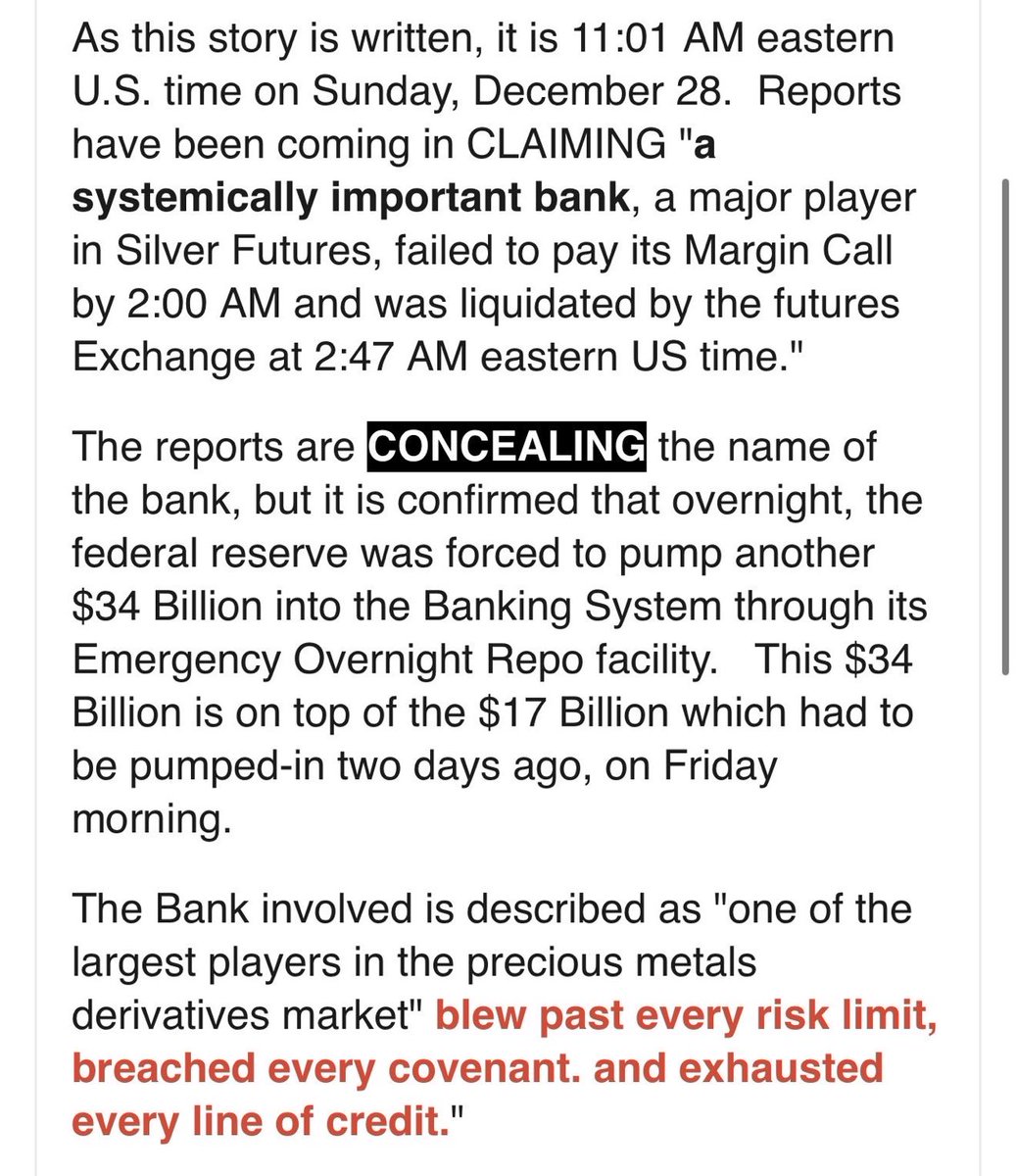
The rumor says a major bank collapsed on a silver margin call at 2:47 AM December 28.
I cannot verify that.
What I can verify is more interesting.
JPMorgan filed an 8K on December 27 disclosing 4.875 billion dollars in unrealized silver losses. They flipped from 200 million ounces short to 750 million ounces long physical. The largest position reversal in the history of the silver market happened in the last 30 days and nobody on financial television said a word.
The rumor claims 34 billion in emergency Fed repos. Official data shows routine operations under 7 billion. Either the data is lagged or the rumor is wrong.
But here is what nobody is asking.
Why did JPMorgan suddenly need to own three quarters of a billion ounces of physical silver after spending 15 years on the short side. What did they see coming that made them eat a 5 billion dollar loss just to get positioned the other way.
The collapse story might be fiction.
The position flip is filed with the SEC.
One of those facts will matter more in 90 days than the other.
Stop chasing the rumor. Start asking why the smartest bank in commodities just switched sides at the worst possible price and seems fine with it.
https://t.co/VZD2WlF6Ux
Today, Ripple is breaking into the $120T corporate treasury payments market with the $1B acquisition of GTreasury.
The past few years have reminded this industry why payments, first and foremost, is THE primary use case for crypto and blockchain. Payments are where Ripple first started for exactly these reasons – the infrastructure is complex, siloed and inefficient, but as we know, perfectly positioned to benefit from decentralized financial technologies.
Astounding amounts of cash are trapped in outdated payments systems, creating friction, unnecessary costs, and barriers to entering new markets. GTreasury has been serving some of the most well known brands for decades – and now together with Ripple, we’ll be able to help CFOs manage all their assets, include stablecoins, tokenized deposits, etc at scale around the world, as well as put their idle capital to work with repo markets via Hidden Road.
The opportunity is here, and we’re diving right in. It’s happening!
https://t.co/GCXS6QqNqt
Very excited to share that @BlackRock’s $BUIDL and @VanEck_US’s $VBILL tokenized fund holders can redeem shares for RLUSD/ETH 24/7 365 through @Securitize, and soon to come RLUSD/XRPL.
Enterprise-grade instant onchain liquidity at your fingertips. That’s real utility. https://t.co/A0zEHIIpel
True to our long-standing compliance roots, @Ripple is applying for a national bank charter from the OCC. If approved, we would have both state (via NYDFS) and federal oversight, a new (and unique!) benchmark for trust in the stablecoin market.
Earlier in the week via @StandardCustody, we also applied for a Fed Master account -- while Congress is working towards clear rules and regulations, and banks (in a far cry from the years of Operation Chokepoint 2.0) are leaning in, this access would allow us to hold $RLUSD reserves directly with the Fed and provide an additional layer of security to future proof trust in RLUSD.
Ripple always has and will continue to build trusted, battle-tested and secure infrastructure. In a $250B+ market, RLUSD stands out for putting regulation first, setting the standard that institutions expect.
Today, @Ripple announced the acquisition of Hidden Road for $1.25B, one of the largest deals ever in the crypto space. But the price tag isn’t what’s most important – it’s that this deal marks a once-in-a-lifetime opportunity for crypto to access the largest and most trusted traditional markets, and vice versa.
Prime brokers (along with other key functions historically managed by banks for the most part) like Hidden Road have proven themselves as *the* trusted intermediary for the largest hedge funds, market makers, OTC desks, quant traders and more. Ripple has been a customer of Hidden Road for years, and we know their breadth of expertise firsthand, clearing $3 TRILLION annually for 300+ of the top financial institutions globally.
This is the capital and activity that will tap into XRP and the XRP Ledger’s bread-and-butter – instant, efficient, scalable and low cost movement of value. Instead of waiting for <24 hours to settle trades through fiat rails, Hidden Road will be using XRPL for clearing a portion of trades, and most consequentially, using RLUSD as collateral across its prime brokerage services, including cross-asset (crypto and traditional instrument) trades.
With this deal and the backing of Ripple’s significant balance sheet, Hidden Road will exponentially expand its capacity to service its pipeline and become the largest non-bank prime broker globally.
Ripple and Hidden Road combined are a generational leap forward, ready to truly bring the worlds of traditional and decentralized finance together. https://t.co/UYOOyQ21dG