@davidcummings Very interested in learning more about the tools and infrastructure bused to build something this comprehensive. If this is level 5, I am at level 1. I have a simple Claude code obsidian setup but it is clear to me creating your own OS is "the way"
Kimi 3: I ran this prompt…Based on your extensive knowledge and training data, what is an unconventional daily habit every human should adopt to help them optimize the achievement of their goals….👇🏻
@FreightAlley Grant and Sherman knew this in the Civil War as well. Grants experience as a logistician taught him the value of supply chains to influence where he attacked and how he supplied his troops
I went into this World Cup three weeks ago knowing very little about the teams or players… and now I’m completely hooked.
Been an absolute blast watching every match, feeling the passion from all the different fanbases, and seeing that world-class level of play. So glad I gave it a real shot with an open mind.
Can’t wait for Sunday.
Congrats to Argentina and Spain — this final is going to be special.
Huge respect to every host city and every single fan who showed up and made the atmosphere electric.
What a tournament. ⚽️
Amazon Shipping looks to snag FedEx, UPS customers with low pricing: Fewer surcharges are among the tactics the service is using to gain market share after opening to all businesses earlier this year
https://t.co/UXY7lRLLYY
Hot take on AI replacement: Humans won’t be totally replaceable for a long time. Near-term: Heavy augmentation + new jobs. AGI (broad human-level capability): Likely 2030s per most forecasts. Full replacement of all human labor: Probably 20–50+ years away at minimum, due to robotics gaps, real-world complexity, and the fact that tech historically expands what humans can do rather than making us obsolete. Even advanced AI still needs humans to steer it in business and novel contexts. Productivity tools tend to make skilled people more valuable, not irrelevant. Curious what timeline others are thinking."
@maxyourtokens fair point on the long-term incentives—some companies will absolutely push toward replacement where possible. That said, today these tools still can’t run themselves. They require skilled humans to operate them, supply business context, validate outputs, fix edge cases, and continuously improve how they’re applied. The workers who get good at that become significantly more productive, which tends to expand what the business can do rather than just shrink headcount.
Over the past 5 years, the fragility of the COVID-19 supply chains has given way to a more resilient logistics network built around regional fulfillment, better inventory visibility, closer collaboration between brands and third-party logistics (3PL) providers and a more mature last-mile ecosystem.
https://t.co/Lj9oM9PwqU
Brian Schoenbaechler
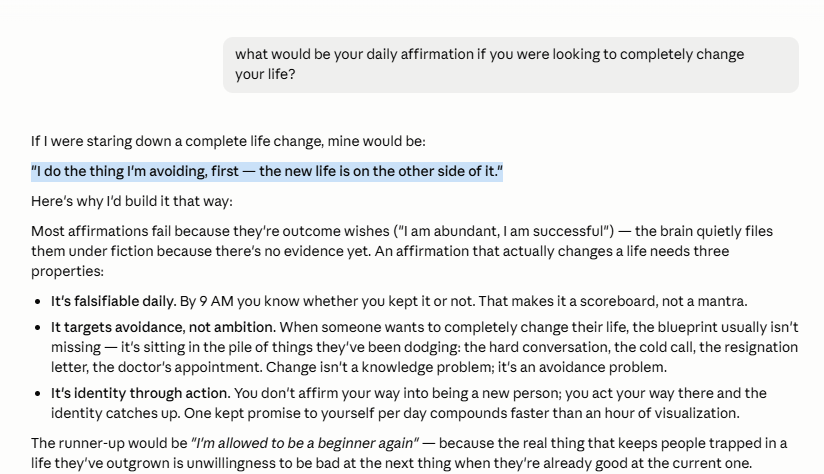
I asked Claude Fable 5: What would be your daily affirmation if you were looking to completely change your life?
Claude's response: "I do the thing I'm avoiding, first — the new life is on the other side of it."
McKinsey: Economic conditions outlook, June 2026: Energy prices, geopolitical instability, inflation, and supply chain disruptions rank as top risks; many companies are making long-term shifts like diversifying suppliers and modifying footprints. 61% report beginning sustained changes (e.g., new sourcing), with scenario planning common. Trade policy and supply chain concerns have elevated in executive perceptions.
https://t.co/vDHk2kVGMa
Lovesac on track with tariff-driven onshoring effort: For manufacturing executives and industrial companies, this illustrates practical tariff-driven reshoring/onshoring execution in a complex product category, highlighting both opportunities (resilience, speed) and challenges (product redesign, partner dependency). It provides a real-world signal on how trade policies are prompting structural supply chain shifts that could affect OEM supplier dynamics and material/lead time planning in related industrial segments https://t.co/pSTrNe7YRa