37 EXCELLENT HIGH RELATIVE STRENGTH STOCKS TO STUDY, TRACK & RESEARCH 🔥🔥🔥
▪ Timex Group
▪ Sigma Advanced Systems
▪ Syrma SGS Technology
▪ Fujiyama Power Systems
▪ Afcom Holdings
▪ KSH International
▪ VA Tech Wabag
▪ Jay Bharat Maruti
▪ Indiabulls Enterprises
▪ Savita Oil Technologies
▪ Indo Borax & Chemicals
▪ Granules India
▪ GNG Electronics
▪ Astra Microwave Products
▪ Bharat Seats
▪ Avalon Technologies
▪ Park Medi World
▪ Acutaas Chemicals
▪ Bajaj Consumer Care
▪ Thangamayil Jewellery
▪ SKM Egg Products Export
▪ Schneider Electric Infrastructure
▪ Aditya Infotech
▪ Yash Highvoltage
▪ Rubicon Research
▪ Sky Gold & Diamonds
▪ Shivalik Bimetal Controls
▪ Shreeji Shipping Global
▪ Standard Engineering Technology
▪ Rishabh Instruments
▪ KMC Speciality Hospitals (India)
▪ Aether Industries
▪ IOL Chemicals & Pharmaceuticals
▪ Shilpa Medicare
▪ Balaji Amines
▪ DEE Development Engineers
▪ HFCL
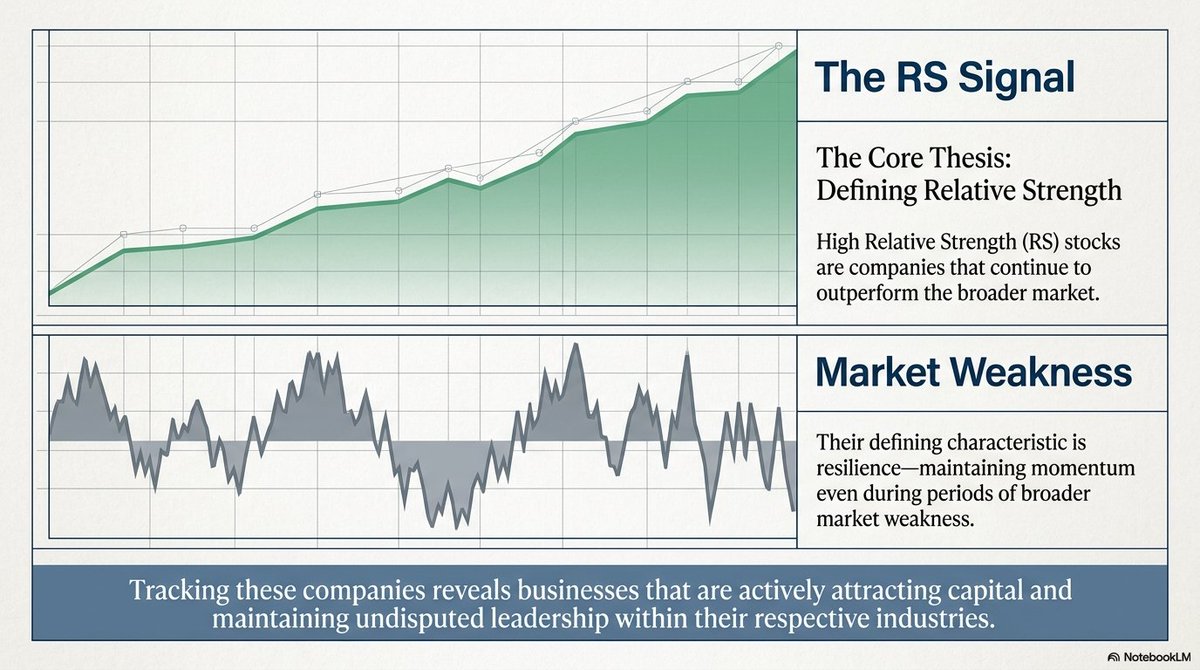
High Relative Strength (RS) stocks are companies that continue to outperform the broader market, often showing resilience even during periods of market weakness.
Such stocks usually indicate strong institutional buying, positive earnings momentum, robust business fundamentals, or sustained sectoral strength.
Tracking these companies helps investors identify businesses that are attracting market interest and maintaining leadership within their respective industries.
Relative strength alone should never be the sole reason for investing. Always combine technical strength with fundamental analysis, quarterly results, annual reports, management quality, valuations, and proper risk management before taking any investment decision.
DISCLAIMER
The above list is shared solely for educational, learning, tracking, and research purposes. It is not a buy, sell, or hold recommendation. Please conduct your own research and maintain proper position sizing and risk management before making any investment decisions.
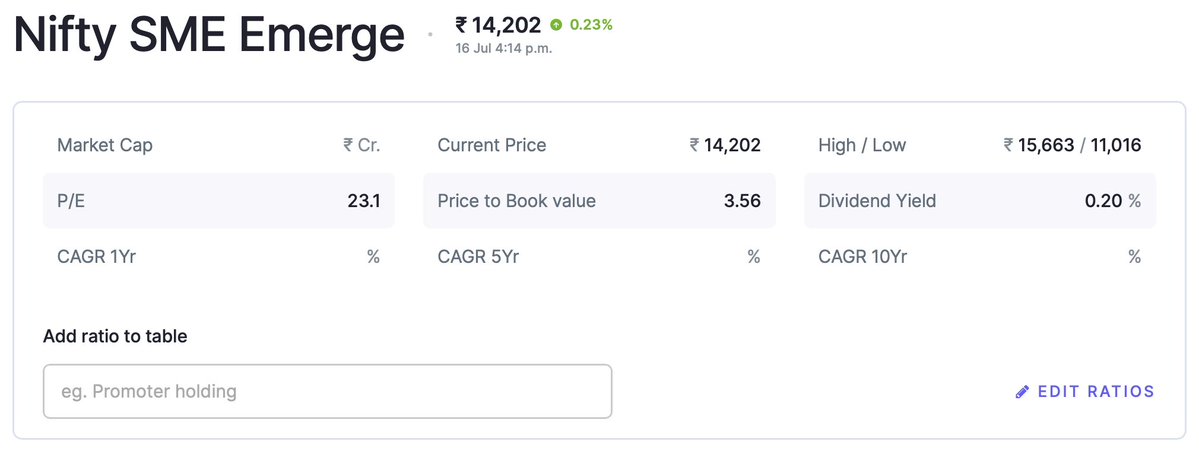
50 EXCELLENT STOCKS FROM BSE SME IPO INDEX & NIFTY SME EMERGE INDEX TO STUDY, TRACK & RESEARCH 🔥🔥🔥
▪ Shree Refrigerations
▪ Zelio E-Mobility
▪ Indo SMC
▪ Merritronix
▪ Airfloa Rail Technology
▪ Neetu Yoshi
▪ JD Cables
▪ Susan Electrical Industries
▪ Systematic Industries
▪ TIPCO Engineering
▪ Msafe Equipments
▪ Accord Transformers
▪ Cryogenic OGS
▪ Highness Microelectronics
▪ V-Marc India
▪ Aimtron Electronics
▪ Anondita Medicare
▪ Danish Power
▪ Monolithisch India
▪ OBSC Perfection
▪ Unihealth Hospitals
▪ Vivid Electromech
▪ Shri Ahimsa Naturals
▪ Sacheerome
▪ Prizor Viztech
▪ Z-Tech (India)
▪ OSEL Devices
▪ Viviana Power Tech
▪ FlySBS Aviation
▪ Influx Healthtech
▪ Freshara Agro Exports
▪ RNFI Services
▪ Namo eWaste Management
▪ Sunlite Recycling Industries
▪ Supreme Power Equipment
▪ KRM Ayurveda
▪ Anlon Technology Solutions
▪ Purple United Sales
▪ Apsis Aerocom
▪ Patil Automation
▪ Maxvolt Energy
▪ Apex Ecotech
▪ EPW India
▪ GCH
▪ Taurian MPS
▪ Avana Electrosystems
▪ Prime Cable Industries
▪ Sat Kartar Life Sciences
The above companies belong to the BSE SME IPO Index and Nifty SME Emerge Index, representing businesses across sectors such as engineering, defence, electronics, railways, healthcare, cables, EVs, recycling, automation, consumer products, and industrial manufacturing.
▪ Studying quality SME companies at an early stage can help you understand emerging business models, niche industries, management execution, and long-term wealth creation opportunities.
▪ Focus on understanding their business, financial performance, competitive advantages, industry tailwinds, management commentary, valuations, and price action instead of looking only at short-term price movements.
▪ Keep these companies on your watchlist, follow quarterly results, conference calls, investor presentations, and important business updates to improve your research process.
Disclaimer: This list is shared purely for educational, learning, tracking, and research purposes only. It is not a buy, sell, or investment recommendation. Please do your own research before making any investment decision.
Eimco Elecon (India) Ltd #EIMCOELECO
A very boring stock in a boring industry (coal mining)
1. Coal plays a vital role in India's energy landscape, contributing approximately 56 percent of the nation's primary commercial energy demand
2. Coal-based power generation accounts for 72 percent of the total electricity produced in India
3. As shallow opencast coal reserves diminish, there is a growing need to transition towards more sustainable underground (UG) mining methods
#Kirloskar Pneumatic CMP 1935 #KIRLPNU
Alert:
the recent correction looks over - pullback rather went till 1860 intra day.
In the process stock has cooled down as well - good
If India’s semiconductor story creates the next wave of multibaggers, they’ll all pass through this tweet.
Bookmark it today.
I’ll keep adding every macro chart and every high-conviction setup below as the story unfolds.
Credits to @Chart_Wallah108 for finding the gems. My charts will tell you when to own them. 🗿📈
Let’s all build wealth from one of India’s biggest themes. 🚀
🔥10 SME stocks that have potential to become multibaggars - Mini Thread 🧵
SME stocks matter because they can unlock early access to high-growth businesses before the market fully recognizes them.
But the real edge comes from choosing strong fundamentals, not just chasing small-cap excitement
If you are aggressive investor - You should have 2-3 SME stocks in your PF
✅Bookmark, Repost for wider reach
Here are my 10 👇
1. Shree Refrigerations
#Semiconductorvaluechain
Understanding the Semiconductor Value Chain: An Investor’s Ecosystem Playbook
Sand to Silicon: The Journey of a Microchip
Every day, you use a smartphone that calculates billions of operations in a split second. But did you know your phone's brain—the microchip—starts its life as ordinary desert sand?
Turning a handful of sand into a smart device requires pushing human technology to its absolute limit. Today, that high-tech journey is moving closer to home. Driven by a massive ₹76,000 Crore ($10 Billion) government push, India is rapidly building its own semiconductor ecosystem from scratch.
Why India’s Electronics Market is Exploding 🚀
Before looking at the factory floor, it helps to understand the massive forces driving this tech boom. India is riding a major long-term growth wave powered by three key pillars:
The India Semiconductor Mission (ISM): A massive ₹76,000 Crore ($10 Billion) government piggy bank. The state uses this money to pay for up to 50% of the heavy setup costs whenever a company builds a new chip factory or packaging plant in the country.
Production-Linked Incentive (PLI) Schemes: Over ₹1,47,000 Crore ($17+ Billion) in cash rewards deployed by the government. Tech brands get paid extra bonuses simply for manufacturing smartphones, laptops, and circuit boards locally in India rather than importing them.
The "China+1" Global Shift: Major global tech giants (like Apple and its partners) are actively trying to diversify their manufacturing networks so they do not rely entirely on a single country. India is stepping up as the primary alternative hub for this international investment capital.
Let's look at the four steps that turn sand into smart tech, along with the Indian companies leading the charge:
Step 1: From Desert Sand to Mirror-Polished Wafers
Ordinary sand is melted down and highly purified into flawless silicon logs. These logs are then sliced into paper-thin, mirror-like disks called wafers, which serve as the foundation for microchips.
Financial Economics (TAM & Capex)
>>Global Segment TAM: ₹1,17,600 Crore ($14 Billion).
>>Minimum Setup Capex (Per Facility): ₹1,680 Crore to ₹4,200 Crore ($200M – $500M). Building a wafer slicing and ingot pulling plant requires major capital for precision diamond wire saws, automated edge-grinders, and high-temperature furnace controls.
>>Global Leaders: Shin-Etsu (Japan), Sumco (Japan), GlobalWafers (Taiwan), Siltronic (Germany).
>>Indian Pioneer to Watch: Raana Semiconductors is working on indigenous CZ-based crystal growth and silicon ingot processing setups.
>>Investor Insight: Raw wafer production remains the most heavily imported step in the domestic pipeline. As the ISM begins rolled-out support for raw chemical refinement, early-stage quartz miners, industrial gas refiners, and chemical players will see long-term structural demand.
Step 2: Front-End Fabrication (The Foundry)
Using light and chemicals, microscopic circuit patterns and billions of tiny switches are printed onto the wafers. Tiny copper wires are then layered on top to connect them all into working microchips.
Financial Economics (TAM & Capex)
>> Global Segment TAM: ₹9,24,000 Crore ($110 Billion).
>> Minimum Setup Capex (Per Facility): ₹42,000 Crore to ₹1,26,000 Crore ($5 Billion – $15 Billion). Foundries represent one of the most capital-intensive industrial installations in human history. A single advanced EUV photolithography scanner from ASML costs over ₹1,600 Crore ($200M), and a fab requires multiple units alongside complex Class 1 cleanroom filtration systems.
>>Global Leaders: TSMC (Taiwan), Intel (USA), Samsung Foundry (South Korea).
>>Indian Pioneers to Watch:
--> Tata Electronics / PSMC JV: Constructing India's landmark ₹91,000 Crore commercial 300mm chip fab in Dholera, Gujarat, targeting legacy and foundational nodes to supply the automotive, power, and consumer electronics spaces.
--> Suchi Semicon: Building foundational chip foundry and micro-assembly manufacturing footprints.
>> Investor Insight: Front-end fabs are highly capital-intensive projects with multi-year gestation periods. The primary investment theme here is ecosystem infrastructure. Companies providing specialized industrial engineering, cleanroom construction, high-purity water systems, and infrastructure logistics are the first to capture cash flows as these mega-fabs break ground.
Step 3: Back-End Packaging & Testing (ATMP / OSAT)
The wafers are sliced with diamond saws into individual chip squares, which are wired onto a base. Each chip is then sealed in a protective black plastic shell and tested under real electrical stress.
Financial Economics (TAM & Capex)
>>Global Segment TAM: ₹3,78,000 Crore ($45 Billion).
>>Minimum Setup Capex (Per Facility): ₹840 Crore to ₹4,200 Crore ($100M – $500M). Packaging facilities are asset-heavy but feature a fraction of the entry costs required by foundries. Capital is deployed into high-speed automated dicing saws, wire-bonding machines, transfer molding presses, and expensive automated test equipment (ATE).
>>Global Leaders: ASE Group (Taiwan), Amkor Technology (USA), JCET (China), SPIL (Taiwan).
>>Indian Players to Watch:
--> CG Power / Renesas JV: Establishing a high-reliability semiconductor assembly ecosystem backed by Murugappa Group's industrial scale.
--> Kaynes Semicon (Subsidiary of Kaynes Technology): Constructing a state-of-the-art mass packaging unit in Sanand, Gujarat, targeting specialized industrial power modules and advanced systems-in-package.
--> Sahasra Semiconductors: Operating India's first active commercial memory packaging plant in Bhiwadi, Rajasthan, exporting finished MicroSD cards and flash arrays globally.
>> Investor Insight: This is the near-term sweet spot for public equity investors. OSAT facilities require significantly less capital expenditure than frontend fabs and reach operational profitability much faster. Companies like Kaynes Technology and CG Power are leveraging strong baseline industrial earnings to cross-fund these high-margin semiconductor ventures, creating an appealing value inflection point on their balance sheets.
Step 4: Circuit Board Assembly (PCBA / SMT)
Robots precisely place the sealed chips onto a fiberglass board using metal paste, which is baked in an oven to permanently melt them into place. The completed circuit board is inspected and built into the final device shell.
Financial Economics (TAM & Capex)
>> Global Segment TAM: ₹46,200 Crore ($5.5 Billion) for advanced defense, space, and high-performance computing boards; stretching past ₹46,20,000 Crore ($550B+) for mass consumer electronic product assemblies.
>> Minimum Setup Capex (Per SMT Line): ₹15 Crore to ₹45 Crore ($2M – $5M) per line. This is a scalable, modular capacity business model. A firm can start with 2 SMT lines (comprising solder printers, high-speed chip shooters, and reflow ovens) and add more lines as customer volume expands.
>> Global Leaders: Foxconn (Taiwan), Pegatron (Taiwan), Jabil (USA), Flex (Singapore).
>> Indian Powerhouses to Watch:
--> Dixon Technologies: The undisputed market leader in domestic high-volume consumer assembly, populating motherboards for global smartphone, notebook, and smart TV brands under multiple PLI umbrellas.
--> Kaynes Technology: The premium player for complex, high-reliability PCBAs serving defense, aerospace, and electric vehicle powertrain segments.
--> Syrma SGS Technology & Avalon Technologies: Design-led EMS specialists capturing high-margin industrial computing, healthcare systems, and global export channels.
>> Investor Insight: The Indian Electronics Manufacturing Services (EMS) layer is experiencing an explosive revenue boom. Driven by localized sourcing mandates under the IT Hardware PLI 2.0, assembly giants are moving from low-margin contract work into high-margin complex component manufacturing. Look for players showing an expanding mix of high-layered PCBAs and proprietary intellectual property, as they will capture significant operating leverage as the domestic supply chain matures.
The Investor’s Ecosystem Playbook
The Indian semiconductor narrative is no longer a distant policy concept—it is a live capital deployment cycle. From an investment perspective, the value chain behaves in distinct waves based on Capex realities and project timelines:
[Wave 1: Capital Projects]
Infrastructure & SMT Equipment
Capex: ₹15C–₹45C per SMT line
(Immediate Cash Flows)
[Wave 2: OSAT Scaling]
Kaynes, CG Power, Sahasra
Capex: ₹840C–₹4,200C per plant
(12–24 Month Earnings)
[Wave 3: Mega Fabs]
Tata Electronics / PSMC
Capex: ₹42,000C+ per Fab
Capex: ₹42,000C+ per Fab
The combination of clear policy directions under the ISM and billions of dollars in private capital deployment has set the stage for major transformations. As these components come together over the coming years, India's electronic ecosystem is well-positioned to evolve from an assembly hub into a core architecture pioneer on the global stage.
[Not investment advice, DYOR]
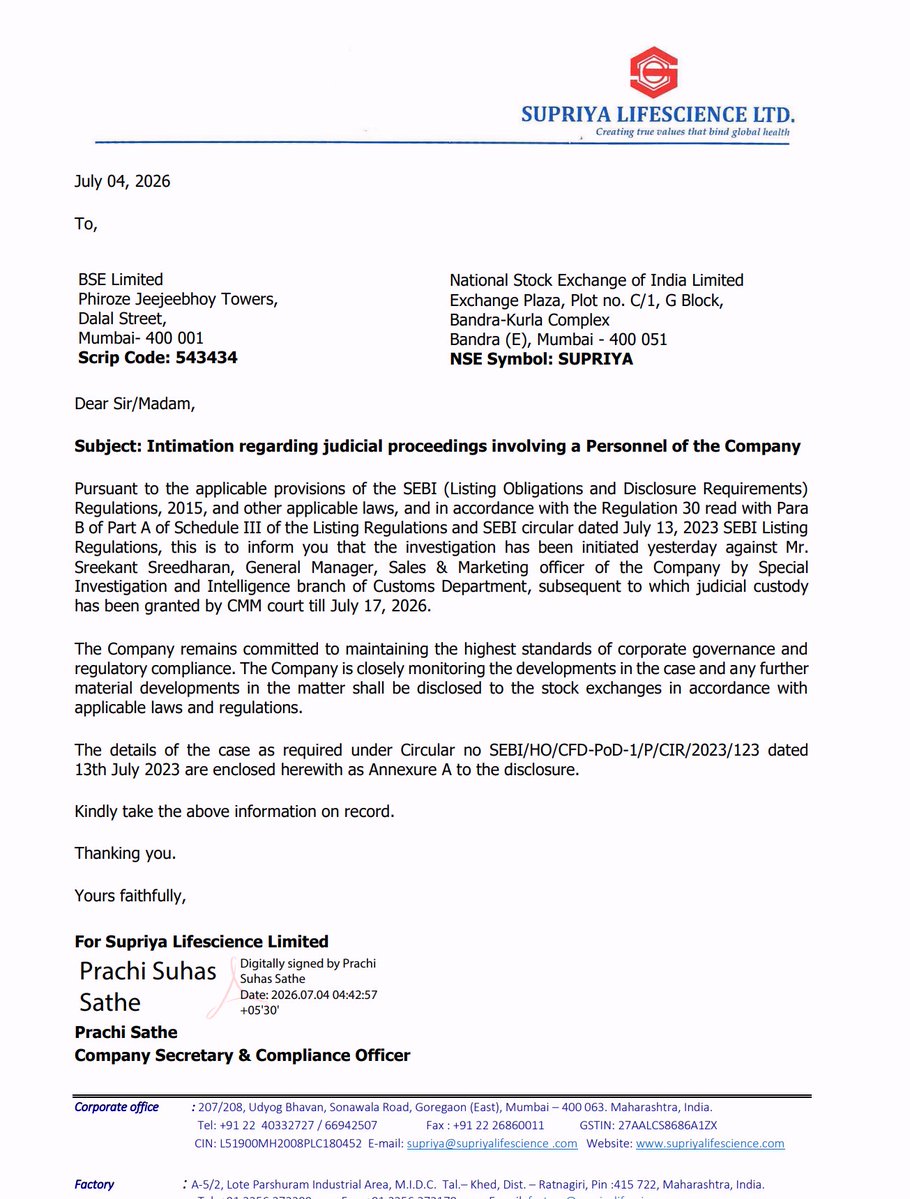
Supriya Life Sciences:
It seems their GM, Sales have been taken into custody by the Customs Dept.
I don't know for sure, but it's very likely that the stock will tank as this looks like a serious offence !!
As investors, we can't anticipate such things.
Only way to control risk is by position sizing...
I never go more than 12% even on my highest conviction stock. So, if you are putting 30-40-50% of your networth in 1 stock, think again !!
@investor_sr33 One more smallcap, Merritronix will get major boost as its majorly into defence PCBs which are brain for this air defence, electronic warfare, surveillance, missiles, sensors.
$STM - One thing I've learned over the years:
Don't fade a multi-decade breakout with heavy institutional accumulation.
STM's chips are used in robotics, satellites, industrial automation, aerospace, and EVs.
Sometimes the biggest winners start with the biggest bases.
$XBI - Biotech ETF
Currently in a massive Stage 2 uptrend with clear institutional accumulation.
Top holdings include:
$TGTX $TVTX $ALKS $TWST $RVMD
After years of underperformance, biotech is quietly starting to look constructive again. 👀
Samhi is looking at cumulative free cash flow post interest of Rs 3000 Crores in next 5 years
Disc: Own in self and client portfolios. Not a buy or sell recommendation.
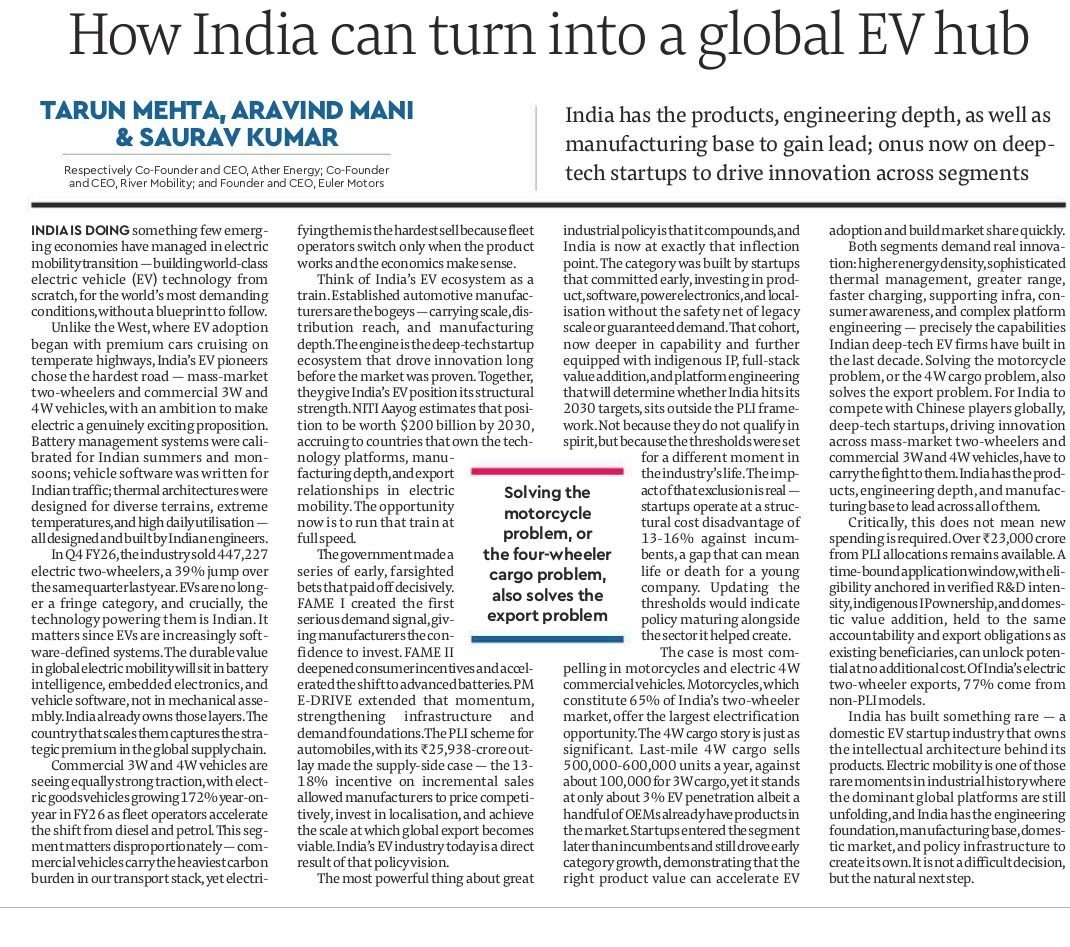
How India can turn into a global EV hub https://t.co/tH2t1Twm5r
"India has the products, engineering depth, as well as manufacturing base to gain lead; onus now on deep-tech startups to drive innovation across segments"
A must read op-ed by @tarunsmehta of @atherenergy, Aravind Mani of @worldofriver and @sauravk_89 of @Euler_Motors!
Bill Ackman literally gave a 44-minute masterclass that explains money better than any business school.
1. Starting early is the single biggest advantage you have. If you save $10,000 at age 22, never add another penny, and earn 10% a year, you have $600,000 by retirement. wait until 32 to start, and the same money only grows to $232,000. The decade you lose at the beginning costs you more than any decade later because compounding does its heaviest lifting at the end.
2. The return rate matters even more than most people grasp. That same $10,000 at 22 earning 10% becomes $600,000. At 15% it becomes over 4 million. At 20%, the rate Warren Buffett has achieved, it becomes 25 million. Einstein called compound interest the most powerful force in the universe. Ackman's lecture is essentially a demonstration of why.
3. Avoiding losses matters as much as chasing returns. if you reach for a 20% return but lose half your money every 12 years from bad decisions or a rough patch, your 25 million collapses to 1.8 million. Buffett's rule one is never lose money. Rule two is never forget rule one. the math of recovery is brutal, so protecting the downside is not caution, it is strategy.
4. Debt is safer, but the upside is capped. Equity is riskier, but the upside is unlimited. In the lemonade stand example, the lender who put up $250 earns a steady 10% and gets paid back first if the business fails. the equity investor who put up $500 earns over 100% if it succeeds but gets wiped out if it fails. The equity holder earns more precisely because they took the risk the lender refused.
5. The risk that matters is permanent loss, not price movement. most people think risk is the stock price bouncing up and down every day. Ackman says ignore that. the real risk is whether you will permanently lose your money. Short-term volatility is noise. the question that matters is whether you get your capital back with a return over the long run.
6. Avoid startups and complicated businesses. You do not need 100% a year to build a fortune. you need 10 to 15% over a long period. so skip the lemonade stands and unknown ventures. Invest in public companies that are established, liquid, and have to clear real hurdles before going public. If you cannot understand how a business makes money, avoid it no matter how good its track record. Ackman cites Enron, a business almost nobody actually understood.
7. Invest in a business you could own forever. if the stock market closed for 10 years, you should not be unhappy holding it. Coca-Cola is his example. easy to understand, sells a syrup and earns a profit on every drink, the population keeps growing, and it is nearly impossible to disrupt with new technology. McDonald's is another. People have to eat, the food is cheap, and they keep growing. find a business you would be comfortable holding through anything.
8. You want products people are loyal to and will pay a premium for. People buy generic flour and sugar without caring about the brand. but they want the Hershey bar, the Cadbury bar, the see's candy specifically. you do not want to sell a commodity that anyone can sell cheaper. You want something unique that customers refuse to substitute even at a 20% discount.
9. Low debt is a safety feature. In the lemonade stand example, $250 of debt was manageable. But if it had been $1,000 and the business hit a rough patch, it could have gone under and wiped out the shareholders. Find companies with little debt or so much profit relative to their interest payments that a bad year cannot sink them.
10. Barriers to entry protect your returns. You want a business that is hard for someone to compete with tomorrow. Coca-Cola's market presence is so strong that you expect to get a Coke at any restaurant. Pepsi has coexisted with it for decades, but neither can put the other out of business. If a competitor can show up next year with a better version and steal the customers, the business is not worth owning long term.
11. The best businesses are immune to outside factors you cannot control. Coca-Cola has survived 120 years through world wars, nuclear weapons, and every kind of crisis, and each year it makes slightly more money. You want companies that do not depend on commodity prices, interest rates, or currency moves. A business that keeps earning regardless of what is happening in the world is the kind you hold forever.
12. Low capital intensity is one of the most underrated qualities. The worst businesses require massive reinvestment to grow. The auto industry has to build enormous factories and buy machine tools before selling a single car, and those tools wear out. GM's stock barely moved over 40 to 50 years for exactly this reason. Coca-Cola, by contrast, sells a formula and collects a royalty. American Express takes a few percent of every dollar spent on its card. a business that earns a royalty on other people's capital is one of the best things you can own.
13. Pay down debt and build a cushion before you invest. If you have high-interest credit card debt, paying it off is a guaranteed return equal to the interest rate. same logic, to a lesser degree, with student loans at 6 or 7%. and you want 6 to 12 months of expenses in the bank so that losing your job tomorrow does not force you to sell. You can only handle market volatility if you do not need the money.
14. Be a buyer when everyone is selling and a seller when everyone is buying. The natural human tendency is the opposite, a lemming-like instinct to sell in a crash and buy in a bubble. people sold into the 1987 crash when they should have been buying. The only way to resist this is to be financially secure enough that the money at risk does not affect your life, so you can withstand the swings without panicking.
15. The stock market is a voting machine in the short term and a weighing machine in the long term. Ben Graham's idea, which Ackman repeats. short-term prices reflect the whims and emotions of investors. long term, prices reflect the actual value of the underlying businesses. If you buy good businesses at reasonable prices and hold them while they grow, you make money over time as long as you are never forced to sell at the wrong moment.
16. A stock is just a bond where you do not know the coupon. Flip a price-to-earnings ratio over, and you get an earnings yield. A stock at 10 times earnings is a 10% earnings yield, which you can compare directly to a 3% treasury. the difference is the bond's coupon is fixed and the stock's coupon, its earnings, moves up and down. Ackman wants an earnings yield higher than a treasury that will also grow over time, so he does not need to be right about explosive growth to earn a good return.
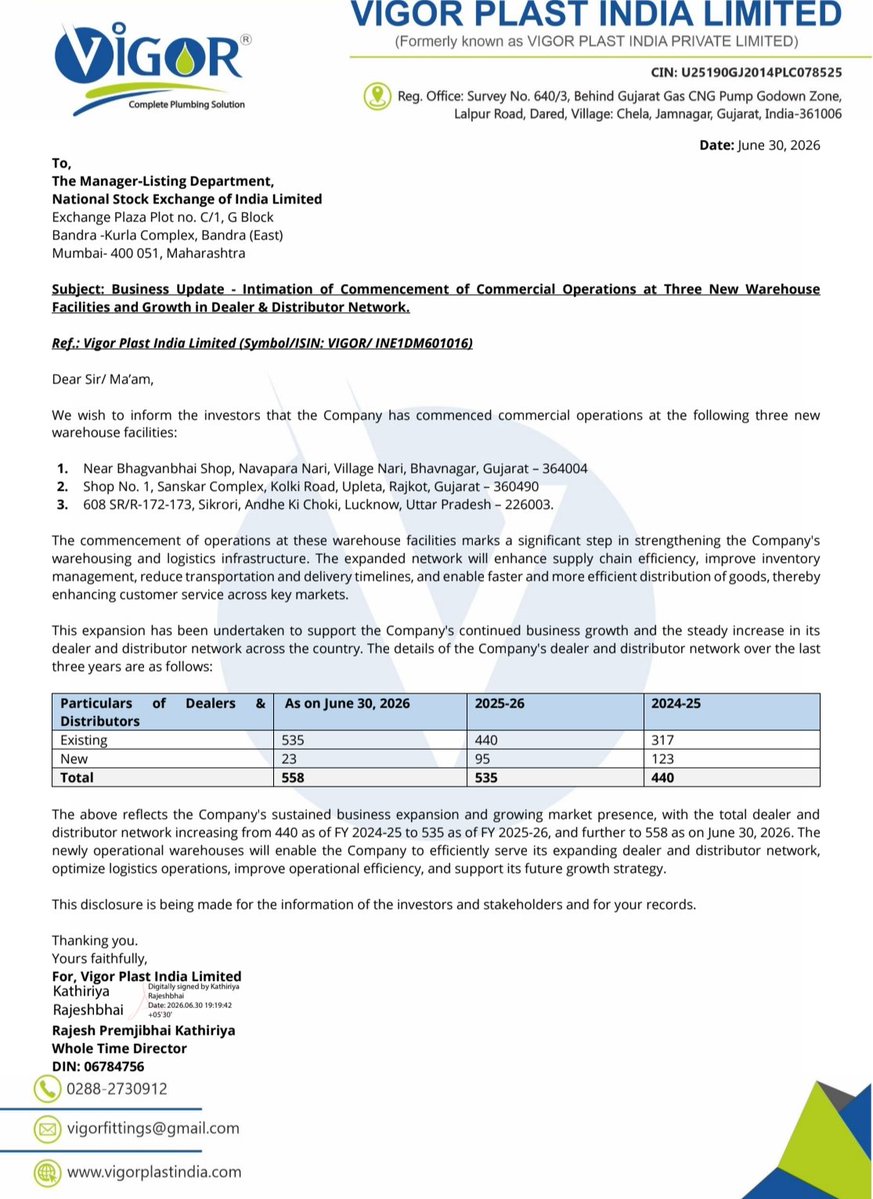
Blue Water Logistics
A company which has given 100% growth and has promised to to deliver the same for next 2 years and company gives quarterly results inspite of being a SME company.
Guidance -
FY27 -800cr revenue with same or better margins
FY28 -1800cr revenue
Company is trading at the TTM PE of 16 as of now.
Company is trading at forward FY27 PE of 8 and FY28 PE of just 3 🙂
Company in the business of Freight forwarding, Custom clearance, Transportation handling services.
Segment wise revenue -
Ocean Freight: 78.1%
Surface Freight & Railway Freight: 11.3%
Air Freight: 9.5%
Custom House Clearance: 1.1%
Global Alliance - With Turkish Airlines
Fleet of 1708 ISO Tank containers
100+ container trailers
Target of 5000+ ISO tanks in next 3 years.
What makes them different from others is that they provide end to end integrated model. They have their own fleet, own containers, own custom clearance and direct relationship with shipping carriers
They have operations in 28 countries
No equity raise plan as of now.
No asset in Strait of Hormuz. So, not affected by the current war situation.
#BlueWater






![ramesh_vd's tweet photo. #Semiconductorvaluechain
Understanding the Semiconductor Value Chain: An Investor’s Ecosystem Playbook
Sand to Silicon: The Journey of a Microchip
Every day, you use a smartphone that calculates billions of operations in a split second. But did you know your phone's brain—the microchip—starts its life as ordinary desert sand?
Turning a handful of sand into a smart device requires pushing human technology to its absolute limit. Today, that high-tech journey is moving closer to home. Driven by a massive ₹76,000 Crore ($10 Billion) government push, India is rapidly building its own semiconductor ecosystem from scratch.
Why India’s Electronics Market is Exploding 🚀
Before looking at the factory floor, it helps to understand the massive forces driving this tech boom. India is riding a major long-term growth wave powered by three key pillars:
The India Semiconductor Mission (ISM): A massive ₹76,000 Crore ($10 Billion) government piggy bank. The state uses this money to pay for up to 50% of the heavy setup costs whenever a company builds a new chip factory or packaging plant in the country.
Production-Linked Incentive (PLI) Schemes: Over ₹1,47,000 Crore ($17+ Billion) in cash rewards deployed by the government. Tech brands get paid extra bonuses simply for manufacturing smartphones, laptops, and circuit boards locally in India rather than importing them.
The "China+1" Global Shift: Major global tech giants (like Apple and its partners) are actively trying to diversify their manufacturing networks so they do not rely entirely on a single country. India is stepping up as the primary alternative hub for this international investment capital.
Let's look at the four steps that turn sand into smart tech, along with the Indian companies leading the charge:
Step 1: From Desert Sand to Mirror-Polished Wafers
Ordinary sand is melted down and highly purified into flawless silicon logs. These logs are then sliced into paper-thin, mirror-like disks called wafers, which serve as the foundation for microchips.
Financial Economics (TAM & Capex)
>>Global Segment TAM: ₹1,17,600 Crore ($14 Billion).
>>Minimum Setup Capex (Per Facility): ₹1,680 Crore to ₹4,200 Crore ($200M – $500M). Building a wafer slicing and ingot pulling plant requires major capital for precision diamond wire saws, automated edge-grinders, and high-temperature furnace controls.
>>Global Leaders: Shin-Etsu (Japan), Sumco (Japan), GlobalWafers (Taiwan), Siltronic (Germany).
>>Indian Pioneer to Watch: Raana Semiconductors is working on indigenous CZ-based crystal growth and silicon ingot processing setups.
>>Investor Insight: Raw wafer production remains the most heavily imported step in the domestic pipeline. As the ISM begins rolled-out support for raw chemical refinement, early-stage quartz miners, industrial gas refiners, and chemical players will see long-term structural demand.
Step 2: Front-End Fabrication (The Foundry)
Using light and chemicals, microscopic circuit patterns and billions of tiny switches are printed onto the wafers. Tiny copper wires are then layered on top to connect them all into working microchips.
Financial Economics (TAM & Capex)
>> Global Segment TAM: ₹9,24,000 Crore ($110 Billion).
>> Minimum Setup Capex (Per Facility): ₹42,000 Crore to ₹1,26,000 Crore ($5 Billion – $15 Billion). Foundries represent one of the most capital-intensive industrial installations in human history. A single advanced EUV photolithography scanner from ASML costs over ₹1,600 Crore ($200M), and a fab requires multiple units alongside complex Class 1 cleanroom filtration systems.
>>Global Leaders: TSMC (Taiwan), Intel (USA), Samsung Foundry (South Korea).
>>Indian Pioneers to Watch:
--> Tata Electronics / PSMC JV: Constructing India's landmark ₹91,000 Crore commercial 300mm chip fab in Dholera, Gujarat, targeting legacy and foundational nodes to supply the automotive, power, and consumer electronics spaces.
--> Suchi Semicon: Building foundational chip foundry and micro-assembly manufacturing footprints.
>> Investor Insight: Front-end fabs are highly capital-intensive projects with multi-year gestation periods. The primary investment theme here is ecosystem infrastructure. Companies providing specialized industrial engineering, cleanroom construction, high-purity water systems, and infrastructure logistics are the first to capture cash flows as these mega-fabs break ground.
Step 3: Back-End Packaging & Testing (ATMP / OSAT)
The wafers are sliced with diamond saws into individual chip squares, which are wired onto a base. Each chip is then sealed in a protective black plastic shell and tested under real electrical stress.
Financial Economics (TAM & Capex)
>>Global Segment TAM: ₹3,78,000 Crore ($45 Billion).
>>Minimum Setup Capex (Per Facility): ₹840 Crore to ₹4,200 Crore ($100M – $500M). Packaging facilities are asset-heavy but feature a fraction of the entry costs required by foundries. Capital is deployed into high-speed automated dicing saws, wire-bonding machines, transfer molding presses, and expensive automated test equipment (ATE).
>>Global Leaders: ASE Group (Taiwan), Amkor Technology (USA), JCET (China), SPIL (Taiwan).
>>Indian Players to Watch:
--> CG Power / Renesas JV: Establishing a high-reliability semiconductor assembly ecosystem backed by Murugappa Group's industrial scale.
--> Kaynes Semicon (Subsidiary of Kaynes Technology): Constructing a state-of-the-art mass packaging unit in Sanand, Gujarat, targeting specialized industrial power modules and advanced systems-in-package.
--> Sahasra Semiconductors: Operating India's first active commercial memory packaging plant in Bhiwadi, Rajasthan, exporting finished MicroSD cards and flash arrays globally.
>> Investor Insight: This is the near-term sweet spot for public equity investors. OSAT facilities require significantly less capital expenditure than frontend fabs and reach operational profitability much faster. Companies like Kaynes Technology and CG Power are leveraging strong baseline industrial earnings to cross-fund these high-margin semiconductor ventures, creating an appealing value inflection point on their balance sheets.
Step 4: Circuit Board Assembly (PCBA / SMT)
Robots precisely place the sealed chips onto a fiberglass board using metal paste, which is baked in an oven to permanently melt them into place. The completed circuit board is inspected and built into the final device shell.
Financial Economics (TAM & Capex)
>> Global Segment TAM: ₹46,200 Crore ($5.5 Billion) for advanced defense, space, and high-performance computing boards; stretching past ₹46,20,000 Crore ($550B+) for mass consumer electronic product assemblies.
>> Minimum Setup Capex (Per SMT Line): ₹15 Crore to ₹45 Crore ($2M – $5M) per line. This is a scalable, modular capacity business model. A firm can start with 2 SMT lines (comprising solder printers, high-speed chip shooters, and reflow ovens) and add more lines as customer volume expands.
>> Global Leaders: Foxconn (Taiwan), Pegatron (Taiwan), Jabil (USA), Flex (Singapore).
>> Indian Powerhouses to Watch:
--> Dixon Technologies: The undisputed market leader in domestic high-volume consumer assembly, populating motherboards for global smartphone, notebook, and smart TV brands under multiple PLI umbrellas.
--> Kaynes Technology: The premium player for complex, high-reliability PCBAs serving defense, aerospace, and electric vehicle powertrain segments.
--> Syrma SGS Technology & Avalon Technologies: Design-led EMS specialists capturing high-margin industrial computing, healthcare systems, and global export channels.
>> Investor Insight: The Indian Electronics Manufacturing Services (EMS) layer is experiencing an explosive revenue boom. Driven by localized sourcing mandates under the IT Hardware PLI 2.0, assembly giants are moving from low-margin contract work into high-margin complex component manufacturing. Look for players showing an expanding mix of high-layered PCBAs and proprietary intellectual property, as they will capture significant operating leverage as the domestic supply chain matures.
The Investor’s Ecosystem Playbook
The Indian semiconductor narrative is no longer a distant policy concept—it is a live capital deployment cycle. From an investment perspective, the value chain behaves in distinct waves based on Capex realities and project timelines:
[Wave 1: Capital Projects]
Infrastructure & SMT Equipment
Capex: ₹15C–₹45C per SMT line
(Immediate Cash Flows)
[Wave 2: OSAT Scaling]
Kaynes, CG Power, Sahasra
Capex: ₹840C–₹4,200C per plant
(12–24 Month Earnings)
[Wave 3: Mega Fabs]
Tata Electronics / PSMC
Capex: ₹42,000C+ per Fab
Capex: ₹42,000C+ per Fab
The combination of clear policy directions under the ISM and billions of dollars in private capital deployment has set the stage for major transformations. As these components come together over the coming years, India's electronic ecosystem is well-positioned to evolve from an assembly hub into a core architecture pioneer on the global stage.
[Not investment advice, DYOR]](https://pbs.twimg.com/media/HMXf-vxb0AAg__g.jpg)