There is a story behind this image. You can't see the story just by looking at it though. But, I've watermarked this image, which means a lot of things...
Of course you need context to enable workflows run by autonomous AI.
The trap is getting so focused on harnessing that context and rebuilding the agentic AI workflow around it, you forget to optimize the workflow. And maybe even forget to start capturing new context once you launch.
The question to ask before "Where is the context we need?" is "How could this be optimized now that smart little agents are running the workflow?"
Otters would never catch fish with a rod and reel, even if they discovered how to keep knots out of the line and when to use a net (OK, I don't have any scientific evidence to back this up, but I'm comfortable with my statement)
https://t.co/XE4PCnObri
@scarpizio It always felt to me like Tomlin's loyalty to veterans (consciously or subconsciously) held back the development of some young talent, but idk 🤷♂️
State of Enterprise AI 2026: @levie on Tokenmaxxing, The Rise of Headless, and AI-Proofing Your Job
00:00 Intro
01:18 Silicon Valley engineering vs. everyone else
05:35 Are enterprise CIOs actually bullish on AI?
08:51 Tokenmaxxing & why your AI bill is about to explode
11:34 The myth of falling token costs and AI spend escaping IT budgets
17:37 The $5B startup hiding in AI compute
18:14 The mosaic of models inside every enterprise
21:28 Why coding works and the rest of knowledge work doesn't
25:53 The Bob and Sally problem: access control breaks agents
30:31 Will enterprise AI really take 10 years to roll out
32:24 The capability overhang: why faster models slow diffusion
34:23 Data is the bottleneck (it always was)
39:02 The rise of internal forward-deployed engineers
41:23 Why the AI doomers are wrong about jobs
43:43 Headless software is inevitable
46:14 What replaces per-seat pricing
47:37 How Box itself is going headless
49:42 How the org chart actually evolves
1:00:33 Future-proofing yourself as an enterprise employee
1:06:40 Are we all just going to work for OpenAI and Anthropic?
1:07:11 Where startups can still win as the labs move up
@Steelersdepot Ross' point at the end is exactly right. If they had an elite front office, they would have won at least one playoff game in the past decade. The FO has been bad for a while, and Khan still has a lot to prove to change that.
Everyone thinks "do things that don't scale" is about building relationships with early users.
Yes AND it's about generating mistakes at maximum density.
When you're doing everything manually (onboarding, support, delivery) you hit errors every hour. Each error teaches you something the dashboard never will.
The manual work IS the learning. Automate too early and you freeze your ignorance in code (and now markdown).
Founder after discovering the enterprise agreement requires SOC 2 compliance, a 12-hour breach notice, unlimited indemnity, customer audit rights, and service credits for downtime caused by the customer.
@Sideburnsofwood I’m not inside Google so I don’t know how it got this way (though I could guess). But the answer is a product portfolio strategy, centered around the core users of the various products. Underpinned by an aligned tech strategy that serves the product strategy.
it’s in gemini, just create it in ai studio. oh, that’s for your personal google one account. for workspace you need gemini business. no, not gemini advanced, that’s ai pro now. unless you need ai ultra. oh agents? you do that in spark actually. no, not gemini api managed agents, that’s different. for coding use jules. unless you mean the agentic ide, that’s antigravity. no, that’s the old antigravity, download the new one. actually gemini cli is being deprecated, use antigravity cli. no the flash model is smarter than the pro model. unless you need pro. if it’s video, use flow. no, flow uses veo. no, nano banana is images. actually that’s in gemini now. unless you’re in search, then it’s ai mode. no, research is notebooklm. anyway it’s all very simple.
@eastdakota I understand the sentiment, but there does need to be room for innovation and experimentation. Build a team whose judgement you trust, encourage them, question them, but don’t let them think if their work doesn’t result in ROI it wasn’t valuable.
The real opportunity, when you have over hired and are still profitable and growing, is to let the “measurers” use AI to automate their jobs, become experts in it. Now you have AI experts that understand how your business operates today, and could operate in the future with AI at its core. What CEO wouldn’t want to be in that position in 18 months??
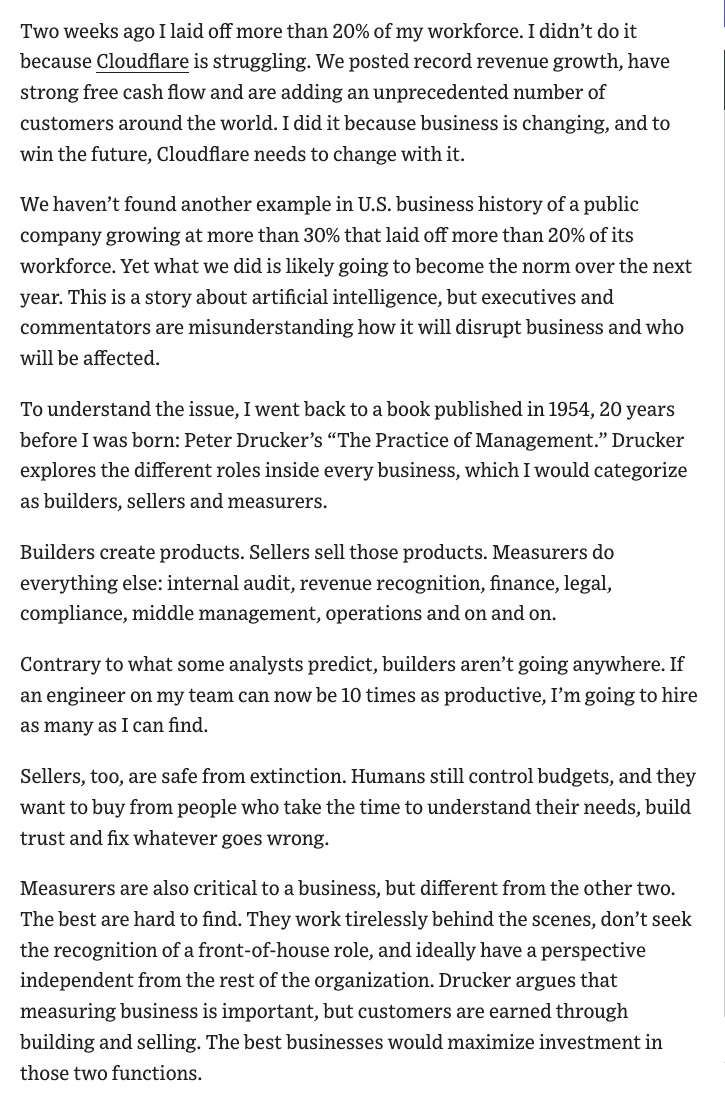
Cloudflare CEO Prince on how AI changes who gets laid off first:
Two weeks ago I laid off more than 20% of my workforce. I didn’t do it because Cloudflare is struggling. We posted record revenue growth, have strong free cash flow and are adding an unprecedented number of customers around the world. I did it because business is changing, and to win the future, Cloudflare needs to change with it.
We haven’t found another example in U.S. business history of a public company growing at more than 30% that laid off more than 20% of its workforce. Yet what we did is likely going to become the norm over the next year. This is a story about artificial intelligence, but executives and commentators are misunderstanding how it will disrupt business and who will be affected.
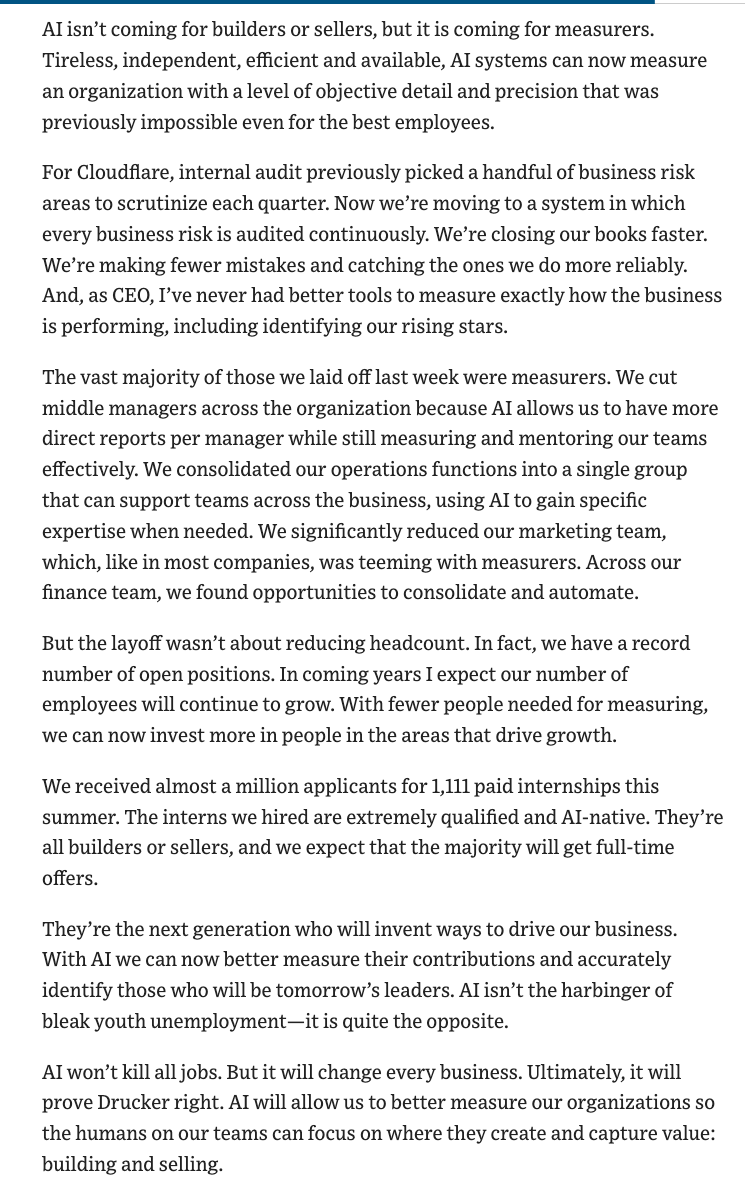
AI isn’t coming for builders or sellers, but it is coming for measurers. Tireless, independent, efficient and available, AI systems can now measure an organization with a level of objective detail and precision that was previously impossible even for the best employees.
For Cloudflare, internal audit previously picked a handful of business risk areas to scrutinize each quarter. Now we’re moving to a system in which every business risk is audited continuously. We’re closing our books faster. We’re making fewer mistakes and catching the ones we do more reliably. And, as CEO, I’ve never had better tools to measure exactly how the business is performing, including identifying our rising stars.
The vast majority of those we laid off last week were measurers. We cut middle managers across the organization because AI allows us to have more direct reports per manager while still measuring and mentoring our teams effectively.
We consolidated our operations functions into a single group that can support teams across the business, using AI to gain specific expertise when needed. We significantly reduced our marketing team, which, like in most companies, was teeming with measurers. Across our finance team, we found opportunities to consolidate and automate.
We received almost a million applicants for 1,111 paid internships this summer. The interns we hired are extremely qualified and AI-native. They’re all builders or sellers, and we expect that the majority will get full-time offers.
Robots are already in your warehouse. Your factory. Your hospital.
Agents are about to become their brain.
Here's the thing nobody is saying out loud:
Most authenticity system protecting physical objects was designed for human eyes. Human hands. Human judgment.
Not for an AI that trusts its inputs completely and acts at machine speed.
That gap is going to matter. A lot.
https://t.co/jxTKASZqPo
@scarpizio The return of Rodgers is just a symptom of the lack of clarity with which ownership views the potential of this team. They aren’t a QB away from a title this season. Playing Rodgers this year certainly doesn’t get you a year closer to a title, if anything it sets you a year back.
@MyKingSoopers 5 lanes open at the Candelas location on a Sunday is a choice. It’s not a good one if you want people to shoot here, but it’s a choice you made.