Tokenization is moving beyond Treasury funds into complex credit strategies.
NYLIM’s first tokenized fund, issued via @Centrifuge, brings an institutional U.S. high-yield corporate bond strategy onchain.
Proof of Asset powers the data verification layer. https://t.co/Jz4n1aY2OV
"The role that Chronicle plays is: how do you make this real world data available and accessible and verifiable to the onchain economy?" — Centrifuge CEO @itsbhaji
Proud to partner with @Centrifuge on the infrastructure making that possible, bringing real-world asset data onchain so tokenized assets can become more useful, composable, and programmable.
"We work with Stripe, BlackRock, BNY, Apollo, Galaxy... some of the largest players in finance."
@nomos_paradox, CEO of @ChronicleLabs, on how a bootstrapped oracle got there by first solving one problem for @MakerDAO.
BUIDL, tokenized by @Securitize, is now verified onchain by Chronicle Proof of Asset.
The BlackRock USD Institutional Digital Liquidity Fund (BUIDL) currently holds $2.1B in AUM and is backed by short-term U.S. Treasuries, repurchase agreements, and cash.
Chronicle Proof of Asset adds a new layer of onchain transparency and data accessibility, enabling independently verified holdings-level data that platforms can integrate with confidence.
Chronicle now provides Proof of Asset verification for @Securitize’s Tokenized AAA CLO Fund (STAC).
STAC is a tokenized fund that aims to invest substantially all of the fund’s assets in U.S. dollar‑denominated AAA‑rated CLO tranches from both the primary and secondary markets.
Chronicle Proof of Asset powers @moonpay's enterprise stablecoin issuance on @m0.
Chronicle provides continuous, independent verification of the underlying assets backing minting and redemption, delivering the precision and transparency required for institutional digital dollars.
Chronicle is proud to be selected as the primary oracle partner for @centrifuge, providing the data foundation for tokenized assets issued and managed on the Centrifuge platform.
Now that ZKEVMs are at alpha stage (production-quality performance, remaining work is safety) and PeerDAS is live on mainnet, it's time to talk more about what this combination means for Ethereum.
These are not minor improvements; they are shifting Ethereum into being a fundamentally new and more powerful kind of decentralized network.
To see why, let's look at the two major types of p2p network so far:
BitTorrent (2000): huge total bandwidth, highly decentralized, no consensus
Bitcoin (2009): highly decentralized, consensus, but low bandwidth - because it’s not “distributed” in the sense of work being split up, it’s *replicated*
Now, Ethereum with PeerDAS (2025) and ZK-EVMs (expect small portions of the network using it in 2026), we get: decentralized, consensus and high bandwidth
The trilemma has been solved - not on paper, but with live running code, of which one half (data availability sampling) is *on mainnet today*, and the other half (ZK-EVMs) is *production-quality on performance today* - safety is what remains.
This was a 10-year journey (see the first commit of my original post on DAS here: https://t.co/Fa0jKFgObW , and ZK-EVM attempts started in ~2020), but it's finally here.
Over the next ~4 years, expect to see the full extent of this vision roll out:
* In 2026, large non-ZKEVM-dependent gas limit increases due to BALs and ePBS, and we'll see the first opportunities to run a ZKEVM node
* In 2026-28, gas repricings, changes to state structure, exec payload going into blobs, and other adjustments to make higher gas limits safe
* In 2027-30, large further gas limit increases, as ZKEVM becomes the primary way to validate blocks on the network
A third piece of this is distributed block building.
A long-term ideal holy grail is to get to a future where the full block is *never* constituted in one single place. This will not be necessary for a long time, but IMO it is worth striving for us at least have the capability to do that.
Even before that point, we want the meaningful authority in block building to be as distributed as possible. This can be done either in-protocol (eg. maybe we figure out how to expand FOCIL to make it a primary channel for txs), or out-of-protocol with distributed builder marketplaces. This reduces risk of centralized interference with real-time transaction inclusion, AND it creates a better environment for geographical fairness.
Onward.
Tokenized assets need more than data, they need verifiable truth.
Proof of Asset brings read-level access directly from custodians, generating tamper-proof proofs that bridge TradFi → DeFi.
🎥 Watch our Founder @nomos_paradox break it down.
If you bought $100 of Bitcoin when Coinbase was founded in June 2012, it would now be worth about $1,500,000.
If you kept the $100 USD you'd only be able to purchase about $73 worth of goods today.
Bitcoin is the best performing asset of the last 12 years, and it's still early days.
Every government, especially those looking to create a hedge against inflation, should create a Bitcoin strategic reserve.
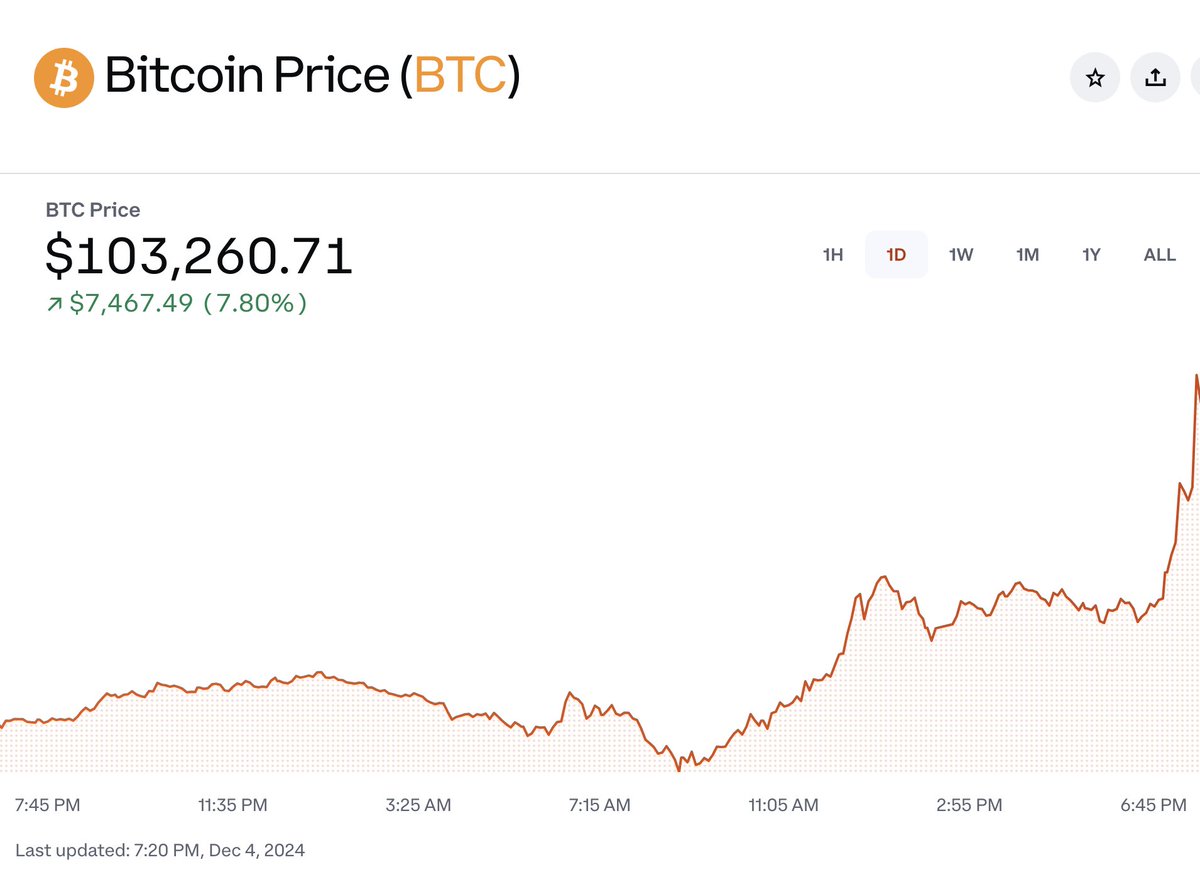
Happy Bitcoin $100k day.