🤯 J'ai trouvé une faille spatio-temporelle vers 2016 à la télévision !
Tous les poncifs (ou presque) sur #Bitcoin dans UNE émission, en moins de dix minutes !
- Bitcoin n'est pas une monnaie
- Bitcoin ça détruit la planète
- Bitcoin c'est de la spéculation pour enrichir très peu de gens
- Bitcoin c'est pas une valeur refuge, parce que ça a perdu 5% l'an dernier
- Bitcoin n'a pas de valeur parce que y'a pas de dividendes
- Bitcoin c'est nul, le vrai truc, c'est LE #blockchain
En 2026, il existe encore une personne sur terre qui dit encore "le" blockchain !
Et sinon, pour la qualité du débat public, on pourrait avoir des contradicteurs compétents ?
Non parce que dans le même temps, aux Etats-Unis, BlackRock, Morgan Stanley ou encore Goldman Sachs sont passés à la recommandation et la fourniture de services Bitcoin à leurs clients, tandis que le pays lui-même a constitué une réserve stratégique.
@swisscryptocat@ZLOK On est bien d'accord, mais pour être proprio il faut vendre des BTC pour les fonds propres... et si le BTC continue à performer comme il le fait à long terme, c'est potentiellement économiquement plus interessant de les garder (mais je n ai pas fait le calcul)
Bitcoin is on the verge of new highs in dollar terms but it's still well off highs in Swiss Francs.
Switzerland has a debt to GDP of about 37% compared to the US at 124%.
The Swiss have no need to devalue their currency to manage their debt. Which makes the Franc a useful measuring stick for asset performance.
The recent divergence between BTC priced in dollars vs. BTC priced in Swiss Francs is screaming that the tariffs + DOGE plan were a failure and the US debt crisis is worsening.
The only way the US can manage its debt is by turning the dollar bill into confetti.
So if you're an American you need to be careful pricing things in Dollars.
Capital flight into Bitcoin is the new 60/40 passive index portfolio.
Most just haven't caught on yet.
Good morning from Davos @wef
While some cozy up to unelected globalists plotting to strip your freedoms and launch CBDCs, I’m rallying every Swiss I meet to vote for 🇨🇭 Swiss Bitcoin Strategic Reserve.
Like and share if you agree 🧡
La Chancellerie fédérale suisse a enregistré aujourd'hui l’initiative populaire fédérale "Pour une Suisse financièrement solide, souveraine et responsable (initiative Bitcoin)", estimant qu'elle remplit les conditions fixées par la loi fédérale Suisse sur les droits politiques.
Lancée par le groupe de réflexion @2B4CH , cette initiative populaire propose de modifier la constitution suisse pour que la Banque nationale suisse (BNS) conserve une part de ses réserves en Bitcoin, en plus de l’or pour renforcer l’indépendance et la diversité des réserves de la Suisse :
"Article 99, alinéa 3 : La Banque nationale constitue, à partir de ses revenus, des réserves monétaires suffisantes, dont une part doit consister en or et en Bitcoin."
Maintenant l'initiative officiellement enregistrée, le comité à l'origine de l'initiative dispose de 18 mois pour recueillir au moins 100 000 signatures de citoyens suisses ayant le droit de vote.
Hey @elonmusk, you once said #Bitcoin could return to Tesla if 50% of its energy came from renewables.
Well, $BTC is now 56.76% sustainable, outperforming every other major industry.
Will Tesla embrace Bitcoin again? The world is watching. 🌍⚡
Today, I submitted a new BIP proposal for public review:
Redefinition of the Bitcoin Unit to the Base Denomination
Abstract
This BIP proposes redefining the commonly recognized "bitcoin" unit so that what was previously known as the smallest indivisible unit becomes the primary reference unit. Under this proposal, one bitcoin is defined as that smallest unit, eliminating the need for decimal places. By making the integral unit the standard measure, this BIP aims to simplify user comprehension, reduce confusion, and align on-chain values directly with their displayed representation.
Motivation
The current convention defines one BTC as 100,000,000 of the smallest indivisible units. This representation requires dealing with eight decimal places, which can be confusing and foster the misconception that bitcoin is inherently decimal-based. In reality, Bitcoin’s ledger represents values as integers of a smallest unit, and the decimal point is merely a human-imposed abstraction.
By redefining the smallest unit as "one bitcoin," this BIP aligns user perception with the protocol’s true nature. It reduces cognitive overhead, ensures users understand Bitcoin as counting discrete units, and ultimately improves educational clarity and user experience.
Specification
Redefinition of the Unit:
Internally, the smallest indivisible unit remains unchanged.
Historically, 1 BTC = 100,000,000 base units. Under this proposal, "1 bitcoin" equals that smallest unit.
What was previously referred to as "1 BTC" now corresponds to 100 million bitcoins under the new definition.
Terminology:
The informal terms "satoshi" or "sat" are deprecated.
All references, interfaces, and documentation SHOULD refer to the base integer unit simply as "bitcoin."
Display and Formatting:
Applications SHOULD present values as whole integers without decimals.
Example:
Old display: 0.00010000 BTC
New display: 10000 BTC (or ₿10000)
Conversion:
Ledger and consensus rules remain unchanged.
Implementations adopting this standard MUST multiply previously displayed BTC amounts by 100,000,000 to determine the new integer representation.
Rationale
Usability:
Integer-only displays simplify mental arithmetic and reduce potential confusion or user error.
Protocol Alignment:
The Bitcoin protocol inherently counts discrete units. Removing the artificial decimal format aligns user perception with Bitcoin’s actual integral design.
Educational Clarity:
Presenting integers ensures newcomers do not mistakenly assume that Bitcoin’s nature is decimal-based. It conveys Bitcoin’s true design from the start.
Future-Proofing:
Adopting the smallest unit as the primary measure ensures a consistent standard that can scale smoothly as Bitcoin adoption grows.
Addressing Alternative Approaches
Refuting the "Bits" Proposal (BIP 176)
An alternative suggestion (BIP 176) proposes using "bits" to represent one-millionth of a bitcoin (100 satoshis). While this reduces the number of decimal places in certain contexts, it fails to fully address the core issues our BIP aims to solve:
Persistent Decimal Mindset:
Using "bits" still retains a layered decimal approach, requiring users to think in terms of multiple denominations (BTC and bits). This shifts complexity rather than eliminating it.
Inconsistent User Experience:
Users must learn to toggle between BTC for large amounts and bits for small amounts. Instead of providing a unified view of value, it fragments the user experience.
Incomplete Alignment with the Protocol’s Nature:
The "bits" proposal does not realign the displayed value with the integral nature of Bitcoin’s ledger. It continues to rely on fractional units, masking the fundamental integer-based accounting that Bitcoin employs.
Not Permanently Future-Proof:
Though "bits" may simplify certain price ranges, future circumstances could demand additional denominations or scaling adjustments. Our integral approach resolves this problem entirely by making the smallest unit the standard measure, avoiding future fragmentation.
In essence, while BIP 176 attempts to simplify small amount representations, it only replaces one decimal representation with another. By redefining "bitcoin" as the smallest indivisible unit, this BIP eliminates reliance on decimal fractions and separate denominations entirely, offering a clearer, more intuitive, and ultimately more durable solution.
Backward Compatibility
No consensus rules are altered, and on-chain data remains unchanged. Differences arise solely in display formats:
For Developers:
Update GUIs, APIs, and documentation to present values as integers. Remove references to fractional BTC.
For Users:
The actual value of holdings does not change. Transitional measures, such as dual displays or explanatory tooltips, can ease the adjustment period.
Security Considerations
A short-term risk of confusion exists as users adapt to the new representation. Users accustomed to decimals may misinterpret initial displays. To mitigate this:
Offer dual displays and tooltips during the transition.
Provide clear educational materials and coordinated messaging.
Use alerts or confirmations in applications if input values appear unexpectedly large or small.
Over time, confusion will subside, leaving a simpler, more intuitive understanding of Bitcoin’s integral values.
Reference Implementation
Some wallets, such as Bitkit, have successfully adopted integer-only displays, demonstrating the feasibility of this approach. Transitional features—like showing both old and new formats side-by-side—can help smooth the transition.
Test Vectors
Old: 1.00000000 BTC → New: 100000000 BTC (or ₿100000000)
Old: 0.00010000 BTC → New: 10000 BTC (or ₿10000)
Old: 0.00500000 BTC → New: 500000 BTC (or ₿500000)
All formerly fractional representations now directly correspond to whole-number multiples of the smallest unit.
Implementation Timeline
Phase 1 (3-6 months): Introduce the concept, provide dual displays and educational materials.
Phase 2 (6-12 months): Prominent services adopt integer-only displays by default.
Phase 3 (12+ months): Integer representation becomes standard. Documentation and user guides no longer reference decimal-based formats.
Conclusion
Redefining the "bitcoin" unit as the smallest indivisible unit and removing decimal-based representations simplifies comprehension and aligns displayed values with the protocol’s integral accounting. While a transition period may be necessary, the long-term benefits include clearer communication, reduced confusion, and a more accurate understanding of Bitcoin’s fundamental design.
Copyright
This BIP is licensed under CC0-1.0.
https://t.co/EOESxFmkFa
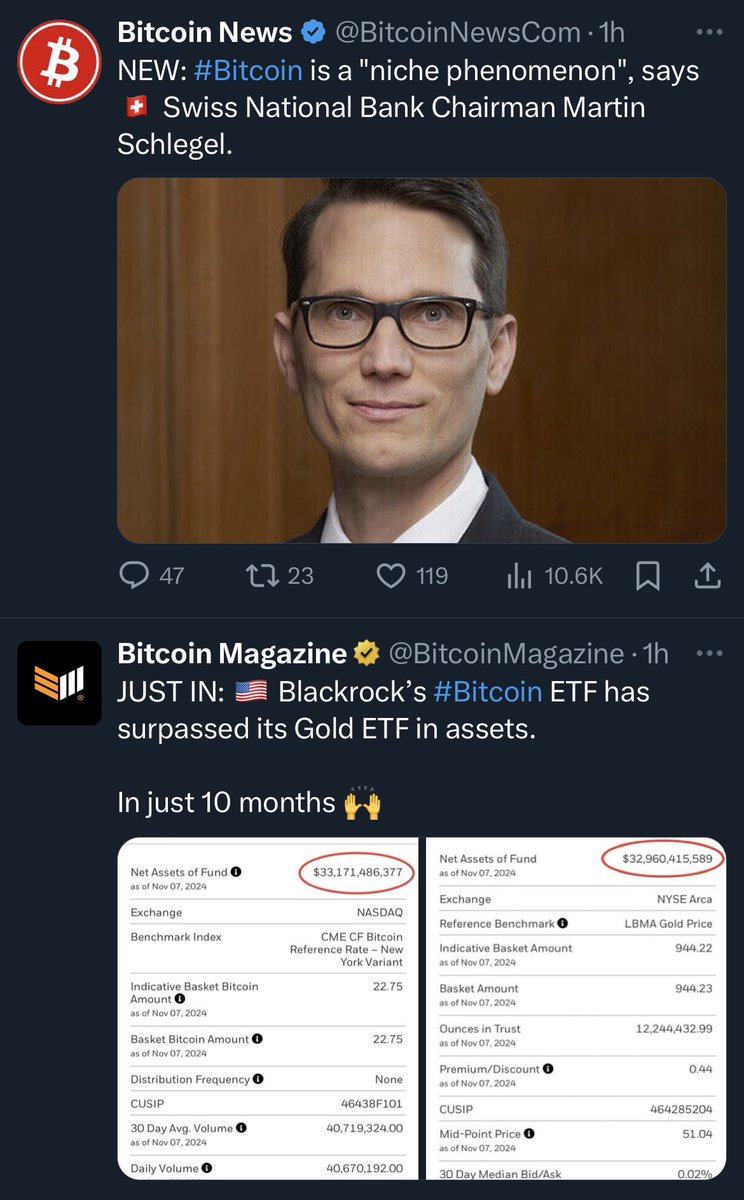
Dear @SNB_BNS ,
According to Blackrock ETF assets, Gold is more of a „niche phenomenon“ than Bitcoin!
Please stay open-minded and don‘t miss the future of finance.
🤔 L’été est propice à l’introspection et à la remise en question : et si #Bitcoin n'était qu'un fantasme pour joueurs de casino désabusés ?
Mon ironie et moi-même sommes très heureux de vous retrouver chaque mois sur @BfmCrypto cette année encore 😁