These men created tools of freedom and financial independence. They wrote code and ran businesses. They are good people.
They were rewarded with federal prison sentences.
Keonne Rodriguez
William Hill
Ian Freeman
Roman Sterlingov
Roman Storm
Free the crypto prisoners.
The prosecution of the Tornado Cash developers is directly relevant to the conclusion of this post, even if the connection isn't immediately obvious.
Closed systems have concentrated incentives. They can protect their intellectual property and trade secrets until they are ready to release a product that can rapidly grow and capture dominant network effects.
Open networks have a different set of advantages: anyone can contribute, anyone can innovate, and everything is permissionless. That only works if you can deploy a permissionless protocol without being held liable if someone misuses it.
In essence (setting aside the rhetoric the government used) the Tornado Cash indictment prosecuted standard protocol team activity. It was no different from what the developers of Uniswap or Aave do: write open-source code, deploy smart contracts, and at most provide ancillary services. In fact, Tornado Cash had even less developer involvement. The protocol itself charged no fees. The relayers were optional ancillary services run by third parties. Also, prosecutors didn't even allege that Roman Storm operated a relayer himself. And unlike Uniswap or Aave, where the team serves the front-end UX, the Tornado Cash developers put the front end on IPFS and merely linked to it from an informational site.
Framing that as running a "financial institution" is a massive expansion of financial regulation into the act of publishing software and speech. If publishing immutable smart contracts and maintaining ancillary services around them makes you a regulated service provider, then any DeFi developer with post-deployment involvement is suddenly treated as a financial institution.
Open networks already have their work cut out for them to produce breakthroughs that rival closed companies. By making developers liable for how strangers use permissionless code, the Tornado Cash prosecution is a direct assault on the ability of open networks to compete in the future.
My guess is that some of the headwinds ETH is facing right now come down to the problem I wrote about a few months ago about how closed AI has hurt the narrative for open networks.
AI/SI will accelerate development in every software industry by some ridiculous factor, e.g. 100 times. Any software project that doesn't fully embrace AI will be left in the dust.
Infuriating. These idiots destroyed California's enormous potential, and now they're doing it to Texas.
This is tha latest moral panic that demagogues are appealing to. The opposition to AI compute facilities is completely fact-free, similar to the opposition to nuclear power expansion 50 years ago that helped de-industrialize the West.
Yanis Varoufakis spent years warning that private cryptocurrency and blockchain systems are dangerous and that money should stay under political or state control.
Now a regular bank has frozen their accounts with no warning and no appeal. They're stuck asking for emergency donations just to keep operating.
This is what happens when you reject alternatives to state-controlled money.
DeFi upgrade keys exist because software has bugs, but the key that can rescue funds shouldn't be able to rewrite the contract. Users could route funds to immutable protocols through a safety contract whose backup key can only send them to a preset address https://t.co/b0IJ99e2oT
Stan Druckenmiller and ICE backing 24/7 futures on Hyperliquid is a major milestone for onchain markets, and the competitor best positioned to benefit from this shift is Lighter. Instead of relying on 27 validators to run its network and control the bridge holding user funds like Hyperliquid does, Lighter matches trades on a fast single server and uses zero-knowledge proofs so Ethereum serves as its consensus computer for security and settlement, with capacity rising further as zk-proving speeds scale and smart contracts roll out.
Cryptocurrency is the blockchain's only native app. It's the app on which the blockchain's security rests. An entirely self-contained economic system that is formally defined by machine-readable code is the only way distributed consensus can emerge within an adversarial environment.
Gabriel shows how smart contracts let people build more tools around an SoV, keeping users' wealth in its economy and making the SoV more valuable.
https://t.co/zquCulziGm
@dhh Too late. I'm being prosecuted for not stopping a tool no one can stop. Read my case story for more. I face up to 45 years in prison.
If it happened to me, it will soon happen to other AI and software developers.
This is actually huge
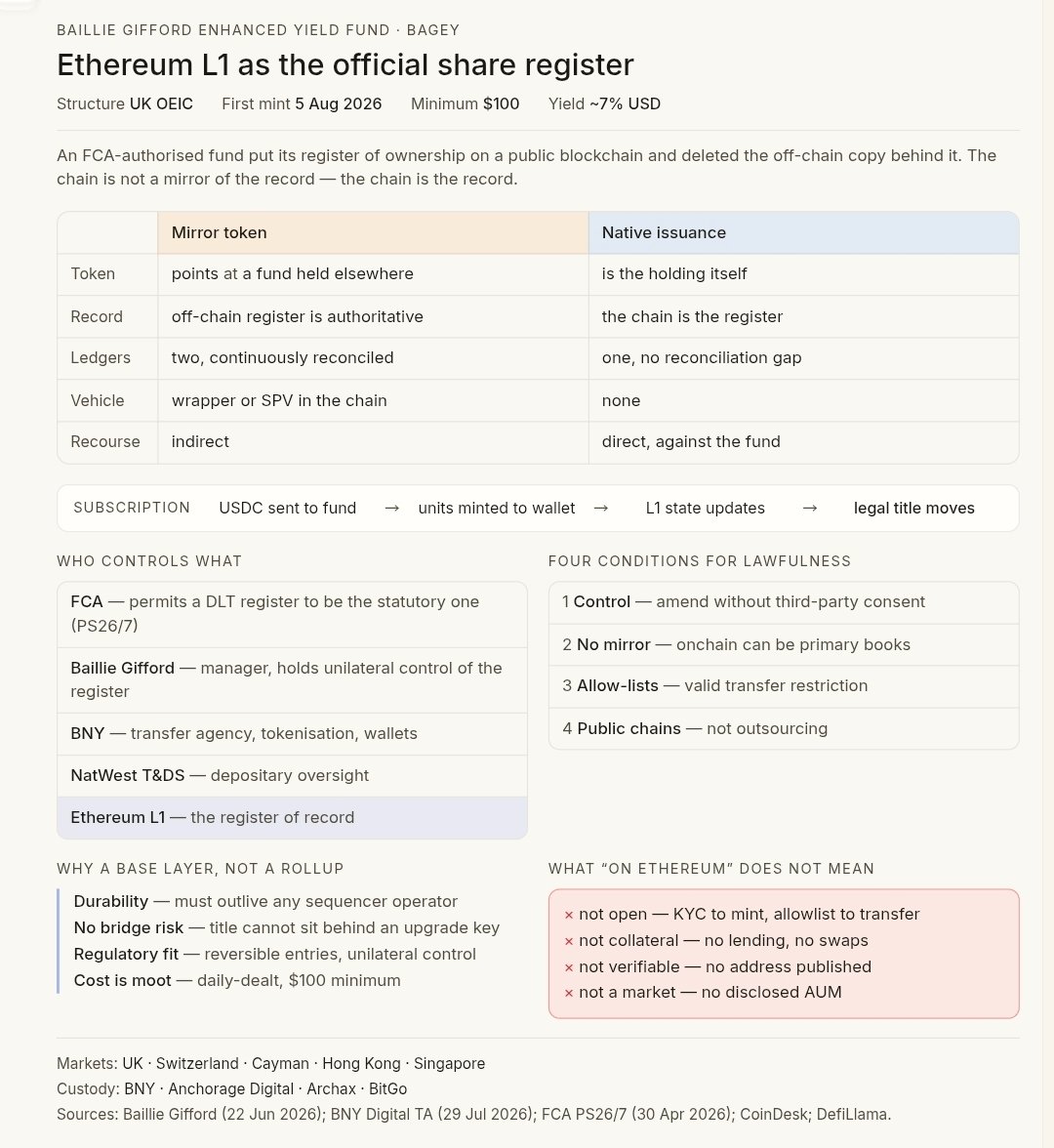
Ethereum L1 is being used as a fully decentralized registry of ownership for an investment fund
This is proving that Ethereum L1 is premium blockspace:
1) L1 is reliable and never goes down
2) L1 is decentralized and credibly neutral
3) L1 ensures data availability
If you spend $650K on a single unit, and you have 50K homeless drug zombies in LA, that's a $32 BILLION boondoggle. The homeless industrial complex in LA is the biggest money laundering scam in the history of our country. These people need to go to prison.
Thanks to @elonmusk & @SpaceX, the City of Memphis finished its Fiscal Year ahead of budget for the first time in a long time.
The City is tracking roughly $5.6 million ahead for the current year.
Memphis Mayor Paul Young said this week that SpaceX generated $54 million in taxes for the City and County this year.
Before my ex was murdered, he kept complaining the city was less safe & he'd face more jail time than a guy who attacked him if he defended himself
He wasn't wrong tbh :/
Our city constantly let violent criminals out of jail, but men who fought back? We all saw what happened to Daniel Penny at first 😭
My ex was killed by a man who'd attacked umpteenth people before him — shoving someone through a glass storefront, kicking someone's face — and he wasn't jailed until he finally killed
It was never necessary. We could've not shut down long-term mental healthcare facilities in my city (this guy needed it) or kept people in jail (not my first choice but better than non-violent people dying).
Sue me, guys, I'm such a suicidal empathy type for preferring humane conditions for violent people to jail 🙄
What we agree on: they shouldn't be freely walking around until they kill