@neerajadeshp Thank you for thoughts on the misuse of social science, when we need to have a discussion about what we consider the good/moral life. Appreciate you. For what it's worth I've heard others express concern that they've properly controlled for the urban areas as a confound.
@kevin2kelly I'll be driving across the US with my wife and our 2 young kids (3.5 yrs and 8 months) this June, to visit family on the East Coast. We'll start in Minneapolis and hit stops in NH, CT, and Philly before heading home. This post inspires me to do some more off-the-track stops too.
And why shouldn't it, students use it as a tool to really engage with the material? We know engagement is important for learning, and having an infinitely patient tutor explain everything gets you over the hump of things that might derail you and make you tune out.
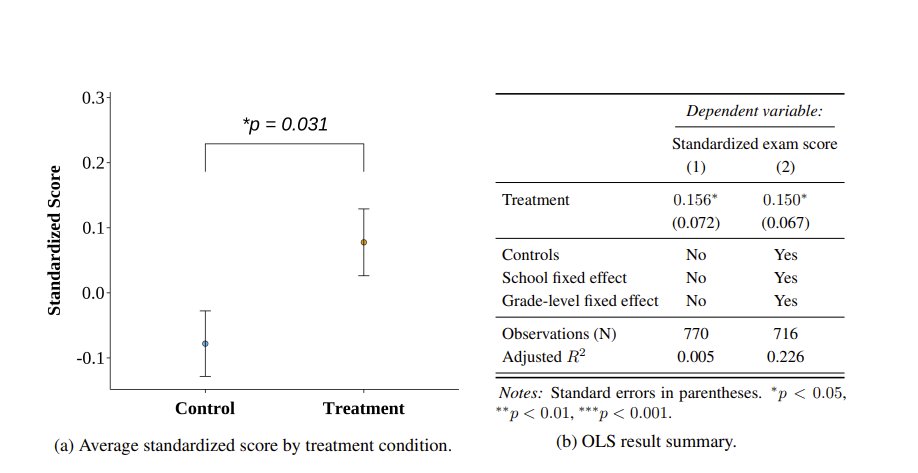
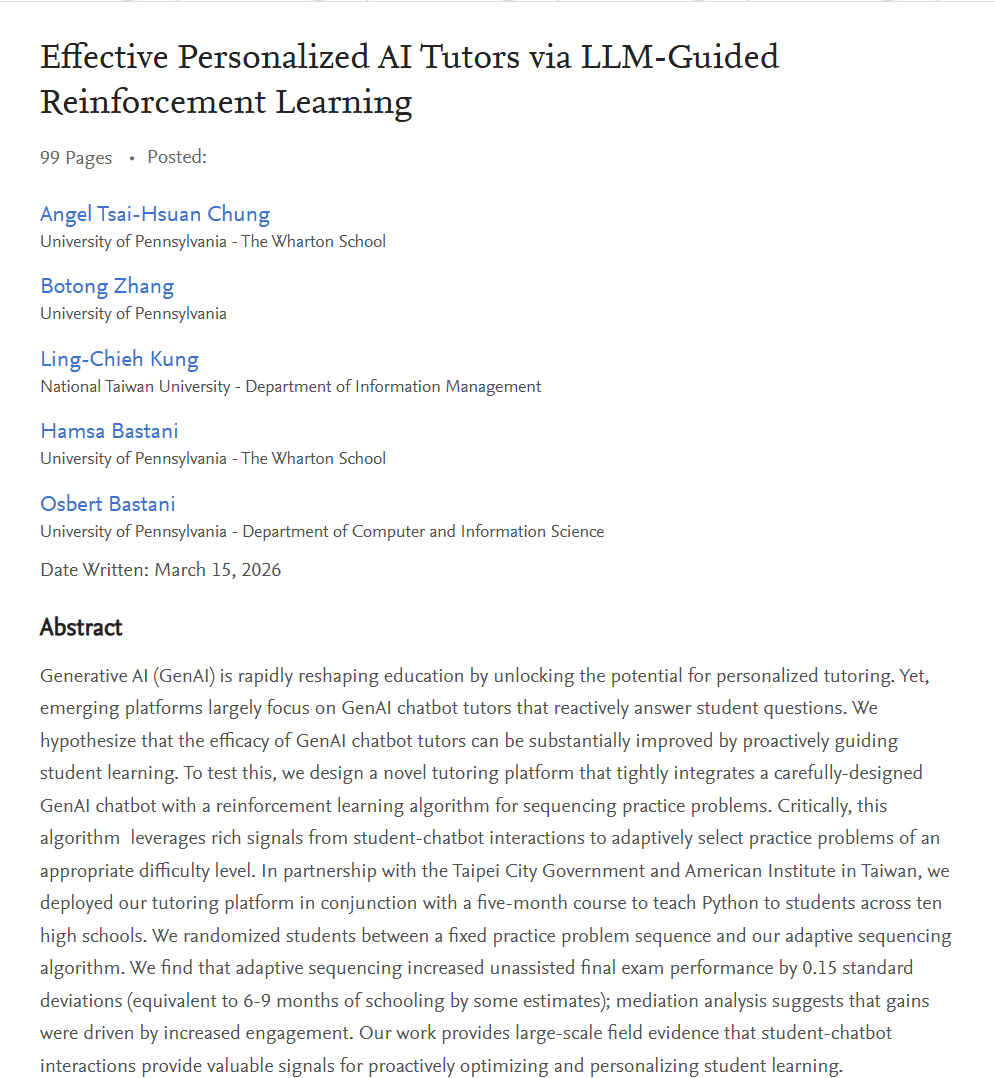
AI really can help education: Randomized controlled experiment on high school students found a GPT-4o powered tutor that personalized problems for students raised final test scores by .15 SD, "equivalent to as much as six to nine months of additional schooling by some estimates"
I've found this to be the case in my work as well. I think human knowledge and skill will continue to be necessary for much longer than many AI pundits are leading us to believe (12-18 months). AI is an amazing tool and will only get better, but we have our strengths.
When AI first arrived on the scene, I worried it would make economists, or even critical thinkers more broadly, less valuable. In my travels in the past 6 months to work with non-profits, for profits, and government agencies, I have observed how people are actually using AI. I have watched them fumble around with insights they clearly did not create themselves.
My fears are now assuaged. One observation is that AI can produce something that in some cases is very wrong and in others looks nearly right, but is not quite there. Even if in time AI improves to "nearly right" or "exactly right" every time, a second issue still arises: explaining the materials.
Explaining why an answer is almost correct but subtly off requires exactly the critical thinking skills that created the knowledge in the first place. Even explaining "exactly right" material takes critical thinking. I've watched smart people confidently present AI-generated material they clearly don't fully understand. The words sound right. But when someone pushes back just a little bit, the sand castle crumbles.
It is quite difficult to defend what you didn't build. This leads me to now make the optimistic case for human expertise. The value of deeply understanding something — of having built the knowledge yourself — hasn't diminished with AI. If anything, it's increased. The people who can tell the difference between "nearly right" and "right" are more valuable than ever. The people who can explain the subtle details about something that is exactly right are invaluable.
Creating knowledge still matters. Maybe now more than ever.
You’ll only be the greatest at what you love.
Alysa Liu’s joyful gold medal performance should be a wake up call to anyone who wakes up dreading work.
10 years before retiring from TechCrunch as the #1 most cited tech journalist, I was earning $20 per article. TWENTY. But god how I loved it.
I was just learning, so I could only write 3 per week. That’s less than minimum wage. Worth burning savings to get to slap the keys for 10M Twitter followers. Letting the the thoughts fly, hour after hour in total flow. 10 years and 4000 articles later, it was still so much fun.
Up at 5am to publish, writing 10 articles in a day at a conference, sprinting to find WiFi so I could break a story, shrugging off belittlement as a “blogger” from career J-school types.
I still loved it, and I think the joy and excitement came through in the writing. I didn’t second guess myself. Hell, I hardly edited. I wanted the world to see what I made.
As most tech reporters got jaded, the joy kept me optimistic. I still covered abuses, had investigations cited in Congress, got Facebook’s Onavo & Teen Research programs shut down. But the earnest enthusiasm meant founders still wanted to talk to me.
Eventually I craved a new challenge in VC. And here too, the investors I look up to most and who seem to do it the best are having fun. South Park Commons’ @adityaag, Long Journey’s @cyantist , Verdict’s @bonatsos, and fellow word rotator @lennysan.
Joy attracts joy, that attracts talent, that attracts capital. And in a world of enough inequality, it’s hard for most people to root for someone joyless, who’s only in it for success.
So if you have the rare privilege to switch and take the short-term hit, do it. Of course, the world has to need what you love, and you need the ability, work ethic, resources, and luck to progress.
But what the world doesn’t need is generalists. It needs outliers. And nothing pushes you further ahead of the crowd than doing it with a smile.
@bigaiguy I haven't checked out GPTs but am intrigued, thank you. Is there a route planner GPT for planning trips? I am planning some travel around the state for work and am interested in helping me plan out efficient routes that I can modify as plans change.
This quote is a good reminder for me as I prepare to do 3 months of intensive public engagement for work while my wife also starts a new job working in the evenings. Via the Waking Up app: https://t.co/W0I8AoGA4n
Hey @RepDonBacon@SenatorWicker?
Don't you think you ought to do something about the RFE journalists Trump is sending back to be tortured in Russia?
https://t.co/2d79S8NGlD
@NateSilver538 How good has o1 been on data analysis for you in other situations? I worked with a spreadsheet today that contained survey results, where I was trying to pull stats and break it down by respondent characteristics. I used the o3 mini w/ spreadsheet attached. it made up stats.
I like to disconnect while on vacation, but sometimes you just want to have things moving along while you're out, so it's not such a huge bummer when you come back and have to catch up. This could be a good way to do it. I'm sure @Outlook could easily bake something like this in.
Idea: an AI trained on all your work emails (those labelled as non-sensitive) that when you set your out of office message, drafts up replies and notifies you when a reply is ready for review. You approve, deny, edit, or snooze the draft messages from your phone while out.
When your toddler decides to use Susan Sontag's works as a booster to reach the light switch for playing her "lights out" game. https://t.co/fBGM7vOSxq
It's like these people have never seen Futurama. Not a great trend for reversing demographic decline and social disconnection. 😓 https://t.co/x4UviWpgsc
"The common narrative is that kids learn faster than adults, but if you watch any toddler they spend a large portion of the day attempting things that are on the edge of their ability.
How much time have you spent on the edge of your ability today?"
-@JamesClear