@evan_thayer It's not a destination it's a direction.
-0.2 x 7 x 24 = -34 lbs
Your body burns ~2000 cals from heart and brain function.
Just eat slightly less than 2000 cals/day and you will forever head in that direction.
If you fuck up one day, just start in that direction again tmrw
Maybe he could be geared towards a passion and skill for Residential or Self Storage or being a Broker (as you were) or straigt contracting. Skills and dispositions vary in nuanced ways from retail development....but still leverage in areas that overlap and where he may appreciate a head start. Just saying maybe not to think of "Real Estate" = only what stripmall guy does.
A lot of developer friends ask how we design and build beautiful buildings with budgets that beat far less attractive projects.
There are many levers.
But most deals quietly die in one place:
Structure.
Here are some pro tips, particularly for multifamily podium design:
Column grid
Keep it tight: 24–28 ft max.
Go wider and you trigger thicker PT slabs, drop panels, punching shear steel, and endless MEP conflicts. The last one might be the most painful, but the first two are the most expensive.
Load path
Never shift columns between floors.
Transfers = heavier structure, more rebar, slower schedules, real money burned. Don’t approve a schematic design layout before this is flushed out.
Slabs & soils
Bad soils force thicker slabs, mats, piles. Foundation costs can jump 2–3×. Choose sites carefully. Get good soils. Expansive soils? We’re out.
MEPs
Stack wet walls. Have dedicated plumbing walls with no structural value. Lock sleeves early. Another killer: Bathrooms over columns or even electrical rooms. Late MEP coordination are how “on-budget” jobs blow up in the field.
Shear & hold-downs
Maintain continuous exterior wall zones (~12–16”) from podium to roof.
Clean load paths = less steel, simpler inspections, better seismic performance.
Wood framing
Align shear walls with column grids.
Misalignment adds transfer forces and structural weight you don’t get paid for. Again, don’t even go past schematic phase until this is sorted out. Only exception. Facade area.
Cost effective constructions isn’t about cheap finishes. They’re about disciplined structure, driven by architectural design logic. Get this right, you’re half way there. Get it wrong, no amount of value engineering will save you.
@scottbelsky@PicnicHealth will gather all your past data from all past visits, aggregate and has
trained its own llm
Introducing LLMD, PicnicHealth’s large language model for more efficient research https://t.co/KyJKs373St
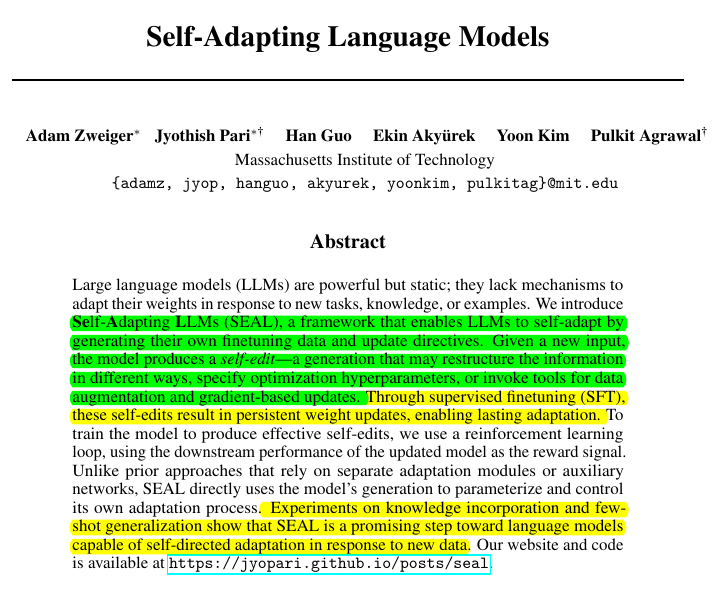
AI just learned to fine-tune itself between questions.
MIT introduces SEAL, a framework enabling LLMs to self-edit and update their weights via reinforcement learning, all by itself.
LLMs consume whatever data they are given, so they stay frozen after pretraining.
SEAL teaches a model to write its own study material, fine-tune on it, and keep learning.
⚙️ The Core Concepts
The core idea behind SEAL is to enable language models to improve themselves when encountering new data by generating their own synthetic data and optimizing their parameters through self-editing.
The model’s training objective is to directly generate these self-edits (SEs) using data provided within the model’s context.
Each self-edit is a text directive that specifies how to make synthetic data and set hyperparameters for updating weights.
The generation of these self-edits is learned through reinforcement learning. The model is rewarded when the generated self-edits, once applied, lead to improved performance on the target task.
@svlevine@ylecun In text, the next word is a single token and all previous tokens are updated to the latest context ready for the next pass so there is a clear concept of a collective "past". In video everything is constantly in the present.
Brillaint 🔥
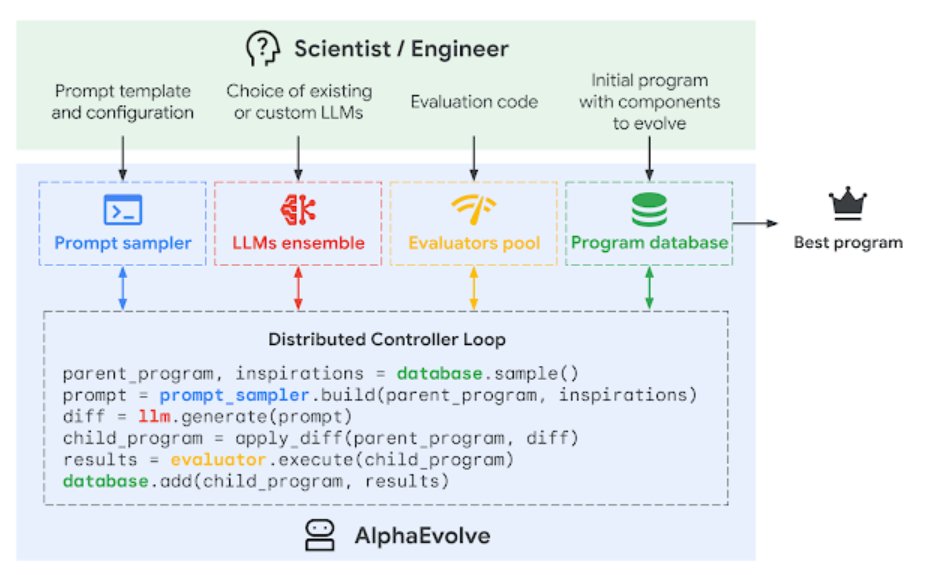
@GoogleDeepMind launched AlphaEvolve, a Gemini-powered coding agent that discovers and evolves algorithms, outperforming its predecessor AlphaTensor.
It achieved 23% matrix kernel speedup, 32.5% GPU kernel boost, and 0.7% compute recovery in data centers, driving major efficiency gains in AI training, chip design, and math problem-solving.
⚙️ The Details
→ AlphaEvolve uses an ensemble of Gemini models—Flash for exploration and Pro for deep refinement—to generate and evolve code for algorithmic tasks. Programs are scored via automated evaluators, enabling objective progress tracking.
→ It discovered faster matrix multiplication algorithms, including a 4x4 complex matrix multiplication using only 48 scalar ops, improving on Strassen’s algorithm.
→ It recovered 0.7% of compute resources globally via improved data center scheduling with interpretable heuristics.
→ Contributed Verilog-level enhancements to Google's TPU design pipeline.
→ Delivered a 23% speedup in matrix ops and 1% reduction in Gemini model training time.
→ Achieved 32.5% acceleration on FlashAttention GPU kernels, reducing dev cycles from weeks to days.
→ AlphaEvolve doesn't just optimize—it innovates. Given only a minimal code skeleton, it co-designed a novel gradient-based optimization procedure, creating multiple new matrix multiplication algorithms.
→ Solved parts of 50+ open math problems, improving 20% of them, including the 11D kissing number problem with 593 spheres.
→ It rediscovered state-of-the-art solutions in 75% of experiments across number theory, geometry, analysis, and combinatorics, validating its mathematical depth.
→ In 20% of cases, AlphaEvolve pushed the frontier, like improving the kissing number problem in 11D with a new configuration of 593 spheres, setting a new lower bound.
→ Setup time for most math problems was just hours, enabling fast iteration and exploration across diverse domains.
→ Early access for academics is being planned, signaling potential broader availability.
@JacobEdwardInc Perhaps seeing results will prove to be a gateway drug in a positive sense to people connecting the mental dots between the direct correlation of quantity consumed and weight. I think lesser of evils is rational if nothing else resonates. Anything to get started.
@thedankoe@dvassallo Would the analogy be closer to being able to build a professional automatic cappacino machine for the price of single Starbucks grande.
@Trace_Cohen@bryanlanders And the use of "search" which is a new and distinct layer on top of transformers that are decision making algorithms that are more deterministic than the pure statistical brute force layer based self attention. Search is what has powered very specific ai like poker bots etc.
@Trace_Cohen@bryanlanders No. Chain of Thought (thinking about thoughts) was introduced in o1 and the latest Gemini and in some ways people were doing this with prompt engineering , function calling , structured outputs and recursive calls...but o3 appears to be this on steroids.