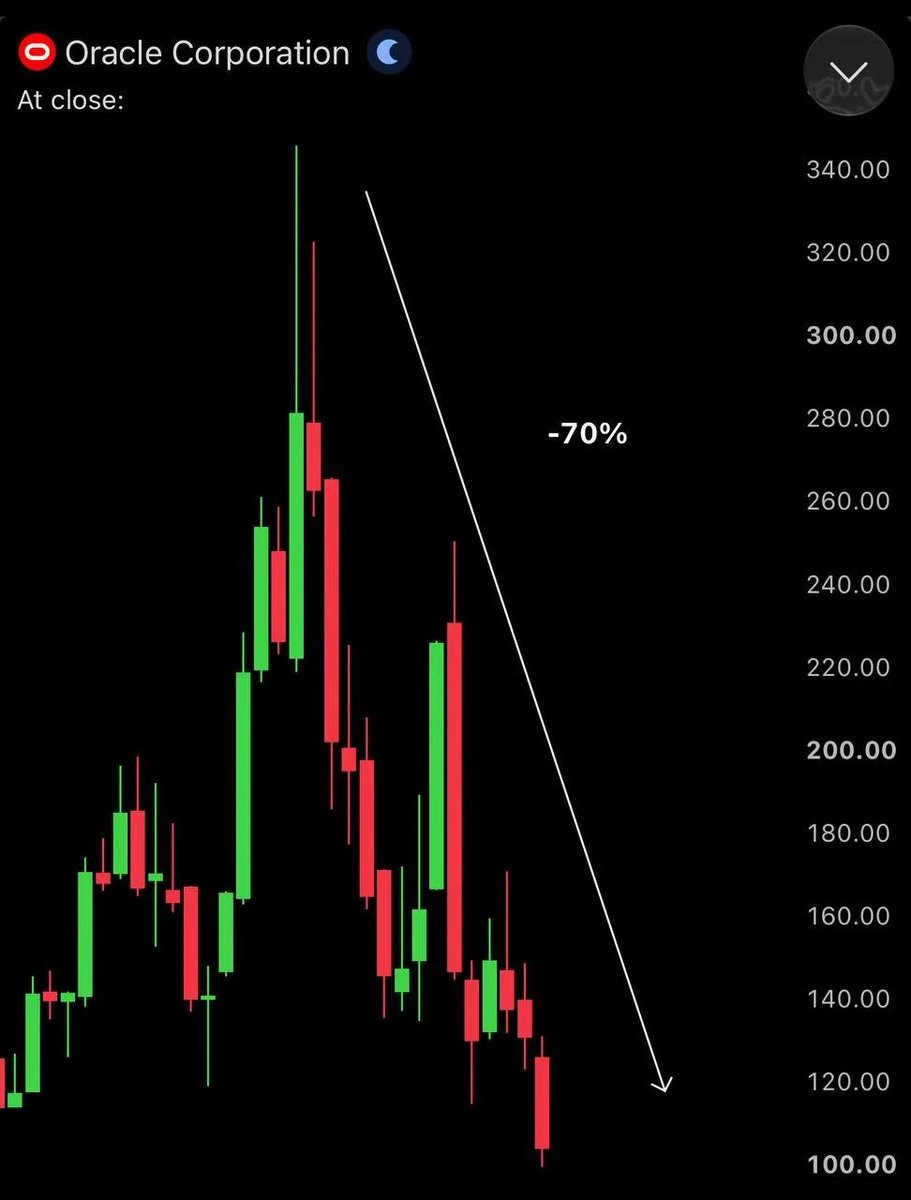
BREAKING: $ORCL has crashed 70% from its 2025 peak due to growing concerns about its debt.
Once nearly a $1 trillion company, Oracle is now worth just $314 billion.
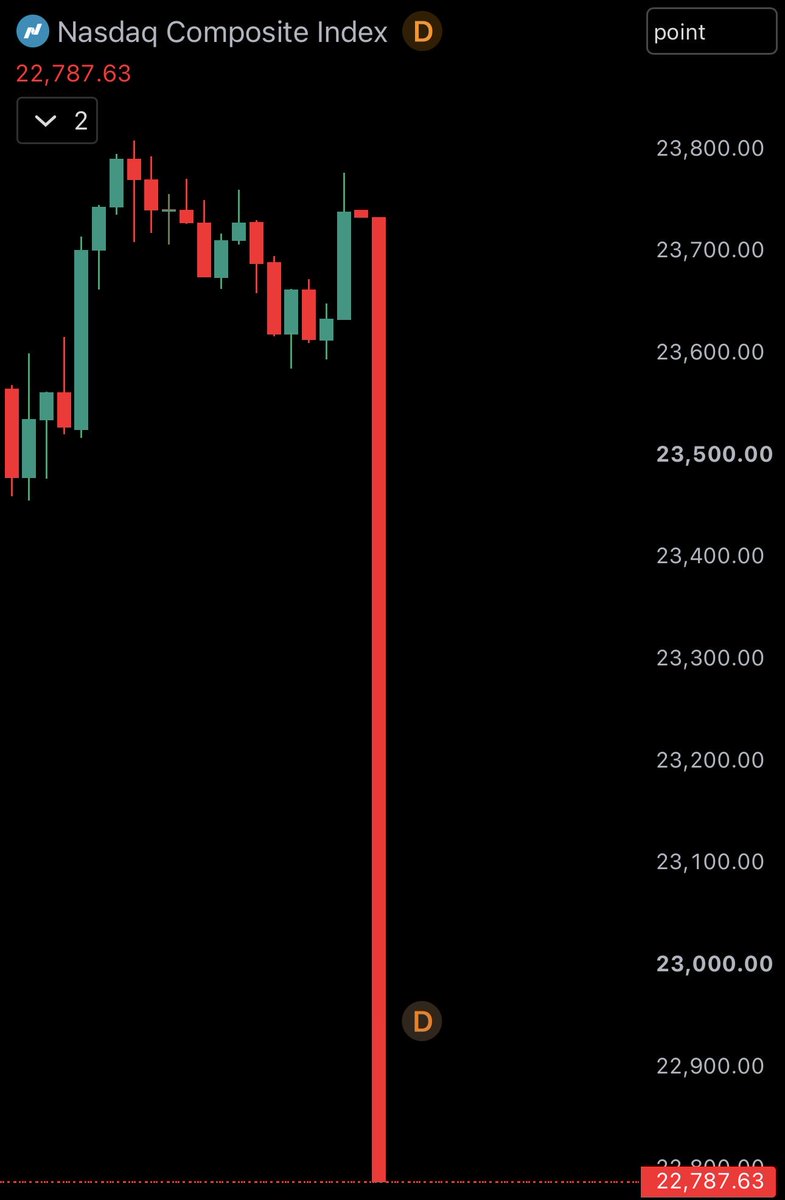
JUST IN: Financial markets are crashing again.
Gold falls under $3,470
S&P 500 falls under 7,000
Nasdaq falls under 22,800
Bitcoin falls under $58,000
Trillions of dollars in combined market value have been wiped out today.
🚨 The current AI market crash looks TERRIFYINGLY similar to the 2000 dot-com crash
On March 10, 2000, the Nasdaq peaked.
Just 48 days later, AT&T Wireless raised $10.6 BILLION in what was then the biggest IPO in U.S. history.
26 years later, the Nasdaq peaked on October 6, 2026.
And just 44 days later, Anthropic completed the biggest IPO in history, raising $93.5 BILLION.
But the timing of these record breaking IPOs is only the beginning.
Look at what else is happening:
• Massive infrastructure spending: In 2000, companies poured billions into telecom networks. Today, it's AI data centers.
Annual AI investment is projected to exceed 3% of U.S. GDP, compared with just 1.1% during the internet boom.
• Aggressive monetary tightening: The Fed raised rates six times from 4.75% to 6.5% between 1999 and 2000.
Today, markets are once again dealing with tighter monetary policy while technology stocks struggle.
• Credit market stress: Financing became increasingly difficult for tech companies during the dot-com crash.
Today, credit risk is rising across major AI companies, with bond investors expecting Anthropic's debt to receive a junk rating.
• Extreme valuations: Unprofitable internet companies attracted billions in 2000.
Today, Anthropic has reached a fully diluted valuation above $2 TRILLION despite reporting a $104 BILLION net loss in the first nine months of 2026.
And the amount of money involved today is MUCH bigger.
Major U.S. technology companies are projected to spend $5.5 TRILLION by 2030, even as borrowing costs rise and investors question whether AI can generate enough profits to justify the spending.
Remember what happened in 2000.
The internet went on to change the entire world, but that didn't stop the Nasdaq from crashing 77%.
It took roughly 15 YEARS for the index to recover its previous all-time high.
AI could transform the global economy just like the internet did.
But even if AI becomes the biggest technological revolution in history, investors could still lose TRILLIONS along the way.
I'm sorry but $SNDK looks like every failed company during the 2000 Dot-Com crash right now...
You gotta realize that not every company can survive brutal drawdowns like this.
$SNDK looks like one of the few that legitimately can't.
If we go much lower, I will sell all of my SanDisk shares.
🚨 DON'T BECOME THEIR EXIT LIQUIDITY
Yesterday, the market gave you the fake recovery I was waiting for.
Some names bounced.
Dip buyers rushed in.
People started saying the bottom was in.
But that bounce was the trap.
This is how relief rallies turn buyers into bagholders.
A little green is all it takes to bring the dip buyers back.
It makes you believe the worst is over.
And now comes the part nobody is ready for:
THE NEXT LEG LOWER.
The Dot-Com collapse followed the same psychological pattern.
The Dot-Com crash wasn't a straight line down.
It was a series of brutal drops followed by fake recoveries.
Each rebound convinced investors the damage was over.
Then the market broke another level lower.
Bubbles don’t unwind in one clean move.
They bleed out through repeated cycles of panic and hope.
The AI bubble has only just started to pop.
The repricing is not over.
Yesterday was the relief rally.
The real pain comes next.
Don’t confuse relief with recovery.
I’m waiting for capitulation.
Remember: I warned you about the Nvidia crash in August at $242, called the Bitcoin top at $126K, called the SpaceX top, and predicted the Gold and Silver collapse.
The next call will matter even more.
When this bubble finally breaks and the REAL bottom forms, I’ll post the exact levels I’m buying here publicly, like I always do.
Turn notifications on.
If you’re not following yet, you’ll understand why that was a mistake later.
Bringing Jensen Huang back is the most DESPERATE move of this entire AI bubble.
Enron's board brought Ken Lay back as CEO in August 2001 to calm the market, and the company filed for bankruptcy 110 days later.
We're short and we gave some money back today, which doesn't bother me one bit, because NOTHING about the economics of AI changed this morning.
The whole system is still cash flow negative by hundreds of billions of dollars, and a CEO comeback doesn't add a single dollar to that.
Again: Show me the money.
When a board rehires the CEO who resigned 12 days earlier, with the White House pushing for it, that tells you how desperate things really are.
Nvidia was already sliding before anyone heard about Jensen's personal life, and I still expect neoclouds like CoreWeave and IREN to go BANKRUPT.
We put up a 57% long/short spread by sticking to fundamentals and valuation, and we keep pressing our shorts. The number-go-up crowd can keep chasing headlines.
History won't be kind to @JensenHuang and NVIDIA.
🇺🇸 The entire AI bubble was on the brink of collapse until Nvidia brought Jensen Huang back
Its shares surged more than 30%, with the Nasdaq jumping around 5%, after Trump personally intervened to support Jensen's reinstatement as CEO.
But financial analyst Simon Dixon believes something far bigger just happened.
Silicon Valley may have just won a power struggle against America's military-industrial complex, with the survival of the AI boom hanging in the balance.
Simon argues that the faction pushing to remove Huang wanted tighter restrictions on advanced chips reaching China, while Wall Street and Silicon Valley desperately needed Nvidia's growth machine to keep running.
And the stakes were enormous.
Following the turmoil surrounding Anthropic's IPO, Simon warns that collapsing confidence threatened to spread into credit markets, potentially triggering a devastating liquidity crisis.
The AI bubble wasn't just wobbling. According to him, it was approaching a breaking point.
Then came the extraordinary reversal.
But Simon warns the underlying bubble hasn't disappeared. Its collapse may simply have been postponed.
And with OpenAI's anticipated IPO still ahead, he suspects the financial establishment has every incentive to keep the party going.
@SimonDixonTwitt
The fact that rehiring one CEO of one company can make the entire stock market soar (and tank bonds) this much is the clearest evidence yet of what a fragile bubble markets are in!
$NVDA
THE AI CRASH IS ALREADY WORSE THAN THE DOT-COM CRASH FOR SOME OF TECH'S BIGGEST NAMES.
Out of 27 major tech stocks, 10 have already fallen more than they had at this point in 2000.
Nvidia is down 48% from its high this year, versus 32% at this point in 2000.
Intel, Oracle, Corning and Western Digital are all down around 60% or more.
The only reason the market doesn't look like 2000 yet is the mega caps.
Apple, Microsoft and Amazon are holding up, while back in 2000 they had already crashed 40% to 75% by this point.
The stocks holding up best are the ones that make most of their money outside AI, from iPhones, online shopping, Windows and Office.
The ones getting crushed are the companies whose growth depends on AI spending: chips, memory, data center fiber and AI cloud.
If AI spending keeps slowing, the pain could spread further.
🚨 DON'T BECOME EXIT LIQUIDITY
Tomorrow, the market will try to fake a recovery.
Some names will bounce.
Dip buyers will rush in.
People will start saying the bottom is in.
But don't fall for it.
This is exactly how the market traps you.
It gives you hope. It shows you green candles.
It makes you believe the worst is over.
And then it rips the floor out from under you.
We saw this exact movie in 2000.
The Dot-Com crash wasn't a straight line down.
It was a series of brutal drops followed by fake recoveries.
Every bounce looked like "the bottom."
Every bounce pulled in more buyers.
And every bounce was followed by a lower low.
That is how bubbles deflate.
Not in one day.
But in waves of false hope.
The AI bubble has only just started to pop.
The repricing is not over.
The real pain hasn't even begun.
Do not chase this bounce.
Wait for the real capitulation.
Remember, I warned you about the Nvidia crash in August at $230, called the $126K Bitcoin top, and predicted the Gold and Silver collapse.
When the bubble finally pops and the real bottom forms, I’ll post the level worth buying here like I always do.
If you’re not following yet, you’ll understand why that was a mistake later.
🇺🇸 The dot com bubble burst with stocks around 150% of the economy... this market is sitting at 230%.
Billionaire investor Frank Giustra calls it the mother of all bubbles and thinks the Anthropic IPO probably marked the top:
"You're basically playing Russian roulette with a 44 Magnum to your head. And the only question you have to ask yourself is, do you feel lucky when you pull that trigger?"
With seven companies making up about a third of the index, he expects the slide to start at the top and spread, just like 2000, which puts everyone's 401(k) in the line of fire.
@Frank_Giustra
BREAKING: Odds of the AI bubble bursting this year surge to 69% as the world's 10 largest companies lose over $2,900,000,000,000.00 in a week.
🔗 https://t.co/pUf8tdSyCP