@mm9sql I find it intriguing that the AI generated web UI often uses the same dark color scheme with bright magenta and turquoise accent colors, making the AI generated UI clearly recognizable.
@adam_chal So the language is safe if it allows one to release a memory that has already been assigned to another caller? Doesn't make sense whatsoever.
@Michael_J_Black Recently two morse code decoder open source projects popped up: A deep learning one and a classical Bayessian one. The later is not worse, maybe better than the deep learning one. The coding agents did a great job writing and optimizing the Bayessian pipeline.
@rms80 Now imagine my pain of having to maintain a large LabView (graphical language) control software for an accelerator. Interestingly, the LLMs are good at explaining the diagram from screenshots.
@probonopd Thanks for the link. I was hacking on StarOffice localization and a bit on KDE Office suite in 1999-2000 when I was employed shortly by SuSE Prague Office. Interesting times.
These days I picked KDE Plasma on my Linux desktop, however I am mostly Windows bound.
@rms80 Only the code is the full spec. I have found out that there are bits of logic that are extremely difficult to explain in words to a coding agent and it is much quicker and more precise to just code it myself. The agent does not know my priors, which are difficult to convey.
The answer is an SDR that you already own!
Let me introduce you to the BirriaSDR! A dual-band 40 Msps SDR (2.4 GHz/5 GHz) based on a mass-produced USB 3.0 Wi-Fi dongle that can export RAW I/Q for under 30 USD.
Apologies, I finished the birria long ago... but only got around to writing this now.
The idea was to use a chip as cheap as the RTL-SDR (<50 USD), with transport already built in (USB 3.0). Not something that costs four times as much or needs to be paired with an FPGA to export any real amount of data.
Now, think for a bit: what kind of mass-produced device fits the bill? Yes, every single USB Wi-Fi dongle!!!
It has been clear for a while that a lot of models have internal firmware that can be modified to export RAW I/Q data via their DMA engines. Most units can even run ASM payloads to modify the data.
Historically, it would be a pain in the ass to reverse engineer the internal mechanisms of every single chipset in each Wi-Fi dongle (there are many!). But with AI, I can do that from my phone while eating birria at my local restaurant.
Before leaving, I connected my MT7921A Wi-Fi dongle to my Raspberry Pi 5 and gave GPT-6 Astra the goal of getting it to export RAW I/Q over USB. Don’t be fooled: this wasn’t a “turn this into an SDR, make no mistakes” prompt. I had to give it leads on how to do this properly. By the way, this is the same chipset that the notorious ALFA AWUS036AXML has.
At first, it created a burst exporter that could only record a short snapshot of RAW I/Q. This is an ancient feature that has been known for a long time and is even present in DD-WRT, but it was useless for our purposes.
Then, after a couple of hours, it improved it to use the internal packetizing engine to create a stream of four consecutive complex samples per 16-byte block, with I and Q each occupying a 16-bit slot and retaining 14-bit precision. These blocks can be moved out of the device via the DMA engine. The RF front end can tune to both the 2.4 GHz and 5 GHz bands. The tested 40 MHz, 80 MHz, and 160 MHz sample rates work, but with a very prominent filter shape, as expected.
The end result was a very capable SDR with dual-band 2.4 GHz/5 GHz reception, 14-bit I/Q resolution, and a nominal complex sample rate of 40 MSps over USB 3.0. Higher sample rates and wider bandwidths are still experimental.
That said, I think this is a good proof of concept that needs to be further refined. Using a Wi-Fi dongle as an SDR solves the data interconnect problem and makes it easy to connect an external antenna with RP-SMA.
I expect it won't take long for manufacturers to start mass-producing devices with the architecture I'm proposing, with a proper USB port, a tunable RF front end, and heat dissipation.
I also want to make the point that you don't need to write a whole new SDR client every time you reverse engineer a Wi-Fi device to be used as an SDR. All you need is a small library that exports the I/Q. To prove this, the whole driver is a single Python script inside a CyberEther flowgraph file.
Want to try it? First, buy an MT7921-based Wi-Fi dongle. They’re widely available and cost less than $30. Then, install CyberEther and download the flowgraph from the repository below. Connect the dongle and open the flowgraph in CyberEther to start streaming I/Q data, as shown in the video below.
This will be available as a built-in block in CyberEther after some refinement.
Download CyberEther: https://t.co/4bFosC4cj5
BirriaSDR Repo: https://t.co/idMu2ni3Qf
P.S. This is the same chipset many laptops come with!
@iquilezles@molecularmusing I have seen surprisingly large and complex applications vibe coded by engineers with little programming skills. Often those applications are repackaging of existing modules into new forms, however those new forms are super useful to at least small group of users.
Early duty here.
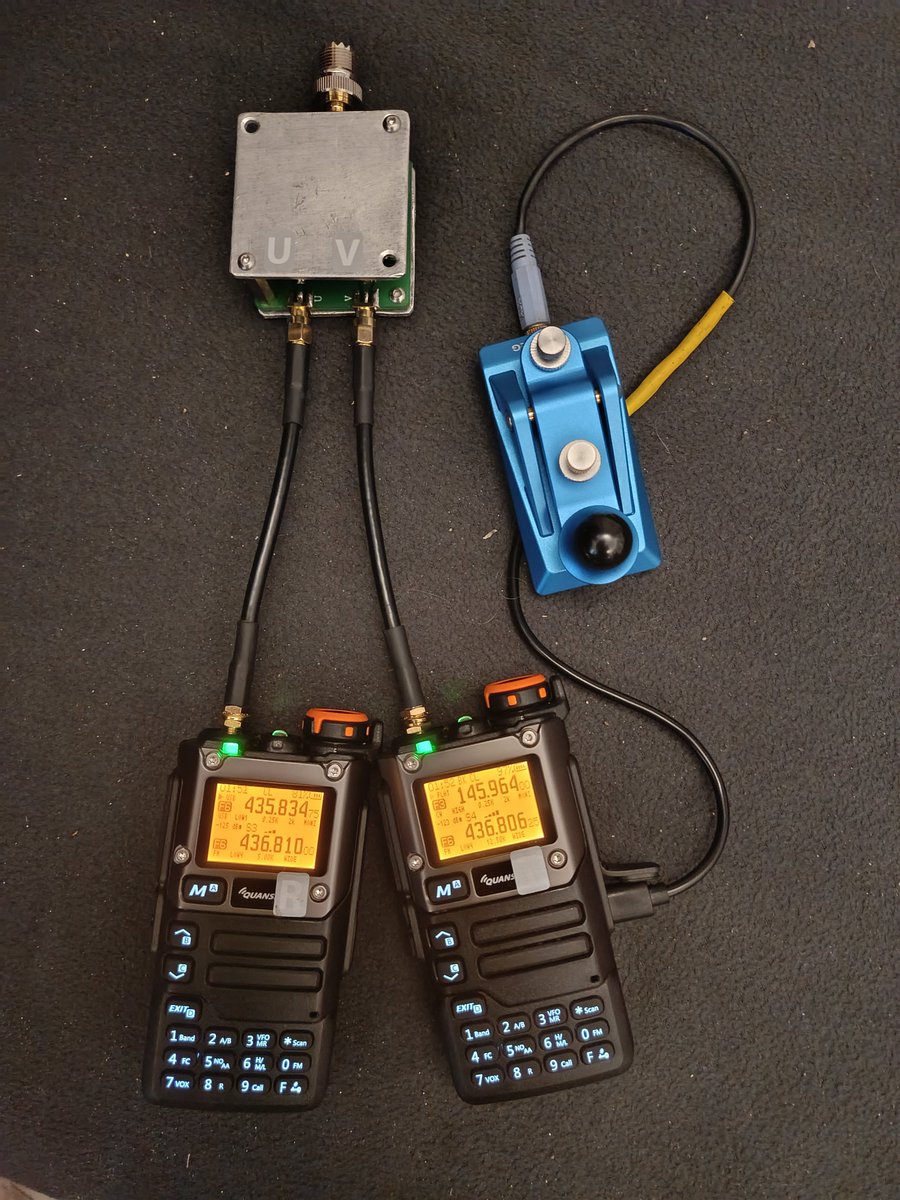
VU2AAP and VU2LBW. 5060km over the ocean.
That is as far as you can make it.
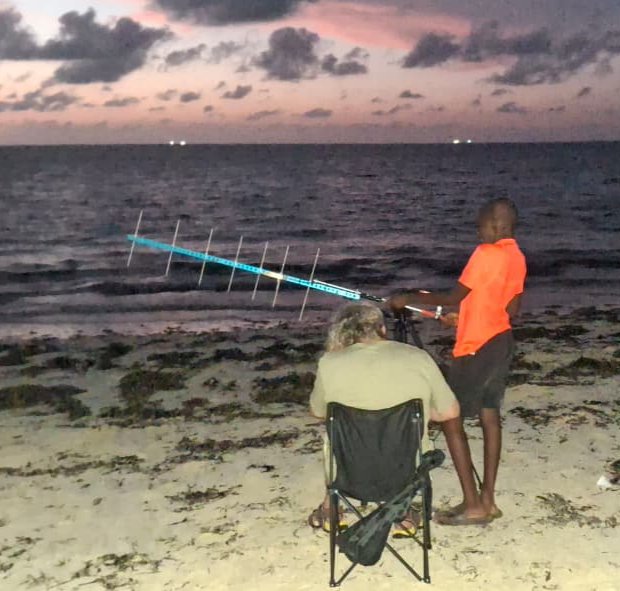
The satellite is on both sides just over the horizon, that is why I had to go to the beach at 5am.
@ocornut@github I vaguely remember github decided to trim the release log messages at one point of time.
Storing important stuff into the repo instead of the github tools is always a good idea.
Would https://t.co/blPlcTgq9Q help to recover your conversations?