Most agentic delivery fails in one place: the same agent writes the code and decides whether it's good.
It grades generously. Every time.
So we split it. Transport moves the work. Judgment decides. Neither can do the other's job. https://t.co/LwhQzqVHrS
@Solomonrojie The useful sequence here is access, direction, feedback—not just more autonomy. The hard design choice is which responsibility to hand off first without losing operator context; I’m testing that boundary here: https://t.co/d7mmGbbqag
One bot that writes the code, reviews it, approves the invoice and picks the stock has no one checking its work.
I split it into roles that disagree on purpose.
Here's how the whole org runs 👇 https://t.co/Cocz3tiIzd
@cyrilXBT Starting with one task and checking the result before trust is the right discipline. The next leap is letting the agent explain why its output passed—otherwise a useful automation can become an invisible dependency. I’m exploring that layer: https://t.co/d7mmGbbqag
One bot that writes the code, reviews it, approves the invoice and picks the stock has no one checking its work.
I split it into roles that disagree on purpose.
Here's how the whole org runs 👇 https://t.co/Cocz3tiIzd
@johnbai A build night is the right format for this—seeing the design loop beats another finished demo. Curious whether teams leave with a reusable design routine or just a one-off prototype: https://t.co/d7mmGbbqag
One bot that writes the code, reviews it, approves the invoice and picks the stock has no one checking its work.
I split it into roles that disagree on purpose.
Here's how the whole org runs 👇 https://t.co/Cocz3tiIzd
@RoundtableSpace 100+ agents under one chief is a scale demo; the interesting constraint is coordination cost, not raw count. What does the chief agent refuse to delegate when usage or context gets tight? I’m exploring that org boundary: https://t.co/d7mmGbbqag
One bot that writes the code, reviews it, approves the invoice and picks the stock has no one checking its work.
I split it into roles that disagree on purpose.
Here's how the whole org runs 👇 https://t.co/Cocz3tiIzd
@RoundtableSpace The phone mode is the sharpest detail here: autonomy only matters if the team can be steered away from a bad first prompt. Where do you put the human checkpoint between “fully autonomous” and “fully wrong”? https://t.co/d7mmGbbqag
One bot that writes the code, reviews it, approves the invoice and picks the stock has no one checking its work.
I split it into roles that disagree on purpose.
Here's how the whole org runs 👇 https://t.co/Cocz3tiIzd
@RoundtableSpace A blueprint that turns repetitive work into a workflow is the right abstraction; the question I’d add to step 10 is the emergency brake—what happens when the repeatable result is wrong? More on that control plane: https://t.co/d7mmGbbqag
One bot that writes the code, reviews it, approves the invoice and picks the stock has no one checking its work.
I split it into roles that disagree on purpose.
Here's how the whole org runs 👇 https://t.co/Cocz3tiIzd
@thegreatest_sv@bot The travel-company demo makes the org idea concrete, but the handoffs are where this either compounds or collapses—who can veto a bad market read before it becomes a product decision? I’m mapping that control layer here: https://t.co/d7mmGbbqag
One bot that writes the code, reviews it, approves the invoice and picks the stock has no one checking its work.
I split it into roles that disagree on purpose.
Here's how the whole org runs 👇 https://t.co/Cocz3tiIzd
@cyrilXBT Turning a one-off task into a skill and routine is the unlock—but “runs forever” hides the hard part: detecting drift before a routine quietly repeats the wrong thing. That boundary is what I’m digging into: https://t.co/d7mmGbbqag
One bot that writes the code, reviews it, approves the invoice and picks the stock has no one checking its work.
I split it into roles that disagree on purpose.
Here's how the whole org runs 👇 https://t.co/Cocz3tiIzd
@unicodef1wn The useful detail isn’t 2,500 PRs—it’s the five-minute feedback loop that kills a stuck agent. The missing question is who owns the stop; that’s the part I’m exploring: https://t.co/d7mmGbbqag
One bot that writes the code, reviews it, approves the invoice and picks the stock has no one checking its work.
I split it into roles that disagree on purpose.
Here's how the whole org runs 👇 https://t.co/Cocz3tiIzd
@RoundtableSpace A one-hour build is compelling—but the real test is what survives after the demo when the agent has to hand work across roles. I’m tracking that boundary here: https://t.co/d7mmGbbqag
One bot that writes the code, reviews it, approves the invoice and picks the stock has no one checking its work.
I split it into roles that disagree on purpose.
Here's how the whole org runs 👇 https://t.co/Cocz3tiIzd
One bot that writes the code, reviews it, approves the invoice and picks the stock has no one checking its work.
I split it into roles that disagree on purpose.
Here's how the whole org runs 👇 https://t.co/Cocz3tiIzd
What if a one-person company shouldn’t run on a chatbot at all?
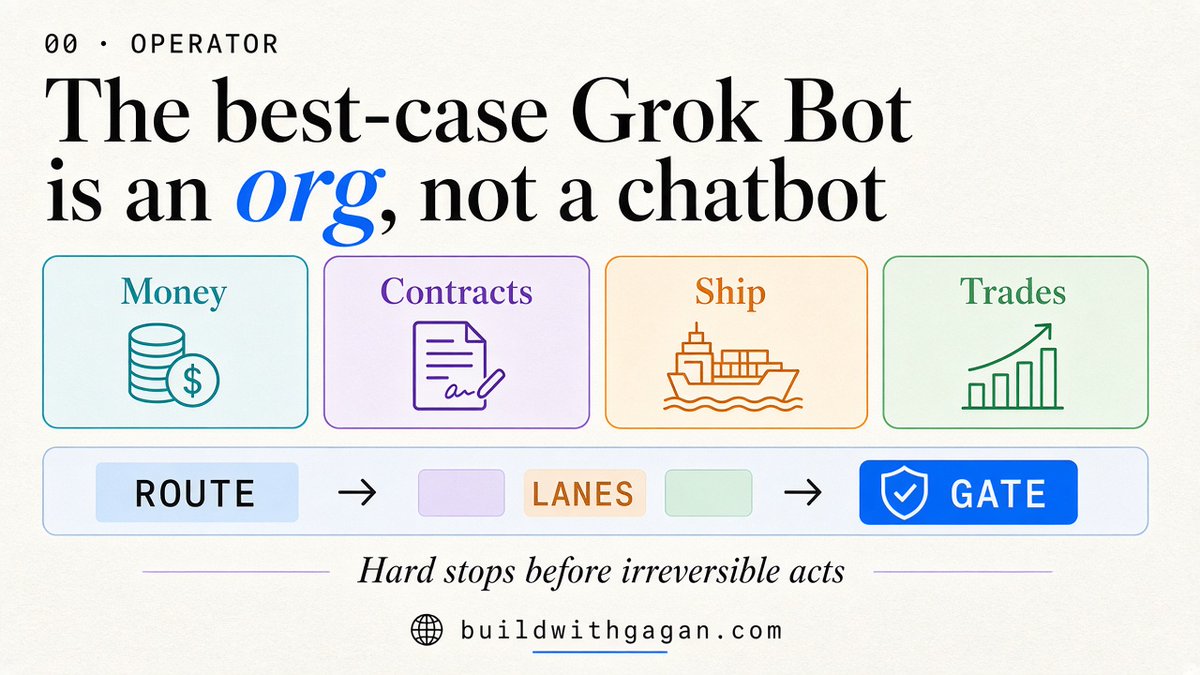
I’ve been using Grok Bot less like an assistant and more like an org chart: a Chief of Staff who only routes, four leads who disagree on purpose, and four acts a person still owns — money out, contracts, production ship, trades.
Curious whether this shape holds up outside my shop:
https://t.co/TUGdUD6AJH
Agree that trust is becoming a first-class capability. The gap I keep seeing in the wild: preference alignment does not transfer cleanly once you add tools, memory, and multi-agent handoffs.
A model can look aligned in a chat sandbox and still leak authority across a tool graph. Independent evaluators help — but only if they’re scoring those failure modes, not just win rates. Muse-style delays are good discipline; the harder version is eval isolation that survives composition.
That’s the moat that compounds.
Independent evaluators are most useful when access is durable, the methodology is public, and uncomfortable findings can’t be quietly buried. The benchmark is only the start; the governance around it is the real test.
I agree with Dario that we need to pace the frontier. This has been a primary topic of discussions we've had at OpenAI in recent weeks.
Committing to having independent evaluators with employee-like access is a great idea, and we will do the same. We'll have more to share soon.
Trustworthy agents need more than aligned outputs: they need inspectable state changes, clear permission boundaries, and a way to recover when intent is ambiguous. Reliability is a product surface, not just a model trait.
Alignment is fundamental to delivering personal superintelligence for everyone. People need agents they can trust to reliably do what they ask. MSL is rapidly scaling up the share of our efforts that goes into alignment as our models become more powerful. We do believe alignment can be the gating factor for scaling as we get closer to the frontier.
@keithpeiris Predicting churn is the obvious demo; the harder product is making the forecast legible enough that a rep changes behavior. Confidence, evidence, and a next-best action matter more than a probability score.