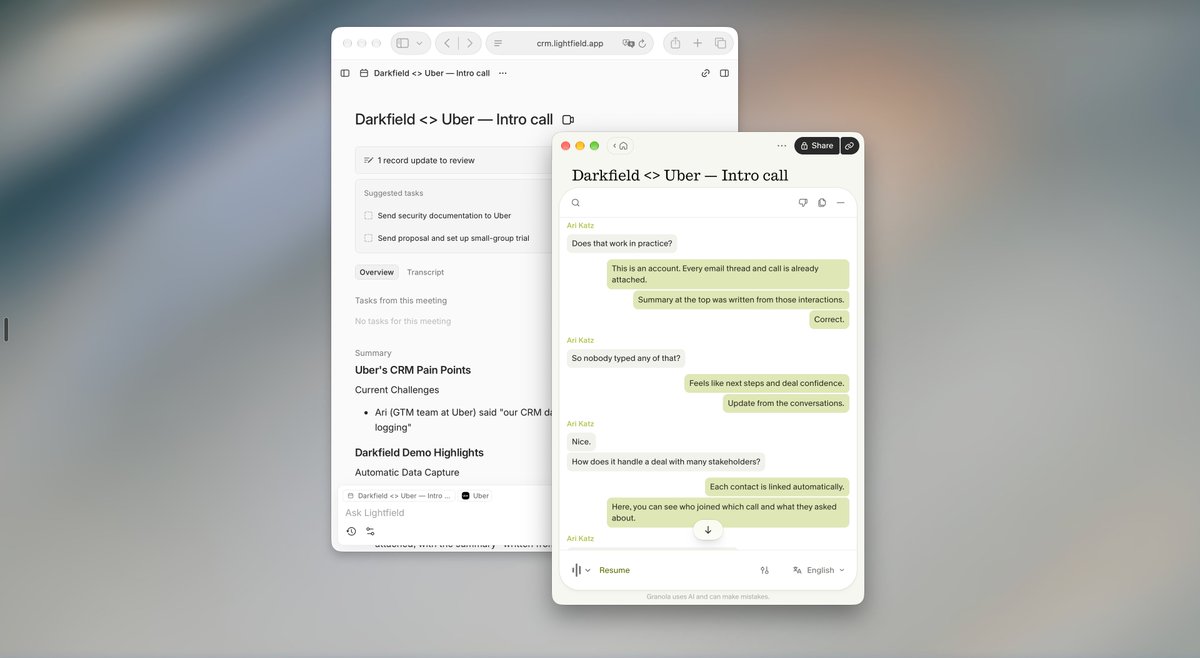
Today we're announcing @lightfld's $47M Series A led by @a16z to reimagine CRM as a world model of a business.
For agents to do customer-facing work, they need to understand how your business actually works.
Salesforce wasn't designed for this. It was built 20+ years ago for humans to update records. Layer agentic processes on top and you get low quality output, because the underlying data is incomplete and lacks the structure agents need.
@lightfld updates itself from every interaction, forming a trustworthy model of your business for people and agents. Since launching last November, 5,000+ companies have signed up - and we're ripping out legacy CRM at mature organizations with hundreds of users.
Companies on Lightfield grow faster than their competitors. It finds prospects that look like your best customers and books meetings with them. It captures commitments from every conversation and automates follow-ups. It diagnoses weaknesses in your funnel and learns from your best sellers to codify what works.
The companies of the future will run on a business world model, not a Salesforce-era database. Our mission is to put that capability in the hands of every employee, and every agent, at every company.
Most people think of a CRM as software that helps a team sell more. Power, who we’ve been working with over the past few months, is a good example of why I think it can do more than that.
Power’s founders started the company after watching people close to them struggle to find clinical trials. When Brandon Li’s close friend learned her brain cancer had come back, the process of finding a trial was confusing and exhausting. When Bask Gill’s father was diagnosed with multiple myeloma, it took him months to work out which trials were worth pursuing.
Power now helps patients find and access clinical research, and helps study teams recruit participants. That work runs through a network of sponsors, trials, research sites, and the people at each one, so we modeled Power’s Lightfield implementation around the relationships across this network.
Recently, a Lightfield agent scanning for news surfaced a Phase 2 Alzheimer’s trial announcement from a company that Power wanted to expand their partnership with. Brandon hadn’t seen it. That signal helped give his team an in to engage their customer and enroll eligible patients in that trial.
Brandon and Bask built Power from the belief that groundbreaking clinical treatment should be available to all patients, regardless of where they live or what their background is. I’m really proud that Lightfield gets to play a small part in helping them do that.
October was a big month for @lightfld and an even bigger month for our customers.
@general_compute raised $100M to build a cloud that runs AI models fast, on chips beyond Nvidia’s.
@fragmentdata raised $56M to build agents that fix the purchasing and payment problems that slow down big companies.
@Albert_Invent raised $55M to help chemists design better experiments with AI.
Many of our customers come to us when the tools they bought as an early-stage start-up prevent them from scaling beyond founder-led sales.
These companies, and many others like them, are closing deals faster and building more pipeline by using our platform to construct a world model of their business. Anyone can query it to make better decisions about how to grow their business. A CRO can see which objections keep costing the team deals. A product leader can see which features prospects ask for most. A new AE can ask which messaging has landed best when preparing for a call.
I’m proud of what our customers have accomplished and how we’ve been able to support their growth. We’re just getting started.
Modeling supply and demand using live data is one of my favorite use cases of a business world model.
"Montana could analyze demand across every deal rather than inspect opportunities one at a time. She started with a question that’s always top of mind for the business: how much customer demand had SF Compute lost because it lacked the right supply"
Excited to partner with you, @sfcompute
@sfcompute runs growth on a business world model built with Lightfield.
Lightfield automatically captures technical requirements like GPU model, GPU count, requested start date, and other details directly from customer interactions.
The team can then query demand across its entire pipeline to understand what customers are asking for and help inform what type of capacity to source.
Read how SF Compute turns customer conversations into market signal with Lightfield: https://t.co/FINsIAcFWM
The business model needs to understand the customers and the prospects. It's a more fundamental starting point than just understanding money changing hands.
(I guess I have a horse in this race)
Instinct and Muse have great agents, but no business model.
Ramp and Mercury have a great business model...now they are gonna build agents (Glass for Ramp, AI Bookkeeping for Mercury).
who wins, for whom and why?
Your transcripts and notes will be auto-associated with any contact, account, or opportunity records in your CRM.
We're working to improve support for more of the ways you capture conversations with customers. More to come!
Details: https://t.co/wCyWZTNWQE
Long time coming: you can now sync your individual + team Granola meetings directly to Lightfield with the Granola API.
Transcripts and notes will match to meetings in Lightfield automatically using your linked calendar.
Have the expensive model teach the cheap one.
@vesko_st shows agents can build readable, editable classifiers that match or beat fine-tuned RoBERTa across six tasks.
Jev matches frontier models on classification at a fraction of the cost. The obvious follow-up: can an agent build and maintain classifiers?
I tested on six tasks. Opus built classifiers matched or beat fine-tuned RoBERTa on all six. https://t.co/WcJhCIjzbF
Win marquee customers or race to capture the market? It depends.
Join me and @joeschmidtiv (@a16z) to talk about sales and early GTM strategy.
Oct 6 · 6:30pm · Exploratorium #SFTechWeek
Details + “Lighthouse or Landgrab” essay below.