Today we're announcing @lightfld's $47M Series A led by @a16z to reimagine CRM as a world model of a business.
For agents to do customer-facing work, they need to understand how your business actually works.
Salesforce wasn't designed for this. It was built 20+ years ago for humans to update records. Layer agentic processes on top and you get low quality output, because the underlying data is incomplete and lacks the structure agents need.
@lightfld updates itself from every interaction, forming a trustworthy model of your business for people and agents. Since launching last November, 5,000+ companies have signed up - and we're ripping out legacy CRM at mature organizations with hundreds of users.
Companies on Lightfield grow faster than their competitors. It finds prospects that look like your best customers and books meetings with them. It captures commitments from every conversation and automates follow-ups. It diagnoses weaknesses in your funnel and learns from your best sellers to codify what works.
The companies of the future will run on a business world model, not a Salesforce-era database. Our mission is to put that capability in the hands of every employee, and every agent, at every company.
Lightfield now supports integration with WhatsApp. Connect your WhatsApp account to pull in context from your messages. Conversations you sync have messages integrated into the contact’s activity log alongside emails and meetings.
You can set it up in Settings → Integrations → WhatsApp..
Power turned its founder’s judgment on how to run deals into a system their entire sales team can run on Lightfield.
As they added sellers, their CEO needed a way to pass on what he had learned from founder-led sales. After switching from HubSpot, Power brought its customer records, call context, and deal coaching into one system modeled around the clinical trial market.
The company’s sales playbook lives in Lightfield as Knowledge that the agent references to suggest next steps for every single deal.
Read how Power is scaling beyond founder-led sales with Lightfield: https://t.co/ezp73jEj2l
October was a big month for @lightfld and an even bigger month for our customers.
@general_compute raised $100M to build a cloud that runs AI models fast, on chips beyond Nvidia’s.
@fragmentdata raised $56M to build agents that fix the purchasing and payment problems that slow down big companies.
@Albert_Invent raised $55M to help chemists design better experiments with AI.
Many of our customers come to us when the tools they bought as an early-stage start-up prevent them from scaling beyond founder-led sales.
These companies, and many others like them, are closing deals faster and building more pipeline by using our platform to construct a world model of their business. Anyone can query it to make better decisions about how to grow their business. A CRO can see which objections keep costing the team deals. A product leader can see which features prospects ask for most. A new AE can ask which messaging has landed best when preparing for a call.
I’m proud of what our customers have accomplished and how we’ve been able to support their growth. We’re just getting started.
@sfcompute runs growth on a business world model built with Lightfield.
Lightfield automatically captures technical requirements like GPU model, GPU count, requested start date, and other details directly from customer interactions.
The team can then query demand across its entire pipeline to understand what customers are asking for and help inform what type of capacity to source.
Read how SF Compute turns customer conversations into market signal with Lightfield: https://t.co/FINsIAcFWM
Lightfield's plugin for @ChatGPT and Codex is now live.
Ask any question about your company or customers, and get answers grounded in a world model of your business.
Install it in ChatGPT: https://t.co/7fMuSXW83i
Lightfield now supports native integration with @meetgranola.
Connect your personal or team account to have transcripts and enhanced notes automatically added to meeting records.
Lightfield's Chief AI Officer @vesko_st tested whether an agent can build and maintain the classifiers to do its repetitive work, with Claude Opus writing the classifiers and TypeSafe's Jev running them.
When given the same training data, agent-built classifiers matched or beat a conventionally fine-tuned model on all six tasks we tested.
Read our latest research to see how agents can hand off repetitive ‘system one’ judgments to classifier models, and how we’re bringing this into Lightfield.
Jev matches frontier models on classification at a fraction of the cost. The obvious follow-up: can an agent build and maintain classifiers?
I tested on six tasks. Opus built classifiers matched or beat fine-tuned RoBERTa on all six. https://t.co/WcJhCIjzbF
Last night we hosted 50 founders and go-to-market leaders at the Exploratorium for a conversation between @joeschmidtiv and @keithpeiris on how to choose the right sales strategy for your company: "Lighthouse" (win a few marquee customers first) or "Landgrab" (close as many logos as fast as possible).
#SFTechWeek
@Macroscope runs its go-to-market on a business world model built with Lightfield.
They ingest customer touchpoints across marketing interactions, product use, and sales into a single platform. This gives agents full context on entire customer lifecycle. Agentic workflows that used to take months to build in other systems can be designed in hours using natural language.
Read how Macroscope is building its GTM system.
https://t.co/6NlNnx6Z1I
Win marquee customers or race to capture the market? It depends.
Join me and @joeschmidtiv (@a16z) to talk about sales and early GTM strategy.
Oct 6 · 6:30pm · Exploratorium #SFTechWeek
Details + “Lighthouse or Landgrab” essay below.
@AgreeHQ runs its sales pipeline with agents on Lightfield.
Every interaction with their customers is automatically captured and structured as a business world model. Their team uses that to manage deal updates, inspect deals, and identify trends to help them decide where to expand next.
Everything they need to know about their business can be accessed through chat in seconds.
Read how they're scaling their GTM organization on Lightfield: https://t.co/JAU9UzjlvV
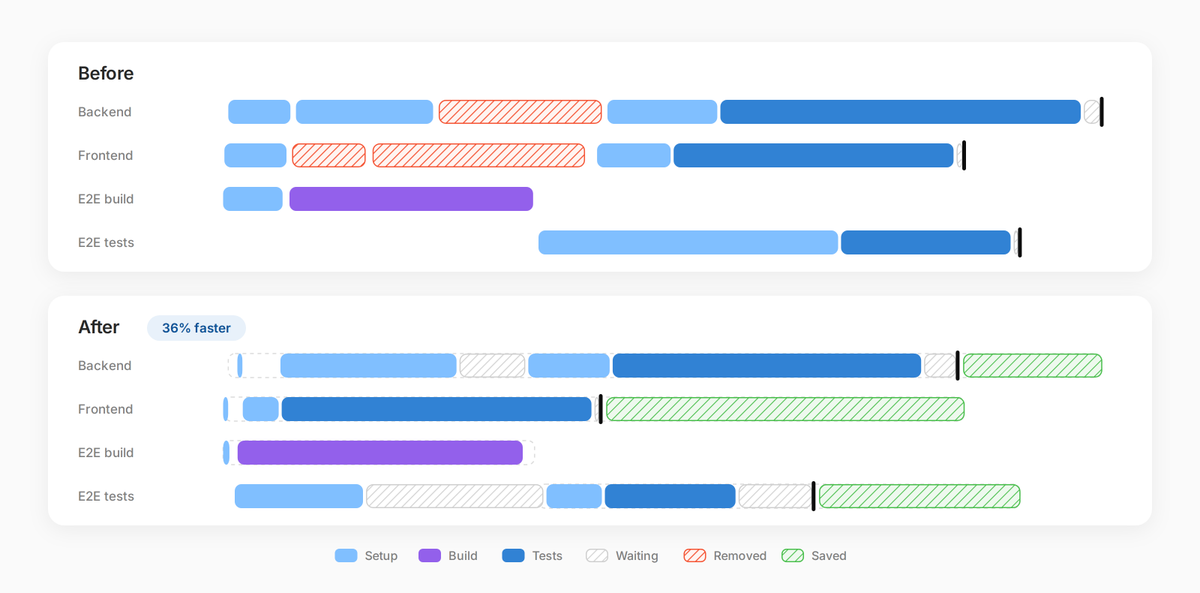
Thanks @linear . We utilized some of these techniques at @lightfld and are seeing PR's clear CI 36% faster 🚀. All still on GitHub actions without changing out the runners yet.
Lightfield's Chief AI Officer @vesko_st benchmarked TypeSafe's Jev model on text understanding, including customer-conversation tasks.
With extended thinking turned off, Jev matched Opus 5 on accuracy at 40 to 150 times lower cost.
Full write-up, including initial thinking on how we'll be using Jev in our own platform:
https://t.co/fGsmvPvlmS
Everyone has been impressed by TypeSafe AI’s Jev — I wanted to see for myself how good it is — and how useful it could be for a product like @lightfld.
I started with text understanding, because it is the foundation of everything a decision model does: it has to understand the input, and it has to understand and follow the instructions you give it.
The short takeaway: TypeSafe's tiny "Jev" classifier is surprisingly good — roughly on the level of Claude Sonnet on classification tasks, while being a couple of orders of magnitude cheaper to run.
I looked at two kinds of work. First, general text understanding: three widely used reading-comprehension and commonsense benchmarks, where Jev performed on par with Opus. Because those may well sit in Jev's training data, I also hand-authored a fresh benchmark over a single random Wikipedia article — every wrong option drawn from the text, so nothing could be memorized. There, Jev landed alongside Sonnet and Opus (it tops CommonsenseQA and MMLU-CF, ties Opus on RACE-H, and is ~150× cheaper and ~10× faster on long-context questions).
Then I tried tasks closer to sales and customer relationships. There aren't many good public benchmarks, so I dug up older customer-service and negotiation datasets. On those, Jev is a bit better than Claude Haiku and slightly below Sonnet 5. Big caveat: none of these come from real B2B sales, so the findings are directional rather than a description of what we actually do at @lightfld .
Overall, the results look good enough that I think small, inexpensive classification models like Jev will have real uses, including in our own product.
Link to the full write-up below.