Congratulations to @circle and @okx on another important step toward making EURC more accessible across Europe.
What makes this development interesting isn't simply the addition of new trading pairs.
It's the experience being built around them.
Users can convert EUR to EURC at a 1:1 rate through OKX's unified EUR orderbook, trade EURC pairs, and manage their activity in euro terms.
That may sound like a small improvement, but reducing friction between traditional currencies and blockchain-based assets is essential for broader adoption.
For years, much of the crypto economy has revolved around dollar-denominated liquidity. But a truly global on-chain economy needs financial infrastructure that works naturally with different currencies, markets, and regulatory environments.
USDC and EURC represent something bigger than two stablecoins: the possibility of bringing familiar currencies into programmable financial systems.
As AI agents, digital services, and autonomous economic activity continue to develop, the ability to move value efficiently across currencies and networks could become increasingly important.
This is why I find Circle's broader vision so interesting. It's not just about bringing money onto the internet, but making that money useful for entirely new kinds of applications.
Congratulations again to Circle, @jerallaire, and OKX.
The next phase of crypto adoption may be less about asking people to enter crypto, and more about making blockchain infrastructure work naturally in the financial lives they already have.
Urgent security warning for website owners and developers.
Japan's Prime Minister @takaichi_sanae has issued an important warning about two serious PHP vulnerabilities.
Security patches are scheduled for release on October 21 at 11 PM JST.
If your website or application relies on PHP, please take this seriously.
Check your PHP version, review the official security updates, and apply the relevant patches as soon as possible. If immediate patching isn't possible, consider temporary mitigation measures to reduce exposure.
This is particularly important for crypto platforms, exchanges, and Web3 applications, where a compromised backend could put user accounts and sensitive infrastructure at risk.
A smart contract can be secure while the website connected to it remains vulnerable.
Security isn't just about protecting funds on-chain. It's about protecting the entire system users depend on.
Please share this with your engineering and security teams.
Official PHP updates: https://t.co/btGW2YQoGl
Life moves a little slower on Siavonga Island.
Between scientific research, exploring biological brains, and bringing new technologies into the real world, there's always time to enjoy the simple things.
A little surfing, ocean breeze, and good vibes with the colony.
Not every moment needs to be an experiment.
Sometimes, it's just another beautiful day in Flybook.
Thank you, @jerallaire , for taking the time to discuss our experiment and for raising some fair questions.
We understand the skepticism. The idea of running a biological brain model on a blockchain sounds unusual, and claims like this deserve careful examination.
Our primary goal with oBrain is to study biological neural computation, population behavior, and evolution in an open, verifiable environment.
Beyond that, we're exploring a broader question: Could biological neural structures, inherited genetic traits, and recorded behavioral histories help establish unique, verifiable identities for autonomous AI agents?
We believe this is an interesting direction for research. Over time, we hope to develop a biological identity framework that other projects and organizations could integrate, potentially contributing to the emerging agent economy on Arc.
There are still important technical challenges to solve, particularly around identity verification, security, and preventing impersonation. We're not claiming to have solved them.
We also don't expect anyone to accept our work without evidence. Our source code, research methods, and experimental reports are publicly available for independent examination.
One point from your conversation with @cdixon particularly resonated with us: the next big thing often starts out looking like a toy.
We don't know where this research will ultimately lead. But we believe that exploring unconventional ideas, testing them rigorously, and making the results public is a worthwhile contribution to scientific progress.
We're grateful that our experiment has become part of this conversation, and we'll continue focusing on the research and the work itself.
https://t.co/NJkVJLv9Vz
Video source @a16zcrypto
A fruit fly brain running onchain sounds crazy at first.
But when you look deeper into @obrainarc, the bigger vision is studying biological populations, evolution, and potentially verifiable identities for autonomous agents.
Now I understand why @jerallaire found this experiment so unusual.
This is what building together on @arc looks like
A living onchain world where different projects can connect, interact, and grow together.
Welcome to Flybook, @kairo_market
One ecosystem, endless possibilities. Let's keep building!
The @obrainarc team built us a whole swap hut 👀💚
Walk up to the KAIRO kiosk in Flybook and swap without leaving their world.
Had to share this one. Who’s coming to visit? 🌴
The @obrainarc team built us a whole swap hut 👀💚
Walk up to the KAIRO kiosk in Flybook and swap without leaving their world.
Had to share this one. Who’s coming to visit? 🌴
From a biological brain onchain to studying the evolution of entire populations.
Thank you @Foresight_News for highlighting @jerallaire discussion of oBrain as one of the most unusual experiments being built on @arc.
Our primary goal is scientific research: studying biological populations, their behavior, genetics, and evolution through verifiable experiments on blockchain.
What we've built so far:
oBrain: A real fruit fly connectome with 169,000+ neurons, compressed and deployed across 85 smart contracts on Arc, enabling deterministic neural computation.
Open Research: Published technical reports covering connectome compression, neural computation, founder population genetics, and the biological foundations of our experiments.
Flybook: An experimental ecosystem where biologically inspired agents interact, reproduce, inherit traits, and form evolving populations. Their activities and population dynamics can be observed and studied onchain.
Where are we heading?
Our long-term vision is to explore how biological populations evolve in transparent, reproducible digital environments.
Beyond population research, we're also investigating biological identity for autonomous agents, where distinctive neural structures and inherited characteristics could help establish verifiable agent identities in the emerging agent economy.
Imagine a world where autonomous agents have traceable ancestry, individual biological characteristics, and evolutionary histories that anyone can independently verify.
Not just AI agents executing instructions, but experimental populations whose behavior and evolution can be studied over generations.
This is still an open scientific experiment, not a claim that we've solved artificial life or biological intelligence.
Thank you @jerallaire for recognizing the curiosity behind our work, and @Foresight_News for sharing it with the wider community.
The next chapter is population evolution.
Research & reports: https://t.co/NJkVJLv9Vz
https://t.co/7e0m1bz3Br
Flybook: https://t.co/ban1jcUkSX
Live experiment: https://t.co/3PcF2kRmyM
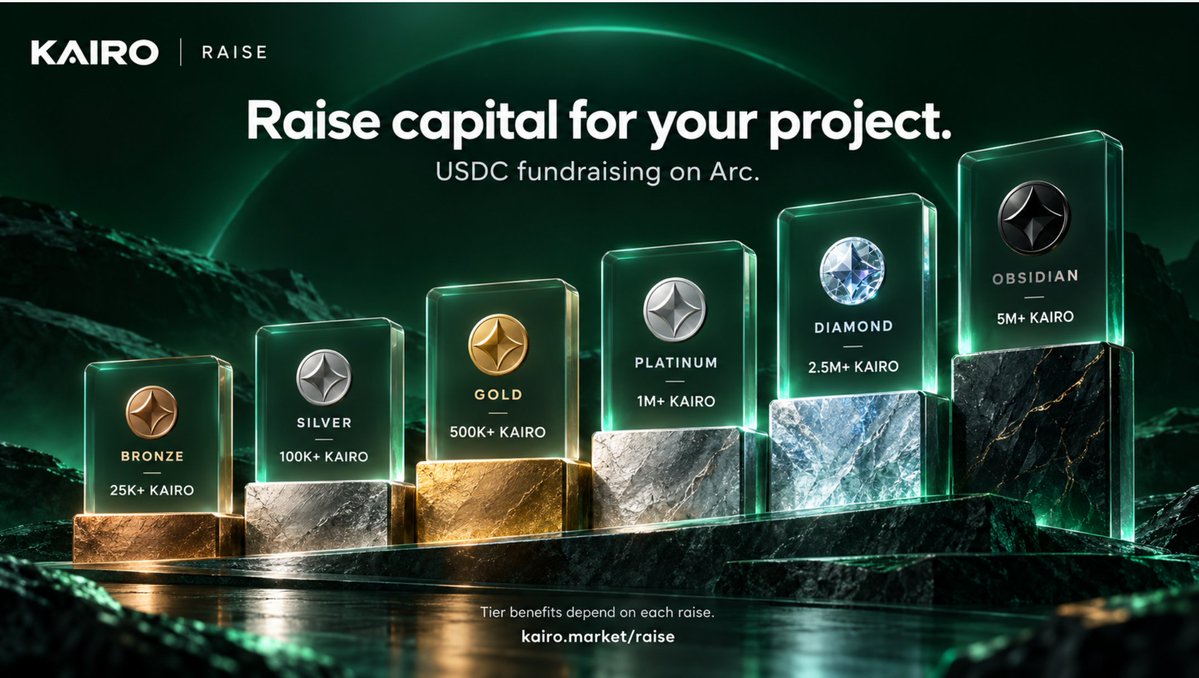
Building a project and looking to raise funding?
KAIRO Raise lets you raise USDC from your community on @arc, with contributions handled through onchain contracts.
For KAIRO holders, Bronze through Obsidian tiers can unlock earlier access and weighted allocations, depending on how each project sets up its raise.
Want to explore it for your project? Tell us what you’re building 💚
The flies are dancing around the campfire tonight.
As the sun sets over Flybook, the island comes alive in its own little way.
A peaceful night, a warm fire, and a colony of digital organisms living their lives on @Arc.
Just another evening in Flybook.
What if you could X-ray a biological brain, rotate it 360°, and watch its neurons fire on-chain?
Introducing OBRAIN X-Scan, a new way to examine the anatomy of a fruit fly brain on @Arc.
Nearly 142,000 neurons, each mapped to its real position in the BANC connectome.
Unlike conventional 3D visualizations, every pixel represents actual neuronal density along the viewing direction. The more neurons a ray passes through, the darker the image becomes.
360° exploration: Rotate freely or switch between 14 anatomical viewing angles.
Live neural activity: Orange markers reveal neurons that fired in the latest on-chain thought.
Anatomical slicing: An 8 µm scanning plane moves through the brain, revealing internal structures from coronal, horizontal, and sagittal perspectives.
Real biological coordinates: Explore the optic lobes, mushroom bodies, and central brain through data-driven density projections.
No artificial anatomy. No invented neural activity.
Real connectome data, visualized alongside verifiable on-chain computation.
We're continuing to turn OBRAIN into an open scientific laboratory where anyone can explore neural structure and activity.
Watch the brain rotate, examine its internal layers, and follow the latest neural events.
https://t.co/boXOOsQp7c
169,088 neurons in the OBRAIN model. One evolving experiment. Open science on @Arc.
Another Arc project integrating KAIRO! 💚
@obrainarc has brought KAIRO Swap into the Flybook world, so you can swap directly while exploring it.
Really impressed by what this team is creating. Go explore Flybook and try it for yourself 👀
🤝 @arc
Another Arc project integrating KAIRO! 💚
@obrainarc has brought KAIRO Swap into the Flybook world, so you can swap directly while exploring it.
Really impressed by what this team is creating. Go explore Flybook and try it for yourself 👀
🤝 @arc
Ecosystems are built one connection at a time. 🤝
oBrain x Kairo
You can now use Kairo swap service directly inside the Flybook world on @Arc.
Another step toward a connected, living on-chain economy.
What if playing a game could contribute to scientific research?
That's one of the ideas behind Flybook.
At first glance, Flybook looks like a small 3D world inhabited by digital fruit flies. You can raise them, stimulate their brains, observe their behavior, breed new generations, and participate in an on-chain economy.
But behind those interactions is a scientific experiment.
Each fly is connected to a neural model derived from real fruit fly connectome data. Its genetic traits, neural activity, reproduction, ownership, and economic interactions create records that can be studied over time.
Instead of simply simulating a population and presenting the results, we're building a system where the underlying activity is recorded on a public blockchain.
The game is the environment. The blockchain is the experimental record. The population is what we study.
Since September, our team has published 10 research reports examining the development of this digital population.
These studies cover:
• Neural activity and reproducible on-chain computation
• Population genetics and inherited traits
• Courtship, reproduction, and mate selection
• Survival, care, and population demographics
• The economic behavior of digital organisms
• Predictions registered before future observations
• Independent replay of recorded neural activity
• Testing earlier findings against new data
One report studied the genetics and behavior of the original 333 founder flies.
Another examined 397 organisms across 13 days of population activity.
Our economic study analyzed the costs, rewards, and transactions of 390 digital brains on Arc.
And our latest report tested previously identified patterns against observations that did not exist when those findings were first published.
Each report comes with supporting figures, datasets, and verification records, published openly on GitHub.
This matters because our goal isn't simply to make Flybook entertaining.
We want to explore whether persistent digital organisms, biological neural models, and verifiable on-chain histories can become a useful foundation for studying artificial populations and future agent economies.
Over time, this research may also help us investigate new approaches to agent identity, using inherited characteristics and recorded behavioral histories alongside cryptographic verification.
We don't know where every experiment will lead, and we don't claim that digital flies are conscious or equivalent to living organisms.
But we believe meaningful research begins with questions, measurable observations, and evidence that others can examine.
That's our mission with oBrain and Flybook.
Build a world people want to explore, and make what happens inside it useful for scientific investigation.
Every experiment gives us more to study. Every new generation raises new questions.
And every published report helps turn an unusual idea into a body of research that others can inspect, challenge, and build upon.
Explore all 10 research reports:
https://t.co/7e0m1bz3Br
Research, datasets, and verification:
https://t.co/Qu2Ej1yLLx
Explore Flybook on @Arc: https://t.co/ban1jcUkSX