2018 Harvard ALI Fellow, IT Banking Exec, PPresident IW&FS TO,Past President the People Bridge Charitable Foundation, President PACE Canada and a Kanooke lover
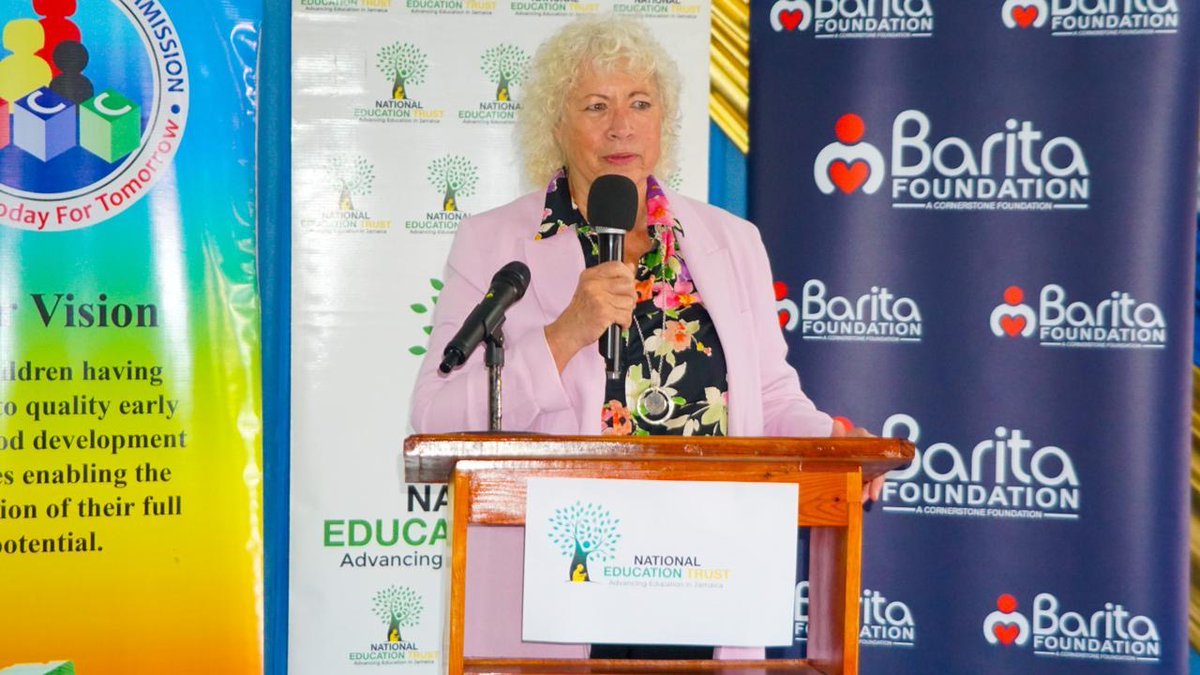
Very proud to be part of PACE Canada's delivery of 1500 OneTab devices developed by https://t.co/KiM6QB2Cpb which will "Help Young Children Succeed" at over 340 kindergarten schools across Jamaica.
https://t.co/dbf4qByMQd
#LatestNews: Energy Minister Daryl Vaz has reported an island-wide blackout Friday evening, and says he is awaiting an update from the Jamaica Public Service Company.
In a post on X about, Vaz said the JPS president Hugh Grant is en route to the company’s emergency operations.
Laura Facey, #Jamaican visual artist, born 72 years ago today on 31 May 1954, in #Kingston. Best known for the monumental sculpture ‘Redemption Song’ (2003) which serves as #Jamaica's national memorial to the Emancipation from African enslavement. #Caribbean
https://t.co/OCu1dqQLcL
One click. All your platforms. Publish and schedule your content across Facebook, Instagram, X, and LinkedIn effortlessly. Simplify your social strategy now!
She was rejected 15 times, dismissed as unruly, and largely written out of the conversation. Then the science proved she was right — and changed everything we thought we knew about life itself.
In 1966, a twenty-eight-year-old biologist named Lynn Margulis sat down and wrote a paper that contradicted one of the most fundamental assumptions in all of science.
She was not a tenured professor. She was not working at a prestigious research institution. She was a young mother of two, recently divorced, completing her PhD while raising her sons largely on her own. The scientific establishment had no particular category for her and no particular interest in what she was proposing.
She proposed it anyway.
Her idea was this: that the story of evolution told through competition and conquest was incomplete. That somewhere in the deep history of life on Earth — billions of years ago, long before anything with a spine had appeared — something had happened that was not a battle but a merger. Two separate organisms, each unable to survive alone, had come together and become something neither could have been independently.
The mitochondria in every one of your cells — the structures that convert food into energy, the engine that powers every thought you are having right now — were once free-living bacteria. They did not evolve gradually inside cells. They moved in. They formed a partnership so deep and so permanent that over billions of years they became indistinguishable from the cell itself.
She called the theory endosymbiosis. She called the process symbiogenesis. What she was really saying was that cooperation, not just competition, was one of the engines of evolution — that life's greatest leaps forward had sometimes come not from one organism defeating another, but from two organisms becoming one.
Fifteen scientific journals rejected the paper before it was published in 1967.
Fifteen.
To understand what she was working against, you need to understand the scientific culture of the 1960s. Neo-Darwinism — the synthesis of Darwin's evolution with Mendelian genetics — was the reigning framework, and it was defended with the particular intensity of a field that had recently achieved hard-won consensus. The idea that a bacterium had simply moved inside another cell and stayed there, permanently, was considered not just wrong but somewhat absurd. Evolution happened through random mutation and natural selection, slowly, over generations. Not through dramatic mergers. Not through cooperation.
The reviewers who rejected her paper used words like speculative and insufficiently rigorous. One described the idea as the sort of thing that was interesting to think about but impossible to prove.
She was also described, more than once, as unruly.
It was the specific word that followed women who challenged scientific consensus — not wrong, not misguided, but unruly, as though the problem were her manner rather than her method.
She had been exceptional from the beginning in ways that made people uncomfortable. Born Lynn Petra Alexander in Chicago on March 5, 1938, she entered the University of Chicago at sixteen — intellectually restless, reading at a level that outpaced her coursework, drawn to the questions at the edges of what science had settled. At nineteen she married a young astronomer named Carl Sagan, who would go on to become one of the most famous scientists of the twentieth century. She would later say, without particular bitterness, that during their marriage she was primarily considered someone's wife rather than someone in her own right.
They divorced in 1964. She raised their sons — including Dorion Sagan, who would become her longtime collaborator — while completing her doctorate in genetics from the University of California, Berkeley. She did the work that would change biology while managing the entire domestic architecture of a life that offered her very little structural support.
When molecular biology caught up with her theory in the 1970s — when DNA sequencing technology became sophisticated enough to actually test what she had proposed — the results were unambiguous. Mitochondria contained their own DNA. That DNA was bacterial. The evidence was not suggestive. It was definitive.
The fifteen journals that had rejected her paper were now looking at proof.
The scientific establishment did what establishments eventually do when reality forces their hand — it incorporated her theory, celebrated it as a cornerstone of modern evolutionary biology, and credited her in terms that ranged from gracious to slightly grudging depending on who was doing the crediting. E.O. Wilson, the legendary sociobiologist, called her the most successful synthetic thinker in modern biology. Richard Dawkins — who disagreed with her on multiple other scientific questions — praised her sheer courage in holding to the endosymbiotic theory through years of institutional resistance until the evidence made denial impossible.
Science magazine, the most prestigious journal in American science, called her science's unruly earth mother.
They still couldn't let go of the word.
She was elected to the National Academy of Sciences in 1983. She received the National Medal of Science in 1999 from President Clinton — the highest scientific honor the United States government bestows. She collaborated with British scientist James Lovelock on the Gaia hypothesis — the provocative and still-debated theory that Earth itself, its atmosphere and oceans and living systems, functions as a single self-regulating organism maintaining the conditions necessary for life. It was another idea that the mainstream received with raised eyebrows, and another idea that has proven more durable than its critics expected.
She wrote books with her son Dorion that translated complex scientific concepts for general readers — believing that science belonged to everyone and that the story of life was too extraordinary to be locked inside academic journals. She co-founded a publishing imprint. She taught at the University of Massachusetts Amherst for decades and trained a generation of scientists who carried her framework into fields she never lived to see it reach.
She died on November 22, 2011, from a hemorrhagic stroke. She was seventy-three years old.
What she left behind was a redrawn map of life itself.
Every complex cell on Earth — every cell in your body, every cell in every plant, every cell in every animal that has ever lived — is a collaboration. It contains within it the descendants of bacteria that chose, billions of years ago, to stop competing and start cooperating. The boundary between self and other is not where we thought it was. It never was.
Lynn Margulis saw that when almost no one else did.
Fifteen journals said no.
The universe had been saying yes for two billion years.
People think learning Claude takes days. It doesn't.
I wrote 17 free guides that teach it in hours:
Claude 101: https://t.co/QQDmzBAoH5
Claude Code: https://t.co/o782qegoKu
Claude Skills: https://t.co/RgQUCNMqzQ
Claude Connectors: https://t.co/cSPMBUNmRG
Claude for Excel: https://t.co/ZgmUFXd0Iw
How to Prompt: https://t.co/Sw2tg2PMMc
Claude Certificates: https://t.co/LyV7fegv4c
Claude for your team: https://t.co/NakViTGCAL
Stop Prompting Claude: https://t.co/45xPLDRB6Y
AI Slides (PPT in 2026): https://t.co/OY7cHDTV7l
Claude Design: https://t.co/FhlRSlH0aD
Set up Claude Cowork: https://t.co/4jygw4M1RO
Claude to sound like you: https://t.co/LyV7fegv4c
Stop writing like AI: https://t.co/JXKAVP6hdS
Claude as your computer: https://t.co/tQDrcs8drQ
Claude Cowork + Project: https://t.co/xU97EpdrEe
Stop hitting Claude limits: https://t.co/Yu24rPQafQ
___
1. Save this list for later (three dots, top right).
2. Share it with a friend by ♻️ reposting this image.
3. Subscribe to my free newsletter: https://t.co/psB7XxAv8w.
Si no eres de los que se ofenden fácilmente, te voy a dar dos consejos:
1. No prefieras tener razón a tener dinero.
2. Ojo con lo que verás aquí ⤵️
https://t.co/xVca6g23qe
While everyone picked sides on AI models, Jensen Huang was at Stanford for 1 hour discussing who actually wins.
Workforce, domestic policy, national strategy, all on camera, all free.
Just 1 hour, and most people scrolled past it.
The people who watch this will understand something everyone else will spend years figuring out.
🚨شوفت رئيس أكبر شركة ذكاء اصطناعي في العالم صدم الكل وقال إيه!
ديميس هاسابيس (رئيس Google DeepMind + حاصل على نوبل في الكيمياء) صدم الجميع في محاضرته بـ Cambridge وقالها علني:
"في المستقبل القريب، شخص واحد بيفهم الذكاء الاصطناعي هيتفوق على تيم كامل في شركة ناشئة"
احفظ البوست ده عندك دلوقتي عشان ترجع له قبل ما تنسى.
الموضوع بقى حرفياً مسألة وقت، والسر اللي الكبار بيخبوه طلع للعلن!
فيه جزء في المحاضرة دي مش قادر أوقف تفكير فيه:
- الـ AI اللي بتستخدمه النهاردة هو أغبى نسخة هتشوفها في حياتك، اللي جاي مرعب.
- كمان 5 سنين، الفجوة بين اللي بيستخدم الـ AI واللي مبيستخدموش هتبقى مستحيل تستخبى.
- الشركات هتدار بـ 10 أشخاص بس بيعملوا شغل كان بيعمله 200 موظف زمان.
- اللي هيوصلوا الأول مش الأذكياء، بل الناس اللي بدأت من دلوقتي صح.
حاليًا، الشخص الطبيعي بيفتح أي موديل، يكتب أي برومبت، ياخد الإجابة، ويقفل التاب.. هو فاكر إنه كده بيستخدم الذكاء الاصطناعي! بس الحقيقة هو مش مستغل أكتر من 10% من قوته.
بدل ما تضيع وقتك في سكرول ملوش لازمة، اتفرج على المحاضرة دي.. ده أوضح وأقوى شرح شوفته في حياتي من الراجل اللي خلّى الذكاء الاصطناعي يحل أعقد مشاكل البيولوجيا.
المحاضرة دي مفيدة جداً، سواء كنت مبتدئ أو بتستخدم الـ AI كل يوم.
نصيحة: احفظ الفيديو وشوفه حالاً عشان تشوف المستقبل رايح فين وتسبق الكل.
لايك وفولو واحفظ البوست عشان يوصلك كل جديد!
Over the next 3 years, the Valuable Lives Project will make the records of over 300,000 people, including details of the last generation of enslaved Africans in Jamaica, available freely & openly through an innovative new website & cutting-edge database https://t.co/5KazJTXB8P
🚨 ÚLTIMA HORA: El cofundador de Google DeepMind acaba de anunciar 2.100 millones de dólares para curar todas las enfermedades.
Demis Hassabis lleva años construyendo la IA que dobla proteínas, diseña moléculas y acelera el descubrimiento de medicamentos. Isomorphic Labs es su apuesta para que la IA resuelva lo que la medicina convencional no ha conseguido en décadas.
2.100 millones. Una sola misión.