Dr. Joseph Warren died on this day in 1775, and he might be the most important Founding Father you were never taught about.
He was born in Roxbury, went to Harvard, and by his early thirties he was the most sought after doctor in Boston. He inoculated the Adams family against smallpox. He took on apprentices. He treated patients on both sides of the growing fight, redcoats included, because he was a doctor first. He was 34 and a widower raising four small children alone after his wife died in 1773.
He was also the quiet engine of the entire revolution in Massachusetts. He wrote the Suffolk Resolves. He ran the Committee of Safety. He stood up twice to give the Boston Massacre orations, and the second time, with British officers packing the room to intimidate him, the story goes that he climbed in through a window rather than be turned away, then delivered the speech to their faces.
On the night of April 18, 1775, it was Warren who learned the British army was about to march. He sent Paul Revere out one way and William Dawes the other to raise the alarm toward Lexington and Concord. There is no midnight ride without Joseph Warren. People have argued for two centuries about where he got his intelligence, and one long running rumor is that his secret source was close to General Gage himself.
The next morning he didn't sit safe behind a desk. He rode out to the fighting at Lexington and Concord and got into the thick of it. A British musket ball came so close it knocked a pin out of the hair beside his ear.
Three days before Bunker Hill, the Provincial Congress made him a major general. When he walked onto the hill on June 17, the officers there offered to hand him command of the whole field. He refused. He said he had come to fight as a volunteer, not to give orders, and he took a musket and went into the redoubt with the ordinary men, in the most dangerous spot on the line.
The Americans held off two British charges. On the third, low on powder, they were overrun. Warren stayed to cover the retreat and was shot in the head. The British knew exactly who they had killed. They stripped him, ran him through with bayonets, and threw him into a shallow pit with another body. A British officer later bragged that he had stuffed the scoundrel into the ground. General Gage is said to have remarked that Warren's death was worth that of 500 ordinary men.
Ten months later, after the British finally gave up Boston and sailed away, his friends went looking for him. The body was beyond recognition. The only reason they ever found him is that Paul Revere, a silversmith by trade, had once wired a false tooth into Warren's jaw with silver wire. Revere dug through the grave, saw his own work in the teeth, and knew. It is remembered as one of the first forensic dental identifications in American history.
His orphaned children were nearly forgotten too, until people like Benedict Arnold, years before he became a traitor, chipped in money to make sure they were raised and educated.
The most famous painting of the battle, by John Trumbull, isn't really about the battle at all. It's about the death of one man in the smoke.
The doctor who could have commanded an army chose to die in the dirt as a private soldier. He was 34 years old. 251 years ago today. Remember him 🇺🇸
At 17, Dawn Loggins came home from a summer program and discovered her family was gone.
No note.
No warning.
No home.
Months later, she received an acceptance letter from Harvard.
This is her story.
Dawn grew up in rural North Carolina in a house without electricity or running water.
When the family needed water, she and her brother walked to a public park and filled jugs from the bathroom faucets.
Showers were rare.
Classmates called her dirty.
She kept showing up to school.
Her parents moved constantly.
Eviction after eviction.
New town.
New school.
By age 17, Dawn had attended four different high schools and missed nearly an entire year of education.
Most students would have fallen behind.
Dawn excelled.
When she arrived at Burns High School in 2010, guidance counselor Robyn Putnam immediately saw something special.
Dawn enrolled in makeup courses.
Studied before sunset because there were no lights at home.
Took AP classes.
Earned straight A's.
Joined clubs.
Then led them.
Photography Club.
Rock Climbing Club.
Spanish Club.
President of all three.
That summer she earned a place at the prestigious Governor's School of North Carolina.
Teachers helped buy her clothes.
Putnam drove her 200 miles to the program.
Nobody knew where Dawn would be living when it ended.
The concern turned out to be justified.
Near the end of the program, Dawn tried calling home.
The number was disconnected.
When she returned, the house was empty.
Her parents had moved away.
She was 17 years old.
Homeless.
Alone.
Most people would have stopped there.
Dawn didn't.
She couch-surfed.
Carried toiletries in her backpack because she never knew where her next shower would come from.
And every morning at 6 a.m., she went to work.
As a school custodian.
She swept hallways.
Cleaned classrooms.
Scrubbed desks.
Then sat down and earned straight A's.
By graduation year, she had:
• Straight A grades
• AP courses
• Leadership roles in three clubs
• A part-time job before school every morning
Then a teacher made one suggestion:
Apply to Harvard.
Dawn laughed.
Then thought:
"Why not?"
She became the first student in Burns High School history to apply.
Months later, an envelope arrived.
Harvard College.
Accepted.
Full tuition.
Full room and board.
Everything covered.
On graduation day in 2012, when her name was announced, the entire gymnasium stood and applauded.
Teachers cried.
Students cheered.
The girl who cleaned their hallways before sunrise was heading to Harvard.
When asked about her parents, Dawn didn't speak with anger.
She simply said:
"I love my parents. I disagree with the choices they've made."
Then she added something even more powerful:
"If I had not had those experiences, I wouldn't be such a strong-willed or determined person."
Burns High School had over 1,000 students.
Dawn Loggins became the first ever accepted to Harvard.
Proof that the circumstances you're born into are not the same thing as the future you're capable of building.
LETTER TO KASH.
Vance Boelter pleaded guilty in federal court to stalking and murdering Minnesota House Speaker Melissa Hortman and her husband Mark. He also admitted to shooting State Senator John Hoffman and his wife.
He showed up in tactical gear, wearing a silicone mask and fake police badge, knocking on doors in the middle of the night. Notebooks full of targets. A manifesto planning to kill as many lawmakers as possible.
The buried part? Boelter wrote a handwritten confession letter addressed directly to FBI Director Kash Patel. He claimed Governor Tim Walz approached him for a “project” and ordered him to kill U.S. Senator Amy Klobuchar and another senator so Walz could take the seat.
That letter was recovered from his abandoned vehicle right alongside his confession to the shootings.
Hortman had been the only Democrat in the House to vote against continuing free healthcare for illegal migrants just days earlier. That vote killed the funding.
A killer’s wild claims don’t change the bodies on the ground or the timing. But when the shooter’s own letter fingers the Governor and it barely registers in the news cycle, that tells you everything about what gets protected.
What does it say when the most explosive detail from the killer’s own hand gets buried?
Today, I’m releasing never before seen intelligence revealing new evidence of past US government funding for more than 120 biolabs in over 30 countries, including Ukraine.
In support of President Trump‘s Executive Order to end federal funding of dangerous gain of function research around the world, and increase transparency and accountability, ODNI will continue working with partners across the Administration to identify where these labs are, what pathogens they contain, and what “research” is being conducted.
https://t.co/pLMD0krc69
The year is 1949.
The Nobel Prize in Medicine has just gone to the man who invented the lobotomy. Your doctor suggests one for your sister, who has not been herself since the baby came. It is the most celebrated advance in psychiatry of the age, and he is simply current. By the time the prize curdles into an embarrassment, close to twenty thousand Americans have had the operation, and proportionally more here in Britain.
The year is 1956.
Lay the baby down on his front, the doctor says. So does the most trusted childcare book ever written, the one on every new mother's shelf. On his back he might choke, the reasoning goes. Millions obey. The advice holds for nearly thirty years, long after the evidence has quietly turned, and a generation of cot deaths is counted before anyone thinks to roll the babies over.
The year is 1966.
A bestselling book informs your wife that menopause is a disease, that she is, in the author's word, a castrate, and that a small daily pill will keep her youthful and tolerable to live with. Her doctor agrees. The drug becomes one of the most prescribed in the country. Nobody mentions that the author sat on the payroll of the company that made it. That detail surfaces decades later, in the same year the landmark trial is halted early for raising rates of breast cancer, stroke and clots.
The year is 1979.
Your ulcer is caused by stress and sharp food, the doctor explains. Calm down, drink milk, take the antacid that happens to be the best-selling medicine on earth. Two Australians are about to prove that most ulcers are caused by a bacterium and cured by a fortnight of antibiotics. The profession laughs. One of them eventually drinks a beaker of the stuff to settle the matter. The establishment takes the better part of twenty years to stop laughing. The Nobel lands in 2005.
The year is 1985.
Butter is dangerous, the doctor says. Switch to margarine, it is modern, it is heart-healthy, the experts are united. The spread he nudges you toward is loaded with trans fats, which the next decade will identify as the genuinely dangerous one, and which will eventually be banned outright. The butter goes quietly back in the fridge. No correction is ever printed at the volume of the original warning.
The year is 1992.
There is a pyramid on the surgery wall, and the very same one in your grandchild's classroom. Bread, cereal, rice and pasta form the broad virtuous base, up to eleven servings a day. Fat is exiled to the tiny tip. The chart was reportedly held back a year while the relevant industries had their say. It is wrong at the bottom and wrong at the top.
Now it is today.
Your doctor has new guidelines, new studies, a fresh consensus, delivered with precisely the steady confidence of every guideline above. He believes it, and he has good reason to. So did every doctor in this thread. None of them were villains. Each was sincere, most were kind, and all were certain, reading from a map that somebody else had drawn and handed them. That is the part worth sitting with.
So when the man in the white coat tells you what to eat, what to fear, and what to swallow every morning for the rest of your life, you are allowed to ask. Who paid for the study. What the evidence says beneath the headline. What he was just as certain about thirty years ago, and where that advice sits now.
Then make up your own mind. Call it scepticism, or call it whatever your grandmother called it when she ignored the advert, kept the butter where it was, and lived to ninety-one.
It has outlasted every consensus on this list. It will outlast this one too.
For the first time in 123 years, Argentina has achieved a sustained fiscal surplus without being in default. We are one of only 5 countries in the world in this position.
LONG LIVE FREEDOM, DAMN IT...!!!
I FOUND IT!
In 1987 I went to a talk that Dr. Meg Peterson, Scottish surgeon, gave in Princeton. I knew if her work and built the Black Box (NET) in my garage. I listened to her presentation and purchased her book and got a fast autograph.
I showed her my box of Junk based on her design and she took time to test it.
“This can change the entire world of behavior and addiction, you must keep the idea moving forward, they are doing everything to stop me”
I built hundreds of these over the decades and gave them away.
Today I assert they can break any addiction just like Pete Townsend. Eric Clapton and Kieth Richards. In Keith’s case he would long gone if not for the Black Box.
I assert this works for ADD (etc), autistic behavior, and other behaviors.
I have built an AI based feedback system to move this into this era.
I am not a doctor. I have no medical treatment.
I will be testing the latest version in July with a new AI platform and a new circuit.
I stayed in touch with Meg for a few decades on and off.
I thought I lost this book. But so much gratitude to her and her work.
And letting me nerd out.
You saved lives Meg, the world was not ready.
Over the years I would hear:
“How is Keith Richards still going?”
I knew one of his secrets in the early 1980s and odds are you never heard of it.
Most assuredly he would not be here today if he did not meet Meg and her Black Box:
“It’s so simple...It's a little metal box with leads that clip on to your ears and in two or three days-which is the worst period for kicking junk-in these 72 hours it leaves your system”— Keith Richards, 1985
You should have heard of it.
It should have been a standard tool in medicine.
I wrote about it in the https://t.co/tcKeuiQyql article listed below.
Milton Friedman's greatest regret.
The federal government discovered the perfect crime in 1943: make employers collect taxes before workers ever see their paychecks. You think you earn $60,000 per year, but you actually earn $75,000 and hand over $15,000 to politicians without ever touching it. The psychological difference is enormous.
Before payroll withholding, Americans wrote quarterly checks directly to the Treasury. Picture yourself sitting at your kitchen table, writing a $3,750 check to the IRS every three months. The pain was immediate and visceral. Politicians faced constant pressure to justify every dollar because citizens felt the extraction in real time.
Withholding transforms this concrete loss into an abstract accounting entry. Your employer becomes an unpaid tax collector, and you never experience the actual cost of government. Worse, most people celebrate their tax refunds as government generosity rather than recognizing them as interest-free loans they provided to politicians. The Treasury collects your money throughout the year, spends it immediately, then returns your own cash and receives gratitude.
This system enables the explosion in government spending you witness today. Defense contractors billing $640 for toilet seats, agricultural subsidies for corn syrup, and congressional salaries for 535 people who rarely show up to work. When taxation feels painless, voters stop demanding accountability for how their money gets spent.
Milton Friedman helped design withholding as a wartime emergency measure and later called it his greatest regret. Free market economists recognized that the psychological pain of direct taxation creates political pressure for fiscal restraint. The temporary always becomes permanent in government hands, and the emergency justification disappears while the extraction mechanism remains forever.
The richest man in America signed a document that could have gotten him hanged, and when someone sneered that he was safe because no one would know which Charles Carroll to come for, he picked up the pen and told the British exactly where to find him.
His name was Charles Carroll, and the colonies were crawling with men who shared it. His own father was Charles Carroll of Annapolis. So when the Declaration of Independence came to him for signing in 1776, a delegate made a cruel little joke. He said Carroll risked nothing by signing. There were so many Charles Carrolls that the King's men would never know which one to hang.
Carroll didn't argue. He leaned over the page and added three words to his signature: "of Carrollton." The name of his estate. His address. He was the only signer in the entire room who wrote down where he lived, and he did it on purpose, so that if the British wanted to come hang the traitor, they would know exactly which door to knock on.
That is who Charles Carroll of Carrollton was.
Here is what makes the moment even sharper. He was not a man with little to lose. He was the single wealthiest man in the thirteen colonies and the largest private landowner among them. While George Washington and John Hancock get talked about as rich men, it was Carroll who topped them all. When he signed, he was wagering the biggest personal fortune in America against a noose.
And he was the last man anyone would have expected to be there at all. Carroll was Catholic. In colonial Maryland, a colony founded as a Catholic refuge that had since turned on its own, Catholics could not vote. They could not hold public office. They could not worship in public. The most educated, wealthiest man in America was, in the eyes of the law, a second-class subject barred from the very government he was helping to create. He had spent seventeen years being educated by Jesuits in France and spoke five languages fluently, and back home he still could not legally cast a ballot.
So he became the only Catholic to sign the Declaration of Independence, putting his name on a revolution that he hoped would build a country with room for men like him. That was its own enormous bet, made by a man the existing system had already shut out.
Then he simply outlived everyone.
Thomas Jefferson and John Adams both died on the same astonishing day, July 4, 1826, exactly fifty years after the Declaration. When they were gone, Charles Carroll of Carrollton was the last living signer left on earth. For six more years he was the final human link to that room in Philadelphia, the last hand that had signed, a living relic of the founding that ordinary Americans traveled to see and shake.
He finally died in November 1832 at the age of ninety-five, fifty-six years after he wrote his address on a treason document and dared the empire to come find him.
The richest man in America. The only Catholic. The last one standing. He had more to lose than any of them, every legal reason to stay quiet, and he signed his full address anyway.
We remember the names we were handed in school. We forget the man who made sure his couldn't be mistaken for anyone else's.
Which Founding Father do you think history shortchanged the most?
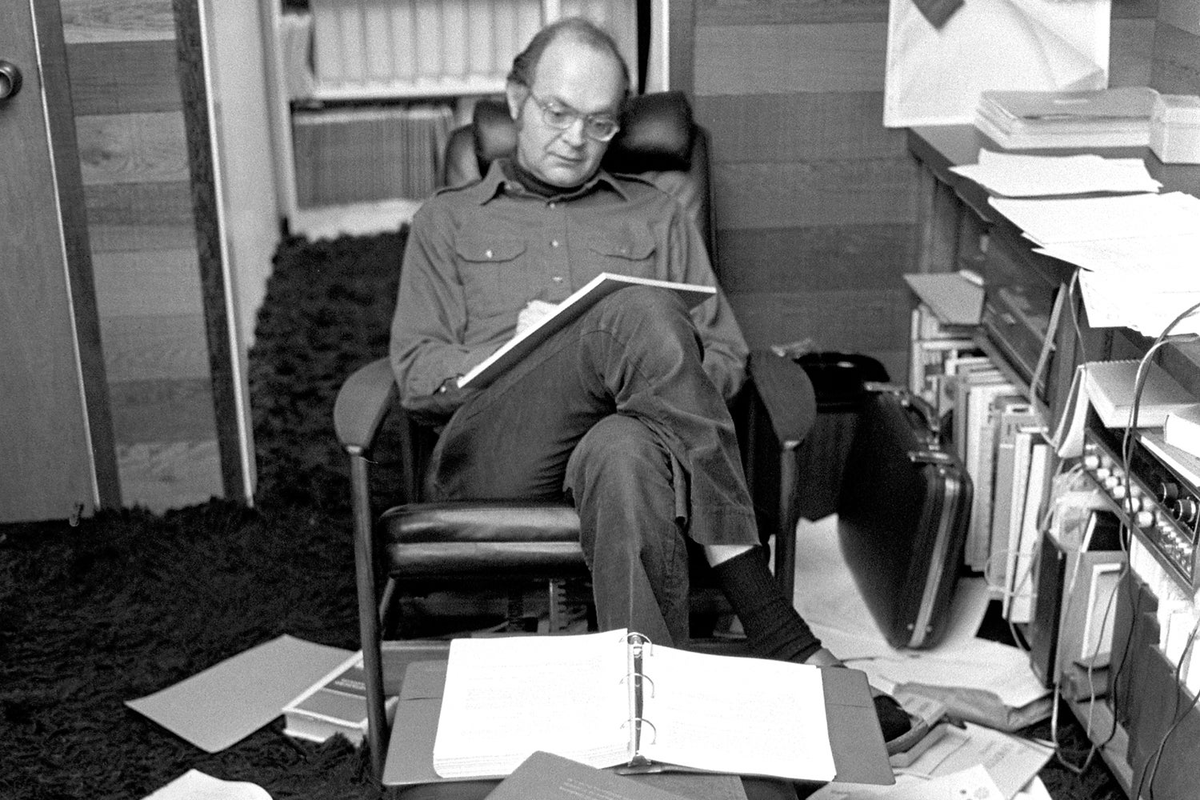
A computer scientist won the Turing Award at 36 and then walked away from almost every other project for the next 50 years to write one book that he has still not finished at age 88, and it may be the most important book in his field.
His name is Donald Knuth. He won the Turing Award in 1974, which is the closest thing computer science has to a Nobel Prize.
He was 36 years old. He had already written volumes one, two, and three of a book series called The Art of Computer Programming. He was the youngest person ever to receive the award at that point in its history.
Almost anyone else would have ridden that moment for the rest of their career. Founded a company. Sat on boards. Gone on speaking tours. Knuth did the opposite. He went back to his desk and kept writing.
He started the book in 1962. He was 24 years old. His publisher had asked him to write a short paperback on compilers. He sat down to outline it and discovered that to explain compilers properly he would have to explain the deeper algorithms underneath them first.
The short paperback became a draft outline of 12 chapters. The 12 chapters became a planned 7-volume series. The 7-volume series became the project he is still working on 63 years later.
Volume 1 came out in 1968. Volume 2 in 1969. Volume 3 in 1973. He was producing books faster than most academics produce papers. Then everything stopped.
In 1977 he received the printed proofs of the second edition of Volume 2. He looked at the pages and was so disgusted by how the publisher had typeset his mathematical notation that he could not bring himself to release the book.
The equations looked ugly. The fonts looked wrong. The spacing was off. He decided he could not in good conscience publish another volume of TAOCP until the typesetting problem was solved.
So he paused the book.
He stopped writing TAOCP and spent the next 8 years inventing TeX from scratch.
TeX is the typesetting system that every academic paper, every math textbook, every physics journal on earth now uses. Every PhD thesis in the sciences is set in TeX. Every paper on arxiv. Every equation in every paper Anthropic, OpenAI, and DeepMind have ever published. The system that the entire scientific publishing world runs on exists because one man refused to compromise on how the second edition of Volume 2 looked.
He gave the entire TeX system away for free. He never tried to commercialize it. He went back to writing TAOCP.
In 1992 he retired from Stanford at the age of 54. Most professors retire to slow down. Knuth retired to speed up. He explicitly said he was leaving teaching because he needed every remaining hour of his life to keep writing the book. He stopped using email on January 1, 1990.
He answers no calls. He takes paper mail only. He is on a personal mission to finish a multi-volume series that nobody is forcing him to write, on a deadline that only exists in his own head.
Volume 4A came out in 2011. Volume 4B in 2022. He is currently working on Volume 4C. Volumes 4D, 4E, 4F, 5, 6, and 7 are still ahead of him. He is 88 years old. He will almost certainly die before he finishes.
The thing that should haunt anyone reading this is the math of his choice.
Every modern incentive structure tells you to optimize for speed. Ship the imperfect version. Get it out the door. Iterate later. Move on to the next thing.
Knuth has spent 63 years doing the exact opposite. He pays a $2.56 reward in hexadecimal dollars to anyone who finds an error in his published books. Real checks, until check fraud made him switch to certificates of deposit. He treats every single error in every single volume as a personal failure. He revises. He rewrites. He goes back to fix issues that nobody else could have spotted.
He could have written 30 books in 63 years. He chose to write one.
The reason is the one almost nobody understands the first time they hear it. There is a category of work that loses all its value when it is done quickly.
A reference book that engineers will rely on for the next 200 years is not the same kind of object as a blog post that has to ship today. The slow project and the fast project look like the same activity from the outside. They are completely different games.
Bill Gates once said in an interview that if you can read the whole of TAOCP, you should send him your resume. He meant it. He was not joking. The man who founded Microsoft was telling the world that the rarest skill on earth is being able to finish a book that one man has spent his entire adult life writing for an audience that mostly does not have the patience to read it.
The book may never be finished.
The man writing it knows this and keeps writing anyway.
The work outlives the worker. That is the entire point.
🚨Michael Burry just said Elon Musk and Nvidia's deal is built on fake numbers.
Burry published a detailed breakdown calling the entire structure "Fugazi", his word for fake.
He is alleging that billions of dollars in Nvidia chips are being hidden off balance sheets, and that American retirees are unknowingly funding the whole thing.
Nvidia, the world's largest AI chip company sold $5.4 billion worth of its most advanced GPUs, the GB200, to a company called Valor.
Valor is not a real operating business. It is a special purpose vehicle, a shell company created specifically to hold these chips and nothing else. Nvidia also invested $1.9 billion of its own money directly into Valor on top of the sale.
Those 100,000+ chips are now physically inside xAI's data center. xAI is Elon Musk's artificial intelligence company, the one that builds Grok. xAI is using every single one of those chips right now to run its AI models.
But here is what Burry is flagging.
Neither Nvidia nor xAI owns those chips on paper. Valor, the shell company holds legal title. That means $5.4 billion in GPU assets do not show up on Nvidia's balance sheet as inventory.
They do not show up on xAI's balance sheet as assets. They are legally invisible to both companies.
Nvidia gets to book the $5.4 billion as a completed sale and record it as revenue. xAI gets full use of the chips without owning them. And the risk disappears into a shell company in the middle.
Now here is where American retirees enter the picture.
Valor needed $3.5 billion in debt to fund this structure. Apollo provided it. Apollo is one of the largest asset managers on earth with $1.03 trillion under management and $834 billion specifically in private credit.
Apollo raised the $3.5 billion, packaged it into debt securities, and sold those securities to Athene.
Athene is Apollo's own insurance company. It sells fixed and indexed annuities, retirement savings products, to ordinary Americans.
When a retiree buys an Athene annuity, they believe their money is sitting in safe, stable investments. That money is now inside a structure funding Elon Musk's AI data center.
The numbers inside Athene are most alarming.
Athene holds $74.2 billion in reserves. It has moved $217 billion in assets into a captive insurer based in Bermuda, meaning those assets sit outside normal US insurance regulation and oversight.
Of the entire portfolio, 34.7%, equal to $103 billion, is classified as Level 3 assets.
Level 3 is an accounting classification that means there is no observable market price for these assets. No outside party can independently verify what they are actually worth.
The leverage sitting on top of those unpriced assets is 16 times.
Burry's says:
Every step of this structure is technically legal and publicly disclosed. But the entire thing was deliberately engineered across 8 to 12 steps to move credit risk off balance sheets and away from any market pricing.
- Nvidia books the revenue.
- Apollo collects the fees.
- xAI gets the computing power.
- And retirees sitting at the bottom of a 16x leveraged Bermuda insurance structure, holding $103 billion in assets with no market price carry the risk without knowing it exists.
Remember the European Hospital in Khan Younis last May?
Israel struck a targeted site there, and the world lost its mind.
Palestinians denied any tunnel existed underneath. The UN and European governments rushed to condemn Israel for attacking a “hospital.” Outrage, headlines, accusations of war crimes… the usual script.
Then June came.
The IDF took international media into the very same location and showed them the tunnel… a full Hamas command center, right under the emergency room.
Weapons, rooms, infrastructure. And yes, that’s where they found and confirmed the body of Mohammed Sinwar, Hamas’s top military commander and brother of Yahya Sinwar.
The strike that killed one of the architects of October 7 was surgically precise, and entirely justified.
Under the Geneva Conventions of 1949, hospitals and other medical facilities lose their protected status when they are used for military purposes, such as command centers, weapon storage, or troop movements. By deliberately turning the European Hospital into a Hamas base, the terrorists themselves stripped it of any legal protection.
Not a single apology from the UN or the European governments that rushed to condemn Israel. Not one admission they were wrong. They simply moved on to the next round of accusations.
This is the pattern. Hamas hides its terror infrastructure under civilian sites, uses hospitals as shields, and the international community reliably attacks the defender for responding, only to be proven wrong again and again and again when the evidence emerges.
How many times does this have to happen before the world stops falling for it?
🚨 BREAKING: Trump-like right wing presidential candidate Abelardo de la Espriella WINS Colombia's election round 1, getting MORE VOTES than the leftist despite trailing the polls
He's going FULL NAYIB BUKELE: "Under my government, any bandit who resists will be eliminated as appropriate, and if he submits, we will imprison him in a mega prison so he can pay his debt to justice as they should."
LET'S GO! 🔥
Espriella would replace President Petro, and is running on a VEHEMENT anti-cartel and tough-on-crime campaign
He's been reportedly TRAILING in some polls to the Left, but just came out with around 44% of the vote, to Cepeda's 41% (preliminary results)
Espriella recently said: "The only peace process I believe in is one imposed by the force of arms and the laws of the republic."
THE RIGHT WING IS RISING IN LATIN AMERICA!
Time to flip Colombia and end the narco-terrorism 🇺🇸🇨🇴
Someone put this diagram together and it deserves to be read slowly.
Three of the most disturbing psychological experiments in modern history placed in a Venn diagram with COVID policy sitting precisely at their intersection.
They were not wrong.
Most people know the Milgram experiment. Ordinary people administering what they believed were lethal electric shocks to strangers because an authority figure in a white coat told them to continue. We wrote about this. COVID replicated it at planetary scale, the doctors, the neighbours, the employers, the family members who enforced mandates with a zeal that had nothing to do with science and everything to do with institutional obedience.
But the other two are equally important and far less discussed.
The Asch Conformity Experiment demonstrated something even more fundamental. Solomon Asch showed in the 1950s that a significant majority of people will deny the evidence of their own eyes will give an answer they know to be factually wrong, simply because everyone else in the room is giving that answer. Not because they were threatened. Not because they were paid. Because the social pressure of the group was sufficient to override direct sensory experience.
This is what masking a healthy population, cancelling Christmas, and demanding that people treat their neighbours as biological threats actually accomplished. It was not about any of those things specifically. It was about training an entire population to override their own perception and defer to the group consensus, however absurd that consensus became.
And then the Stanford Prison Experiment.
Philip Zimbardo’s 1971 study abandoned early because it spiralled so rapidly out of control, showed that ordinary people assigned roles of authority over other ordinary people will, within days, begin to abuse that authority in ways they would have found unthinkable before the role was assigned. The guards became cruel not because they were cruel people but because the structure gave them permission and the institution backed them up.
We watched this happen in real time.
The COVID marshals. The border agents turning families away. The hospital administrators barring visitors from dying patients. The teachers reporting parents. The neighbours calling police on children playing in parks. The HR departments gleefully processing terminations for the unvaccinated. Ordinary people, handed a role and a uniform of institutional approval, discovering capacities for cruelty that their pre-2020 selves would not have recognised.
Now go deeper.
Because the institution at the centre of this, the one that has connected these threads across decades is not an accident of history.
Stanford sits at the intersection of centralised medicine, defence research, and the surveillance architecture that has been constructed around human attention and behaviour for the better part of a century. The Stanford Research Institute. The connections to MKUltra the CIA’s mind control programme that ran from the early 1950s and included everything from Mexican mescaline experiments to the weaponisation of LSD on unwitting subjects, overseen by figures who moved seamlessly between military intelligence and the medical establishment.
From General Groves who oversaw the Manhattan Project and the deliberate suppression of radiation health data to Sidney Gottlieb, the CIA chemist who ran MKUltra’s most extreme programmes. The through-line is not conspiracy. It is institutional continuity. The same networks. The same funding streams. The same willingness to use human beings as experimental subjects in the service of power dressed as science.
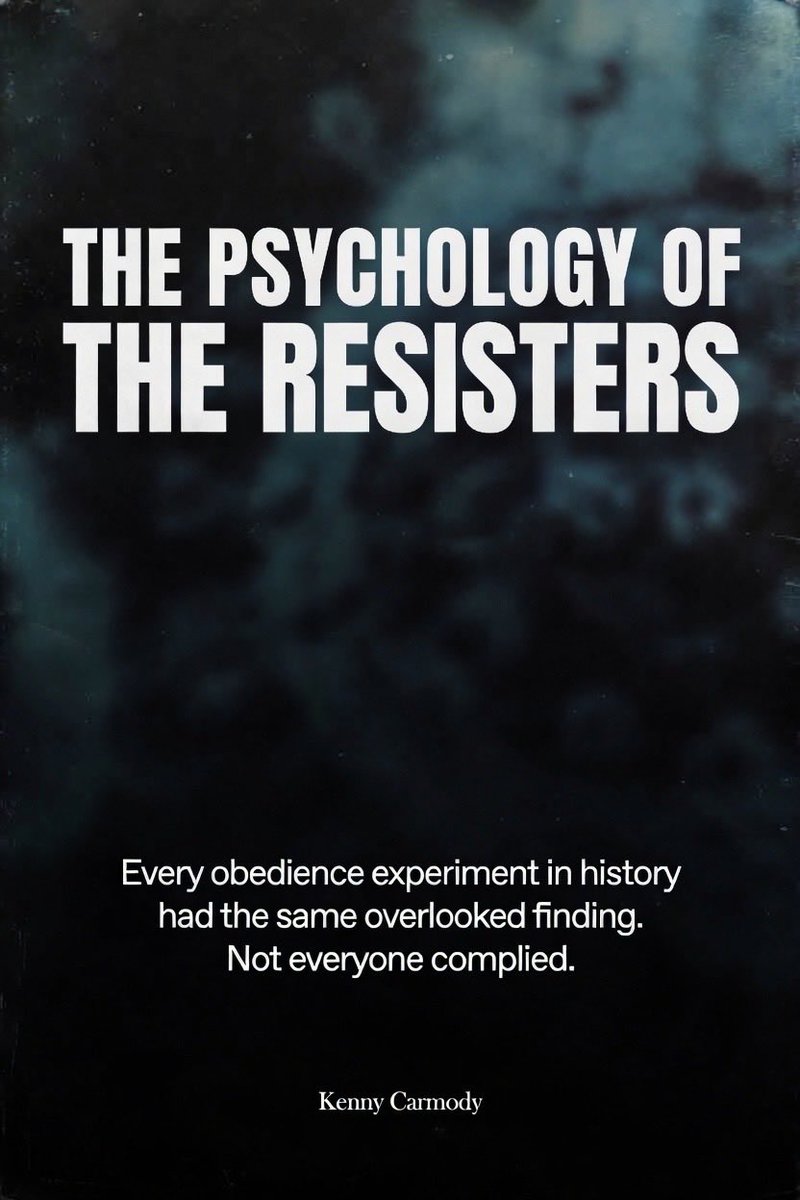
Every obedience experiment in history had the same overlooked finding.
Not everyone complied.
In Milgram’s lab, 35% refused to deliver the final shock. In Asch’s line experiments, 25% never conformed, not once, across any trial. In Zimbardo’s prison, at least one guard refused to dehumanize. One prisoner demanded a lawyer instead of a doctor and broke the psychological frame entirely.
We spent decades studying the ones who obeyed.
We barely asked what made the others different.
That question matters more now than it ever has.
The resisters in the COVID era were not difficult to find. Physicians who filed exemptions and lost their licenses. Nurses who walked away from careers rather than mandate patients into decisions they hadn’t genuinely chosen. Scientists who published contrary data knowing what it would cost them. Parents who stood alone at school board meetings. Ordinary people who simply said, quietly, without drama , no.
What made them different?
Research consistently identifies a cluster of factors. Not personality traits you either have or don’t. Situational and cognitive patterns that can be cultivated.
First: prior reflection on authority. The resisters had usually thought, before the crisis, about the limits of institutional trust. They weren’t cynics. They were people who had already asked the question “under what conditions would I refuse?” before anyone was asking them to comply.
Second: a concrete reference point outside the consensus. A value, a principle, an oath, a relationship that existed independently of the institutional structure demanding compliance. Something the system couldn’t reach.
Third: at least one other person. Milgram found that a single dissenting confederate reduced compliance dramatically. The resisters rarely stood entirely alone. They found each other. Sustained each other. Gave each other permission.
Fourth: the willingness to tolerate social pain. Not immunity to it. Tolerance of it. They felt the pressure. They felt the exclusion. They chose the discomfort of integrity over the comfort of belonging.
None of this is innate. All of it is learnable.
The most important thing Milgram, Asch, and Zimbardo taught us is not how fragile conscience is.
It’s that conscience can hold, if you’ve trained it, named its limits, and found even one other person willing to hold theirs beside you.
Build that now. Because the experiment is always running.
Until then stay humble.
America's most powerful CEOs have been advising Xi Jinping's university for YEARS.
And the Pentagon just opened investigations into this.
Tim Cook, Elon Musk, Mark Zuckerberg, Jensen Huang, Satya Nadella, Jamie Dimon, and Larry Fink.
All of them sit on the advisory board of Tsinghua University in Beijing. The same university that trains China's military AI leadership and the same university the US Defense Counterintelligence Security Agency officially flagged in 2018 for seeking export-controlled American materials.
Tim Cook joined the board in 2013 and became its chairman in 2019. He's been running it for 7 years.
The story only broke this week because Jensen Huang quietly joined the same board, and somebody finally connected the dots on who else was already sitting at the table.
Tsinghua isn't a normal university:
It runs 8 military research labs on its campus. It has signed a formal strategic cooperation agreement with the Chinese Navy. And its leadership has publicly committed to advancing the CCP's strategy of military-civilian fusion in artificial intelligence.
Tsinghua-affiliated researchers have contributed to Chinese hypersonic weapons, fourth-generation nuclear weapons technology, and advanced semiconductor breakthroughs.
A House investigation last year named the university as one of the primary pipelines transferring American research into China's defense industrial base.
This is the institution being advised by the men who run Apple, Tesla, Meta, Nvidia, Microsoft, JPMorgan, and BlackRock.
The board has existed since 2000. The names on it have been publicly listed on Tsinghua's OWN website the entire time but nobody in Washington raised a single public concern for years.
Senator Jim Banks said he is launching an investigation. Laura Loomer filed a formal complaint with the Department of War.
But here's the BIGGER question this exposes...
The US government has spent the last four years building the most aggressive technology export control regime in modern history.
Banning Nvidia chips from China, blacklisting Chinese tech companies, indicting smugglers, and spending billions to prevent AI from reaching the Chinese military.
In March, the co-founder of Supermicro - Nvidia's biggest hardware partner - got charged for smuggling $2.5 billion in Nvidia servers to Chinese buyers through a Southeast Asian shell company.
And the entire time these controls were being built, the CEOs being asked to comply with them were listed as advisors to the school the controls were designed to protect against.
On a public website for anyone to see.
Either every administration since George W. Bush knew about this arrangement and said nothing.
Or nobody in Washington bothered to check a publicly available advisory board list for over a decade.
Both options are equally insane.
And now look at the timing:
Jensen Huang flew to Beijing with Trump in May. Days after he returned, he accepted the Tsinghua board seat.
He did this while simultaneously sitting on Trump's Council of Advisors on Science and Technology and while Nvidia chips remain BANNED from sale to China.
And he's not making a private career decision here.
This is a man being used as a diplomatic asset between Washington and Beijing while pretending the export controls he publicly supports actually work.
The same logic applies to every name on that board:
Tim Cook is not advising Tsinghua as a hobby, Larry Fink is not on that board for academic interest, Jamie Dimon is not flying to Beijing for the food.
These men have spent years operating the most powerful informal diplomatic channel between American capital and the Chinese state - listed publicly and hiding in plain sight the entire time.
And the only reason anyone is talking about it now is because Jensen Huang joined three days ago but failed to keep it a "secret."
Milton Friedman: “Keep your eye on one thing and one thing only: how much government is spending, because that’s the true tax.”
“If you’re not paying for it in the form of explicit taxes, you’re paying for it indirectly in the form of inflation or borrowing.”