This man is ruining Australia. The family of the man who the ATO are chasing for 275 million dollars, have given @AlboMP a one million dollar donation to turn up to their mansion. The ATO will most likely never get the 275 million desperately need dollars but Albo will most likely make sure @australianlabor get the million bucks. He is for the billionaires, not the battlers, he can’t make it any clearer.
We are in uncharted waters in Australia. There are deep cracks in both the political and economic foundations that have shaped this country for decades.
For 80 years we had a stable two-party system, where the main centre-right and centre-left parties together attracted more than three quarters of the primary vote. In recent years there has been a political earthquake. Support for the major parties has fallen below 50% of the primary vote. A party that sat at the margins of Australian political debate for 30 years is suddenly the most popular party in the country.
This political earthquake isn’t occurring in a vacuum.
“It’s the economy, stupid.” A lot has changed in recent decades. One thing hasn’t. Australians reasonably expect that economic prosperity will be the non-negotiable foundation of the Australian promise, and that each generation will be better off than the one before it.
That is no longer our reality. Productivity growth is the foundation of national prosperity, and it has been anaemic in Australia for over a decade. Real income per household is still below pre-Covid levels and the cost of living is soaring.
So why are we in a post-productivity era, and why are Australians doing it so tough?
There are many reasons: low levels of business investment, excessive red tape, fewer new businesses being created, and plummeting business dynamism, with fewer people moving from established, low-productivity companies to newer, more dynamic ones.
There is plenty of blame to share. Our current federal and state Governments inherited many of these challenges. They have been decades in the making, as the benefits of the great economic reforms of the 1980s and 1990s wore off and were replaced by poor policy settings.
This is the reality we are operating in. We desperately need an economic reboot, and pro-productivity, pro-growth policies.
The Government’s response is a budget that does the opposite. It destroys the incentive for companies to invest. It destroys the incentive for companies to hire. It destroys the incentive for people to start something new. It is exactly the wrong set of policies at exactly the wrong time.
There is a silver lining. For the first time in a long time, we are having a real debate about the kind of country we want to be. Australians are making their voices heard, advocating for an Australia where ambition and aspiration are admired and encouraged, not denigrated.
We are a remarkable country with a great standard of living and quality of life and high levels of social cohesion. It is time to stop taking these things for granted and fighting for a better Australia.
That is the conversation we need to have.
Here's what happens to your nation's air defenses when the budget for Pansirs ends up in Swiss Bank accounts, luxury flats in Knightsbridge and the Paris apartments of mistresses with a fondness for Versace Crocodile skin toilet seat covers.
Jim Chalmers is in Singapore at business event explaining the benefits to startups why they should start their business in Australia under the new CGT regime
Australia’s new tax changes are a joke.
$250k income + $50k capital gain = $106k in tax here.
Same earnings in USA = $51k tax.
I made an app to show you where all your tax goes.
The largest supply shock in history is pricing into the curve, not the backend (yet).
I've been saying this since 2004: the curve shape reflects the fundamentals. The long end reflects the industry's marginal cost, incorporating the cost of capital which are ultimately driven by liquidity.
ICE Brent spot is $107/bbl, while the three-year is at $75/bbl. Percent backwardation — which strips out price-level effects — hit an all-time high in April. It remains near record today. The largest oil supply shock in history is reasonably priced into the curve, and it likely has much more to run. Remember we are in the depths of the shoulder months, so there is no stress on the system.
Markets are fixated on Dated Brent differentials, c.$5/bbl last night which is down sharply, but that is a microcosm of the oil market. Dated Brent is Sullum Voe. One North Sea terminal. Not the global oil market.
Spot has not exceeded the Russia-Ukraine peak for one reason: the back end of the curve sits $10–$12/bbl below where it was then.
But the long end isn't a clean signal. Liquidity past 24 months is thin, dominated by producer hedges. Cal-29 isn't where the market thinks oil settles. It is where corporate treasurers are forced to transact, which makes it consistent with their costs of capital.
The cleaner signal is the energy equity complex — long-dated call options on undeveloped reserves. ExxonMobil holds 14 years. Chevron, 15. Equity prices integrate the entire forward strip. Diverge too far and an arbitrage opens. In a capacity-constrained world those reserves are worth more, not less. The equity market is pricing the opposite. Every oil CEO has warned we exit this disruption with lasting supply problems. The market refuses to listen.
S&P Energy ÷ S&P 500 can be used as a proxy for the long-dated oil price, and it currently implies long-run Brent of ~$70 — below the strip at $72–$75 — but not too far away.
A proxy for the curve shape follows: Brent ÷ (S&P Energy ÷ S&P 500). Or rewritten: Brent × S&P 500 ÷ S&P Energy. That single number proxies the FCF yield differential between the energy sector and the rest of the market. That has been bouncing around all-time highs.
When the FCF yield gap reaches extremes, investors should rotate. Even at $75 — not spot's $105 — the energy complex yields 600-1,000 bp above the S&P 500. In 2022, investors did rotate and those that did weathered the ensuing 35% collapse in the NASDAQ much better than those that didn’t.
The equity market is betting Brent falls to realign FCF yields. If it doesn't, capital has to buy Energy and sell the Mag 7. A 1,000bp differential in FCF yields cannot persist. And if oil breaks out as we expect, something has to give. You know which one I think will give. That is the Revenge of the Old Economy!
We are at the tipping point.
2/10
This is Clare Oneil MP............. @ClareONeilMP
Australia’s house building dynamo. Clare has not built many houses even though she has Billions at her disposal.
She does have a massive department full of pen pushers though.
This financial year, according to the budget papers, during a housing crisis, Clare has over seen the building of exactly how many houses? ....ZERO.
Share, because people need to know.
What a disgrace.
A total disgrace of Australias new priorities.
We allow the ISIS Brides to return.
While we pursue Ben Roberts-Smith through the courts.
What does Australia stand for in 2026?
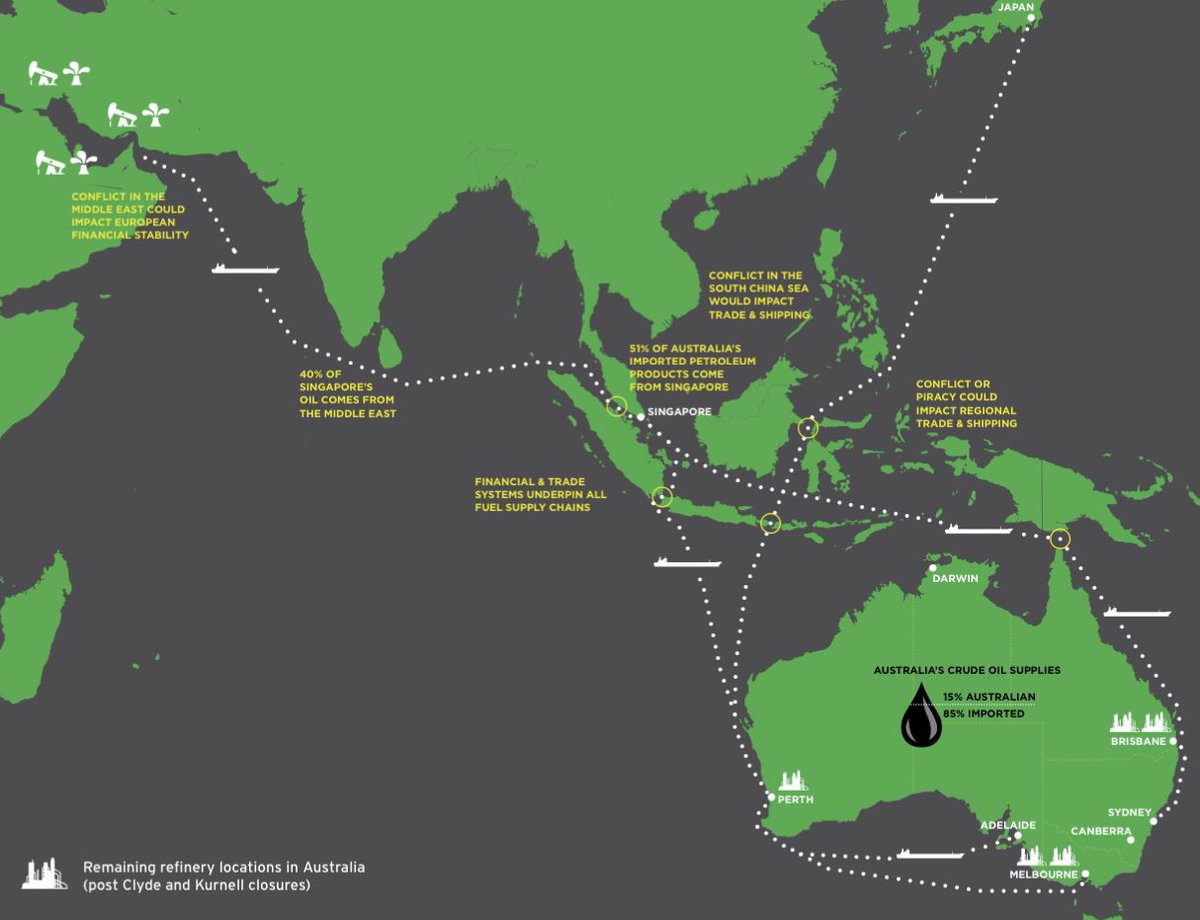
In 2013, a retired Air Vice-Marshal named John Blackburn wrote a report for the NRMA warning that Australia had adopted a “she’ll be right” approach to fuel security.
He warned that a conflict in the Middle East would disrupt supply chains and leave Australia exposed within weeks.
He warned that without adequate liquid fuel, food production and distribution would be severely curtailed, most businesses could not operate, and our Defence Forces could not function
He warned that Australia was the only IEA member noncompliant on the 90 day reserve requirement, and that actual usable supply was closer to 23 days.
He warned, specifically, that Singapore refineries sourcing crude from the Middle East were a critical vulnerability in Australia’s supply chain.
That was 2013. 12 years ago.
This week, an entire town in Victoria ran out of fuel. Farmers have idle tractors mid planting. NSW declared an energy supply emergency. The government is now scrambling to build a fuel taskforce that Blackburn said we needed over a decade ago.
“You can have the best military in the world,” he said, “but it’s futile if you can’t fuel it.”
Nobody listened.
I spent 100 hours over the past week researching, writing and editing the piece we just put out.
It’s a scenario, not a prediction like most of our work. But it was rigorously constructed, dismissing it outright requires the kind of intellectual laziness that tends to get expensive.
And we’ve released it for free. Hopefully you enjoy it.
https://t.co/YK8E11GcDU
Countries where 𝕏 is banned:
🇮🇷 Iran
🇨🇳 China
🇷🇺 Russia
🇲🇲 Myanmar
🇻🇪 Venezuela
🇰🇵 North Korea
🇹🇲 Turkmenistan
Countries trying to ban 𝕏:
🇬🇧 The UK
🇨🇦 Canada
🇦🇺 Australia
These girls graduated 6th grade in Afghanistan. With tearful eyes, they said goodbye, knowing they may never sit in a classroom again. The Taliban’s cruel ban on girls’ education beyond 6th grade has stolen their dreams and futures. 💔