@kimmonismus You basically can create games of my childhood on n64 within hours for way less than a monthly salary of a programmer. What a time to be alive
BREAKING: The market now sees a record 60% chance of a 25 basis point Fed rate hike in September.
In other words, the market now believes Kevin Warsh's first policy move as Fed Chair will be a rate hike.
Talk about a turn of events.
@energy_charts_d@VladonPuskin@RainerReelfs@grok Kein Mensch baut ein Kernkraftwerk, um es 2000 Stunden im Jahr laufen zu lassen. Ihre »Studie« hält einfachsten Plausbilitätschecks nicht stand. Was Sie hier machen, hat nichts mit Wissenschaft am Hut. Das ist schlicht politischer Aktivismus.
@energy_charts_d@VladonPuskin@RainerReelfs@grok „Es gibt kein richtiges Rechnen im Falschen“ (frei nach Adorno).
Wenn Sie die Randbedingungen solange trimmen, bis ein AKW sich nicht mehr lohnt, dann ist Ihr Einmaleins zwar richtig gerechnet, aber Ihre Aussage ist trotzdem falsch.
Und das wissen Sie.
Eigentlich hat @FraunhoferISE richtig gerechnet. Zum jetzigen Zeitpunkt sind die Baukosten hoch und die erwarteten Risikozinsen ebenso.
Das Problem ist, dass Fraunhofer nicht hinterfragt, warum das so ist!
Kernenergie wurde über Jahrzehnte mit überhöhten überbürokratischen Risikoanforderungen belastet, obwohl Tschernofuk nur grundsätzliche Designfehler hatten, die leicht korrigierbar sind - und die viele AKW vor dem Eintreten der Unfälle eh schon berücksichtigt hatten. Damit wurde die Technologie unnötig teuer gemacht, während zur gleichen Zeit um Größenordnungen mehr Menschen durch fossile Quellen und Wasserkraft sterben.
Nachdem der Westen zunächst verlernt hat, AKW zu bauen, sind die Kosten für die ersten neuen Anlagen natürlich immens. Gerade in Zeiten völlig überzogener Bürokratie. Deswegen sind auch die Zinsen hoch, weil Investoren vor Kinderkrankheiten und Bürokratie Angst haben.
In die 1960er Jahren, ohne massenweise gezielt ausgebildetes Personal, wurden die Anlagen viel schneller gebaut. Die Forschung war bunt, es gab nukleare zivile Prototypenschiffe, es wurde gebrütet etc.
Diesen Geist könnte man wiederbeleben + Lehren aus den bekannten und weniger bekannten Unfällen könnte man nutzen, um schnell und billig AKW zu bauen und so Deutschland mit tatsächlich billigem Ökostrom zu versorgen. Aber dieses Szenario will Fraunhofer ISE natürlich nicht einmal theoretisch durchdenken, sonst müssten sie sich ganz schnell in INE umbenennen.
Man kann sich natürlich noch auf sowas ausruhen, wie, dass es kein Endlager für nuklearen Müll gibt. Dann muss man aber auch vermeiden, darüber zu reden, warum Herfa-Neurode und Heilbronn kein Problem sind, obwohl deren Müll nie zerfällt, und warum nicht wiederaufbereitet und gebrütet werden darf.
Und Uran gibt es ja wahrscheinlich auch nicht mehr lange. Klar. Das kann man gerne mit der Inbrunst verbreiten, wie der @ClubOfRome es in den 1970er über das Erdöl gesagt hat.
Kurz, die Kernenergie, wenn man es richtig macht, hat, zumindest jenseits des 45. Breitengrades, den geringsten ökologischen Fußabdruck (ja, eine Kernwende braucht erstaunlich viel weniger Ressourcen), könnte überraschend günstig sein und ist letztlich die einzige Lösung, wie wir die Energiewende ohne Deindustrialisierung schaffen. Aber dazu müsste das Fraunhofer ISE seine nuklearen Scheuklappen fallen lassen und mit diesen Halbwahrheiten aufhören.
Glücklicherweise tut sich ein bisschen in den USA was. Der nukleare Entdecker-Geist ist der wieder aufgewacht.
Ich stelle nicht in Frage, dass die Photovoltaik am Äquator und im All gigantische Potenziale hat. Zusammen mit billigen Batterien wahrscheinlich in ein paar Jahren in durchgängig sonnigen Gebieten unschlagbar, teilweise jetzt schon. Aber überall wo es Winter und lange Zeiten dunkle Tage durch Bewölkung gibt, wird es schwierig.
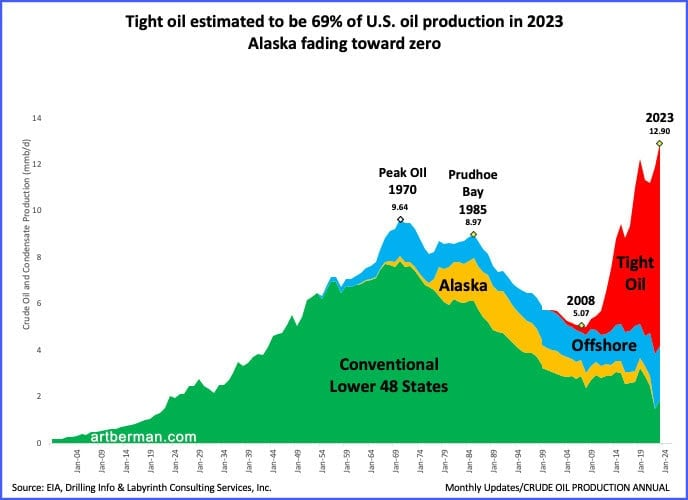
US shale is running out of Tier 1 drilling locations.
When US conventional oil fields ran out of Tier 1 drilling locations around 1970...
- US production rolled over and declined for decades.
- Back then oil traded at just $3.
Geological constraints > oil prices.
@egoimperio@75Jamin AKWs benötigen zudem deutlich weniger Fläche, haben weitaus längere Laufzeiten und es sind massiv weniger Rohstoffe notwendig um die gleiche Menge an Energie zu erzeugen. Es gibt also nicht nur ein gutes Argument für Atomstrom.
@cmdrzoke Die Rechnung ist sicherlich gut und fair. Der Punkt ist, dass die meisten sich die nötige Infrastruktur dafür nicht leisten können. Schließlich ist ein eigenes Haus und Auto dafür unabdingbar
Klar, auch Kernkraftwerke müssen aus verschiedenen Gründen hin und wieder abgeschaltet oder gedrosselt werden. Aber nicht alle gleichzeitig. Kernenergie ist die zuverlässigste Stromerzeugungsquelle, die es gibt.
Wer hier nur auf die fehlenden 7,7 % zeigt, anstatt auf die sagenhaften 92,3 % Verfügbarkeit, der verfolgt offensichtlich eine politische Agenda.
BREAKING: Yuan currency is growing in African continent:
Zambia, Kenya, Ethiopia, and Angola officially use the yuan for national reserves, mining taxes, debt repayment, or trade settlements with China.
Fed didn’t hike rates as expected. Dollar down, Hang Seng Futures up. It’s crystal clear which stocks one wants to own now!
Add our portfolio to your watchlist:
https://t.co/AfaY2GARkM
On Monday, in addition to the IPO of DRAM manufacturer CXMT, the news that China is now capable of producing DUV machines domestically also caused a stir on the stock markets. U.S. technology stocks have been under heavy pressure ever since, with the Nasdaq 100 now trading around ten percent below its all-time high, while doubts about the AI rally are growing louder. I would therefore like to put the situation into perspective for you.
China has possessed DUV technology for a long time and uses it to manufacture chips. The fact that the state-backed start-ups Aishengna and Yuliangsheng are now capable of producing the machines themselves is therefore not a technological game changer. In addition, the companies expect to manufacture five DUV machines by the end of the current year and 20 next year. For comparison, ASML produces around 130 units per year. In the short term, this achievement will therefore neither provide China with a significant boost nor harm ASML.
The situation looks different in the medium term. There is no country in the world that is as good at scaling as China. It is therefore far from implausible that, by the end of the decade, China could produce as many DUV machines per year as ASML – and at significantly lower costs. Since DUV machines account for around half of ASML’s revenue, there is certainly significant disruptive potential.
The actual game changer is not the domestic production of DUV machines, but Huawei’s Tau Scaling Law. Thanks to this development, DUV technology is sufficient – EUV technology is not required – to manufacture AI chips that outperform Nvidia’s high-end chips in terms of price-performance. Domestic production of DUV machines is merely the final piece of the puzzle that was missing for China to become virtually self-sufficient in the production of AI chips.
This brings us to the really interesting question: How will the markets react to the latest developments in the coming weeks?
As I have already mentioned several times, I believe that the price spiral in the chip sector has stopped turning. Prices are therefore coming back down and creating deflationary pressure, as underlined by the latest inflation figures, which came in significantly lower than expected. In addition, with the bond market currently under considerable pressure in the United States, Fed Chair Kevin Warsh is likely to adopt a dovish stance on Wednesday evening. As a side note, there have been very few U.S. Federal Reserve meetings in recent years at which the outcome was not already known in advance with a probability of at least 90 percent. According to the FedWatch tool, however, the probability of a pause in interest-rate hikes currently stands at only 70 percent.
A dovish Fed or an interest-rate pause is therefore far from being fully priced in. Stock markets should consequently react positively, triggering what I believe will be the final upward wave of the AI rally.
Conclusion: In the short term, a dovish Fed will lead to lower bond yields, a weaker U.S. dollar and, consequently, rising share prices. Riskier asset classes such as small caps, cryptocurrencies and, above all, Chinese stocks should benefit particularly strongly. In the medium term – by the end of the year at the latest – deflation will have gained the upper hand, causing the AI bubble to burst.
Based on this assumption, we recently closed our short positions in Nvidia and ASML. If the scenario outlined above materializes, we can re-enter these positions at higher prices in a few weeks. You can find the exact positioning here: https://t.co/GMO3grDfqv
As explained here https://t.co/kyFSjvDXSU we think rate hike expectations will fall rapidly and that we may even see rate cuts until the years end. Fed will be dovish today to save the bond market and start the last up wave before the bubble finally bursts!
Everyone is raging about the fact that china can built DUV machines now. But that’s not the gamechanger, china had this technology for years. The real gamechanger happens month ago and nobody was watching!
@ShangguanJiewen The crazy thing is that many are worried about higher river water temperatures once nuclear fusion is achieving. Tells you everything about the green stupidity of many people this country. I mean you basically get the greenest energy on earth but we are still able to complain…