France recorded a high of 44.6°C today.
That’s so far beyond anything seen in the historical record, a 4.2 sigma deviation from the norm that it gives a return period of 87 thousand years.
It’s really difficult to convey just how utterly extreme this is.
Terwijl de Wereldgezondheidsorganisatie waarschuwt dat de hittegolf die West-Europa momenteel treft, roept minister van Defensie @FranckenTheo op om vooral te genieten van het mooie weer en je niet zo aan te stellen.
https://t.co/j7kbhM78Gy
January 2, 1974
On the 15th anniversary of the Cuban Revolution, Fidel Castro paid tribute to his fallen comrade, Ernesto “Che” Guevara, declaring:
“Che, we dedicate to you this 15th anniversary of our Revolution.”
A powerful reminder of the bond between two revolutionaries and the enduring legacy of Che Guevara.
#copied
One of the worst heatwaves in European history is underway.
Peak high temperatures forecast this week:
France: 45°C / 113°F Monday-Tuesday
London: 39°C / 102°F
Amsterdam: 34°C / 93°F
Berlin: 38°C / 100°F
Paris: 41°C / 106°F
There have been various attempts to downplay or deny Nazi crimes over the last fifty years. This has become ever more prominent since the 1980s and the destruction of the Soviet Union in the counter revolution of 1989 to 1991. This started with attempts to equate Communism with Nazism and the liberals really embraced that idea. This was pushed further by the Baltic compradors of today who can't get over the fact that they were booted out of power in 1939 by revolutionary actions of their own working class.
In the west it has led to both liberals and more open reactionaries promoting fascism. The liberals still squeak with embarrassment if the tattoos of any of their brave Ukrainian heroes are actually explained or if you ask them who exactly leads "free" Syria now. The Conservatives in the US though have been moving in a pro fascist direction for a while now but this has intensified since 2022.
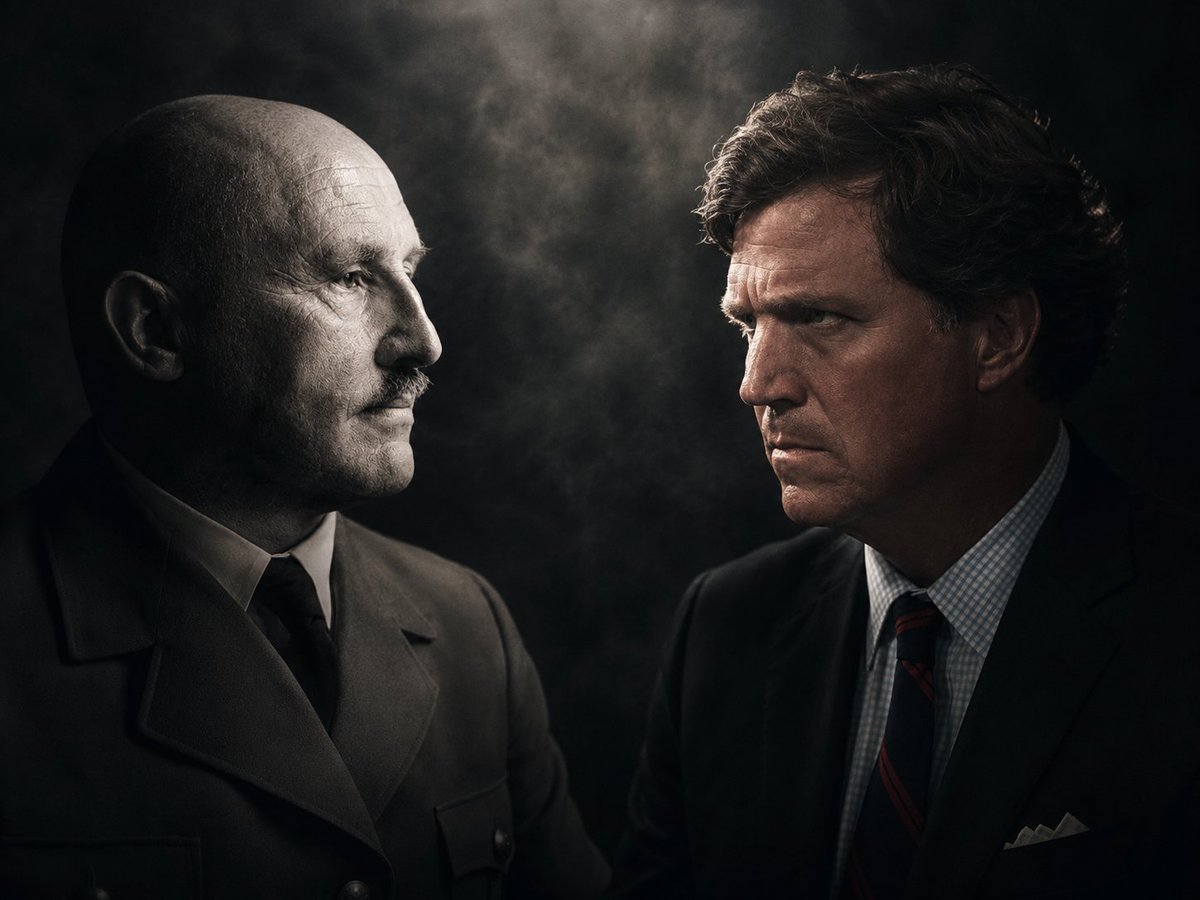
Now there's a whole media ecosystem that pushes classical fascist propaganda in the guise of "Anti globalism". Some people get taken in by this as these figures appear radical, critical of the US government, they may even reject certain wars or criticise Israel. What you should remember is that fascism has always pretended, at certain times, to be a radical or even a revolutionary force. Hitler made such claims, as did Mussolini and Franco. What you're seeing now with the likes of Tucker Carlson and Douglas Macgregor is the mainstreaming of this type of fascist propaganda. We must be aware of it and expose it for what is, an attempt to rehabilitate the third reich in order to build a fascist movement more effectively in the USA.
Part 2:
Loosen that fact, and the ideology becomes discussable again. That is the only purpose the rehabilitation serves.
The fourth move is false symmetry.
"Some people believe X. Others believe Y. We will let you decide." When X is documented historical fact and Y is denial or revisionism, presenting them as two positions of comparable standing is not balance. It is a delivery mechanism. It introduces the discredited position into the conversation as if it belongs there, as if reasonable people land on both sides, as if the evidence is genuinely uncertain.
It works because it wears the costume of a virtue: open-mindedness, letting the audience think for themselves. In reality it is the deliberate use of that costume to smuggle in a position that could not survive direct introduction.
The fifth move is the attribution.
This is where the system completes itself. Real grievances are real. Wages have stagnated. Institutions have failed people. Communities have been hollowed out. The anger that comes from those experiences is legitimate and earned. The system does not manufacture that anger. It inherits it.
What it does with the anger is the move. Instead of explaining the failures through the structural forces that actually produced them (policy decisions, economic systems, the specific choices of specific identifiable people), it locates the cause in hidden deliberate agency. A group is doing this to you. On purpose. With a plan.
The explanation personalizes what would otherwise be abstract. It creates a villain. It takes justified anger and points it at a target selected not through evidence but through centuries of accumulated prejudice.
The person who has absorbed the full system was never told to hate anyone. They were shown evidence. They were asked questions. They heard from experts. They reached their own conclusions. Every step of the journey felt like independent thinking. That is the design. That is what makes this specific form of ideological manipulation so effective and so hard to undo. It leaves no fingerprints on the mind it has shaped.
The technique is old. The platforms are new. The algorithm that financially rewards the spread of outrage and forbidden knowledge is new. The speed at which it reaches people is new.
The trick is not new.
It has worn many faces, spoken many languages, and adapted to every medium ever invented. The face is always changing. The structure beneath it is always the same. Six moves, in sequence, adding up to a worldview that feels like the truth because the audience was never told what they were being handed.
Now you know what you are looking at.
The Julius Streicher Method.
Part 1:
After the twentieth century made explicit antisemitism historically and morally indefensible, after the world saw exactly where that road leads, the ideology faced a choice: die or adapt. It adapted. It traded the megaphone for the microphone, the pamphlet for the podcast, the accusation for the question. In doing so, it became something more dangerous than before: plausibly deniable.
What follows is a description of exactly how the trick works. Not who is doing it. The trick itself. Because the trick is more important than any single person running it. People come and go. The trick stays.
The first move is the frame.
Before any specific claim is made, the audience is told that what they are about to hear has been hidden from them. " What they don’t want you to know." "How come we were never taught this in school?" "The things you can’t say on mainstream television."
These phrases do something precise: they position whatever follows as forbidden knowledge, and they preload the audience’s defenses against any counter-information they might later encounter.
Here is why that matters. If you accept that a powerful group is suppressing the truth, then any institutional denial of what you have heard is not evidence against it. It is evidence of the suppression.
The frame makes the theory unfalsifiable before the theory has even been stated. Every rebuttal confirms it. Every fact-check proves the point. The louder the denial, the deeper the conspiracy must run.
It is not a belief system. It is a trap. And it is built before the audience has heard a single specific claim.
The second move is the question.
Direct accusations can be challenged. Questions cannot, at least not in the same way. So the system operates almost entirely through questions.
" Why do you think so many people in these positions come from such similar backgrounds?" "Who do you think really benefits from this narrative?" "Why would they want to keep this story quiet?"
Every one of these questions imports an assumption as if it were already established fact. The question "Why would they lie about this?" presupposes a lie. The question "Who really controls the media?" presupposes control.
The audience accepts the presupposition in order to engage with the question at all, and by accepting it, absorbs it. Nothing was asserted. Everything was communicated.
Deployed consistently over months and years, this technique installs a complete conspiratorial worldview through inquiry alone. The audience arrives at the conclusions feeling as though they reasoned their way there. That feeling, that it was their own thinking and their own logic, is the most valuable thing the system produces. Beliefs you think you chose are almost impossible to dislodge.
The third move is the guest.
The host cannot say certain things directly without losing deniability. So the host invites someone else to say them: a guest with credentials, a book, a title, or a claim to serious historical research. The guest makes the argument. The host nods, extends it with follow-up questions, never challenges, and never pushes back. At the end, the host is merely a curious interviewer who provided a platform for diverse perspectives.
The specific use of this technique for historical revisionism is the tell. There is no legitimate scholarly debate about whether Adolf Hitler sought peace and was denied it, or whether his historical reputation is Allied propaganda. Those are not contested empirical questions. When a guest appears on a major platform to make exactly these arguments, and the host treats them with respectful curiosity rather than challenge, something specific is happening: the one historical fact that most viscerally discredits this ideology, that following it to its conclusion produced the Holocaust, is being softened. Made debatable. Made the kind of thing reasonable people might see differently.
There is something people still fail to understand about Palestine.
Not every battle is fought first on the battlefield. Some are fought inside the human being. Some are fought against fear, humiliation, and the belief that submission is inevitable.
That is why so many people connect Palestine to Karbala. Not because the events are identical, but because they see in Karbala the refusal to accept that truth is measured by power, numbers, or immediate outcomes.
Imam Husayn (AS), in Shia tradition, became a symbol of refusing legitimacy to what one believes is oppression even when the cost is immense. The lesson many take from that story is not seeking death — it is refusing to let fear decide what is true.
When figures in Palestinian resistance publicly speak positively about Iranian support, many supporters interpret that through that same lens: not as sect, ethnicity, or geography, but as standing with those who they believe chose support over abandonment at moments they felt isolated.
To them, the real victory begins before territory. It begins when a people stop believing that defeat is their natural condition.
The most dangerous thing any occupier can lose is not land. It is control over the imagination of the people.
Because once people stop accepting humiliation as destiny, history changes.
Karbala, for those who invoke it, was never simply about who remained standing at the end of the day. It was about what survives after sacrifice: conviction, memory, and the refusal to normalize what one sees as injustice.
That is why some say: first the mind is liberated, then the land follows.
Fidel never considered international solidarity as an act of charity but as a Revolutionary Duty. We shall always remeber the blood of Cuban soldiers who helped to liberate our continent from the chains of colonialism.
As we celebrate the centenary anniversary of the birth of Comrade Fidel Castro, we continue to express our unwavering solidarity to the people of Cuba who have for decades defended their revolution despite all the economic sanctions imposed by Yankee Imperialism.
BettBeat Media hosted a conversation on the collapse of Europe and the specific case of the #Netherlands. Daniël Samar & @Marjoleinvpagee observe that there is rather a continuity than change when it comes to #colonial and #racist attitudes, watch (25min):
https://t.co/B8WrEoSlsA
‼️Ramin Rezaeian to a US journalist on a handful of spectators whistling during Iran’s national anthem before the match against New Zealand:
“That’s none of your business. What happens between Iranians is our own matter, and we will resolve it ourselves.”
Nobody should cater to obnoxious idiots who barely delve into a space and immediately demand everyone change how they do things to make them more comfortable.
Serious people learn why a discussion is taking place, take sides, and help conclude it.
See e.g. Lu Xun, Ho Chi Minh:
Sure, any idiot can jump into the communist scene and stay "Gosh you guys stop fighting!!!" but it's honestly about as mature and serious as those idiots who keep calling on Palestinians and "Israelis" to "make peace together."
Unlike "Trotskyist", "Stalinist" is a pejorative term used to attack anti-imperialists who take anti-American positions without prefacing "both sides are bad".
Ambivalent about Stalin? "Stalinist!"
Xi Jinping is described as a "Stalinist" by the State Department, for example:
They're also not evenly-sized or symmetric constituencies.
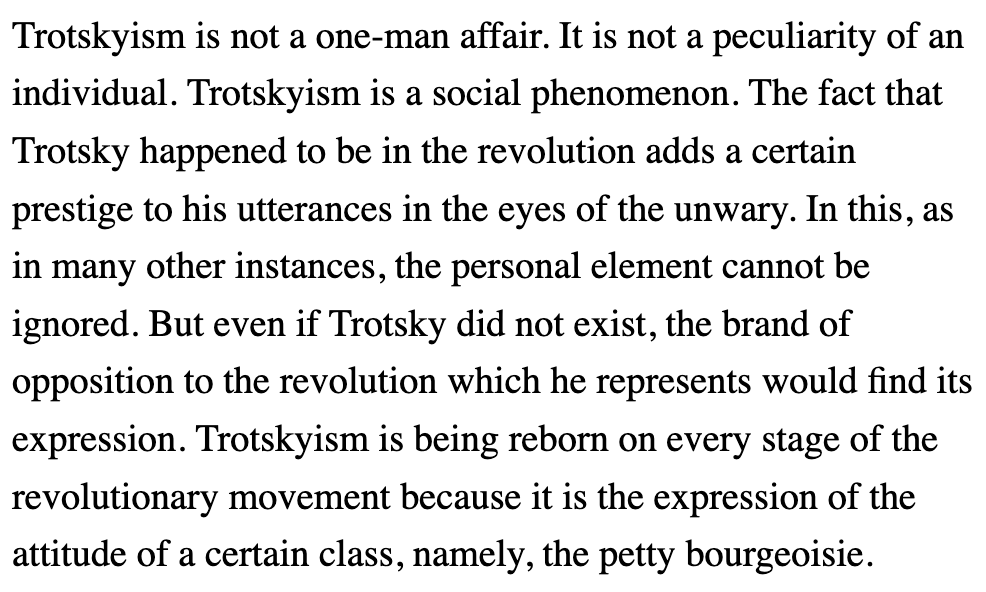
Trotskyists do go around calling every historical socialist experiment "Stalinist" and every ongoing socialist experiment "betrayed." They exist in reaction to Stalin.
But "Stalinists" don't self-ID that way.
Olgin and Losurdo (among others) have both written well about why this disagreement remains relevant: Stalin and Trotsky are historical "avatars" for different constituencies.
I'd concede that centering their names confuses more than clarifies, but who's got a good alternative?
“Arab nationalist slogans have been exploited to the extent that the popular masses no longer take them seriously. This is particularly evident when declarations promoting immediate Arab unity and the liberation of Palestine are quickly replaced by collaborative regimes waging war against the Iranian people…”